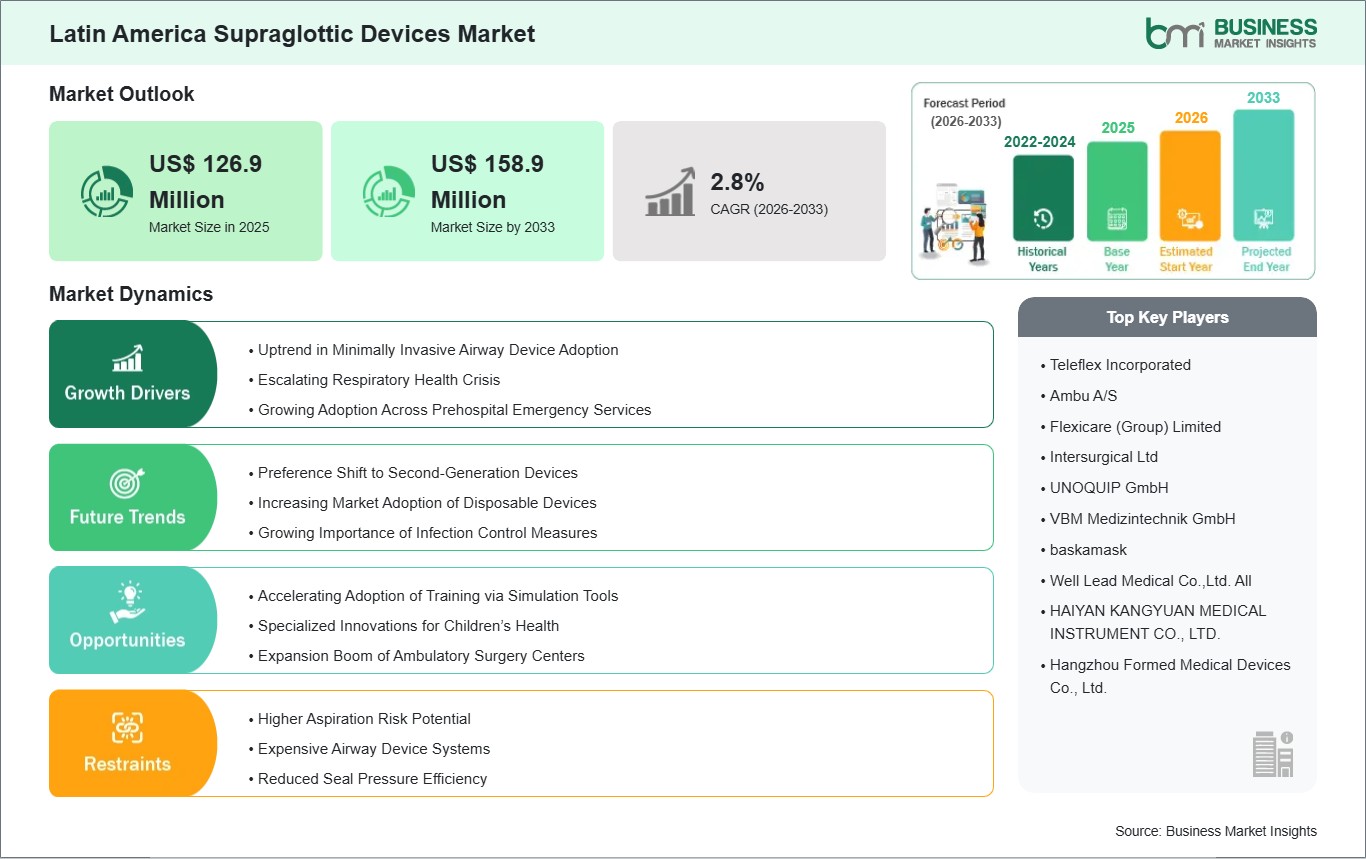
The Latin America Supraglottic Devices market size is expected to reach US$ 158.9 million by 2033 from US$ 126.9 million in 2025. The market is estimated to record a CAGR of 2.8% from 2026 to 2033.
The Latin America supraglottic devices market is gradually expanding, shaped by a mix of growing healthcare infrastructure in urban centers and ongoing efforts to improve emergency and surgical care across the region. Supraglottic airway devices are increasingly recognized as practical and efficient solutions for airway management, especially in hospitals and trauma centers where rapid intervention is critical. Their ease of use, minimal invasiveness, and ability to provide reliable airway control make them highly valuable in perioperative, emergency, and critical care settings.
The main driver for the market is the increased emphasis on patient safety and efficiency in the clinical process. Hospitals are using such equipment to avoid any potential hazards during anesthesia, enhance surgical results, and streamline work processes in busy hospitals. The private network of healthcare organizations and specialized surgical centers is another important force behind the market growth due to the introduction of new devices and education programs. Nevertheless, financial constraints in publicly funded healthcare organizations may limit purchases of sophisticated or disposable equipment, and the quality of professional education may impact the use of devices in smaller hospitals. Difficulties in the distribution of equipment to remote regions and underdeveloped hospitals may also hinder its adoption. In spite of all possible challenges, growing awareness about airway safety, an increase in surgical procedures, and modernization efforts facilitate steady market growth in Latin America.

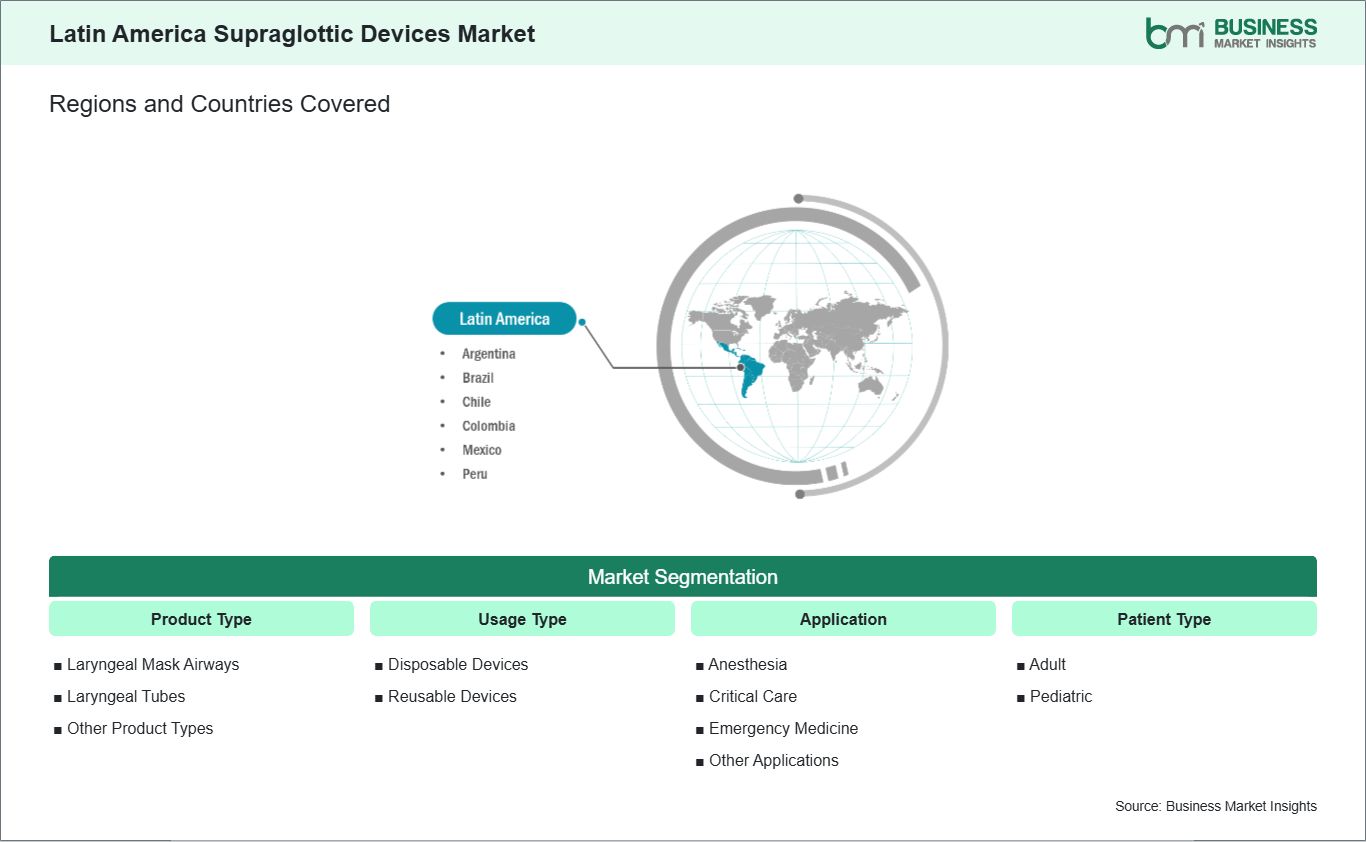
Key segments that contributed to the derivation of the Latin America Supraglottic Devices market analysis are product type, usage type, application, patient type, and end user.
The Latin America supraglottic devices market is experiencing notable growth as hospitals and clinics increasingly adopt less invasive airway management solutions. Rising awareness of patient safety and the need to reduce procedural complications is driving healthcare providers to integrate supraglottic airway devices (SGAs) into standard protocols. Unlike traditional intubation, these devices allow rapid airway control without extensive pre-procedural preparation, making them particularly suitable for emergency care and high-turnover surgical environments.
Economic pressures and resource limitations are influencing adoption patterns. Many healthcare facilities in the region face high patient loads and limited availability of highly trained anesthesiologists, making SGAs a practical choice for maintaining care quality while improving operational efficiency. Devices that can be deployed quickly and with minimal equipment support are gaining favor, especially in facilities aiming to expand surgical and critical care services without proportionally increasing staffing requirements.
Clinical versatility is another key driver. Supraglottic devices are increasingly being used beyond traditional operating rooms, including in pre-hospital care, remote hospitals, and outpatient centers. Their ability to provide effective ventilation with minimal setup allows healthcare providers to manage a variety of patient conditions safely. Combined with growing confidence in minimally invasive procedures among regional clinicians, these factors are contributing to a sustained uptrend in SGA adoption across Latin America.
Simulation-based training is emerging as a strategic tool for increasing the use of supraglottic airway devices in Latin America. Hospitals and medical schools are leveraging simulation labs to allow clinicians to practice device placement and troubleshoot challenging scenarios without risk to patients. This approach is particularly beneficial in regions where clinical exposure to advanced airway cases may be uneven, helping standardize skills across diverse healthcare settings.
Investment in structured training programs is rising. Workshops combining scenario-based learning with hands-on practice are helping staff master supraglottic device handling, including insertion in anatomically challenging situations and management of emergencies like airway obstructions. By providing repeated exposure to realistic patient scenarios, these programs improve both technical proficiency and decision-making, which is critical in high-pressure environments such as trauma care and intensive care units.
Simulation training is also enhancing long-term competency and adoption of SGAs. Low-cost simulators, peer-led workshops, and modular training programs make these learning tools accessible even in smaller hospitals or rural clinics. Clinicians report greater confidence in airway management following simulation exercises, which translates into broader acceptance and consistent use of supraglottic devices. As a result, the integration of simulation-based education is reinforcing skill development, patient safety, and market growth for SGAs throughout Latin America.
The Latin America Supraglottic Devices market demonstrates steady growth, with size and share analysis highlighting evolving trends and competitive dynamics among key players. The report evaluates important subsegments categorized within product type, usage type, application, patient type, and end user, highlighting their respective contributions to overall market performance.
By product type, the laryngeal mask airways subsegment dominated the supraglottic devices market in 2025. The dominance of laryngeal mask airways is driven by their ease of insertion, high success rate in securing the airway, reduced risk of complications compared to traditional intubation, and broad adoption in surgical and emergency settings, making them a key revenue contributor for manufacturers.
Based on usage type, the disposable devices subsegment led the market in 2025. Disposable supraglottic devices are preferred due to their reduced risk of cross-contamination, lower sterilization requirements, and convenience for high-volume clinical environments, which supports their widespread adoption across hospitals and emergency care facilities.
In terms of application, the anesthesia subsegment dominated the market in 2025. This leadership is attributed to the frequent use of supraglottic devices in elective and emergency surgical procedures, the increasing number of surgeries worldwide, and the clinical benefits of providing a safe and effective airway without the need for invasive intubation.
By patient type, the adult subsegment dominated the market in 2025. The preference for adult patients is driven by higher procedural volumes in adult surgeries, the established clinical efficacy of supraglottic devices in adult airway management, and increasing adoption in critical care and emergency settings.
Based on end user, the hospitals subsegment dominated the market in 2025. Hospitals lead due to their well-established anesthesia and critical care departments, access to advanced airway management devices, trained staff, and the capability to perform a high volume of surgical and emergency procedures requiring reliable airway management.
| Report Attribute | Details |
|---|---|
| Market size in 2025 | US$ 126.9 Million |
| Market Size by 2033 | US$ 158.9 Million |
| CAGR (2026 - 2033) | 2.8% |
| Historical Data | 2022-2024 |
| Forecast period | 2026-2033 |
| Segments Covered | By Product Type
|
|
Regions and Countries Covered
| |
| Latin America | Mexico, Brazil, Argentina, Peru, Chile, Colombia |
| Market leaders and key company profiles |
|
The "Latin America Supraglottic Devices Market Size and Forecast (2022–2033)" report provides a detailed analysis of the market covering below areas:
The geographical scope of the Latin America Supraglottic Devices market report is divided into: Brazil, Mexico, Argentina, Colombia, Chile, and Peru. Mexico held the largest share in 2025.
Within Latin America, the dominant markets benefit from relatively advanced hospital infrastructure, rising surgical volumes, and a growing focus on modernizing perioperative and emergency care. Supraglottic airway devices are well-integrated within large hospitals, trauma centers, and specialized surgery departments due to their fast insertion and non-invasive nature, which gives obvious advantages over traditional intubation techniques.
The availability of skilled professionals and constant professional development contribute significantly to the promotion of the product. Physicians from reputable hospitals specialize in the use of supraglottic airway devices, ensuring appropriate implementation in the clinical environment. Private health care companies have an even higher potential for promoting innovative devices, considering that such organizations tend to be leaders in acquiring cutting-edge medical technologies and implementing proper airway management guidelines. Although advancements in cities have been significant, small hospitals and rural areas may experience certain problems associated with financial resources, staff qualification, and difficulties in obtaining medical devices. Despite such barriers, current trends of modernization, enhanced professional training, and the rising focus on patient safety and efficiency will continue to favor the introduction of supraglottic airway devices in key facilities of the area.

The Latin America Supraglottic Devices market is evaluated by gathering qualitative and quantitative data post primary and secondary research, which includes important corporate publications, association data, and databases. A few of the key developments in the Latin America Supraglottic Devices market are:
The Latin America Supraglottic Devices Market is valued at US$ 126.9 Million in 2025, it is projected to reach US$ 158.9 Million by 2033.
As per our report Latin America Supraglottic Devices Market, the market size is valued at US$ 126.9 Million in 2025, projecting it to reach US$ 158.9 Million by 2033. This translates to a CAGR of approximately 2.8% during the forecast period.
The Latin America Supraglottic Devices Market report typically cover these key segments-
The historic period, base year, and forecast period can vary slightly depending on the specific market research report. However, for the Latin America Supraglottic Devices Market report:
The Latin America Supraglottic Devices Market is populated by several key players, each contributing to its growth and innovation. Some of the major players include:
The Latin America Supraglottic Devices Market report is valuable for diverse stakeholders, including:
Essentially, anyone involved in or considering involvement in the Latin America Supraglottic Devices Market value chain can benefit from the information contained in a comprehensive market report.
Please tell us your area of interest
(Market Segments/ Regions and Countries/ Companies)