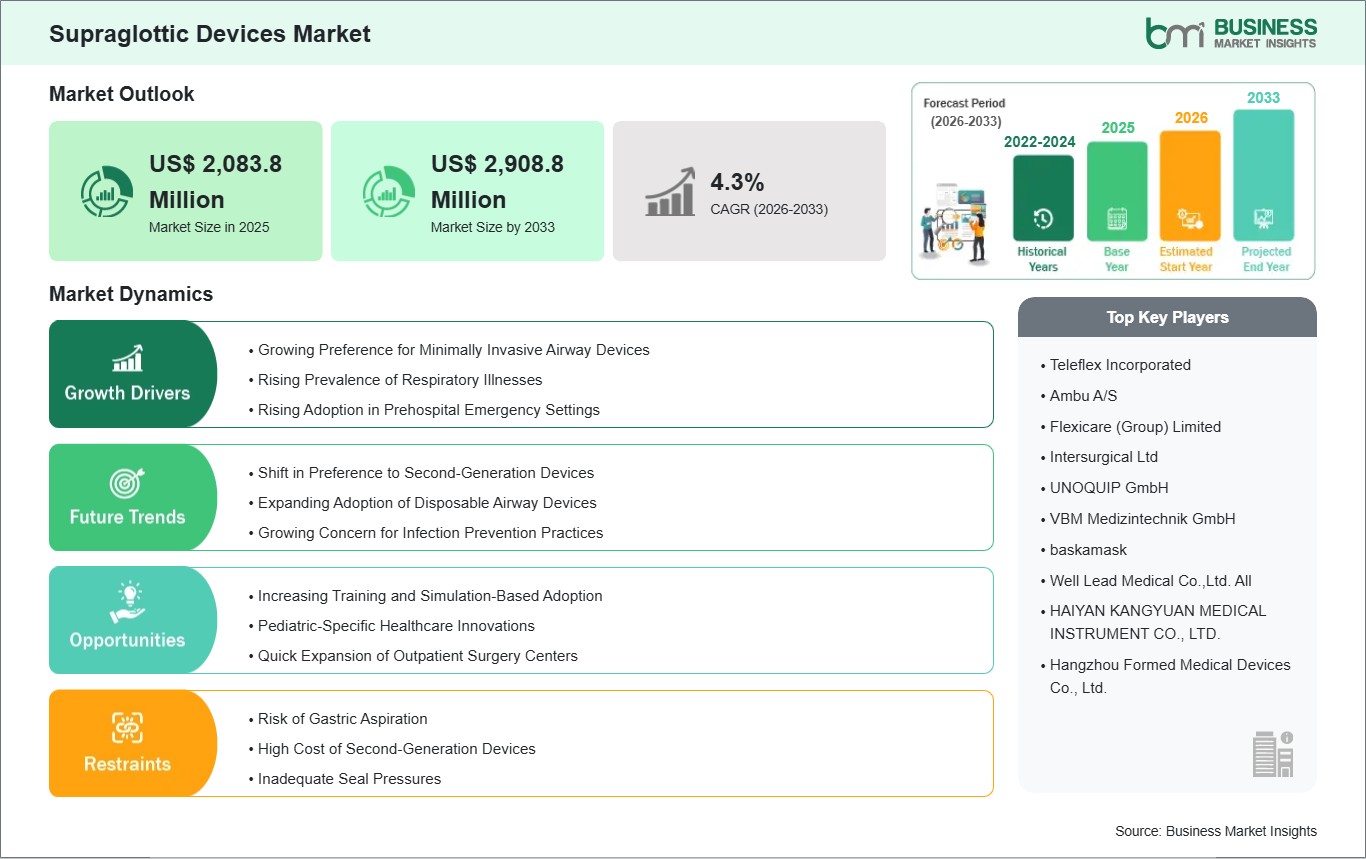
The Supraglottic Devices Market size is expected to reach US$ 2,908.8 million by 2033 from US$ 2,083.8 million in 2025. The market is estimated to record a CAGR of 4.3% from 2026 to 2033.
The global market for supraglottic airway devices is steadily growing, due to increasing awareness about advanced airway management procedures, advancements in health infrastructure, and patient safety concerns. Supraglottic airway devices are preferred by doctors because of their easy installation process, reduced airway injury risks, and compatibility with anesthetic and emergency medical situations. Healthcare facilities are now using these devices to increase efficiency in operations and reduce potential complications arising from conventional airway intubation procedures. Infection control measures and disposable products available in this market are driving factors in this growing trend, particularly in areas that conduct large numbers of surgeries and have strict health infrastructure standards.
Inequalities in access to supraglottic devices arise from differences in the economic status of regions and the structure of healthcare systems. Providers in developing countries tend to choose reusable airway devices for economic reasons. Supraglottic airway devices also require proper training for correct use.

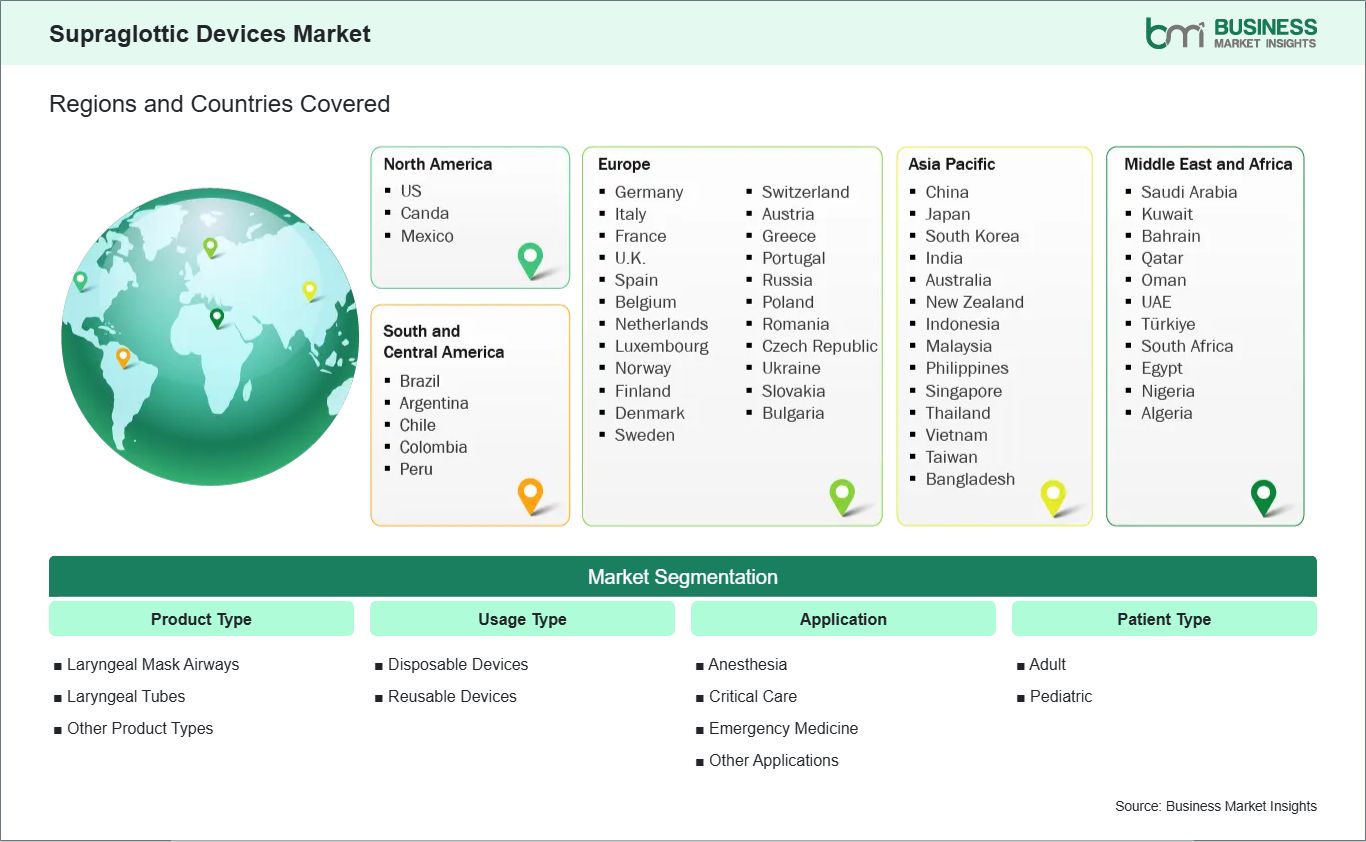
Key segments that contributed to the derivation of the supraglottic devices market analysis are product type, usage type, application, patient type, and end user.
Healthcare providers are focused on patient safety, procedural efficiency, and operational optimization. Supraglottic airway devices (SGAs) offer rapid airway management without the need for complex intubation skills, making them suitable for diverse clinical settings ranging from high-volume surgical centers to pre-hospital emergency care. Their simplicity and adaptability enable clinicians to manage airways efficiently while minimizing patient risk.
Rising volumes of surgical procedures and emergency interventions across regions are driving this trend. Minimally invasive airway devices allow for reduced anesthesia times, faster patient recovery, and improved workflow efficiency, particularly in outpatient and day-surgery procedures. Hospitals benefit from devices that can be used across multiple applications, including elective surgeries, trauma care, and intensive care units, creating a consistent demand for SGAs globally.
Economic, safety, and infection-control factors also influence adoption. Single-use devices reduce sterilization requirements and cross-contamination risks, while advanced designs improve patient comfort and ventilation effectiveness. As awareness of minimally invasive techniques grows and healthcare infrastructure evolves worldwide, SGAs are increasingly integrated into standard airway management protocols, reinforcing their global adoption trend.
Simulation-based training programs are becoming a pivotal driver for the adoption of supraglottic airway devices globally. Healthcare institutions are investing in structured programs that allow clinicians to practice airway management techniques in controlled, risk-free environments. These programs provide hands-on experience with device insertion, troubleshooting complications, and responding to critical scenarios, ensuring clinicians are confident and proficient in real-world applications.
Scenario-based learning modules are widely implemented to expose practitioners to a variety of patient conditions and device types. This approach reinforces standardized airway management protocols, improves multidisciplinary team coordination, and promotes uniform clinical outcomes. Simulation also allows healthcare professionals to experience high-pressure emergencies safely, enhancing decision-making and technical proficiency.
The global accessibility of simulation-based education is increasing, with mobile simulation units, virtual reality modules, and peer-led workshops extending training opportunities to hospitals of all sizes. Repeated practice in realistic scenarios builds confidence, sharpens technical skills, and supports consistent and safe use of SGAs across healthcare systems.

The supraglottic devices market is experiencing steady growth, with market size and share analysis reflecting evolving treatment preferences and competitive dynamics among key players. The report evaluates important subsegments categorized within product type, usage type, application, patient type, and end user, highlighting their respective contributions to overall market performance.
By product type, the laryngeal mask airways subsegment dominated the supraglottic devices market in 2025. The dominance of laryngeal mask airways is driven by their ease of insertion, high success rate in securing the airway, reduced risk of complications compared to traditional intubation, and broad adoption in surgical and emergency settings, making them a key revenue contributor for manufacturers.
Based on usage type, the disposable devices subsegment led the market in 2025. Disposable supraglottic devices are preferred due to their reduced risk of cross-contamination, lower sterilization requirements, and convenience for high-volume clinical environments, which supports their widespread adoption across hospitals and emergency care facilities.
In terms of application, the anesthesia subsegment dominated the market in 2025. This dominance is attributed to the frequent use of supraglottic devices in elective and emergency surgical procedures, the increasing number of surgeries worldwide, and the clinical benefits of providing a safe and effective airway without the need for invasive intubation.
By patient type, the adult subsegment dominated the market in 2025. The preference for adult patients is driven by higher procedural volumes in adult surgeries, the established clinical efficacy of supraglottic devices in adult airway management, and increasing adoption in critical care and emergency settings.
Based on end user, the hospitals subsegment dominated the market in 2025. Hospitals lead due to their well-established anesthesia and critical care departments, access to advanced airway management devices, trained staff, and the capability to perform a high volume of surgical and emergency procedures requiring reliable airway management.
| Report Attribute | Details |
|---|---|
| Market size in 2025 | US$ 2,083.8 Million |
| Market Size by 2033 | US$ 2,908.8 Million |
| Global CAGR (2026 - 2033) | 4.3% |
| Historical Data | 2022-2024 |
| Forecast period | 2026-2033 |
| Segments Covered | By Product Type
|
|
Regions and Countries Covered
| |
| North America | US, Canada, Mexico |
| Europe | Germany, Italy, France, UK, Spain, Belgium, Netherlands, Luxembourg, Norway, Finland, Denmark, Sweden, Switzerland, Austria, Greece, Portugal, Russia, Poland, Romania, Czech Republic, Ukraine, Slovakia, Bulgaria |
| Asia-Pacific | China, Japan, South Korea, India, Australia, New Zealand, Indonesia, Malaysia, Philippines, Singapore, Thailand, Vietnam, Taiwan, Bangladesh |
| South and Central America | Brazil, Argentina, Chile, Colombia, Peru |
| Middle East and Africa | Saudi Arabia, UAE, Kuwait, Bahrain, Qatar, Oman, Turkiye, South Africa, Egypt, Nigeria, Algeria |
| Market leaders and key company profiles |
|
The "Supraglottic Devices Market Size and Forecast (2022–2033)" report provides a detailed analysis of the market covering below areas:
The geographical scope of the supraglottic devices market report is divided into five regions: North America, Asia Pacific, Europe, Middle East & Africa, and South & Central America. The Supraglottic Devices market in North America is expected to grow significantly during the forecast period.
Globally, North America leads the supraglottic devices market because of its state-of-the-art healthcare facilities, a large number of surgeries performed, and emphasis on patient safety and efficacy. Supraglottic airway devices are extensively used in hospitals and surgery centers in the region during anesthesia procedures and emergencies requiring airway control. The doctors in North America receive adequate training for proper management of the airway, which makes them more confident and increases the adoption rate of these devices.
A key factor driving North America's leadership is the competitive medical device industry, which continuously introduces innovations focused on usability, infection control, and patient comfort. Emergencies in urban and rural environments have begun to adopt the use of supraglottic devices in their pre-hospital care protocols in recognition of the usefulness of such devices when standard intubation proves difficult or time-intensive. Furthermore, with an appreciation for evidence-based practice and efficiency in procedure, airway management products that improve patient care are preferred by North American hospitals. However, financial constraints and rigid approval processes hinder adoption.

The Supraglottic Devices market is evaluated by gathering qualitative and quantitative data post primary and secondary research, which includes important corporate publications, association data, and databases. A few of the key developments in the Supraglottic Devices market are:
The Supraglottic Devices Market is valued at US$ 2,083.8 Million in 2025, it is projected to reach US$ 2,908.8 Million by 2033.
As per our report Supraglottic Devices Market, the market size is valued at US$ 2,083.8 Million in 2025, projecting it to reach US$ 2,908.8 Million by 2033. This translates to a CAGR of approximately 4.3% during the forecast period.
The Supraglottic Devices Market report typically cover these key segments-
The historic period, base year, and forecast period can vary slightly depending on the specific market research report. However, for the Supraglottic Devices Market report:
The Supraglottic Devices Market is populated by several key players, each contributing to its growth and innovation. Some of the major players include:
The Supraglottic Devices Market report is valuable for diverse stakeholders, including:
Essentially, anyone involved in or considering involvement in the Supraglottic Devices Market value chain can benefit from the information contained in a comprehensive market report.
Please tell us your area of interest
(Market Segments/ Regions and Countries/ Companies)