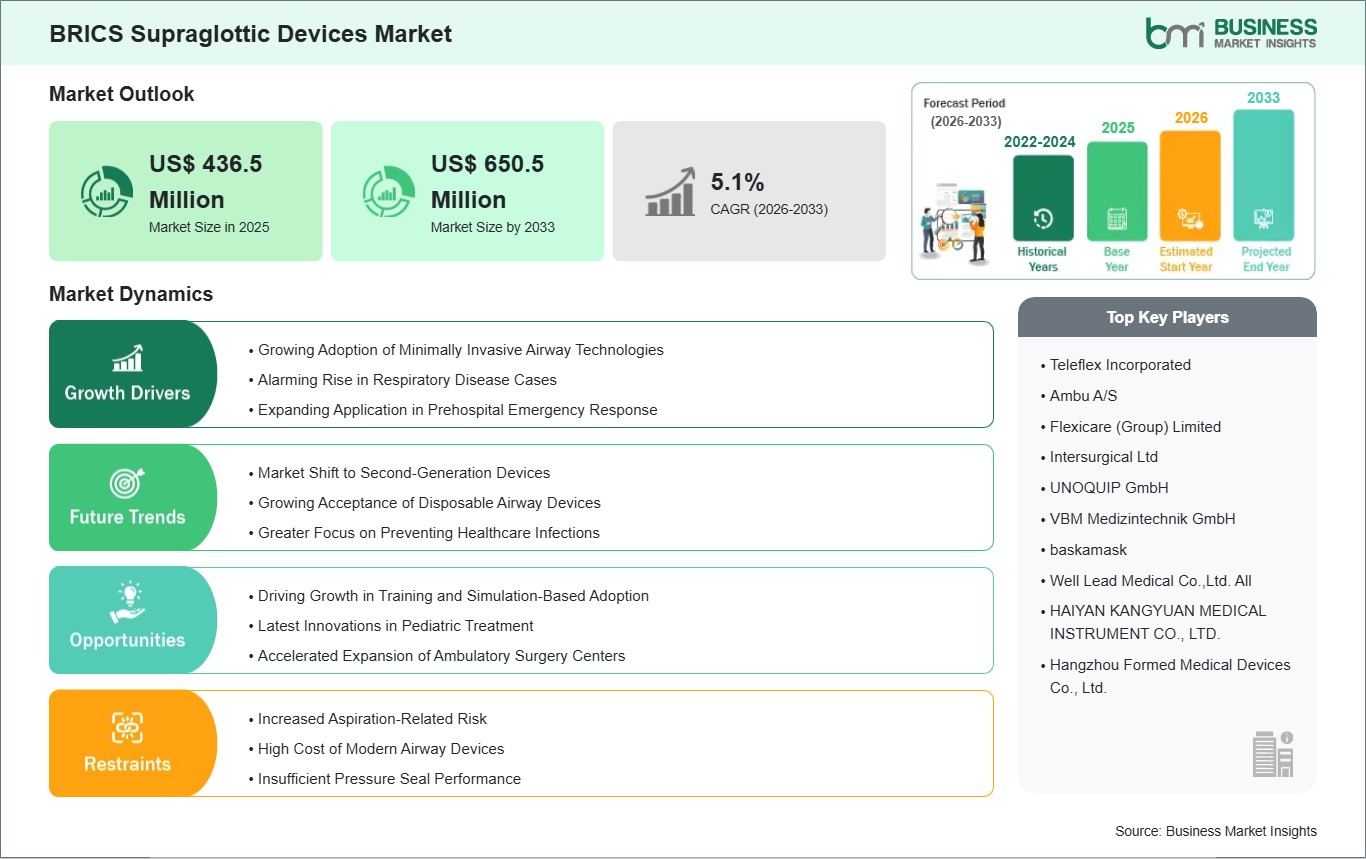
The BRICS Supraglottic Devices market size is expected to reach US$ 650.5 million by 2033 from US$ 436.5 million in 2025. The market is estimated to record a CAGR of 5.1% from 2026 to 2033.
The BRICS supraglottic airway device market dynamics include a blend of developing healthcare infrastructure along with growing needs for innovative solutions to manage airways in Brazil, Russia, India, China, and South Africa. There exists a varied healthcare scenario where developed urban areas exist alongside less-developed rural regions with limited availability of specialists. Supraglottic airway devices are considered to be a reliable tool to manage airway emergencies and surgery patients when a limited number of anesthetists are available. Their ease of use and rapid deployment make them highly valuable for hospitals and emergency response units operating under time-sensitive conditions.
The increase in demand for the BRICS market is attributed to the increasing emphasis on emergency and perioperative care. There is investment from governments and private healthcare firms in upgrading their hospital infrastructure and supplying state-of-the-art equipment that will help manage the airways better. Other factors include an increased number of surgeries, trauma cases, and the implementation of standards for ensuring patients' safety. The BRICS market will face a few obstacles, such as inequality in the distribution of healthcare services and training between urban and rural settings. In some cases, hospitals owned by the government in BRICS nations might be reluctant to adopt expensive technologies like supraglottic airways. Instead, they prefer reusable medical devices that offer a more efficient cost-to-benefit ratio. The BRICS market is favorable for expansion because of its innovative cities adopting new products such as supraglottic airways.

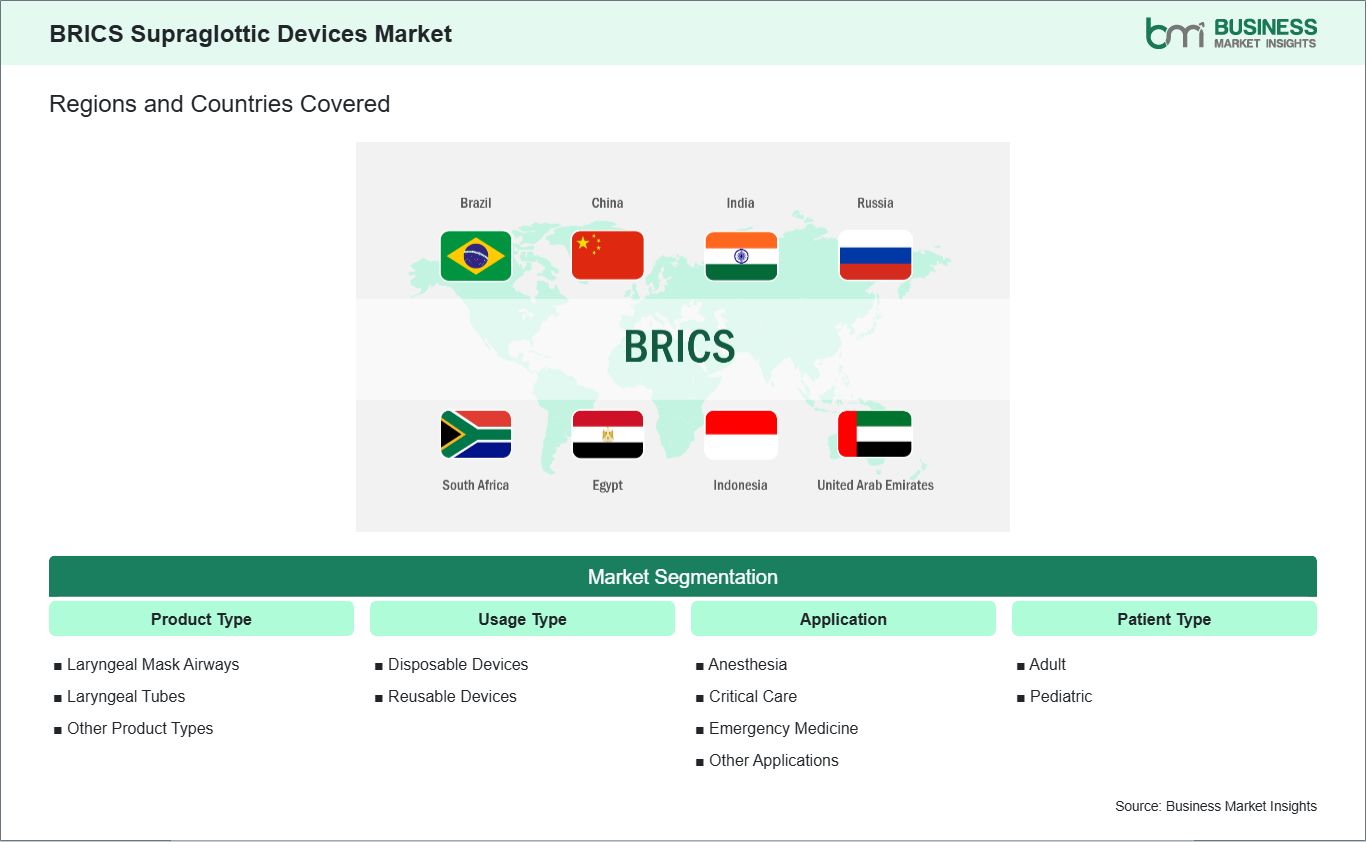
Key segments that contributed to the derivation of the BRICS Supraglottic Devices market analysis are product type, usage type, application, patient type, and end user.
The BRICS supraglottic devices market is experiencing steady growth as healthcare providers increasingly turn to minimally invasive airway technologies. Supraglottic airway devices (SGAs) are being favored for their ease of use, faster placement, and reduced procedural complexity compared to conventional intubation methods. In high-volume hospitals and emergency care settings, these devices allow clinicians to secure patient airways efficiently, improving workflow and reducing the risk of complications during surgical and emergency interventions.
Rising demand for surgical procedures and critical care services across the BRICS region is further driving adoption. Hospitals and healthcare facilities are seeking devices that can be deployed rapidly in diverse patient populations, including both elective and emergency cases. SGAs meet these needs by offering reliable ventilation and oxygenation with minimal setup, which helps healthcare providers optimize patient outcomes while managing growing procedural volumes.
Cost-effectiveness and safety considerations also play a significant role in adoption. Single-use supraglottic devices reduce cross-contamination risks and the burden of sterilization, making them suitable for healthcare systems with varied infrastructure levels. Combined with improved design and sealing efficiency, SGAs are increasingly becoming a standard tool for airway management across the region, reflecting a broader trend toward minimally invasive and resource-efficient medical technologies.
The adoption of training and simulation-based programs is a key factor in driving the use of supraglottic airway devices in the BRICS region. Healthcare systems are focusing on equipping practitioners, nurses, and emergency responders with practical skills to ensure safe and effective device use. Simulation-based training allows staff to practice insertion techniques, troubleshoot complications, and gain confidence in a controlled, risk-free environment, which is especially important in emergency and critical care settings.
Structured workshops and hands-on training programs are increasingly integrated into clinical education. These initiatives combine theoretical knowledge with real-world practice, allowing clinicians to gain experience with various SGA types and patient scenarios. By promoting standardized airway management protocols, simulation-based training enhances procedural consistency, reduces errors, and supports improved patient outcomes across a variety of healthcare facilities.
Simulation as a component of professional training also adds momentum to the uptake of these technologies, even by those organizations with few resources available. The use of low-cost simulators and the conduct of practice sessions by peers offer an easy and effective way for clinicians to sustain their skills over time. This helps in gaining confidence and competence in using SGAs. This emphasis on training and simulation has contributed to safe and successful uptake of minimally invasive airway technologies across the BRICS healthcare system.
The BRICS Supraglottic Devices market demonstrates steady growth, with size and share analysis highlighting evolving trends and competitive dynamics among key players. The report evaluates important subsegments categorized within product type, usage type, application, patient type, and end user, highlighting their respective contributions to overall market performance.
By product type, the laryngeal mask airways subsegment dominated the supraglottic devices market in 2025. The dominance of laryngeal mask airways is driven by their ease of insertion, high success rate in securing the airway, reduced risk of complications compared to traditional intubation, and broad adoption in surgical and emergency settings, making them a key revenue contributor for manufacturers.
Based on usage type, the disposable devices subsegment led the market in 2025. Disposable supraglottic devices are preferred due to their reduced risk of cross-contamination, lower sterilization requirements, and convenience for high-volume clinical environments, which supports their widespread adoption across hospitals and emergency care facilities.
In terms of application, the anesthesia subsegment dominated the market in 2025. This leadership is attributed to the frequent use of supraglottic devices in elective and emergency surgical procedures, the increasing number of surgeries worldwide, and the clinical benefits of providing a safe and effective airway without the need for invasive intubation.
By patient type, the adult subsegment dominated the market in 2025. The preference for adult patients is driven by higher procedural volumes in adult surgeries, the established clinical efficacy of supraglottic devices in adult airway management, and increasing adoption in critical care and emergency settings.
Based on end user, the hospitals subsegment dominated the market in 2025. Hospitals lead due to their well-established anesthesia and critical care departments, access to advanced airway management devices, trained staff, and the capability to perform a high volume of surgical and emergency procedures requiring reliable airway management.
| Report Attribute | Details |
|---|---|
| Market size in 2025 | US$ 436.5 Million |
| Market Size by 2033 | US$ 650.5 Million |
| CAGR (2026 - 2033) | 5.1% |
| Historical Data | 2022-2024 |
| Forecast period | 2026-2033 |
| Segments Covered | By Product Type
|
|
Regions and Countries Covered
| |
| BRICS | Russia, Brazil, South Africa, India, China, Egypt, Indonesia, Saudi Arabia, United Arab Emirates |
| Market leaders and key company profiles |
|
The "BRICS Supraglottic Devices Market Size and Forecast (2022–2033)" report provides a detailed analysis of the market covering below areas:
The geographical scope of the BRICS Supraglottic Devices market report is divided into: Russia, Brazil, South Africa, India, China, Egypt, Indonesia, Saudi Arabia, and the UAE. China held the largest share in 2025.
The dominance of China in the supraglottic devices category in the BRICS market is driven by the presence of a highly sophisticated health care system with a huge number of surgical procedures, as well as a focus on developing perioperative and emergency medicine. Modern medical facilities and the availability of highly technological equipment in Chinese hospitals provide an attractive setting for using such devices as supraglottic devices. Such devices can be used in elective operations, emergency departments, and pre-hospital conditions.
The other important reason why China is a leader in the use of supraglottic devices among BRICS countries is the emphasis on training and development of skills for anesthesiologists, emergency physicians, and paramedics. The training sessions for health workers help them develop necessary skills for handling the airways effectively, increasing their confidence in using supraglottic devices alongside conventional approaches. In addition, the procurement and distribution systems for medical supplies and equipment in China make it possible to get a variety of supraglottic devices. Although cities are the first to benefit from such innovations, the government’s continued efforts will ensure that more regional and secondary hospitals can access them. Regardless of existing regional differences, China’s advanced health care policies and facilities give it a competitive advantage in the BRICS supraglottic devices market.

The BRICS Supraglottic Devices market is evaluated by gathering qualitative and quantitative data post primary and secondary research, which includes important corporate publications, association data, and databases. A few of the key developments in the BRICS Supraglottic Devices market are:
The BRICS Supraglottic Devices Market is valued at US$ 436.5 Million in 2025, it is projected to reach US$ 650.5 Million by 2033.
As per our report BRICS Supraglottic Devices Market, the market size is valued at US$ 436.5 Million in 2025, projecting it to reach US$ 650.5 Million by 2033. This translates to a CAGR of approximately 5.1% during the forecast period.
The BRICS Supraglottic Devices Market report typically cover these key segments-
The historic period, base year, and forecast period can vary slightly depending on the specific market research report. However, for the BRICS Supraglottic Devices Market report:
The BRICS Supraglottic Devices Market is populated by several key players, each contributing to its growth and innovation. Some of the major players include:
The BRICS Supraglottic Devices Market report is valuable for diverse stakeholders, including:
Essentially, anyone involved in or considering involvement in the BRICS Supraglottic Devices Market value chain can benefit from the information contained in a comprehensive market report.
Please tell us your area of interest
(Market Segments/ Regions and Countries/ Companies)