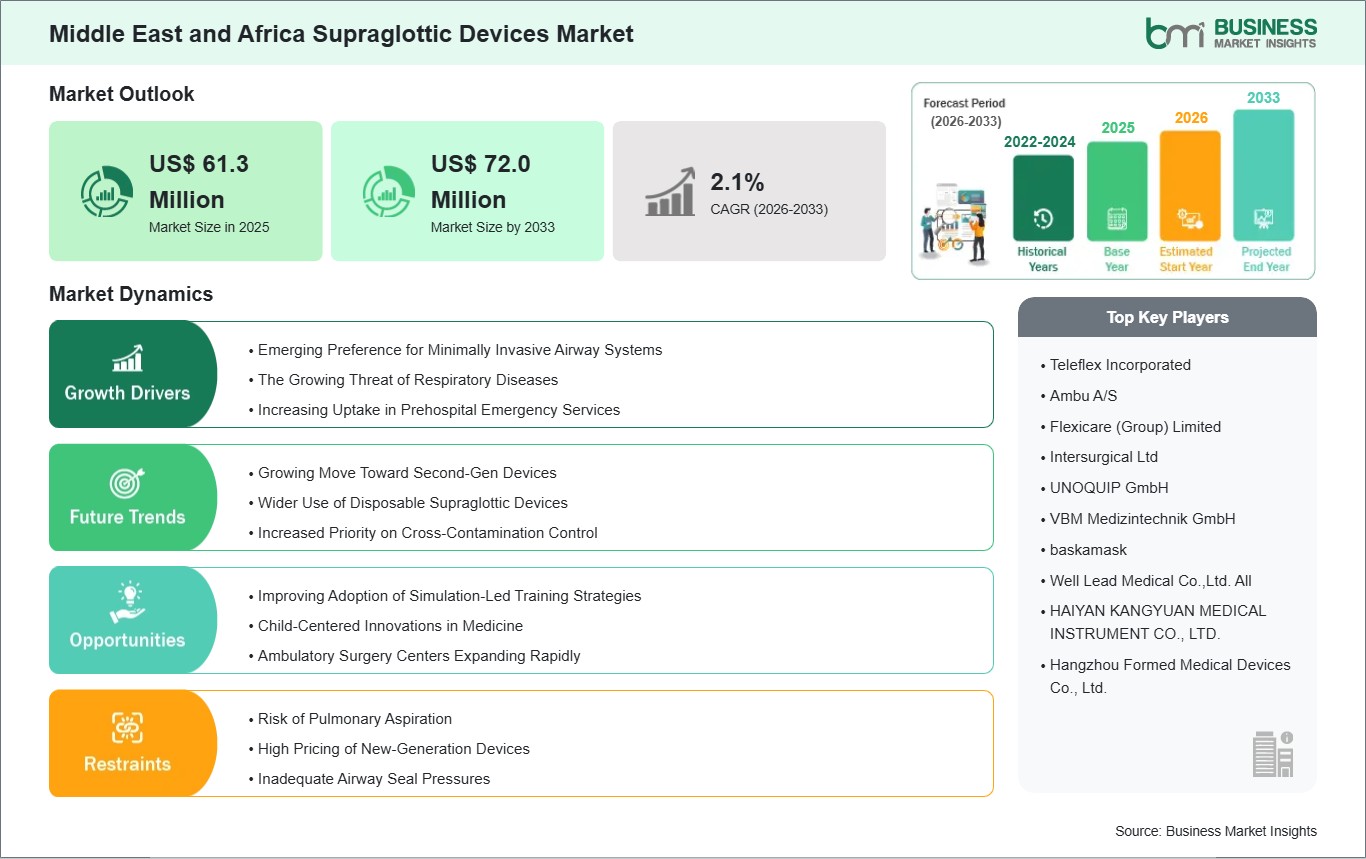
The Middle East and Africa Supraglottic Devices market size is expected to reach US$ 72.0 million by 2033 from US$ 61.3 million in 2025. The market is estimated to record a CAGR of 2.1% from 2026 to 2033.
The Middle East and Africa supraglottic devices market is witnessing steady development, driven primarily by the expansion of surgical infrastructure and the rising emphasis on airway management in emergency and critical care settings. The Gulf nations have been making significant investments in upgrading their hospitals to include new and improved anesthetics and respiratory equipment, leading to the popularity of supraglottic airway devices as a safer and more efficient alternative to endotracheal tubes for specific procedures. Moreover, enhanced knowledge amongst healthcare professionals about the advantages of using minimally invasive airway management devices has prompted their use during elective surgery and emergencies before hospital admission. Chronic respiratory disorders and trauma patients, including victims of motor vehicle accidents, are also driving the demand.
Nevertheless, the market is hindered by the unequal distribution of health services among African countries and insufficient medical professionals in remote and developing locations. Besides, cost consciousness continues to be a restraint, mainly in poor regions where reusable equipment is used more frequently than disposable ones. However, there is still a chance for growth because of reforms in the health industry and an increase in private organizations' involvement.

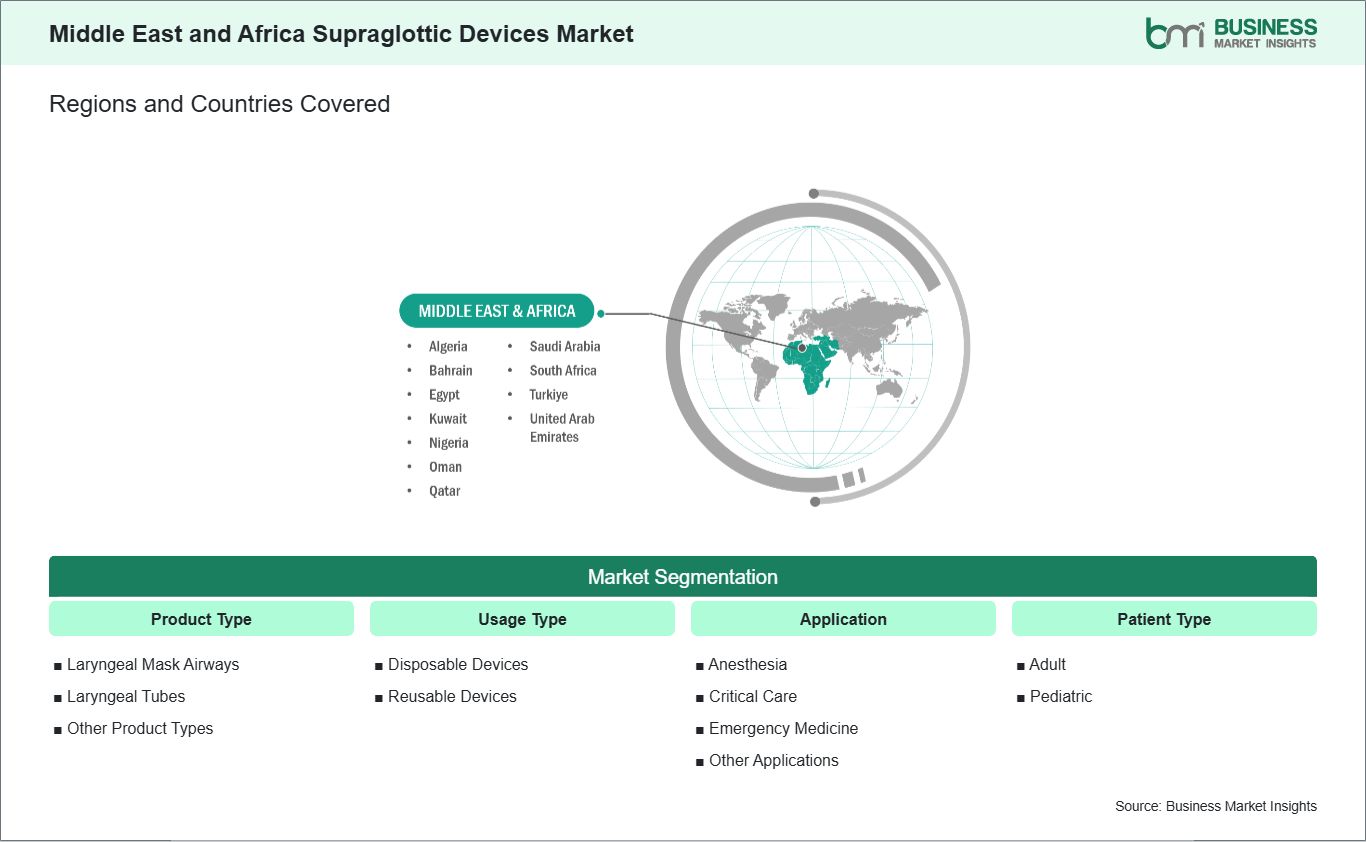
Key segments that contributed to the derivation of the Africa Supraglottic Devices market analysis are product type, usage type, application, patient type, and end user.
The Middle East and Africa supraglottic devices market is gradually shifting toward minimally invasive airway systems as healthcare providers prioritize faster, more adaptable clinical interventions. Supraglottic airway devices (SGAs) are gaining recognition for their ability to provide effective airway control in settings where rapid response is critical, particularly in emergency units and trauma care environments. Their simplified insertion process allows clinicians to stabilize patients quickly, which is especially valuable in healthcare systems managing unpredictable patient inflows and diverse case complexities.
Infrastructure variability across the region is also shaping this preference. While advanced hospitals are incorporating SGAs into routine surgical workflows, smaller and developing facilities are adopting these devices as a practical alternative to more technically demanding airway management techniques. This dual dynamic creates a broad base of demand, where both high-end and resource-limited institutions see value in devices that reduce dependency on specialized equipment and extensive procedural preparation.
Another important factor is the growing focus on infection prevention and operational resilience. Disposable supraglottic devices are increasingly viewed as a reliable solution for maintaining hygiene standards in environments where sterilization capacity may fluctuate. At the same time, newer device designs that offer better sealing and adaptability to different patient anatomies are improving clinical outcomes. These combined factors are reinforcing the region’s transition toward minimally invasive airway systems as a sustainable and scalable solution.
Simulation-led training strategies are an important enabler of supraglottic device adoption across the Middle East and Africa. Healthcare institutions are increasingly recognizing the need to build practical airway management skills among a broader range of healthcare workers, including those who may not specialize in anesthesiology. Simulation-based learning provides a controlled setting where clinicians can repeatedly practice SGA insertion and management, helping bridge gaps in hands-on clinical exposure.
Training initiatives are evolving to address the region’s diverse healthcare landscape. Programs often focus on scenario-based learning, where participants manage simulated emergencies such as respiratory distress or airway obstruction. This approach strengthens both technical skills and real-time decision-making, ensuring that practitioners can respond effectively under pressure. In many cases, these programs are designed to be adaptable, allowing institutions with varying levels of resources to implement training modules suited to their capabilities.
The increasing use of accessible training models is further supporting adoption. Low-cost simulators, mobile training units, and peer-led workshops are helping extend skill development opportunities beyond major hospitals to smaller facilities and remote areas. This decentralized approach is improving overall competency in airway management and encouraging consistent use of supraglottic devices. As a result, simulation-led training is not only enhancing clinical preparedness but also playing a critical role in expanding the practical use of SGAs across the region.
The Middle East and Africa Supraglottic Devices market demonstrates steady growth, with size and share analysis highlighting evolving trends and competitive dynamics among key players. The report evaluates important subsegments categorized within product type, usage type, application, patient type, and end user, highlighting their respective contributions to overall market performance.
By product type, the laryngeal mask airways subsegment dominated the supraglottic devices market in 2025. The dominance of laryngeal mask airways is driven by their ease of insertion, high success rate in securing the airway, reduced risk of complications compared to traditional intubation, and broad adoption in surgical and emergency settings, making them a key revenue contributor for manufacturers.
Based on usage type, the disposable devices subsegment led the market in 2025. Disposable supraglottic devices are preferred due to their reduced risk of cross-contamination, lower sterilization requirements, and convenience for high-volume clinical environments, which supports their widespread adoption across hospitals and emergency care facilities.
In terms of application, the anesthesia subsegment dominated the market in 2025. This leadership is attributed to the frequent use of supraglottic devices in elective and emergency surgical procedures, the increasing number of surgeries worldwide, and the clinical benefits of providing a safe and effective airway without the need for invasive intubation.
By patient type, the adult subsegment dominated the market in 2025. The preference for adult patients is driven by higher procedural volumes in adult surgeries, the established clinical efficacy of supraglottic devices in adult airway management, and increasing adoption in critical care and emergency settings.
Based on end user, the hospitals subsegment dominated the market in 2025. Hospitals lead due to their well-established anesthesia and critical care departments, access to advanced airway management devices, trained staff, and the capability to perform a high volume of surgical and emergency procedures requiring reliable airway management.
| Report Attribute | Details |
|---|---|
| Market size in 2025 | US$ 61.3 Million |
| Market Size by 2033 | US$ 72.0 Million |
| CAGR (2026 - 2033) | 2.1% |
| Historical Data | 2022-2024 |
| Forecast period | 2026-2033 |
| Segments Covered | By Product Type
|
|
Regions and Countries Covered
| |
| Middle East and Africa | Saudi Arabia, United Arab Emirates, Kuwait, Bahrain, Qatar, Oman, Turkiye, South Africa, Egypt, Nigeria, Algeria |
| Market leaders and key company profiles |
|
The "Middle East and Africa Supraglottic Devices Market Size and Forecast (2022–2033)" report provides a detailed analysis of the market covering below areas:
The geographical scope of the Middle East and Africa Supraglottic Devices market report is divided into: Saudi Arabia, the United Arab Emirates, Kuwait, Bahrain, Qatar, Oman, Turkiye, South Africa, Egypt, Nigeria, Algeria, and the Rest of MEA. Turkiye held the largest share in 2025.
Turkiye emerges as the country leading in the Middle East and Africa supraglottic devices market because of its highly developed healthcare infrastructure, as well as its geographical advantage as a center for medical treatment between Europe and Asia. Turkiye has achieved notable success in expanding the number of its hospitals, especially those formed through Public Private Partnership (PPP). Supraglottic devices have been steadily increasing in use not only in public hospitals but also in private hospitals, owing to the increasing demand for faster procedures.
The presence of skilled anesthesiologists and continuous medical education programs has further strengthened the adoption of these devices in clinical practice. Additionally, Turkiye’s thriving medical tourism industry plays a crucial role, as hospitals catering to international patients are more likely to use advanced and disposable supraglottic devices to maintain high standards of care and infection control. Emergency medical services in urban areas are also becoming more sophisticated, incorporating supraglottic airway devices in pre-hospital care protocols. While economic fluctuations can influence procurement patterns, the country’s strong healthcare infrastructure and increasing demand for quality care continue to support market growth.

The Middle East and Africa Supraglottic Devices market is evaluated by gathering qualitative and quantitative data post primary and secondary research, which includes important corporate publications, association data, and databases. A few of the key developments in the Middle East and Africa Supraglottic Devices market are:
The Middle East and Africa Supraglottic Devices Market is valued at US$ 61.3 Million in 2025, it is projected to reach US$ 72.0 Million by 2033.
As per our report Middle East and Africa Supraglottic Devices Market, the market size is valued at US$ 61.3 Million in 2025, projecting it to reach US$ 72.0 Million by 2033. This translates to a CAGR of approximately 2.1% during the forecast period.
The Middle East and Africa Supraglottic Devices Market report typically cover these key segments-
The historic period, base year, and forecast period can vary slightly depending on the specific market research report. However, for the Middle East and Africa Supraglottic Devices Market report:
The Middle East and Africa Supraglottic Devices Market is populated by several key players, each contributing to its growth and innovation. Some of the major players include:
The Middle East and Africa Supraglottic Devices Market report is valuable for diverse stakeholders, including:
Essentially, anyone involved in or considering involvement in the Middle East and Africa Supraglottic Devices Market value chain can benefit from the information contained in a comprehensive market report.
Please tell us your area of interest
(Market Segments/ Regions and Countries/ Companies)