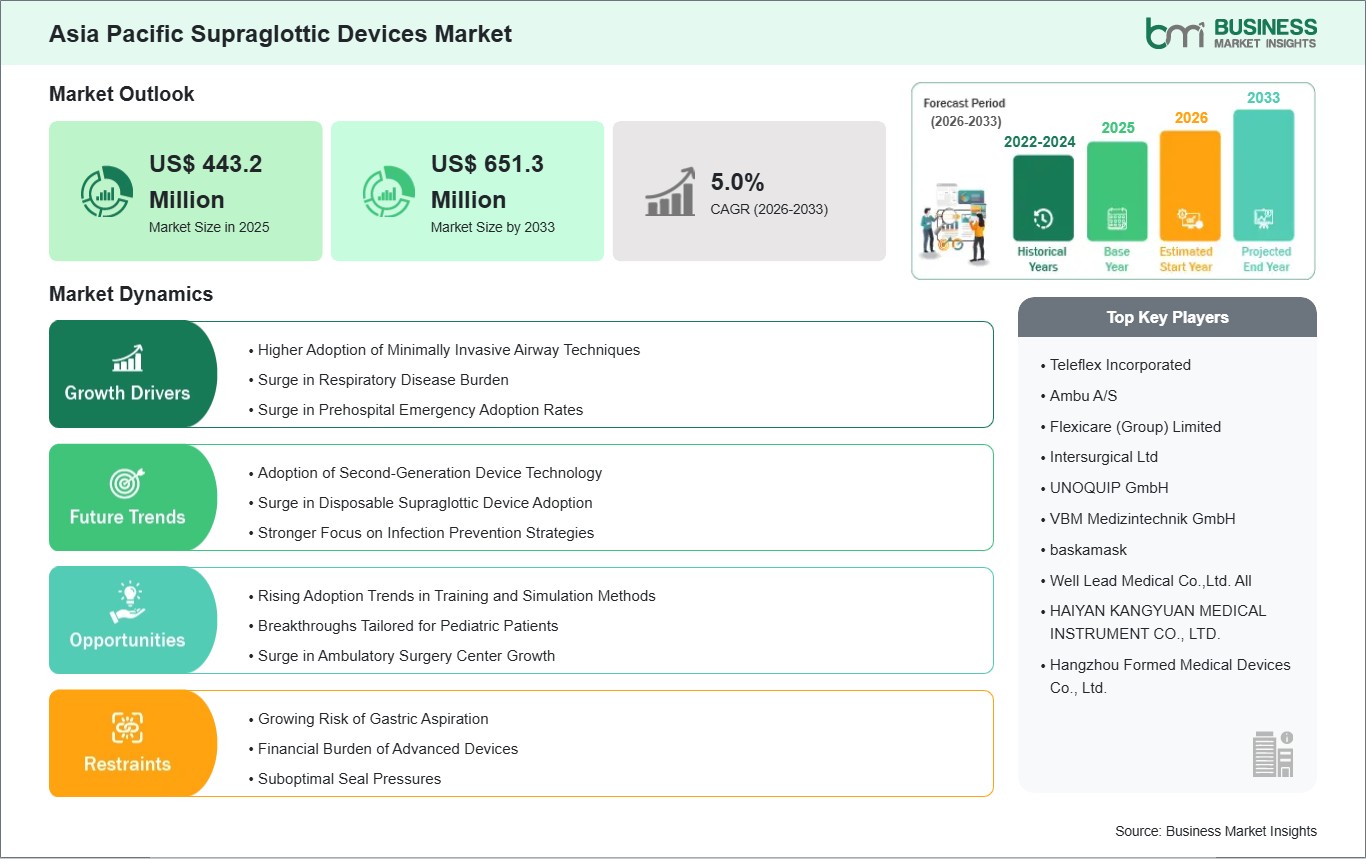
The Asia Pacific Supraglottic Devices market size is expected to reach US$ 651.3 million by 2033 from US$ 443.2 million in 2025. The market is estimated to record a CAGR of 5.0% from 2026 to 2033.
The Asia Pacific supraglottic devices market is shaped by the region’s dynamic healthcare evolution, where rapid urbanization and healthcare infrastructure expansion intersect with varying degrees of clinical capability across countries. Within this highly diverse environment, there has been a marked increase in the appreciation of the value of supraglottic airway devices in terms of their contribution towards facilitating the management of the airway during surgery and in emergencies, especially within high-volume institutions and perioperative settings. An important factor that has contributed towards stimulating interest within the marketplace has been the emphasis placed upon upgrading emergency response and critical care capabilities through government initiatives designed to minimize preventable morbidities.
An additional factor that plays an important role in the development of the market is the growth of private healthcare centers and multi-specialty hospitals within the Asia Pacific region, which have better access to advanced clinical equipment and focus more on training their physicians. Such institutions act as a trigger for others in the region due to the benefits of supraglottic airway devices. However, rural and resource-poor locations in a number of nations still encounter difficulties when trying to obtain these high-tech devices, and in such settings, the need for more traditional airways is felt, owing to issues with training and budgets. Moreover, differences between training programs offered by different clinics can be another factor that slows down the implementation of new airway devices, particularly within the secondary hospitals and community-based facilities.

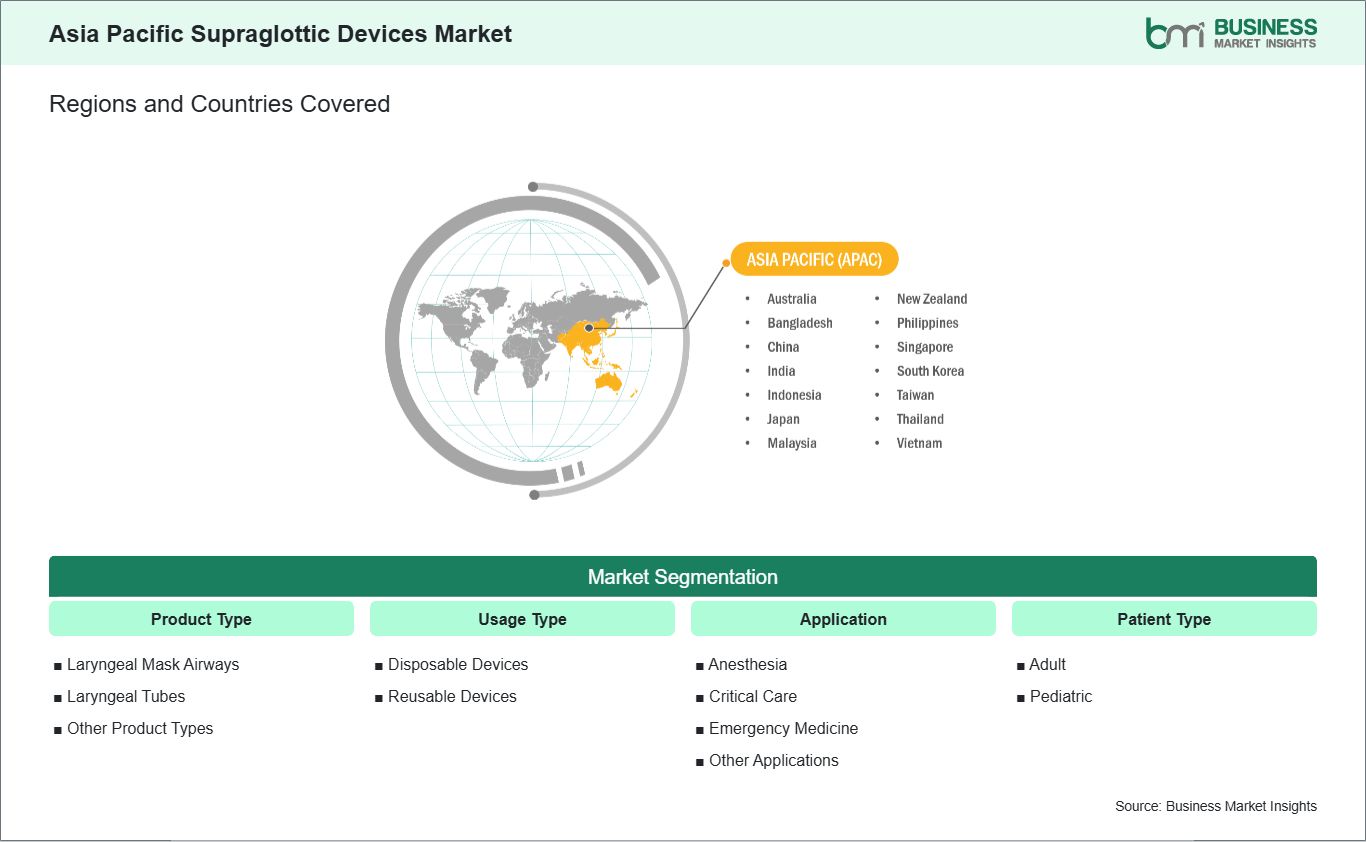
Key segments that contributed to the derivation of the Asia Pacific Supraglottic Devices market analysis are product type, usage type, application, patient type, and end user.
The Asia Pacific supraglottic devices market is experiencing significant growth as healthcare providers increasingly favor minimally invasive airway management techniques. Supraglottic airway devices (SGAs) have become a preferred solution due to their ease of use and rapid deployment, which allow clinicians to manage patient airways efficiently without the need for extensive intubation training. In high-volume hospitals and emergency settings, the ability to secure an airway quickly is critical, and SGAs provide a reliable option that reduces procedure time while maintaining safety standards.
Rising surgical volumes and growing demand for elective procedures are further fueling the adoption of these devices. Minimally invasive airway techniques streamline surgical workflows, enabling healthcare facilities to handle more patients without compromising quality of care. The versatility of SGAs also allows them to be used in a wide range of procedures, from routine surgeries to complex emergency interventions, making them a practical solution in diverse clinical environments.
In addition to the benefits of cost-effectiveness and patient safety, other elements are playing a role in the increased acceptance. Supraglottic single-use devices ensure that there is no cross-contamination, and their low maintenance feature is appropriate for health care facilities lacking adequate funding and those that have high patient turnover. These qualities together have made minimally invasive airway devices a key element in airway management in the Asia Pacific region.
Training and simulation-based programs are increasingly shaping the adoption of supraglottic airway devices in the Asia Pacific region. Healthcare institutions are placing greater emphasis on hands-on training initiatives to ensure that clinicians, nurses, and emergency responders can operate SGAs safely and effectively. Simulation provides a controlled, low-risk environment where practitioners can practice device insertion, troubleshoot potential complications, and refine their technique before applying these skills in real-world scenarios.
Structured educational programs and interactive workshops have further enhanced this trend. By combining theoretical instruction with practical exercises, these initiatives allow healthcare professionals to gain experience with a variety of device types and patient conditions. Simulation-based training also promotes standardized protocols for airway management, ensuring that procedures are performed consistently across different clinical settings and improving overall patient outcomes.
The integration of simulation into professional development and continuing education is expanding access to high-quality skill-building opportunities. Even in facilities with limited resources, low-cost models and peer-led training sessions provide effective ways to develop proficiency. Repeated exposure to realistic scenarios builds confidence and competence among healthcare providers, leading to increased utilization of supraglottic devices. Ultimately, the emphasis on training and simulation is reinforcing the safe and efficient adoption of minimally invasive airway solutions throughout the Asia Pacific healthcare landscape.
The Asia Pacific Supraglottic Devices market demonstrates steady growth, with size and share analysis highlighting evolving trends and competitive dynamics among key players. The report evaluates important subsegments categorized within product type, usage type, application, patient type, and end user, highlighting their respective contributions to overall market performance.
By product type, the laryngeal mask airways subsegment dominated the supraglottic devices market in 2025. The dominance of laryngeal mask airways is driven by their ease of insertion, high success rate in securing the airway, reduced risk of complications compared to traditional intubation, and broad adoption in surgical and emergency settings, making them a key revenue contributor for manufacturers.
Based on usage type, the disposable devices subsegment led the market in 2025. Disposable supraglottic devices are preferred due to their reduced risk of cross-contamination, lower sterilization requirements, and convenience for high-volume clinical environments, which supports their widespread adoption across hospitals and emergency care facilities.
In terms of application, the anesthesia subsegment dominated the market in 2025. This leadership is attributed to the frequent use of supraglottic devices in elective and emergency surgical procedures, the increasing number of surgeries worldwide, and the clinical benefits of providing a safe and effective airway without the need for invasive intubation.
By patient type, the adult subsegment dominated the market in 2025. The preference for adult patients is driven by higher procedural volumes in adult surgeries, the established clinical efficacy of supraglottic devices in adult airway management, and increasing adoption in critical care and emergency settings.
Based on end user, the hospitals subsegment dominated the market in 2025. Hospitals lead due to their well-established anesthesia and critical care departments, access to advanced airway management devices, trained staff, and the capability to perform a high volume of surgical and emergency procedures requiring reliable airway management.
| Report Attribute | Details |
|---|---|
| Market size in 2025 | US$ 443.2 Million |
| Market Size by 2033 | US$ 651.3 Million |
| CAGR (2026 - 2033) | 5.0% |
| Historical Data | 2022-2024 |
| Forecast period | 2026-2033 |
| Segments Covered | By Product Type
|
|
Regions and Countries Covered
| |
| Asia Pacific | China, Japan, South Korea, India, Australia, New Zealand, Indonesia, Malaysia, Philippines, Singapore, Thailand, Vietnam, Taiwan, Bangladesh |
| Market leaders and key company profiles |
|
The "Asia Pacific Supraglottic Devices Market Size and Forecast (2022–2033)" report provides a detailed analysis of the market covering below areas:
The geographical scope of the Asia Pacific Supraglottic Devices market report is divided into: China, Japan, South Korea, India, Australia, New Zealand, Indonesia, Malaysia, the Philippines, Singapore, Thailand, Vietnam, Taiwan, Bangladesh, and Rest of Asia. China held the largest share in 2025.
China stands at the forefront of the Asia Pacific supraglottic devices market, driven by its expansive healthcare system and strategic focus on modernizing clinical capabilities nationwide. Within the country’s vast network of tertiary and community hospitals, there is growing recognition of the role that supraglottic airway devices play in improving airway management, particularly in busy operating theaters and emergency departments. In addition to minimizing the risks associated with anesthesia and ensuring safety during surgery, the use of these devices has been driven by the need to minimize risk and increase safety during anesthesia and perioperative care.
The improvements that have been witnessed in the emergency medical services provided by China have resulted in the increased use of these supraglottic airway devices during pre-hospital care, which often requires rapid management of airways. Professional development efforts for anesthesia practitioners, paramedics, and emergency medicine professionals have been essential in increasing the proficiency of clinicians in using these devices. Moreover, China’s procurement process in the healthcare sector, which combines centralization with the independence of local hospitals, is contributing to a wider availability of various types of airway devices for use in hospitals of all sizes. Large urban hospitals have readily incorporated the latest supraglottic airway devices in airway management, whereas there are ongoing efforts in incorporating such technology into smaller regional hospitals based on the Chinese government’s focus on providing equal access to healthcare services across the nation. However, regional disparities in funding and training still pose obstacles to the adoption of this technology in other areas beyond large metropolitan cities.

The Asia Pacific Supraglottic Devices market is evaluated by gathering qualitative and quantitative data post primary and secondary research, which includes important corporate publications, association data, and databases. A few of the key developments in the Asia Pacific Supraglottic Devices market are:
The Asia Pacific Supraglottic Devices Market is valued at US$ 443.2 Million in 2025, it is projected to reach US$ 651.3 Million by 2033.
As per our report Asia Pacific Supraglottic Devices Market, the market size is valued at US$ 443.2 Million in 2025, projecting it to reach US$ 651.3 Million by 2033. This translates to a CAGR of approximately 5.0% during the forecast period.
The Asia Pacific Supraglottic Devices Market report typically cover these key segments-
The historic period, base year, and forecast period can vary slightly depending on the specific market research report. However, for the Asia Pacific Supraglottic Devices Market report:
The Asia Pacific Supraglottic Devices Market is populated by several key players, each contributing to its growth and innovation. Some of the major players include:
The Asia Pacific Supraglottic Devices Market report is valuable for diverse stakeholders, including:
Essentially, anyone involved in or considering involvement in the Asia Pacific Supraglottic Devices Market value chain can benefit from the information contained in a comprehensive market report.
Please tell us your area of interest
(Market Segments/ Regions and Countries/ Companies)