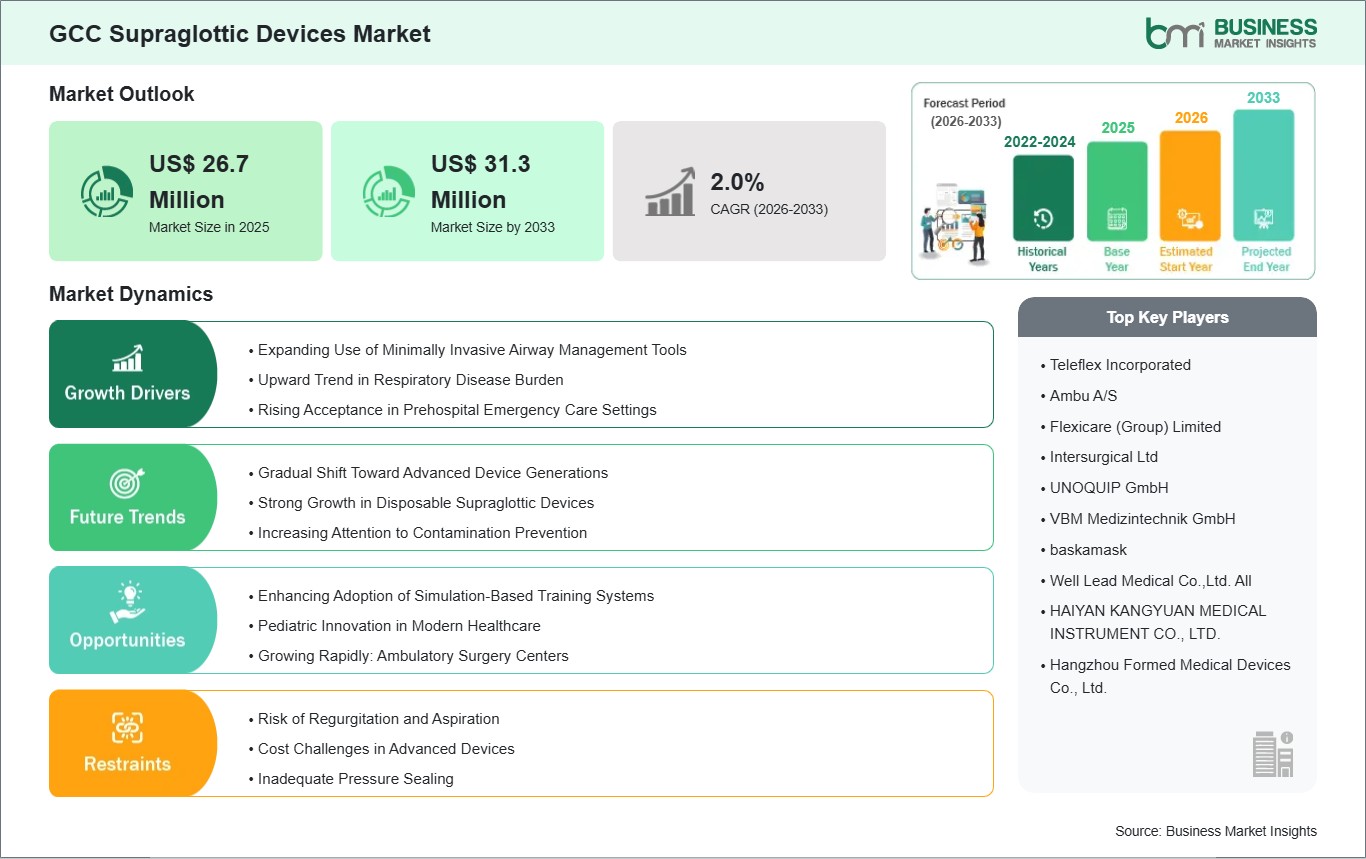
The GCC Supraglottic Devices market size is expected to reach US$ 31.3 million by 2033 from US$ 26.7 million in 2025. The market is estimated to record a CAGR of 2.0% from 2026 to 2033.
The GCC market for supraglottic airway devices is experiencing consistent growth due to continued investment in modern health infrastructure, growing numbers of surgeries, and enhanced awareness of advanced airway management techniques. There is an emphasis in this region on upgrading hospitals and trauma centers, leading to increased demand for airway management products that can ensure patient safety. Supraglottic airway devices are popular because of their simple design and fast installation process, as well as their efficacy in elective procedures and emergencies.
One such driver behind the growth of the market is the focus on patient safety and quality. Airway management devices are being used by healthcare organizations to increase efficiency in procedures, minimize risks associated with anesthesia, and achieve better surgical results. An increased number of private healthcare institutions and efforts to improve critical care and emergency services also facilitate the use of supraglottic airway devices in the region. However, despite all the opportunities that the region offers, there are still some restraints that need to be considered. The high cost of purchasing devices, both advanced and single-use ones, could discourage adoption in smaller healthcare institutions or publicly owned ones. The presence of qualified medical staff would be able to make proper use of the devices could also act as a restraint in developing regions.

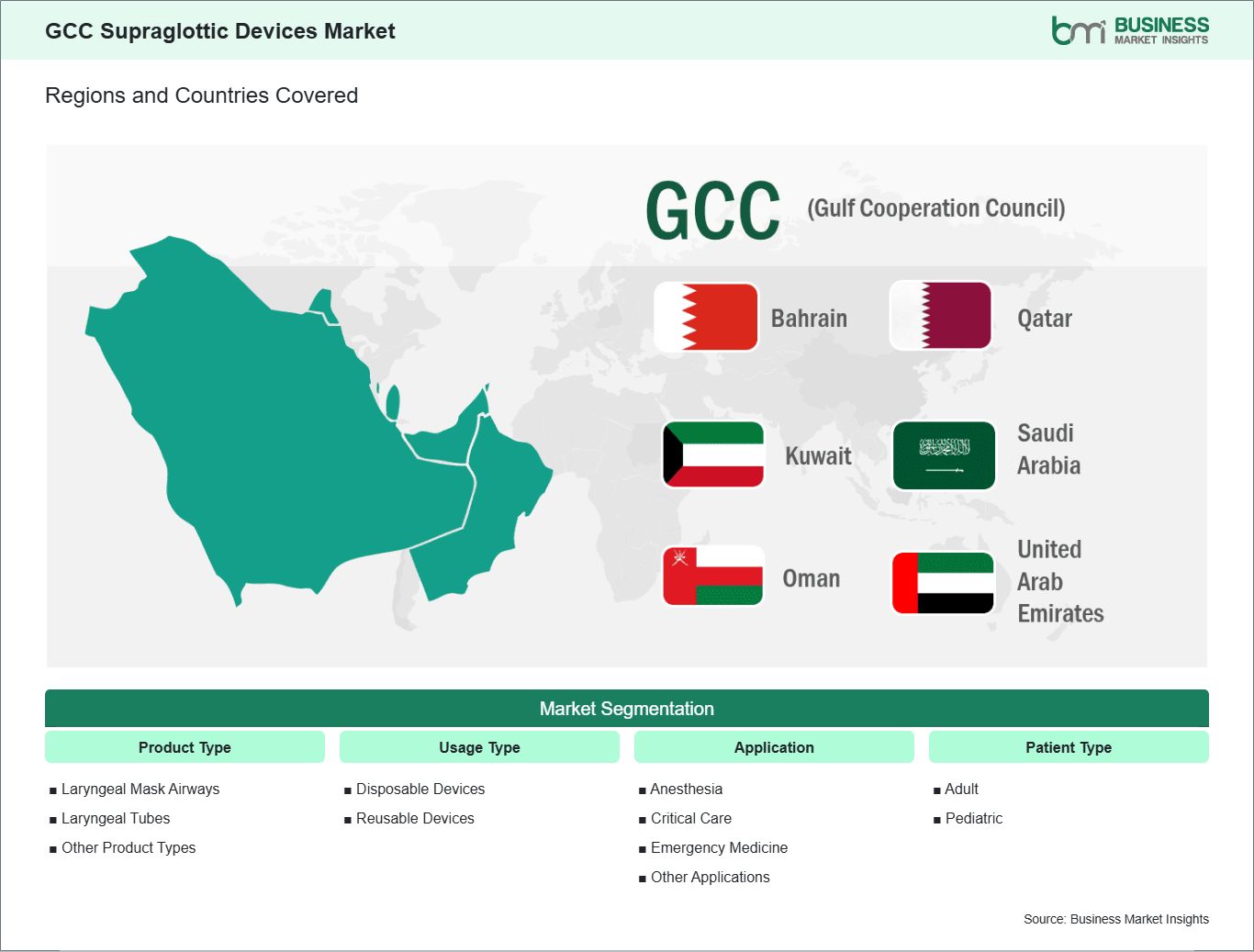
Key segments that contributed to the derivation of the GCC Supraglottic Devices market analysis are product type, usage type, application, patient type, and end user.
The GCC supraglottic devices market is witnessing an expanding adoption of minimally invasive airway management tools as healthcare providers focus on improving patient safety and operational efficiency. Supraglottic airway devices (SGAs) are increasingly preferred due to their ease of insertion, rapid deployment, and reduced reliance on highly specialized intubation skills. In fast-paced hospital and surgical environments, these devices enable clinicians to secure airways quickly and reliably, helping to minimize procedural delays and enhance patient outcomes.
Growth in surgical and emergency care volumes is further driving demand for SGAs. Hospitals are seeking solutions that allow rapid airway control while supporting shorter anesthesia times and faster patient turnover. Minimally invasive airway devices provide a practical alternative to conventional intubation, particularly in settings where efficiency and safety must be balanced, and their versatility across routine, elective, and emergency procedures makes them an integral part of modern clinical workflows.
Cost-effectiveness and infection control considerations also contribute to market expansion. Single-use SGAs help reduce cross-contamination risks and decrease the burden of sterilization, while improved designs enhance patient comfort and ventilation efficiency. As awareness of minimally invasive approaches grows, healthcare systems across the GCC are increasingly integrating these devices into standard airway management protocols, reflecting a broader shift toward efficient, safe, and patient-centric care.
Simulation-based training systems are playing a critical role in enhancing the adoption of supraglottic airway devices across the GCC. Healthcare institutions are investing in structured programs that allow clinicians, nurses, and emergency responders to practice SGA insertion, troubleshooting, and airway management techniques in a controlled, risk-free environment. These programs are particularly important in emergency and high-acuity care settings, where proficiency directly affects patient safety and procedural outcomes.
Hands-on workshops and interactive simulation modules are increasingly integrated into professional development programs. By combining practical exercises with theoretical instruction, these initiatives expose clinicians to multiple device types and diverse patient scenarios, helping to standardize airway management practices and ensure consistent application across various clinical environments. Simulation also supports multidisciplinary teamwork, allowing different members of care teams to coordinate effectively during critical procedures.
The growing emphasis on simulation in continuing education and skills development is further strengthening SGA adoption. Even in facilities with limited access to high-fidelity simulation equipment, low-cost models and peer-led training initiatives offer practical avenues to build and maintain competence. Repeated practice in realistic scenarios enhances confidence and technical skill, promoting the safe and efficient use of supraglottic airway devices. Simulation-based training is becoming a cornerstone of modern airway management strategy in the GCC healthcare landscape.
The GCC Supraglottic Devices market demonstrates steady growth, with size and share analysis highlighting evolving trends and competitive dynamics among key players. The report evaluates important subsegments categorized within product type, usage type, application, patient type, and end user, highlighting their respective contributions to overall market performance.
By product type, the laryngeal mask airways subsegment dominated the supraglottic devices market in 2025. The dominance of laryngeal mask airways is driven by their ease of insertion, high success rate in securing the airway, reduced risk of complications compared to traditional intubation, and broad adoption in surgical and emergency settings, making them a key revenue contributor for manufacturers.
Based on usage type, the disposable devices subsegment led the market in 2025. Disposable supraglottic devices are preferred due to their reduced risk of cross-contamination, lower sterilization requirements, and convenience for high-volume clinical environments, which supports their widespread adoption across hospitals and emergency care facilities.
In terms of application, the anesthesia subsegment dominated the market in 2025. This leadership is attributed to the frequent use of supraglottic devices in elective and emergency surgical procedures, the increasing number of surgeries worldwide, and the clinical benefits of providing a safe and effective airway without the need for invasive intubation.
By patient type, the adult subsegment dominated the market in 2025. The preference for adult patients is driven by higher procedural volumes in adult surgeries, the established clinical efficacy of supraglottic devices in adult airway management, and increasing adoption in critical care and emergency settings.
Based on end user, the hospitals subsegment dominated the market in 2025. Hospitals lead due to their well-established anesthesia and critical care departments, access to advanced airway management devices, trained staff, and the capability to perform a high volume of surgical and emergency procedures requiring reliable airway management.
| Report Attribute | Details |
|---|---|
| Market size in 2025 | US$ 26.7 Million |
| Market Size by 2033 | US$ 31.3 Million |
| CAGR (2026 - 2033) | 2.0% |
| Historical Data | 2022-2024 |
| Forecast period | 2026-2033 |
| Segments Covered | By Product Type
|
|
Regions and Countries Covered
| |
| GCC | UAE, Bahrain, Saudi Arabia, Oman, Qatar, Kuwait |
| Market leaders and key company profiles |
|
The "GCC Supraglottic Devices Market Size and Forecast (2022–2033)" report provides a detailed analysis of the market covering below areas:
The geographical scope of the GCC Supraglottic Devices market report is divided into: Saudi Arabia, the United Arab Emirates (UAE), Qatar, Kuwait, Bahrain, and Oman. Saudi Arabia held the largest share in 2025.
Saudi Arabia dominates the GCC supraglottic devices market due to its robust healthcare infrastructure, government-led healthcare modernization programs, and high volume of surgical procedures. The country has invested heavily in expanding hospitals, trauma centers, and specialized surgical facilities, creating a favorable environment for the adoption of advanced airway management devices. Supraglottic devices are increasingly used in both elective surgeries and emergency care, providing clinicians with reliable, rapid, and less invasive alternatives to traditional intubation methods.
A key factor supporting Saudi Arabia’s market leadership is the focus on professional training for anesthesiologists, critical care specialists, and emergency medical personnel. Regular skill development programs ensure that medical staff are proficient in the use of supraglottic devices across various clinical scenarios, enhancing adoption and effective utilization. Additionally, private hospitals and tertiary care centers in metropolitan areas are proactive in integrating new medical technologies to improve patient safety and operational efficiency. Government initiatives, including investments in nationwide emergency medical services and trauma care, further support the use of supraglottic devices in pre-hospital and critical care settings. While adoption in smaller public hospitals may face budgetary constraints and training limitations, Saudi Arabia’s focus on infrastructure, professional expertise, and high-quality patient care solidifies its position as the dominant market for supraglottic devices in the GCC.

The GCC Supraglottic Devices market is evaluated by gathering qualitative and quantitative data post primary and secondary research, which includes important corporate publications, association data, and databases. A few of the key developments in the GCC Supraglottic Devices market are:
The GCC Supraglottic Devices Market is valued at US$ 26.7 Million in 2025, it is projected to reach US$ 31.3 Million by 2033.
As per our report GCC Supraglottic Devices Market, the market size is valued at US$ 26.7 Million in 2025, projecting it to reach US$ 31.3 Million by 2033. This translates to a CAGR of approximately 2.0% during the forecast period.
The GCC Supraglottic Devices Market report typically cover these key segments-
The historic period, base year, and forecast period can vary slightly depending on the specific market research report. However, for the GCC Supraglottic Devices Market report:
The GCC Supraglottic Devices Market is populated by several key players, each contributing to its growth and innovation. Some of the major players include:
The GCC Supraglottic Devices Market report is valuable for diverse stakeholders, including:
Essentially, anyone involved in or considering involvement in the GCC Supraglottic Devices Market value chain can benefit from the information contained in a comprehensive market report.
Please tell us your area of interest
(Market Segments/ Regions and Countries/ Companies)