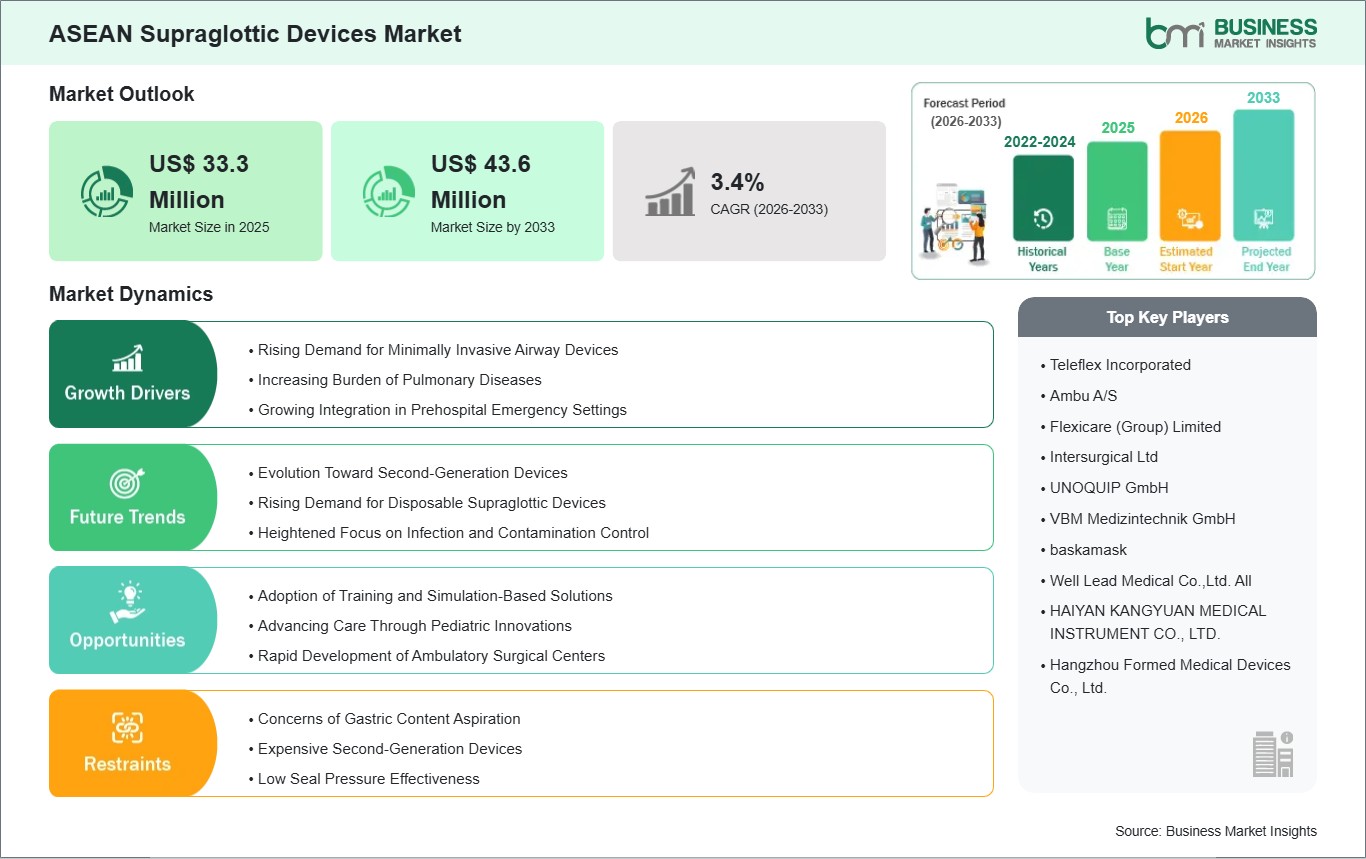
The ASEAN Supraglottic Devices market size is expected to reach US$ 43.6 million by 2033 from US$ 33.3 million in 2025. The market is estimated to record a CAGR of 3.4% from 2026 to 2033.
The ASEAN market for supraglottic airway devices shows the dynamics of a complex healthcare environment, which includes rapid development in city locations coupled with continuing difficulties in terms of resource availability in rural locations. In this case, supraglottic devices for airway management is highly popular due to their simplicity and lack of dependence on a thorough education in anesthesiology. Supraglottic devices are becoming more popular in emergency situations, surgical procedures, and even in the field due to the importance of quick and effective access to airways. One important reason for this trend includes increasing interest in enhancing the quality of emergency services and perioperative care, which is associated with high incidences of injuries and non-communicable diseases that require surgery. Also, the expansion of private medical service providers in cities adds to this trend.
However, the disparity in funding for health care facilities in various member states results in a disparity in the availability of high-quality airway management equipment. In many public health facilities and rural health centers, conventional airway management equipment is still commonly used owing to insufficient funds and infrequent purchase schedules. There are additional barriers related to training issues, as some health workers may lack confidence in using advanced supraglottic equipment. Moreover, logistics problems in the regional delivery chain could also affect the constant availability of such medical devices in archipelagic nations. Despite these obstacles, the ASEAN region is poised for gradual growth in supraglottic device utilization, supported by initiatives aimed at improving emergency and surgical care infrastructure.

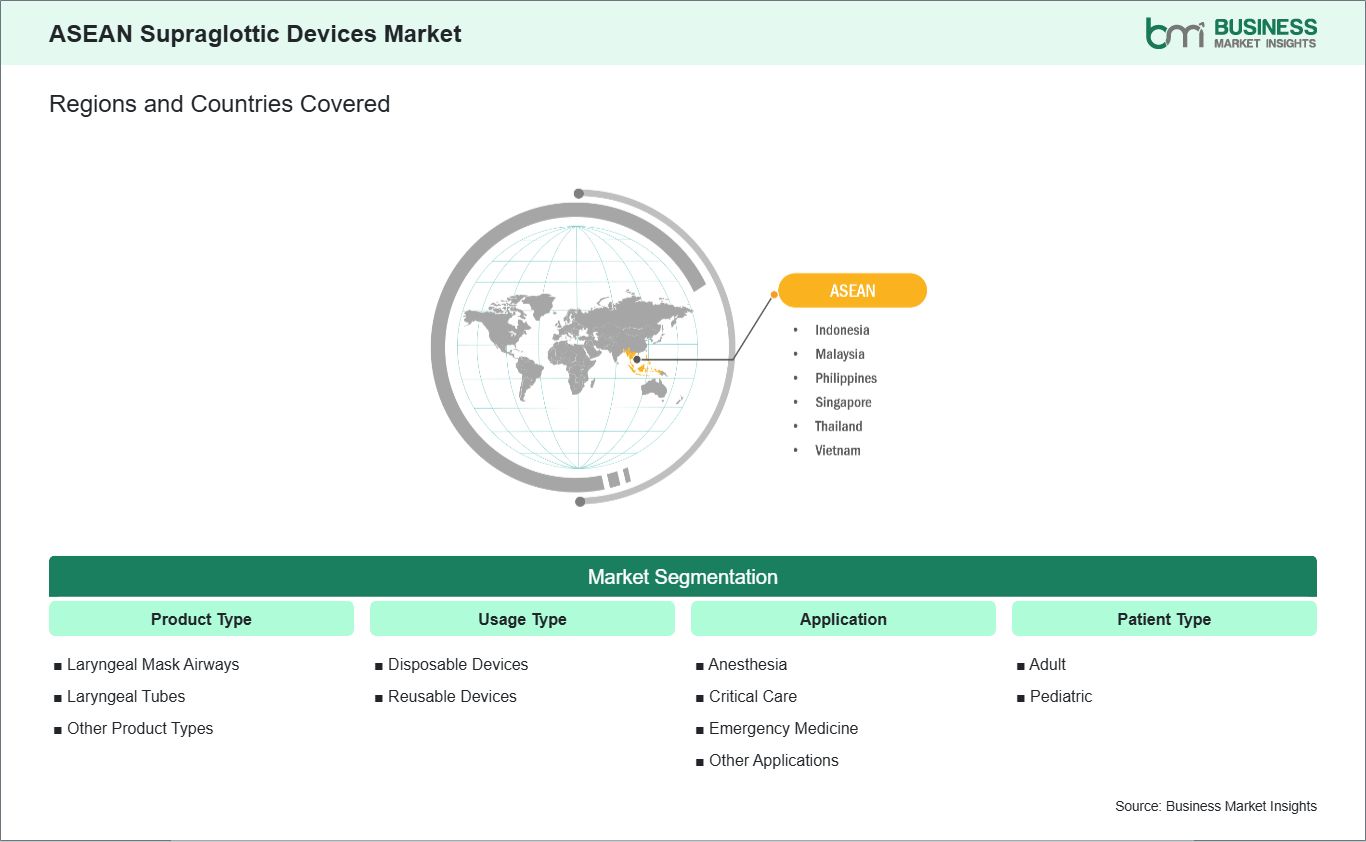
Key segments that contributed to the derivation of the ASEAN Supraglottic Devices market analysis are product type, usage type, application, patient type, and end user.
The ASEAN supraglottic devices market is witnessing a notable rise in demand due to the increasing preference for minimally invasive airway management solutions. Supraglottic airway devices (SGAs) have become an attractive alternative to traditional endotracheal intubation because they can be inserted quickly and effectively, without requiring highly specialized training. This characteristic makes them particularly suitable for busy clinical environments, emergency care, and surgical units, where efficiency and patient safety are top priorities. As hospitals and clinics expand their surgical and procedural capacities, SGAs provide a reliable solution for managing airways with reduced procedural complexity, shorter insertion times, and lower risk of complications compared to conventional methods.
An increase in the number of surgeries and emergency cases also fuels the increase in demand for the product. The ability of SGAs to facilitate quick airway management eliminates the downtime in performing other surgeries. In addition, their user-friendly nature eliminates the need for highly trained professionals and specialized equipment, thus making them suitable for institutions with different skill levels among their employees.
Furthermore, cost-efficiency and infection control considerations support wider adoption. Single-use supraglottic devices reduce cross-contamination risks and the need for extensive sterilization, making them appealing for healthcare facilities aiming to maintain high standards while managing limited resources. The convergence of efficiency, safety, and cost-effectiveness is driving the region’s growing reliance on minimally invasive airway devices.
The adoption of training and simulation-based solutions is a major driver of supraglottic airway device usage in the ASEAN region. Variability in clinical expertise has highlighted the need for practical, hands-on training programs that equip healthcare professionals with the skills to use SGAs safely and effectively. Simulation-based training allows practitioners to repeatedly practice insertion techniques, troubleshooting, and emergency response in a controlled, low-risk environment. This approach improves procedural confidence, reduces error rates, and ensures that airway devices are applied correctly across a variety of clinical scenarios, from routine surgeries to high-pressure emergencies.
Structured workshops and interactive sessions further enhance adoption by combining theoretical instruction with real-time hands-on practice. These programs familiarize clinicians with a wide range of device types, patient anatomies, and clinical conditions, reinforcing standardized procedures and enabling consistent performance. The training approach also supports multidisciplinary collaboration, ensuring that doctors, nurses, and emergency responders can coordinate effectively during airway management procedures.
Additionally, simulation-based education is increasingly integrated into continuing professional development, helping practitioners maintain and refine their skills over time. Even in resource-constrained settings, low-cost simulation models and peer-led practice sessions offer valuable opportunities for skill enhancement. By providing repeated exposure to realistic scenarios, these training initiatives foster competence, build confidence, and promote consistent utilization of supraglottic devices, ultimately improving patient safety and clinical outcomes throughout the region.

The ASEAN Supraglottic Devices market is experiencing steady growth, with market size and share analysis reflecting evolving treatment preferences and competitive dynamics among key players. The report evaluates important subsegments categorized within product type, usage type, application, patient type, and end user, highlighting their respective contributions to overall market performance.
By product type, the laryngeal mask airways subsegment dominated the supraglottic devices market in 2025. The dominance of laryngeal mask airways is driven by their ease of insertion, high success rate in securing the airway, reduced risk of complications compared to traditional intubation, and broad adoption in surgical and emergency settings, making them a key revenue contributor for manufacturers.
Based on usage type, the disposable devices subsegment led the market in 2025. Disposable supraglottic devices are preferred due to their reduced risk of cross-contamination, lower sterilization requirements, and convenience for high-volume clinical environments, which supports their widespread adoption across hospitals and emergency care facilities.
In terms of application, the anesthesia subsegment dominated the market in 2025. This leadership is attributed to the frequent use of supraglottic devices in elective and emergency surgical procedures, the increasing number of surgeries worldwide, and the clinical benefits of providing a safe and effective airway without the need for invasive intubation.
By patient type, the adult subsegment dominated the market in 2025. The preference for adult patients is driven by higher procedural volumes in adult surgeries, the established clinical efficacy of supraglottic devices in adult airway management, and increasing adoption in critical care and emergency settings.
Based on end user, the hospitals subsegment dominated the market in 2025. Hospitals lead due to their well-established anesthesia and critical care departments, access to advanced airway management devices, trained staff, and the capability to perform a high volume of surgical and emergency procedures requiring reliable airway management.
| Report Attribute | Details |
|---|---|
| Market size in 2025 | US$ 33.3 Million |
| Market Size by 2033 | US$ 43.6 Million |
| CAGR (2026 - 2033) | 3.4% |
| Historical Data | 2022-2024 |
| Forecast period | 2026-2033 |
| Segments Covered | By Product Type
|
|
Regions and Countries Covered
| |
| ASEAN | Indonesia, Malaysia, Philippines, Singapore, Thailand, Vietnam |
| Market leaders and key company profiles |
|
The "ASEAN Supraglottic Devices Market Size and Forecast (2022–2033)" report provides a detailed analysis of the market covering below areas:
The geographical scope of the ASEAN Supraglottic Devices market report is divided into: Indonesia, Malaysia, the Philippines, Singapore, Thailand, and Vietnam. Indonesia held the largest share in 2025.
Indonesia dominates the ASEAN PFA market due to its relatively advanced healthcare infrastructure and concentration of specialized cardiac centers in major cities like Jakarta and Surabaya. Innovations in cardiac operations become more commonplace in hospitals based in such urban centers because of the growing frequency of arrhythmia and cardiovascular diseases induced by modern lifestyles. The choice to implement PFA technology is influenced by the desire of doctors to use less invasive approaches in surgery and by hospitals’ willingness to purchase advanced equipment.
A significant driver in Indonesia is the growing patient awareness of advanced cardiac treatment options, as individuals seek procedures with faster recovery times and reduced procedural risk. Hospitals using PFA have dedicated considerable effort to train their staff, build state-of-the-art catheter laboratories, and work with foreign cardiac technology firms. Nevertheless, uptake has been rather inconsistent, and smaller/rural hospitals have not been able to introduce this technology because of expensive equipment and a lack of specialists. As Indonesia is a center of excellence for the implementation of this innovation within the region, knowledge exchange can take place to help other ASEAN member states introduce PFA gradually.

The ASEAN Supraglottic Devices market is evaluated by gathering qualitative and quantitative data post primary and secondary research, which includes important corporate publications, association data, and databases. A few of the key developments in the ASEAN Supraglottic Devices market are:
The ASEAN Supraglottic Devices Market is valued at US$ 33.3 Million in 2025, it is projected to reach US$ 43.6 Million by 2033.
As per our report ASEAN Supraglottic Devices Market, the market size is valued at US$ 33.3 Million in 2025, projecting it to reach US$ 43.6 Million by 2033. This translates to a CAGR of approximately 3.4% during the forecast period.
The ASEAN Supraglottic Devices Market report typically cover these key segments-
The historic period, base year, and forecast period can vary slightly depending on the specific market research report. However, for the ASEAN Supraglottic Devices Market report:
The ASEAN Supraglottic Devices Market is populated by several key players, each contributing to its growth and innovation. Some of the major players include:
The ASEAN Supraglottic Devices Market report is valuable for diverse stakeholders, including:
Essentially, anyone involved in or considering involvement in the ASEAN Supraglottic Devices Market value chain can benefit from the information contained in a comprehensive market report.
Please tell us your area of interest
(Market Segments/ Regions and Countries/ Companies)