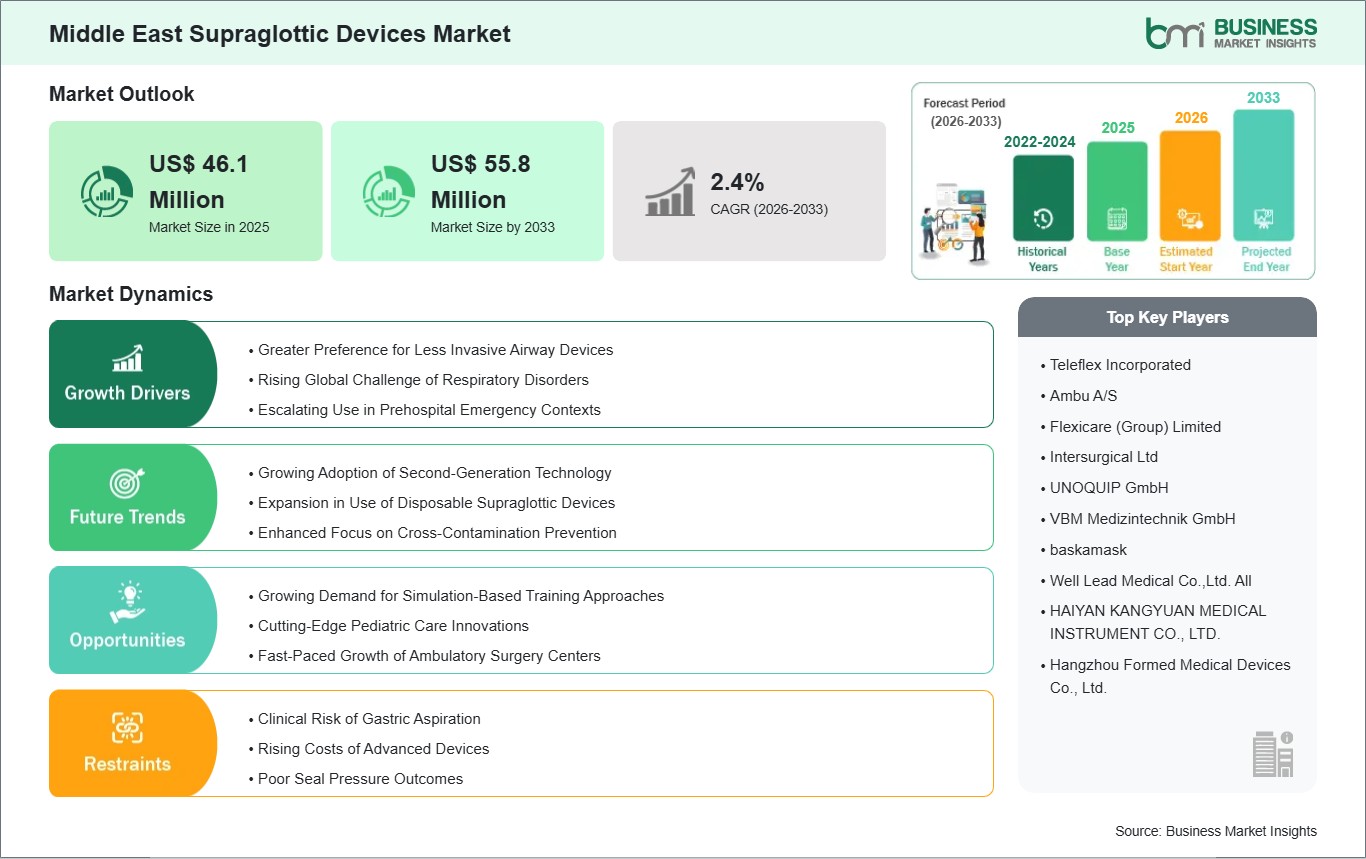
The Middle East Supraglottic Devices market size is expected to reach US$ 55.8 million by 2033 from US$ 46.1 million in 2025. The market is estimated to record a CAGR of 2.4% from 2026 to 2033.
The Middle East supraglottic devices market is characterized by a gradual but consistent shift toward advanced airway management practices, supported by ongoing healthcare modernization across the region. Countries in the Gulf are actively upgrading surgical and critical care infrastructure, which is increasing the adoption of supraglottic airway devices in operating rooms, emergency departments, and intensive care units. This development is being preferred by clinicians because of its user-friendliness, less need for manipulation of the airway, and versatility to be used for general anesthesia and emergency airways. Increasing interest in the patient's safety, sterility issues, and procedural efficiency is fueling the adoption of these devices as replacements for other methods in selected clinical situations.
However, the inconsistent health care infrastructure in the area presents challenges in the adoption of these devices because of limited access to advanced technology in the countries within the area. Budgetary pressures are also an impediment to the adoption of new products because reusable equipment is preferred in the public sector to save money. Furthermore, in some settings, a lack of trained personnel and dependence on traditional airway management practices may affect the adoption of the device.

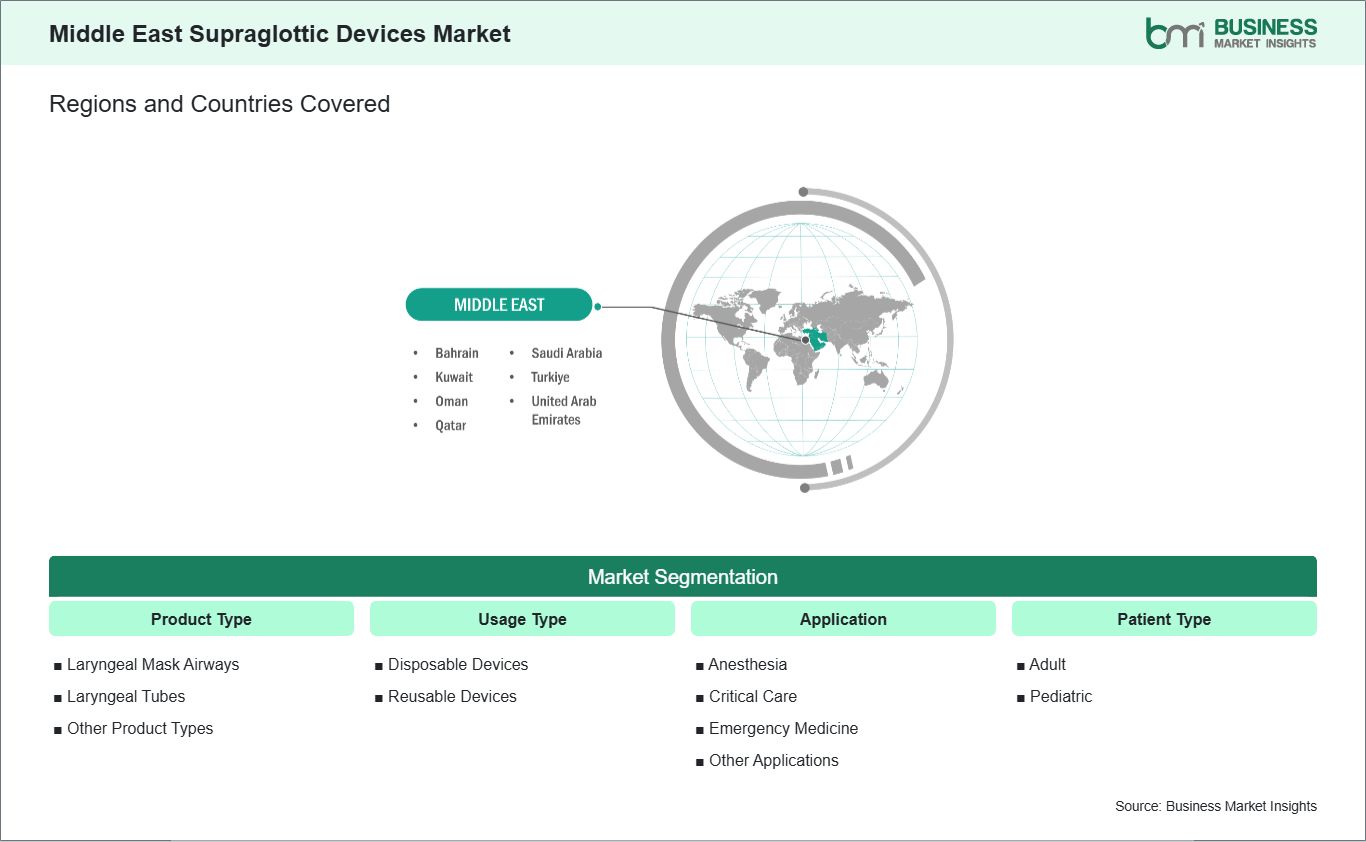
Key segments that contributed to the derivation of the Middle East Supraglottic Devices market analysis are product type, usage type, application, patient type, and end user.
The Middle East supraglottic devices market is showing a growing preference for less invasive airway devices as healthcare systems prioritize efficiency and patient-centered care. Supraglottic airway devices (SGAs) are increasingly utilized due to their ability to provide rapid airway access with minimal procedural complexity. In high-acuity care environments, such as emergency departments and critical care units, these devices enable faster stabilization of patients, particularly in situations where immediate intervention is required and time-sensitive decision-making is critical.
The expansion of surgical services and specialized care facilities across the region is also contributing to this trend. As healthcare providers aim to optimize operating room utilization, devices that reduce anesthesia time and simplify airway management are gaining traction. SGAs support smoother procedural workflows by enabling quick insertion and reducing the likelihood of airway-related complications, which is especially valuable in settings managing a mix of routine and complex surgical cases.
In addition, emerging standards within the healthcare sector and changes in accreditation are contributing to an increase in the use of safer and more effective airway management equipment. Supraglottic disposable devices have become increasingly popular due to the focus on infection control and standardization of patient treatment in healthcare facilities. Better designs of these devices that provide better seal and flexibility with regard to different patient types are adding to their effectiveness.
The demand for simulation-based training approaches is increasing in the Middle East as healthcare providers seek to enhance clinical competency in airway management. Simulation training offers a practical and risk-free environment for clinicians to develop hands-on experience with supraglottic airway devices. This is particularly important in a region where healthcare systems are rapidly evolving, and there is a need to ensure consistent skill levels across a diverse workforce.
Training programs are increasingly incorporating realistic clinical scenarios to prepare practitioners for a wide range of airway management challenges. Scenario-based simulations allow healthcare professionals to practice responding to emergencies such as airway obstruction or respiratory distress, improving both technical proficiency and decision-making skills. These programs also support team-based learning, enabling better coordination among multidisciplinary healthcare teams during critical procedures.
Furthermore, the accessibility of simulation-based education is improving through the adoption of flexible training models. Mobile simulation units, modular training setups, and institution-led workshops are making it easier to extend training beyond major healthcare centers. This broader reach helps ensure that clinicians in various care settings can develop and maintain competency in using supraglottic devices. As a result, simulation-based training is playing a key role in strengthening clinical preparedness and supporting the wider adoption of SGAs across the Middle East.
The Middle East Supraglottic Devices market demonstrates steady growth, with size and share analysis highlighting evolving trends and competitive dynamics among key players. The report evaluates important subsegments categorized within product type, usage type, application, patient type, and end user, highlighting their respective contributions to overall market performance.
By product type, the laryngeal mask airways subsegment dominated the supraglottic devices market in 2025. The dominance of laryngeal mask airways is driven by their ease of insertion, high success rate in securing the airway, reduced risk of complications compared to traditional intubation, and broad adoption in surgical and emergency settings, making them a key revenue contributor for manufacturers.
Based on usage type, the disposable devices subsegment led the market in 2025. Disposable supraglottic devices are preferred due to their reduced risk of cross-contamination, lower sterilization requirements, and convenience for high-volume clinical environments, which supports their widespread adoption across hospitals and emergency care facilities.
In terms of application, the anesthesia subsegment dominated the market in 2025. This leadership is attributed to the frequent use of supraglottic devices in elective and emergency surgical procedures, the increasing number of surgeries worldwide, and the clinical benefits of providing a safe and effective airway without the need for invasive intubation.
By patient type, the adult subsegment dominated the market in 2025. The preference for adult patients is driven by higher procedural volumes in adult surgeries, the established clinical efficacy of supraglottic devices in adult airway management, and increasing adoption in critical care and emergency settings.
Based on end user, the hospitals subsegment dominated the market in 2025. Hospitals lead due to their well-established anesthesia and critical care departments, access to advanced airway management devices, trained staff, and the capability to perform a high volume of surgical and emergency procedures requiring reliable airway management.
| Report Attribute | Details |
|---|---|
| Market size in 2025 | US$ 46.1 Million |
| Market Size by 2033 | US$ 55.8 Million |
| CAGR (2026 - 2033) | 2.4% |
| Historical Data | 2022-2024 |
| Forecast period | 2026-2033 |
| Segments Covered | By Product Type
|
|
Regions and Countries Covered
| |
| Middle East | UAE, Saudi Arabia, Bahrain, Oman, Kuwait, Qatar, Turkiye |
| Market leaders and key company profiles |
|
The "Middle East Supraglottic Devices Market Size and Forecast (2022–2033)" report provides a detailed analysis of the market covering below areas:
The geographical scope of the Middle East Supraglottic Devices market report is divided into: the UAE, Saudi Arabia, Bahrain, Oman, Kuwait, Qatar, and Turkiye. Turkiye held the largest share in 2025.
Turkiye is the primary market in the Middle East for supraglottic devices due to its advanced healthcare infrastructure and medical expertise. The country features a large number of multi-specialty hospitals and surgical facilities that utilize supraglottic airway devices in their anesthetic procedures. Their adoption is supported by a growing preference for techniques that enhance procedural efficiency while minimizing complications, particularly in short-duration surgeries and day-care procedures.
The presence of a well-versed group of medical professionals skilled at current airway management techniques constitutes one of the reasons for the prominence of the Turkiye market. Continued education, alongside familiarity with foreign standards in the medical sphere, has been a motivating factor for adopting the use of supraglottic devices in everyday practice. Furthermore, growth in the private medical industry and development as a place of medical tourism in Turkiye have contributed to the increasing demand for high-end, often disposable medical devices. Such developments can also be observed in emergency services, which are incorporating such products more and more in urban regions.

The Middle East Supraglottic Devices market is evaluated by gathering qualitative and quantitative data post primary and secondary research, which includes important corporate publications, association data, and databases. A few of the key developments in the Middle East Supraglottic Devices market are:
The Middle East Supraglottic Devices Market is valued at US$ 46.1 Million in 2025, it is projected to reach US$ 55.8 Million by 2033.
As per our report Middle East Supraglottic Devices Market, the market size is valued at US$ 46.1 Million in 2025, projecting it to reach US$ 55.8 Million by 2033. This translates to a CAGR of approximately 2.4% during the forecast period.
The Middle East Supraglottic Devices Market report typically cover these key segments-
The historic period, base year, and forecast period can vary slightly depending on the specific market research report. However, for the Middle East Supraglottic Devices Market report:
The Middle East Supraglottic Devices Market is populated by several key players, each contributing to its growth and innovation. Some of the major players include:
The Middle East Supraglottic Devices Market report is valuable for diverse stakeholders, including:
Essentially, anyone involved in or considering involvement in the Middle East Supraglottic Devices Market value chain can benefit from the information contained in a comprehensive market report.
Please tell us your area of interest
(Market Segments/ Regions and Countries/ Companies)