Non Steroidal Anti Inflammatory Drugs (NSAIDs) Market Regional Highlights
North America Non Steroidal Anti Inflammatory Drugs Market
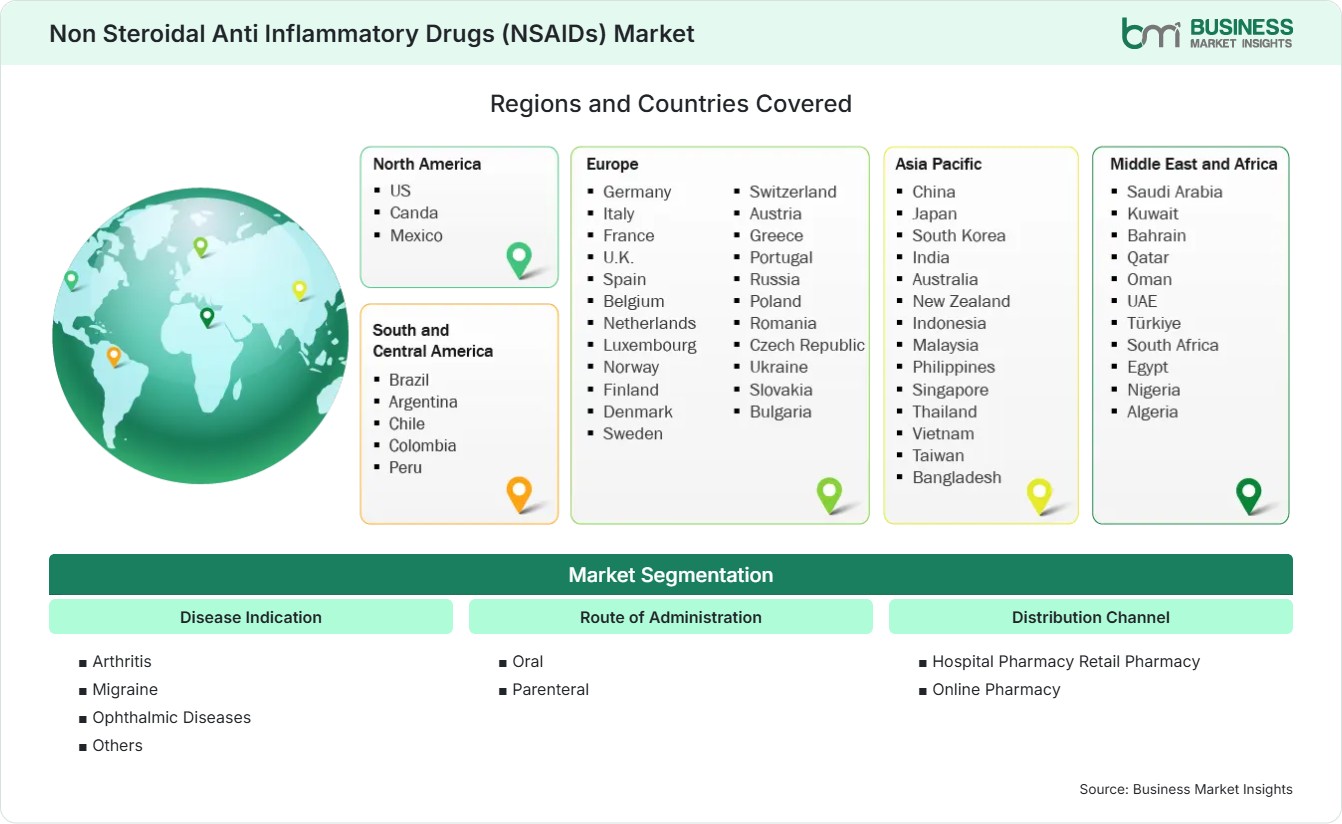
North America accounts for approximately 36%–39% of the Non Steroidal Anti Inflammatory Drugs Market share in 2025 and is projected to expand at a CAGR of 6.8%–7.2% through 2033. Strong healthcare expenditure, widespread OTC medicine penetration, high arthritis prevalence, and robust pharmaceutical distribution networks support regional leadership.
- The increasing prevalence of both osteoarthritis and rheumatoid arthritis is continuing to fuel demand for both prescribed and over-the-counter medications among older populations, which in turn provides pharmaceutical companies with long-term business opportunities.
- The expansion of digital pharmacy networks leads to better access to medications, makes it more convenient for patients with chronic pain, and enables repeated purchases of products via integrated healthcare ecosystems.
- Ongoing investment in pharmaceutical research helps improve formulations, focusing on gastrointestinal tolerability, extended-release mechanisms, and improved patient adherence.
- Retail pharmacy chains have extensive product visibility and accessibility, which in turn enhances consumer engagement and helps to maintain demand for over-the-counter anti-inflammatory treatments.
US Non Steroidal Anti Inflammatory Drugs Market
The United States represents approximately 83%–87% of North American revenue and is projected to expand at a CAGR of 6.9%–7.3% through 2033. High healthcare spending, strong consumer preference for OTC pain management products, extensive retail pharmacy coverage, and increasing musculoskeletal disease burden support NSAID Market stability.
- Healthcare spending linked to arthritis is still rising as the population ages, which in turn drives continued long-term demand for anti-inflammatory drugs commonly prescribed across a variety of healthcare settings.
- Online pharmacy sites are making it easier for people in suburban and rural areas to get medicines, providing patients with more ways to buy their drugs and thus improving their adherence to treatment for chronic pain.
- Awareness on the part of consumers about how to look after themselves when experiencing mild or moderate pain is still helping to maintain steady sales of over-the-counter medicines in a number of distribution channels.
- To boost their competitiveness and achieve brand differentiation in established therapeutic areas, pharmaceutical companies are putting money into better dosage forms and more patient-friendly packaging.
Europe Non Steroidal Anti Inflammatory Drugs Market
Europe accounts for approximately 27%–30% of global Non Steroidal Anti Inflammatory Drugs Market revenue in 2025 and is expected to expand at a CAGR of 6.7%–7.1% through 2033. Strong healthcare systems, broad reimbursement coverage, increasing treatment rates for inflammatory disorders, and established generic medicine markets support regional demand.
- Germany is still the biggest market in the region, due to the extent of its healthcare infrastructure, the high rate at which arthritis is diagnosed, and the strong use of prescribed medicines in both hospitals and outpatient clinics.
- The United Kingdom has the advantage of well-established pharmacy networks and a rising level of adoption of digital healthcare services, which in turn ensures consistent access to treatment and keeps consumers engaged.
- Poland is one of the more rapidly growing markets, due to increasing investment in healthcare and the greater availability of affordable generic pharmaceutical products.
- Pharmaceutical manufacturers keep increasing local production to improve supply chain strength and make sure medicine stays available in European countries.
- Attention being paid to the care of older patients and to the management of chronic diseases is still promoting the use of long-term anti-inflammatory therapy in the area.
Asia Pacific Non Steroidal Anti Inflammatory Drugs Market
Asia Pacific contributes approximately 25%–28% of global Non Steroidal Anti Inflammatory Drugs Market revenue in 2025 and is forecast to record the fastest regional CAGR of 8.6%–9.1% through 2033. Rising healthcare expenditure, expanding insurance coverage, growing middle-class populations, and increasing prevalence of chronic pain conditions support strong growth momentum.
- China retains its position of leadership due to its extensive capacity for pharmaceutical manufacturing, the increasing amount spent on healthcare, and the strong demand for affordable pain treatments.
- India is still one of the fastest-growing national markets, due to the expansion of its healthcare infrastructure, its strong capacity for producing generic medicines, and increasing patient awareness.
- Japan is still obtaining a great deal of revenue from its advanced healthcare system and from the fact that its large elderly population needs long-term management of inflammatory diseases.
- The availability of online medicine sales and the integration of telehealth services are speeding up access for people in urban areas and improving the efficiency of pharmaceutical distribution.
- Regional manufacturers are still increasing their investment in production facilities and in their ability to export in order to take advantage of the rising demand both at home and abroad.
Rest of World Non Steroidal Anti Inflammatory Drugs Market
The Rest of World region accounts for approximately 8%–11% of total Non Steroidal Anti Inflammatory Drugs Market revenue in 2025 and is projected to expand at a CAGR of 7.4%–7.9% through 2033. South and Central America benefit from expanding healthcare access and improving pharmaceutical distribution networks. Meanwhile, the Middle East and Africa are supported by healthcare infrastructure development and increasing public health investment.
- Brazil has the highest level of demand in the region because of its large population, the expansion of access to healthcare, and the greater use of inexpensive pain relief medications within urban healthcare systems.
- Mexico is achieving steady growth as a result of greater penetration of pharmacies, increased awareness of healthcare, and the wider availability of generic pharmaceutical treatments.
- Saudi Arabia benefits from healthcare transformation initiatives and greater investment in pharmaceutical distribution infrastructure, supporting medicine accessibility.
- The United Arab Emirates is still drawing in pharmaceutical investment by means of its healthcare modernization initiatives and through the expansion of its private healthcare services.
- The increasing number of diagnoses of chronic musculoskeletal disorders in emerging economies is still contributing to the growing demand for long-term therapy.