
Network Centric Warfare Market Outlook: Size, Share, Trends, Growth Analysis, Competitive Landscape & Forecast, 2026-2033

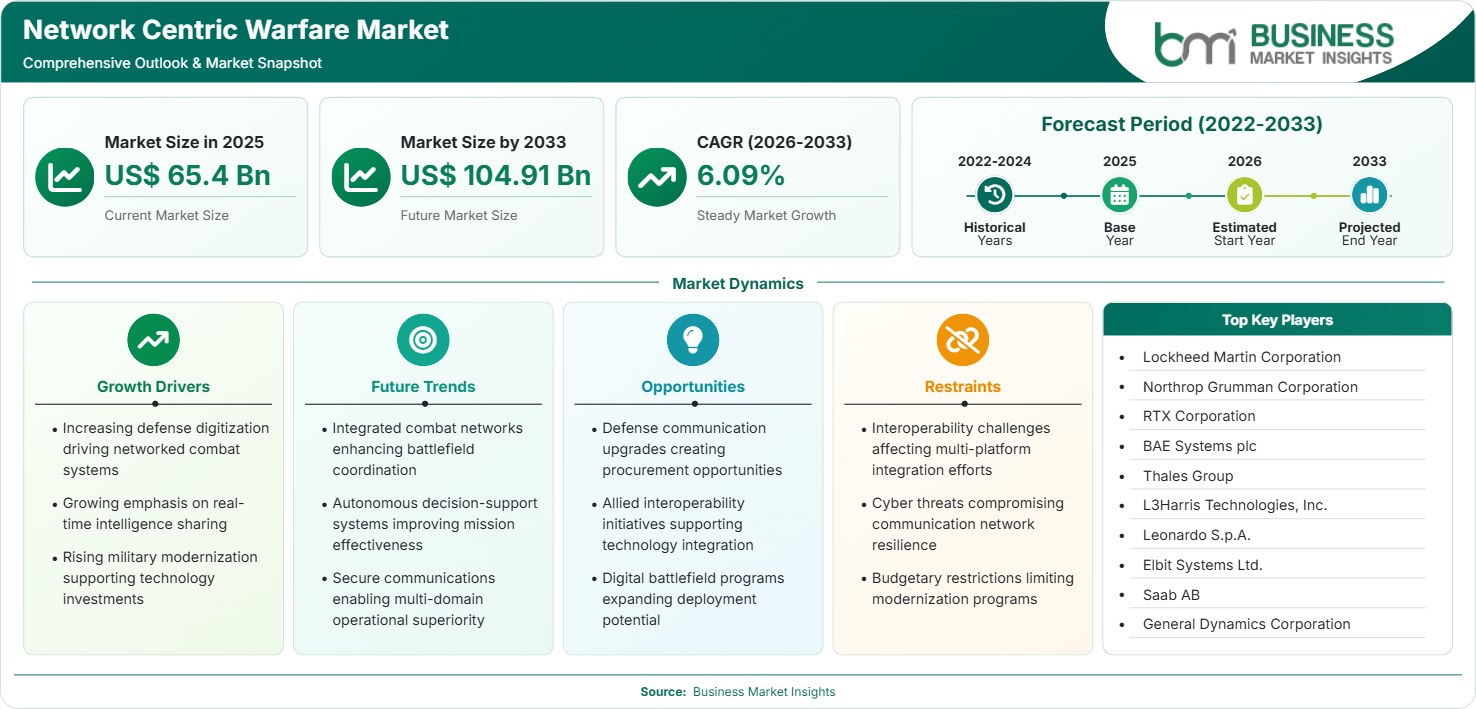
The Network Centric Warfare Market size was valued at US$ 65.4 Billion in 2025 and is projected to reach US$ 104.91 Billion by 2033, growing at a CAGR of 6.09% during 2026–2033, driven by multi-domain operations, secure communications, C4ISR modernization, cyber resilience, and AI-enabled battlefield decision-making.

Report Coverage
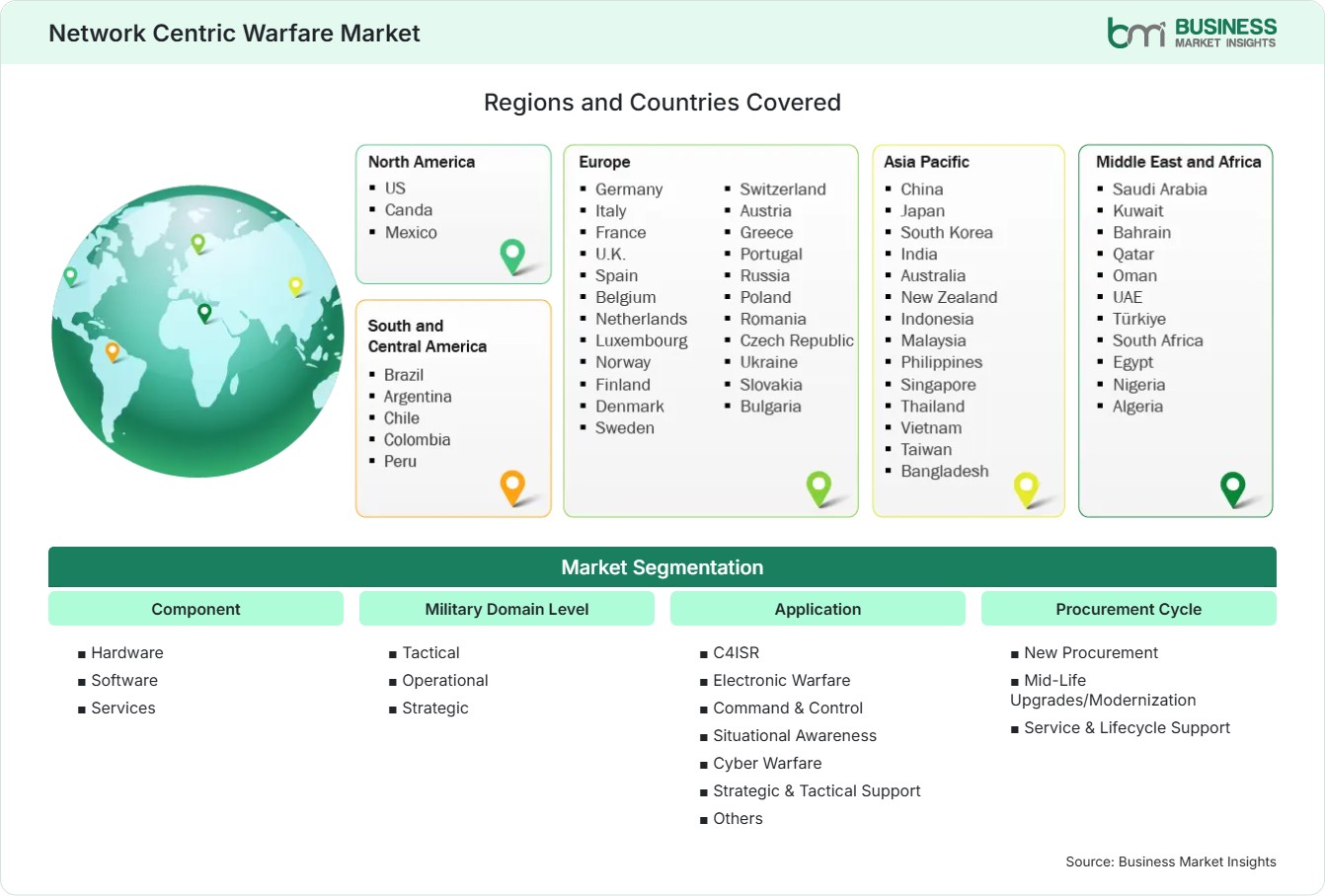
  • Component: Hardware, Software, Services
  • Military Domain Level: Tactical, Operational, Strategic
  • Application: C4ISR, Electronic Warfare, Command & Control, Situational Awareness, Cyber Warfare, Strategic & Tactical Support, Others
  • Procurement Cycle: New Procurement, Mid-Life Upgrades/Modernization, Service & Lifecycle Support
US$ 65.4 Bn Market size in 2025
US$ 104.91 Bn Market Size by 2033
6.09% CAGR, 2026 - 2033
2026-2033 Forecast Period

AI Overview

Network Centric Warfare Market Summary

  • North America Region: North America holds a Network Centric Warfare Market share of 35%–38% in 2025, growing with a CAGR of 5.8%–6.2%, influenced by defense modernization, resilient tactical networks, C4ISR integration, AI-enabled command systems, and interoperability requirements. The US represents the dominant national market, supported by sustained procurement of integrated communications, mission systems, electronic warfare, and command-and-control technologies.
  • Fastest Growing Region: Asia Pacific holds a market share of 22%–25% in 2025, growing with a CAGR of 7.4%–7.9%, driven by military modernization, maritime security requirements, indigenous defense production, satellite communications, unmanned systems, and increasing investment in networked command architectures.
  • Leading Segment: Hardware holds a market share of 45%–48% in 2025, growing with a CAGR of 5.8%–6.2%, supported by demand for tactical radios, sensors, secure communications equipment, computing infrastructure, data links, and integrated mission electronics across platforms.
  • High Growth Segment: Cyber Warfare holds a Network Centric Warfare Market share of 11%–14% in 2025, growing with a CAGR of 8.0%–8.6%, supported by escalating cyber threats, digital battlefield dependence, zero-trust architectures, secure data exchange, threat intelligence, and resilient command networks.
  • Key Market Opportunity: Networked forces increasingly require interoperable architectures that connect sensors, commanders, weapons, aircraft, vehicles, ships, satellites, and cyber assets, creating opportunities for software-defined networking, AI-enabled data fusion, resilient communications, and lifecycle modernization.
  • Major Market Players: Lockheed Martin Corporation, Northrop Grumman Corporation, RTX Corporation, BAE Systems plc, Thales Group, L3Harris Technologies, Inc., Leonardo S.p.A., Elbit Systems Ltd., Saab AB, and General Dynamics Corporation.
Strategic Insights

Network Centric Warfare Market: Strategic Insights

Network Centric Warfare Market Strategic Framework
FREE PDF
Request your free sample
Request free sample
Stakeholder View

Key Takeaways

  • The value chain increasingly spans semiconductor suppliers, communications specialists, mission-system integrators, software developers, cybersecurity providers, platform manufacturers, and defense agencies. Prime contractors remain influential because networked architectures require integration across multiple classified and mission-critical systems.
  • Cyber warfare, command-and-control modernization, and situational awareness offer stronger upside than conventional standalone communications because they increasingly determine the effectiveness of connected forces. Demand is moving toward integrated capabilities that shorten decision cycles and preserve connectivity in contested environments.
  • Software-defined architectures are becoming central to system evolution. Modular computing, AI-assisted sensor fusion, adaptive electronic warfare, edge processing, and open interfaces allow militaries to introduce new capabilities without redesigning entire platforms.
  • Asia Pacific provides an attractive investment case because governments are simultaneously modernizing air, maritime, land, space, and cyber capabilities. India, Japan, South Korea, and Australia are particularly relevant for suppliers seeking programs involving sovereign production and interoperability.
  • Strategic investment is increasingly directed toward specialized software, cybersecurity, electronic warfare, communications, and mission-data capabilities. Partnerships between prime contractors, technology firms, telecommunications companies, and local defense manufacturers are expanding addressable opportunities.
  • Lifecycle support is becoming strategically important because installed systems require continuous software updates, cybersecurity improvements, data-link upgrades, interoperability testing, and electronic-threat adaptation. This increases recurring revenue opportunities beyond initial equipment procurement.
Geographic Outlook

Network Centric Warfare Market Regional Highlights

North America Network Centric Warfare Market

North America had a market share of 35%-38% for Network Centric Warfare in 2025 and is estimated to witness a 5.8%-6.2% CAGR till 2033. Advanced defense industries, huge budgets for modernization, need for allied interoperability, and pre-existing C4ISR systems are some advantages of North America. The USA is considered to be the main demand source, while Canada plays its role in modernizing communications and command centers. Modernization in procurement includes resilient tactical networks, AI-based decision-making systems, electronic warfare, and cyber protection.

  • US programs emphasize resilient communications, integrated air and missile defense, sensor fusion, and multi-domain command architectures, creating sustained demand for networked mission systems across land, air, maritime, space, and cyber environments.
  • Canada is strengthening interoperability with allied forces, supporting opportunities for secure tactical communications, surveillance integration, command systems, and modernization services linked to continental defense and Arctic operational requirements.
  • North American suppliers benefit from established defense electronics ecosystems, classified technology programs, extensive testing infrastructure, and strong relationships with military customers requiring continuous upgrades and secure interoperability.
  • The regional opportunity is reinforced by increased defense-industrial investment and requirements for rapid technology adoption, strengthening demand for modular architectures and software-enabled capability insertion.

US Network Centric Warfare Market

The US has accounted for 82%–86% of the North American market share in Network Centric Warfare in 2025, and this share is expected to grow at a CAGR of 5.9%–6.3% through 2033. Demand from the US has been driven by multi-domain operations, interoperability of joint forces, resilient communications, cybersecurity, and modernization of legacy command-and-control capabilities. Increasingly, there have been efforts to integrate the sensors, platforms, operators, and weapons through the common mission network. It also boasts the most extensive supply chain of prime contractors, specialty electronics companies, software, cybersecurity, and communications companies.

  • The Department of Defense's emphasis on joint all-domain connectivity supports investment in tactical data links, mission networking, edge computing, secure communications, and cross-domain information exchange.
  • US forces increasingly require networks that remain functional during electronic attack, cyber disruption, satellite degradation, and contested-spectrum conditions, increasing demand for resilient communications and distributed architectures.
  • Domestic suppliers benefit from established procurement relationships and technology-development programs, while allied Foreign Military Sales expand addressable demand for interoperable communications and mission systems.

Europe Network Centric Warfare Market

Europe accounted for 24%–27% of the global share in 2025, having an expected 6.2%–6.6% CAGR from 2025 to 2033 for the Network Centric Warfare Market. Germany, the UK, France, and Italy are among the top markets in Europe, whereas Poland and Nordic nations offer lucrative growth prospects. The demands in Europe are driven by rearming, joint procurement, interoperability needs, and modernization of command structures. The European Union’s Readiness 2030 strategy aims to achieve significant growth in defense spending.

  • Germany remains strategically important because accelerated defense investment is supporting modernization of command, communications, surveillance, and digital battlefield capabilities across the armed forces.
  • France and the United Kingdom maintain sophisticated indigenous defense ecosystems, supporting demand for integrated C4ISR, secure communications, electronic warfare, and sovereign mission-system technologies.
  • Poland is emerging as a high-growth market, with expanding defense expenditure and requirements for interoperable command, surveillance, communications, and air-defense infrastructure.
  • Nordic countries increasingly prioritize resilient communications and distributed command architectures because geography, Arctic conditions, and regional security requirements increase the value of persistent connectivity.

Asia Pacific Network Centric Warfare Market

The Asia Pacific region captured a market share of 22%-25% in the global NCW Market in 2025 and is predicted to witness the highest regional growth at a 7.4%-7.9% CAGR through 2033. The countries with the highest demand include China, Japan, India, South Korea, and Australia, with some emerging opportunities in Southeast Asia. Some factors influencing purchases include military modernization, maritime security, electromagnetic environments, local manufacturing initiatives, and satellite communications. Increasing defense budgets in Asia would offer greater financial support for networks and technologies. According to SIPRI, there was an 8.1% increase in military spending in Asia and Oceania in 2025.

  • India is expanding indigenous defense electronics and C4ISR capabilities, creating opportunities for local manufacturing partnerships, tactical communications, secure networking, and command-system integration.
  • Japan and South Korea are prioritizing advanced command, surveillance, electronic warfare, missile-defense connectivity, and interoperability with allied forces across increasingly complex regional security environments.
  • Australia is strengthening sovereign communications and integrated mission capabilities while aligning its defense architecture with allied networks, supporting demand for secure software-defined systems.
  • Southeast Asian countries provide emerging opportunities as maritime surveillance, border security, disaster response, and joint-force interoperability become higher procurement priorities.

Rest of World Network Centric Warfare Market

Rest of World accounted for 13%–16% of the global share in 2025, with a projected growth rate of 5.4%–5.9% CAGR in the Network Centric Warfare Market till 2033. Countries in South & Central America are focusing on border surveillance, communication security, and upgrading command infrastructure, whereas Middle Eastern nations are concentrating on air defense, ISR, cyber defense, and electronic warfare systems. The major countries in the region include Saudi Arabia and the UAE from Middle East and Brazil from South America.

  • Saudi Arabia and the United Arab Emirates continue developing advanced defense ecosystems, creating demand for integrated C4ISR, secure communications, surveillance, and electronic warfare capabilities.
  • Brazil provides opportunities for network modernization linked to territorial monitoring, maritime awareness, border security, and indigenous defense-industrial development.
  • Middle Eastern procurement increasingly favors interoperable architectures that connect sensors, command centers, aircraft, unmanned platforms, and air-defense systems.
  • Latin American buyers generally emphasize scalable systems, lifecycle support, and cost-efficient modernization rather than complete replacement of installed defense infrastructure.
Global Market Geography
FREE PDF
Request your free sample
Request free sample
Segment Analysis

Network Centric Warfare Market Segmentation

Component

Component will continue to be basic to procurement due to the need for coordination among the military architectures that are interlinked. Hardware accounted for 45%-48% of market share in 2025, with a CAGR of 5.8%-6.2%. The Network Centric Warfare Market share for this component is high due to the demand for communication equipment, computers, sensors, and mission electronics.

  • Hardware: Tactical radios, processors, sensors, gateways, servers, antennas, and networking equipment provide the physical infrastructure required for secure battlefield connectivity and real-time information exchange.
  • Software: Mission applications, command platforms, analytics, cybersecurity tools, and data-fusion software improve decision support, interoperability, automation, and adaptability across heterogeneous defense architectures.
  • Services: Integration, maintenance, cybersecurity, training, testing, technical support, and lifecycle modernization enable continuous capability improvement and reduce operational disruption throughout system deployment.

Military Domain Level

The level of the military domain determines how information flows among tactical units, operational headquarters, and strategic command structures. Tactical platforms are the largest consumer level, facilitated by frontline communication and sensor to shooter requirements. The Network Centric Warfare Market trend increasingly favors an architecture that facilitates information flow between domains.

  • Tactical: Tactical networking connects soldiers, vehicles, aircraft, unmanned platforms, and forward command elements, emphasizing low latency, mobility, resilience, and communications under contested conditions.
  • Operational: Operational networks synchronize formations and mission commands, integrating intelligence, logistics, surveillance, fires, and maneuver information to support coordinated theater-level decision-making.
  • Strategic: Strategic architectures connect national and senior military command structures, emphasizing persistent communications, cybersecurity, intelligence integration, satellite connectivity, and high-level decision support.

Application

Application demands are now moving towards the integration of command, cyber, electronic warfare, and situational awareness. While the C4ISR applications market continues to be dominant, cyber warfare is growing at a higher rate owing to the increased use of digital technology. This trend enlarges the scope of the Network Centric Warfare Market beyond communication to decision-making.

  • C4ISR: Combines communications, computing, command, intelligence, surveillance, and reconnaissance to create a common operational picture and coordinate distributed military assets.
  • Electronic Warfare: Enables electromagnetic sensing, protection, deception, and attack while supporting spectrum awareness and resilience against hostile interference and digitally enabled threats.
  • Command & Control: Provides commanders with integrated information, planning tools, communications, and decision-support capabilities for coordinated operations across multiple domains.
  • Situational Awareness: Aggregates sensor, intelligence, geospatial, and operational information to improve threat recognition, mission planning, force protection, and battlefield responsiveness.
  • Cyber Warfare: Protects mission networks while enabling defensive and offensive cyber capabilities, with growing emphasis on identity management, encryption, threat detection, and resilient architectures.
  • Strategic & Tactical Support: Supports logistics, mission planning, operational coordination, training, sustainment, and battlefield support through connected information systems and decision tools.
  • Others: Supporting applications include specialized mission management, interoperability tools, simulation, testing, training, and infrastructure capabilities that complement core networked operations.

Procurement Cycle

Procurement now has a healthy balance between new procurement and upgrades for the existing fleet. The new procurement provides a next-generation architecture, while upgrades enable faster capability insertion into the existing platform. Requirements from the services generate repeat business due to the need for cybersecurity, software refresh, and interoperability testing.

  • New Procurement: New platforms require integrated networking from initial design, allowing secure communications, computing, sensors, and mission applications to be engineered as a unified architecture.
  • Mid-Life Upgrades/Modernization: Upgrades extend platform relevance by replacing legacy radios, processors, software, sensors, and interfaces without requiring complete fleet replacement.
  • Service & Lifecycle Support: Lifecycle services provide maintenance, cybersecurity, software updates, training, integration, testing, and technical assistance throughout extended military system operating periods.

Platform

Platform integration will influence the performance of the network capabilities in relation to mobility, environmental, bandwidth, and survivability requirements. The land-based and command posts will provide the connectivity for the tactical networks while air, maritime, and space platforms will help expand the network in the other domains. The Network Centric Warfare Market favors an architecture that supports information sharing among platforms.

  • Land Vehicles and Command Posts: Mobile command vehicles, armored platforms, and field headquarters require ruggedized networking, tactical radios, edge computing, and resilient communications for dispersed operations.
  • Aircraft and Aerial Platforms: Aircraft require high-speed data links, mission computers, sensors, electronic warfare systems, and secure communications capable of operating across rapidly changing electromagnetic environments.
  • Maritime Platforms: Ships and naval task forces require persistent connectivity, combat-management integration, satellite communications, sensors, electronic warfare, and secure fleet-level information exchange.
  • Space: Satellites and associated ground infrastructure extend network reach through communications, surveillance, positioning, timing, and data-relay capabilities supporting operations across terrestrial domains.
Market Forces

Network Centric Warfare Market Dynamics

Key Market Drivers

Expansion of Multi-Domain Operations and Integrated Command Networks

Defense solutions are shifting from standalone command systems to integrated networks that coordinate assets on land, air, sea, space, and cyber domains. As reported by SIPRI, total global military expenditures have increased to US$2.887 trillion in 2025, and military expenditures in Europe and Asia have experienced particularly rapid growth, thereby increasing the available budget for digital transformations. In this regard, the Network Centric Warfare Market will be propelled by demand for capabilities and increased modernization budgets. The integration of command systems enables commanders to consolidate all sensor, communications, intelligence, and operations data into a single decision-making environment. The tendency is further amplified by NATO capabilities objectives in the areas of air and missile defense, long-range weapon systems, logistics, and large land formations.

Rapid Adoption of AI-Enabled Sensor Fusion and Edge Processing

The evolution of AI technologies is changing how military networks process raw data into useful information. Today, more sensors are being used on military planes, vehicles, ships, satellites, and unmanned platforms, resulting in vast amounts of information to process, and central processing may not be able to handle it effectively. Edge Computing would ensure that mission information is processed near its origin, thereby reducing bandwidth requirements and improving response time. Moreover, AI could be used to classify threats and assist the command center, even if not all data streams reach the centralized node. The Network Centric Warfare Market will thus move towards becoming smart gateways, distributed analysis, automated information fusion, and software-defined mission systems. This will prove advantageous for suppliers of computing power and cybersecurity.

Modernization of Tactical Communications and Resilient Data Links

Connected missions rely on communication networks that continue to function even under conditions of jamming, cyber-attack, destruction of infrastructure, and degradation of satellite communication capabilities. Contemporary tactical networks are becoming more advanced in their use of combinations of different waveforms, ground communications, satellite communications, mobile nodes, and edge gateways. The need for resilience is particularly critical when forces fight over vast geographic areas or within an electronic warfare environment. Such networks rely on redundancy, dynamic routing, encryption, spectrum management, and reconfigurability. Such requirements drive the Network Centric Warfare Market growth since there is always demand for radios, gateways, antennas, network controllers, encryption, and software upgrades. L3Harris has already worked on resilient multi-channel routing and multi-domain networks, demonstrating the necessity of network adaptability.

Key Market Opportunities

Open Architectures and Software-Defined Capability Insertion

An open architecture may reduce reliance on proprietary interfaces and increase flexibility for defense forces to implement new applications, sensors, communication waveforms, and cybersecurity capabilities. This presents a compelling opportunity in light of the growing desire among the militaries to upgrade capabilities fast without having to replace their platforms entirely. The use of modular interfaces allows procurement organizations to incorporate technology from a variety of vendors, thus facilitating participation of specialists along with the large defense companies. Network architecture based on reusable software components may facilitate continuous testing and deployment of technologies, thereby reducing the time between technology creation and deployment. Thus, vendors providing open standards, secure APIs, modular processors, and software-defined networking stand to benefit from modernization spend during several procurement cycles.

Expansion of Cyber-Resilient Network Infrastructure

Cyber Resilience has now become a basic necessity rather than a complementary layer of security because the disruption of communication could undermine command and control and battlefield effectiveness. Cyber security entails the use of network identity management, encryption, monitoring, segmentation, gateways, threat detection, and recovery tools. There is a business growth opportunity in hardware, software, services, and lifecycle management. Recurring income is made possible by providing cyber security services together with the initial deployment of the networks, software maintenance, software updates, vulnerability management, and even certifications. Defense agencies are demanding architecture that works in a degraded network environment as opposed to being dependent on one network connection. It is this that has made possible the dynamic routing of information through authentication and prioritization. Network Centric Warfare Market Forecasts is thus becoming more dependent on cyber-resilient modernization than simple communication acquisition.

Indigenous Defense Technology and Allied Interoperability Programs

Governments need more control over defense technology while still retaining interoperability with strategic allies. This enables local production agreements, technology transfer, collaboration, regional manufacturing hubs, and sovereign software. India, Australia, South Korea, European countries, and Middle Eastern countries are very important because the modernization programs tend to involve a local industrial base. Those suppliers that are able to offer architecture that is proven globally but engineered and manufactured locally would be capable to meet needs of sovereign solutions and interoperability at the same time. Collaboration will make it easier for technology specialists to enter into the market where they cannot compete with prime contractors due to the size limitations.

Market Restraints and Challenges

High Integration Complexity Across Legacy and Next-Generation Systems

Factor: The defense platforms themselves use different technological generations, from different vendors, have different communications, are cleared at different levels, and run in different software environments. The creation of a system from all of those components is an extensive engineering effort. Impact: This makes projects time-consuming and expensive, and the acquisition process favors evolutionary improvements over revolutionary replacement. Interoperability inside the network becomes especially difficult when proprietary interfaces or outdated hardware prohibit data transfer. Vendors need to retain their backward capability while providing new software-defined capabilities. The resulting engineering effort could reduce the budgets available for functionality and lengthen qualification cycles.

Cybersecurity Exposure and Electromagnetic Spectrum Disruption

Factor: Networked warfare expands the number of nodes, channels, components, and interdependencies that can be attacked by adversaries to disrupt operations. Impact: Compromised nodes, jammed communication channels, corrupted data flow or satellite connections can affect situational awareness and command and control of multiple connected forces. Therefore, defense organizations will have to allocate resources to secure their networks through encryption, authentication, segmentation, redundancy, monitoring, and routing resilience. This will add complexity and cost to the systems. Another source of uncertainty is electronic warfare, as communication performance may become highly unpredictable in the adverse environment of spectrum operations. It is necessary for suppliers to keep up with waveform, cybersecurity, threat, and configuration updates.

Company Analysis

Competitive Landscape

Network Centric Warfare Market Analysis suggests that the market is characterized by competition dominated by diversified defense primes backed by specialized suppliers of communication, electronic warfare, mission software, cybersecurity, sensors, and tactical networking solutions. Competing solutions now rely on architecture and interoperability rather than individual hardware characteristics. Key players boast broad government connections and a technological base across different operational domains. Specialized players distinguish themselves with their software, electronic warfare, secure communications, and mission-focused competencies. Positioning in terms of competition is also influenced by geographical industrial presence and cooperation that allows for localization. The following list presents key active players in the domain of networked defense solutions.

Company Name

Overview

Products and Services relevant to this market

Lockheed Martin Corporation

Major US defense prime with extensive mission-system integration capabilities and broad exposure to networked multi-domain operations.

C4ISR, integrated command systems, tactical communications, sensors, mission computers, data links, space systems, and network integration.

Northrop Grumman Corporation

Diversified aerospace and defense company specializing in advanced sensing, command, communications, cyber, and mission integration.

C4ISR, battle management, ISR, command systems, cyber capabilities, sensors, electronic warfare, and mission networking.

RTX Corporation

Global defense technology provider with strong capabilities in sensors, communications, air defense, electronic warfare, and mission systems.

Radars, command systems, electronic warfare, secure communications, integrated air defense, sensors, and networked mission solutions.

BAE Systems plc

Major defense technology company with broad electronic systems and combat-system capabilities across multiple military domains.

Tactical communications, electronic warfare, C4ISR, mission systems, data links, sensors, cyber capabilities, and lifecycle support.

Thales Group

European technology group with significant defense communications, command, surveillance, cyber, and secure information-system capabilities.

Secure communications, C4ISR, tactical networks, radars, cybersecurity, command systems, satellite communications, and electronic warfare.

L3Harris Technologies, Inc.

Defense technology specialist focused strongly on resilient communications, tactical networking, ISR, electronic warfare, and mission systems.

Tactical radios, Link 16, network gateways, ISR terminals, secure communications, data links, command systems, and network management.

Leonardo S.p.A.

European aerospace and defense company providing integrated electronics, sensors, communications, cyber, and mission capabilities.

C4ISR, electronic warfare, radars, secure communications, mission systems, sensors, and command-and-control technologies.

Elbit Systems Ltd.

Defense electronics company specializing in integrated systems across land, air, maritime, intelligence, and communications applications.

C4ISR, tactical communications, battlefield management, electronic warfare, sensors, unmanned systems, and intelligence technologies.

Saab AB

Swedish defense technology company providing integrated command, surveillance, communications, electronic warfare, and combat-system solutions.

C4ISR, tactical communications, electronic warfare, command systems, sensors, data links, and networked combat capabilities.

General Dynamics Corporation

Diversified defense contractor with major capabilities in mission systems, communications, information technology, and combat platforms.

Tactical communications, C4ISR, command systems, cyber capabilities, mission computing, networking, and integrated defense systems.

Trust & Transparency

Research Methodology

The market analysis combines proprietary research with secondary data from government agencies, company disclosures, regulatory filings, industry databases and expert interviews. Market estimates are validated through data triangulation, cross-market benchmarking and analyst review.

View Full Research Methodology

Questions Answered

Frequently Asked Questions

Why are lifecycle services becoming more important?

Life-cycle services provide for perpetual upgrades to software and security, interoperability testing, maintenance, training, and adaptation to threats. Such considerations mean there is potential for revenue beyond equipment purchases, and the military can remain relevant during extended platform life cycles.

What does the Network Centric Warfare Market report cover?

The report examines segments including components, military domain level, application, procurement cycle, and platform, and analyzes regional dynamics, competitive position, growth drivers, opportunities, constraints, recent trends, and strategic implications in the market until 2033.

Which region offers the strongest expansion opportunity?

The Asia-Pacific region offers the most viable growth opportunity due to rising demand for military modernization, maritime security, indigenous arms manufacturing, satellite communications, and interoperability across many significant defense markets.

How does cyber warfare affect networked military operations?

Cyber warfare can disrupt communications, compromise data, manipulate information, or disable mission systems. Consequently, modern network architectures increasingly incorporate encryption, identity controls, segmentation, continuous monitoring, resilient routing, and rapid recovery mechanisms.

What technologies are most important to network-centric warfare?

Secure tactical communications, AI-enabled data fusion, edge computing, electronic warfare, cybersecurity, satellite connectivity, software-defined networking, and interoperable command-and-control systems are among the most important technologies because they connect distributed assets and support rapid operational decisions.

Access the Full Network Centric Warfare Market Report

Get segment-level forecasts, regional estimates, competitive benchmarking, company profiles and downloadable Excel datasets.

Access the full Network Centric Warfare Market Report
350 pages PDF & Excel | 2026-09-18
Similar Research

Related Market Reports