
Spacecraft Market Outlook: Size, Share, Trends, Growth Analysis, Competitive Landscape & Forecast, 2026-2033

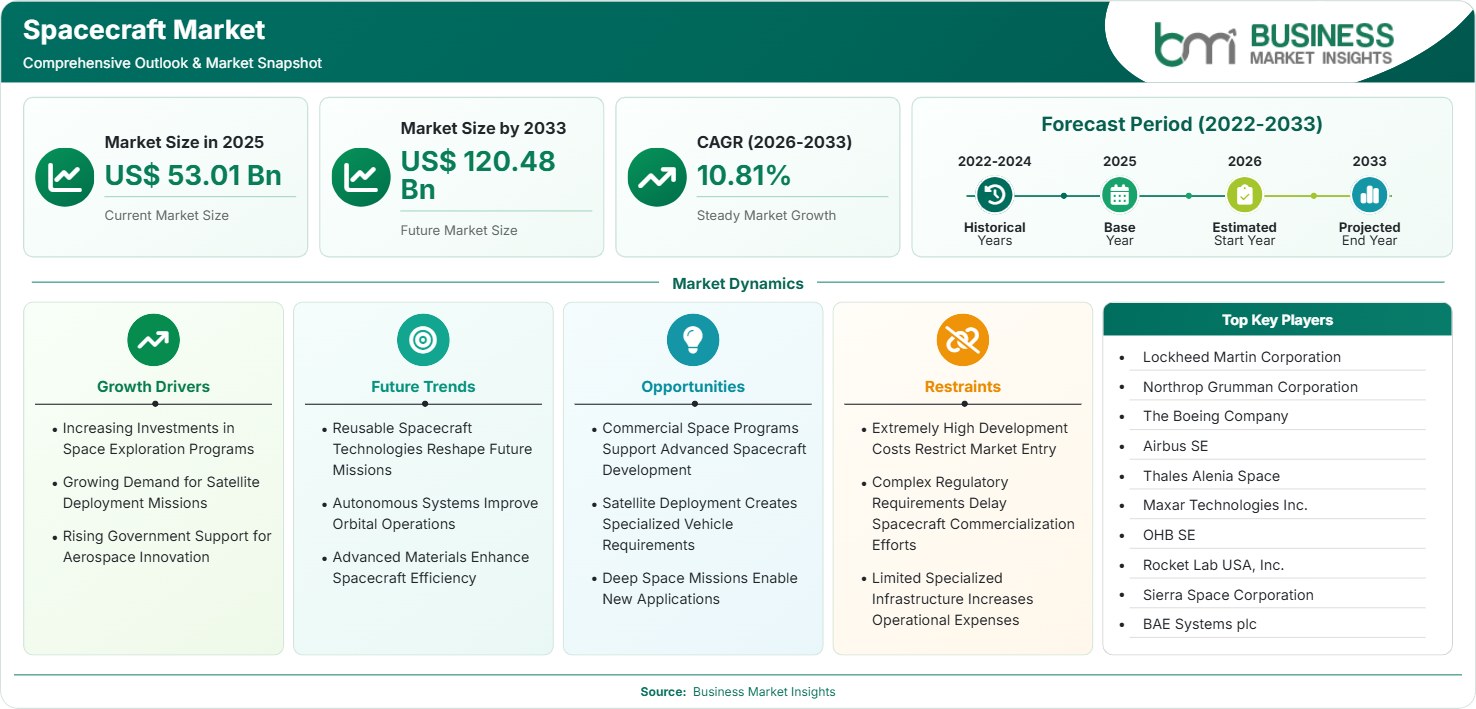
The Spacecraft Market size was valued at US$ 53.01 Billion in 2025 and is projected to reach US$ 120.48 Billion by 2033, growing at a CAGR of 10.81% during 2026–2033, supported by rising satellite deployments, defense modernization programs, lunar exploration missions, commercial space investments, and expanding deep-space communication infrastructure.

Report Coverage
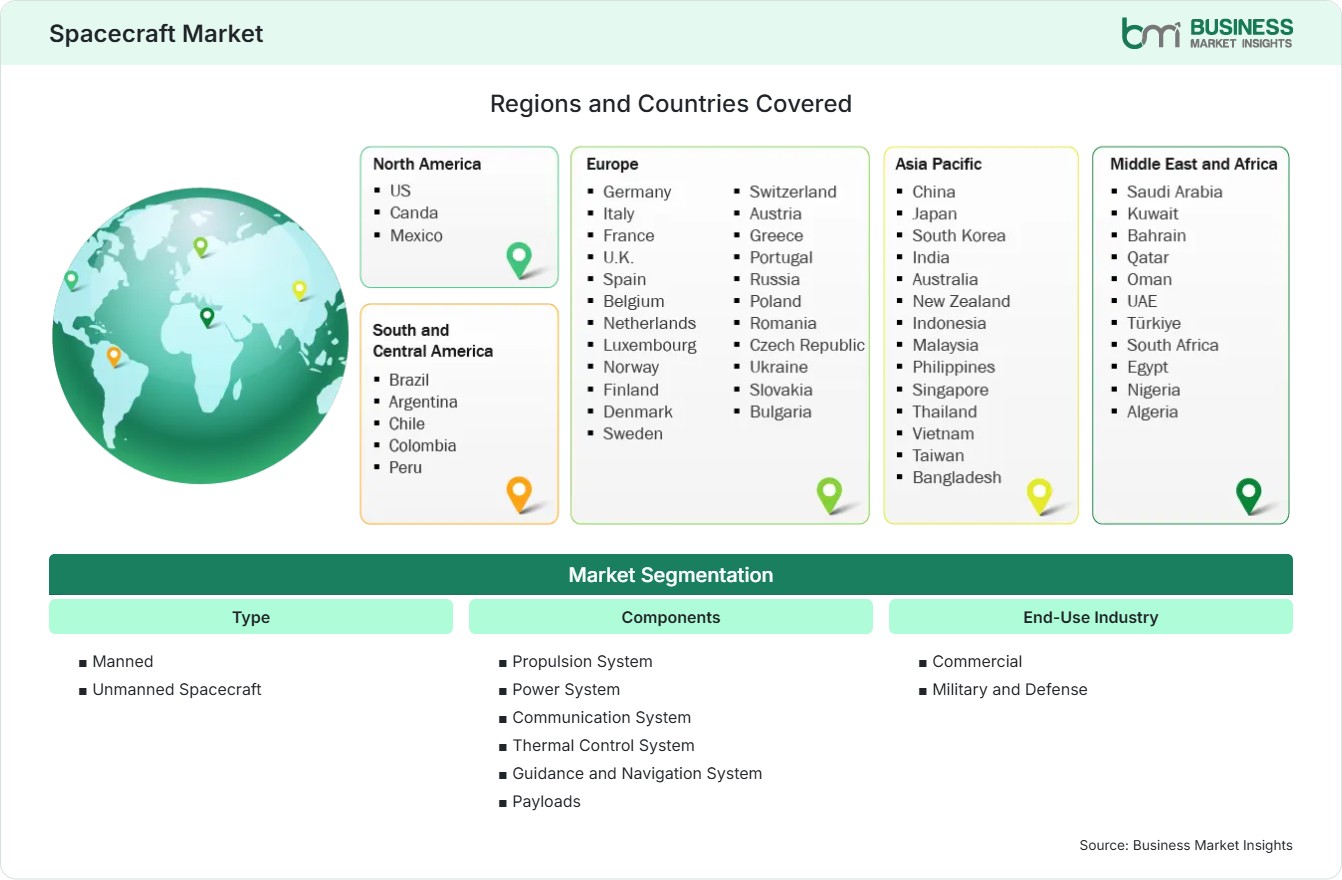
  • Type: Manned, Unmanned Spacecraft
  • Components: Propulsion System, Power System, Communication System, Thermal Control System, Guidance and Navigation System, Payloads
  • End-Use Industry: Commercial, Military and Defense
US$ 53.01 Bn Market size in 2025
US$ 120.48 Bn Market Size by 2033
10.81% CAGR, 2026 - 2033
2026-2033 Forecast Period

AI Overview

Spacecraft Market Summary

  • North America Region: North America holds a 38%–41% share in 2025, growing with a CAGR of 9.8%–10.4% during 2026–2033. Government-funded exploration programs, defense procurement, commercial launch activity, manufacturing scale, and private investment ecosystems continue creating strong expansion opportunities. Brief U.S. analysis: The U.S. remains the innovation hub, supported by NASA programs and defense spending, advancing at 9.9%–10.5% CAGR.
  • Fastest Growing Region: Asia Pacific holds a 24%–27% share in 2025 and advances at a CAGR of 12.4%–13.1% through 2033. National space programs, launch infrastructure expansion, satellite manufacturing investments, regional security priorities, and commercialization initiatives accelerate demand across emerging economies.
  • Leading Segment: Unmanned Spacecraft accounts for 68%–72% share in 2025 and expands at a CAGR of 11.0%–11.7%. Earth observation, communication networks, navigation systems, scientific missions, and lower deployment costs support broad-based adoption and sustained industrial demand.
  • High Growth Segment: Commercial end-use represents 46%–50% share in 2025 and records a CAGR of 12.3%–13.0%. Broadband constellations, remote sensing services, private exploration projects, and venture-backed satellite ventures continue opening long-term revenue opportunities.
  • Key Market Opportunity: Expansion of low-Earth-orbit constellations, autonomous mission architectures, orbital servicing platforms, and lunar infrastructure projects creates substantial opportunities for component suppliers, manufacturers, software developers, and communication service providers worldwide.
  • Major Market Players: Lockheed Martin Corporation, Northrop Grumman Corporation, The Boeing Company, Airbus SE, Thales Alenia Space, Maxar Technologies Inc., OHB SE, Rocket Lab USA, Inc., Sierra Space Corporation, BAE Systems plc.
Strategic Insights

Spacecraft Market: Strategic Insights

Spacecraft Market Strategic Framework
FREE PDF
Request your free sample
Request free sample
Stakeholder View

Key Takeaways

  • The industry value chain is becoming more vertically integrated, with manufacturers increasingly combining spacecraft design, launch support, data services, and mission operations to improve profitability and reduce deployment timelines.
  • Commercial communication constellations and earth-observation applications offer the strongest long-term demand upside, particularly for scalable unmanned platforms and advanced payload technologies.
  • Innovation is shifting toward autonomous mission management, AI-enabled onboard processing, electric propulsion systems, and software-defined spacecraft capable of adapting to changing mission requirements.
  • Asia Pacific presents one of the most compelling investment cases due to rising national budgets, expanding launch infrastructure, indigenous manufacturing initiatives, and fast-growing commercial participation.
  • Strategic acquisitions, venture investments, and defense partnerships are increasing as established aerospace firms seek access to emerging technologies and next-generation spacecraft capabilities.
  • In-orbit servicing, refueling, debris management, and lunar logistics platforms are emerging as new revenue pools beyond traditional satellite deployment activities.
Geographic Outlook

Spacecraft Market Regional Highlights

North America Spacecraft Market

North America accounted for approximately 38%–41% of global demand in 2025 and is projected to expand at a CAGR of 9.8%–10.4% through 2033. The region benefits from strong government funding, commercial launch leadership, advanced manufacturing infrastructure, and defense modernization initiatives. Spacecraft Market share remains highest in North America due to major procurement programs, private-sector innovation, and mature supply chains. Continued investments in lunar exploration, missile warning systems, and commercial constellations support sustained adoption across both public and private sectors.

  • NASA exploration programs stimulate demand for advanced spacecraft platforms, propulsion technologies, and scientific payload integration capabilities.
  • Defense agencies continue investing in resilient orbital architectures, enhancing procurement opportunities for manufacturers and subsystem providers.
  • Commercial communication constellations drive production scale and improve utilization of domestic launch infrastructure.
  • Private funding availability accelerates innovation in autonomous mission management and spacecraft miniaturization technologies.
  • Strong industry collaboration enables faster technology commercialization and deployment readiness.

US Spacecraft Market

The U.S. represents nearly 78%–82% of North American Spacecraft Marketdemand and advances at a CAGR of 9.9%–10.5% during the forecast period. Government procurement, national security, and the dynamic business environment serve to enhance leadership. Competitiveness is assured by industrial capacity that includes spacecraft building, payload creation, launch, and mission support. Continuous investment in exploration and communication infrastructure facilitates future success.

  • NASA's Artemis-related procurement activities continue supporting demand for advanced spacecraft technologies.
  • Large defense budgets strengthen adoption of surveillance, reconnaissance, and communication platforms.
  • Commercial operators deploy next-generation satellite constellations serving connectivity and earth-observation applications.
  • Venture-backed firms accelerate innovation in reusable systems and autonomous spacecraft operations.

Europe Spacecraft Market

Europe held around 22%–25% share in 2025 and is forecast to register a CAGR of 10.1%–10.8% through 2033. The region's growth comes from sovereign space ventures, ESA-sponsored projects, environmental monitoring missions, and industrial collaboration. France is at the forefront of regional demand, while Germany shows promising growth opportunities with a CAGR of about 11% to 12%. The increasing importance of secured communications and sovereignty in space keeps the investments flowing.

  • ESA-backed programs stimulate technological advancement and long-term manufacturing visibility.
  • France remains the leading market through satellite communications and exploration activities.
  • Germany records strong growth through industrial innovation and governmental investments.
  • Climate-monitoring missions generate opportunities for advanced earth-observation spacecraft.
  • Collaborative projects enhance regional competitiveness and strengthen supply chains.

Asia Pacific Spacecraft Market

Asia Pacific commands approximately 24%–27% share in 2025 and records the fastest CAGR at 12.4%–13.1% through 2033. Expansion is fueled by national investment programs, growing corporate involvement, military modernization projects, and indigenous manufacturing capabilities. China takes the lead in deployment numbers in the region. India is one of the fastest-growing nations, with a CAGR of over 13%.

  • China continues investing heavily in lunar, navigation, communication, and scientific missions.
  • India strengthens manufacturing ecosystems through commercial launch and satellite initiatives.
  • Japan advances next-generation spacecraft technologies and deep-space research programs.
  • Regional governments support sovereign capabilities through targeted funding mechanisms.
  • Expanding private-sector participation improves innovation and deployment efficiency.

Rest of World Spacecraft Market

Rest of World contributes roughly 10%–13% of global revenue in 2025 and is anticipated to advance at a CAGR of 10.8%–11.5%. South and Central America are gradually expanding satellite utilization for connectivity and environmental monitoring. Meanwhile, Middle East and Africa markets benefit from national diversification programs, communication infrastructure projects, and strategic investments. The Spacecraft Market growth outlook remains favorable as governments pursue indigenous capabilities and international partnerships.

  • Brazil remains a leading South American participant supported by earth-observation initiatives.
  • UAE demonstrates rapid expansion through exploration ambitions and technology investments.
  • Satellite communication demand strengthens adoption across underserved regions.
  • International collaborations improve access to advanced manufacturing and mission expertise.
  • National innovation programs support long-term development of local space ecosystems.
Global Market Geography
FREE PDF
Request your free sample
Request free sample
Segment Analysis

Spacecraft Market Segmentation

Type

Type segment accounts for the largest industry allocation, with unmanned platforms representing 68%–72% market share in 2025 and achieving 11.0%–11.7% CAGR. Increasing deployment flexibility, lower operational costs, and broad applicability support adoption. The Spacecraft Market scope continues expanding through communication, navigation, defense, and scientific missions requiring reliable autonomous platforms.

  • Manned Spacecraft: Human exploration programs, crew transport missions, orbital stations, and governmental research activities support sustained development despite higher costs and longer qualification timelines.
  • Unmanned Spacecraft: Extensive use in communication, earth observation, navigation, defense surveillance, and scientific research drives demand through scalability, operational efficiency, and technological advancement.

Components

Components constitute a critical value creation area, supported by increasing complexity of modern missions. This segment contributes 32%–36% industry value in 2025 and advances near 10.8%–11.4% CAGR. Spacecraft Market trends indicate rising demand for efficient propulsion, resilient communication systems, advanced guidance technologies, and high-performance payload integration.

  • Propulsion System: Electric and hybrid propulsion adoption increases mission flexibility, fuel efficiency, orbital maneuverability, and lifespan extension capabilities.
  • Power System: Advanced solar arrays and energy storage technologies improve operational performance for long-duration missions.
  • Communication System: Growing data transmission requirements support development of high-bandwidth and secure communication architectures.
  • Thermal Control System: Essential for mission reliability by protecting critical onboard electronics from environmental extremes.
  • Guidance and Navigation System: Autonomous navigation solutions improve positioning accuracy and reduce operational complexity.
  • Payloads: Scientific instruments, communication modules, imaging equipment, and surveillance systems remain key value contributors.

End-Use Industry

End-use demand is increasingly diversified across commercial and government-led applications. Commercial deployment maintains 46%–50% share in 2025 and records 12.3%–13.0% CAGR, making it the fastest-growing segment. Increasing private participation, constellation deployments, and service-based business models reinforce adoption throughout the value chain.

  • Commercial: Communication networks, earth observation, satellite broadband, navigation services, and private exploration ventures continue expanding addressable demand.
  • Military and Defense: Surveillance, intelligence gathering, missile warning systems, secure communications, and strategic resilience programs support sustained procurement activity.
Market Forces

Spacecraft Market Dynamics

Key Market Drivers

Rising Government Space Program Expenditure

Space agencies and defense organizations continue allocating larger budgets toward exploration, security, and scientific missions. NASA, ESA, ISRO, and multiple national agencies are pursuing long-term lunar, orbital, and deep-space initiatives. Such initiatives generate a steady stream of demand for space vehicle manufacturing, propulsion, payload, and support infrastructure needs. The growing emphasis on sovereignty and resilience in geopolitics also helps drive procurement cycles. The outcome is a positive environment for the manufacturers and suppliers of technologies involved. Public-private partnerships become increasingly useful in improving deployment and commercial opportunities. All of these help form a strong base that supports future growth.

Expansion of Commercial Satellite Constellations

Broadband connectivity, earth observation, navigation services, and industrial monitoring applications are accelerating deployment requirements worldwide. In larger constellation missions, standardized production, scalable integration solutions, and sophisticated space vehicle designs are becoming more essential. As per market trends, commercial users prefer modular designs that can support different mission scenarios. With improved launch economics, smaller space vehicles, and increasing demand for real-time services, the trend is further encouraged. Apart from that, communication infrastructure gaps in isolated areas continue to attract investment. The commercial segment has become one of the major demand drivers of the market, facilitating growth in spacecraft producers and vendors.

Advancements in Autonomous and Digital Technologies

Artificial intelligence, onboard analytics, digital twin, autonomy of navigation, and software-defined architecture make mission success more efficient. These technologies simplify operations, increase flexibility, and ensure optimal use of resources. The market will be driven by autonomous features, which will enable spacecraft to adapt to mission changes with almost no human input. Manufacturers widely use sophisticated simulation tools to accelerate product development and improve reliability. Better computing performance will also provide more capabilities for communications, imaging, and scientific applications.

Key Market Opportunities

Development of Orbital Servicing and Refueling Markets

The increasing value and longevity of space-based assets have led to the development of servicing, maintenance, inspection, and refueling solutions. Space operators are looking for ways to extend their investment while minimizing replacement costs. Technologies for rendezvous, docking, and manipulation for life extension are getting substantial investment.  Spacecraft Market Forecasts is becoming more involved with demand from space infrastructure activities outside of the conventional deployment cycle. Service providers that can extend missions can earn recurring revenue while improving the economics of their fleets. This applies to both governmental and commercial service providers.

Lunar Infrastructure and Deep-Space Exploration

Government agencies and commercial enterprises are expanding investments in lunar habitats, logistics, communication networks, and research platforms. Such progress requires highly advanced space technologies that can function under difficult conditions. In addition to transport services, requirements include navigation, energy provision, communication capabilities, and scientific equipment. Suppliers working in such areas can take advantage of long-term funding and technology upgrades. The growth in cooperation between countries expands options for suppliers of specialized equipment and technology.

Growth of Emerging National Space Programs

Countries across the Middle East, Asia, Africa, and Latin America are investing in sovereign capabilities supporting economic development, security, and scientific research. National space programs have been focusing increasingly on communication services, environment monitoring, disaster management, and navigation systems. Such developments have led to business opportunities for spacecraft builders, integrators, and consultants. Technology transfer agreements, joint ventures, and local manufacturing agreements can open up additional market channels. With the growth of national agencies and budgetary allocation, the demand for custom solutions will continue to grow.

Market Restraints and Challenges

High Development Costs and Extended Qualification Cycles

Factor: Spacecraft development requires specialized materials, testing procedures, certification processes, and highly skilled engineering resources. Impact: The factors make the process capital-intensive and increase the duration of commercialization processes. Such an issue is especially critical for smaller firms attempting to penetrate the market. Project postponements may cause additional expenses and affect the return on investment. The lengthy qualification period also hinders adoption, regardless of high demand. Producers need to find a compromise between reliability and affordability; investors estimate risks in the context of long product development.

Supply Chain Complexity and Component Constraints

Factor: Many critical components depend on specialized suppliers and stringent qualification standards. Impact: Disruption can cause delays in production plans, lead to high procurement costs, and restrict deployment capacity. Reliance on specialized technology exposes the organization to sourcing risk, especially when there is high demand. Regulatory requirements, export restrictions, and political risks are other factors that may make procurement difficult. To avoid vulnerability, organizations are now adopting diversified suppliers and developing local production capabilities. It is, however, challenging to achieve both.

Company Analysis

Competitive Landscape

The Spacecraft Market analysis indicates competition is driven by technological capability, government relationships, manufacturing scale, mission expertise, and vertical integration across spacecraft design, launch support, and mission operations.

Company Name

Overview

Products and Services relevant to this market

Lockheed Martin Corporation

Major aerospace contractor serving defense, exploration, and government missions globally.

Spacecraft platforms, deep-space systems, military satellites, mission integration services.

Northrop Grumman Corporation

Leading provider of advanced aerospace and space technologies.

Spacecraft buses, satellite servicing solutions, defense space systems, payload integration.

The Boeing Company

Global aerospace manufacturer with extensive space heritage.

Crew systems, satellite platforms, exploration technologies, mission support services.

Airbus SE

European aerospace leader with diversified space operations.

Communication satellites, earth-observation platforms, spacecraft systems, digital solutions.

Thales Alenia Space

Specialized space systems provider active across commercial and government missions.

Satellite manufacturing, exploration modules, navigation systems, communication payloads.

Maxar Technologies Inc.

Provider of space infrastructure and geospatial capabilities.

Satellite platforms, robotic systems, imaging technologies, mission support.

OHB SE

European space technology company focused on satellite development.

Small satellites, exploration systems, scientific spacecraft, integration services.

Rocket Lab USA, Inc.

End-to-end space company supporting launch and spacecraft solutions.

Spacecraft buses, launch services, mission management, satellite components.

Sierra Space Corporation

Commercial space enterprise advancing next-generation infrastructure.

Space stations, mission systems, commercial spacecraft technologies, logistics services.

BAE Systems plc

Defense and aerospace company with growing space activities.

Radiation-hardened electronics, spacecraft subsystems, defense-oriented space technologies.

Trust & Transparency

Research Methodology

The market analysis combines proprietary research with secondary data from government agencies, company disclosures, regulatory filings, industry databases and expert interviews. Market estimates are validated through data triangulation, cross-market benchmarking and analyst review.

View Full Research Methodology

Questions Answered

Frequently Asked Questions

Which regions offer the most attractive future opportunities?

Asia Pacific presents strong expansion potential due to growing government investment, commercial participation, manufacturing development, and launch infrastructure improvements, while the Middle East is emerging rapidly.

How does the Spacecraft Market Report help investors?

The Spacecraft Market Report provides insights into regional demand, segment opportunities, competitive positioning, technology evolution, growth drivers, and investment priorities supporting strategic decision-making.

What technologies are reshaping future spacecraft development?

Artificial intelligence, electric propulsion, autonomous navigation, digital engineering, software-defined payloads, and high-efficiency power systems are transforming mission capabilities and operational efficiency.

Why are unmanned platforms dominating industry revenue?

Unmanned systems offer lower development costs, broader mission flexibility, scalable deployment, and suitability for communication, defense, navigation, and scientific applications.

Which application area is generating the strongest demand?

Commercial communication constellations, broadband connectivity networks, and earth-observation services currently generate the highest deployment volumes due to growing global demand for data and connectivity.

Access the Full Spacecraft Market Report

Get segment-level forecasts, regional estimates, competitive benchmarking, company profiles and downloadable Excel datasets.

Access the full Spacecraft Market Report
350 pages PDF & Excel | 2026-09-16
Similar Research

Related Market Reports