
Stealth Warfare Market Outlook: Size, Share, Trends, Growth Analysis, Competitive Landscape & Forecast, 2026-2033

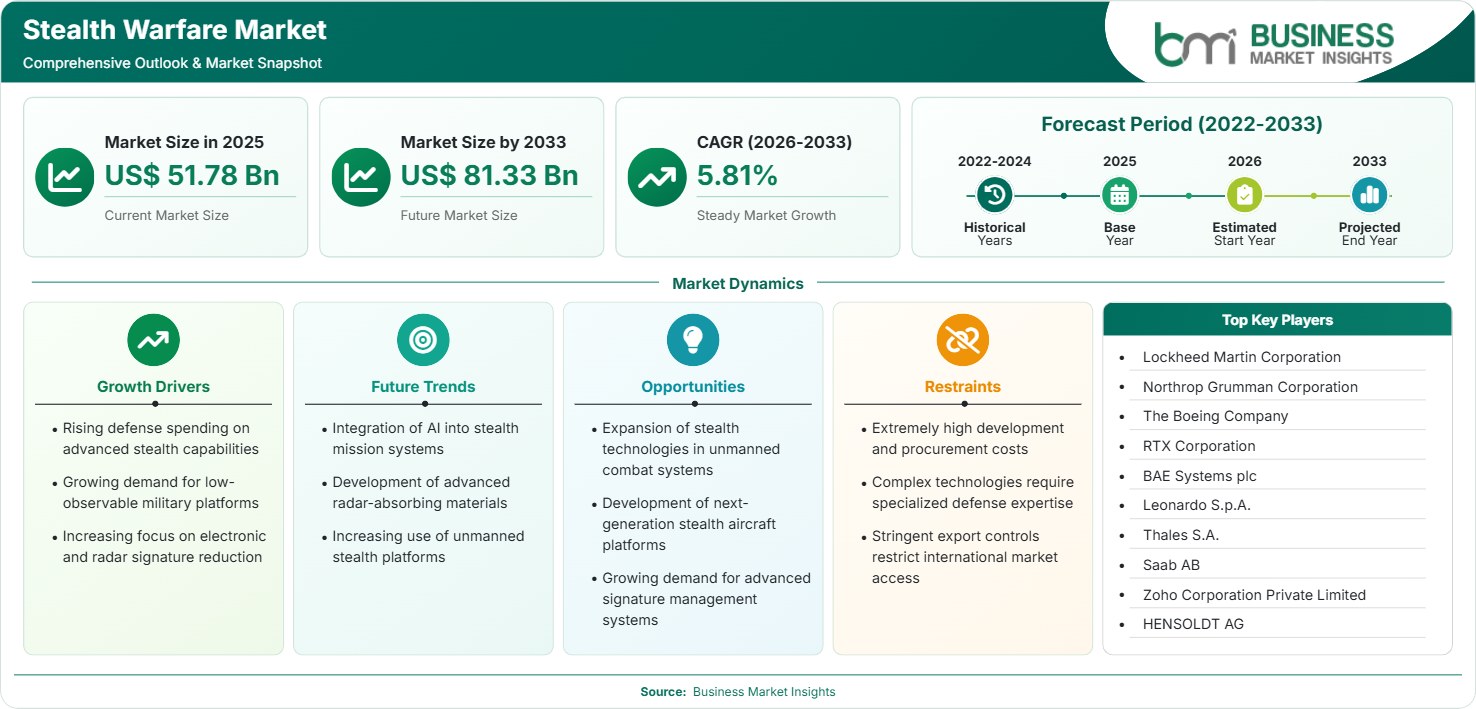
The Stealth Warfare Market size was valued at US$ 51.78 Billion in 2025 and is projected to reach US$ 81.33 Billion by 2033, growing at a CAGR of 5.81% during 2026–2033, driven by advanced aircraft, autonomous platforms, electronic warfare, sensors, and defense modernization.

Report Coverage
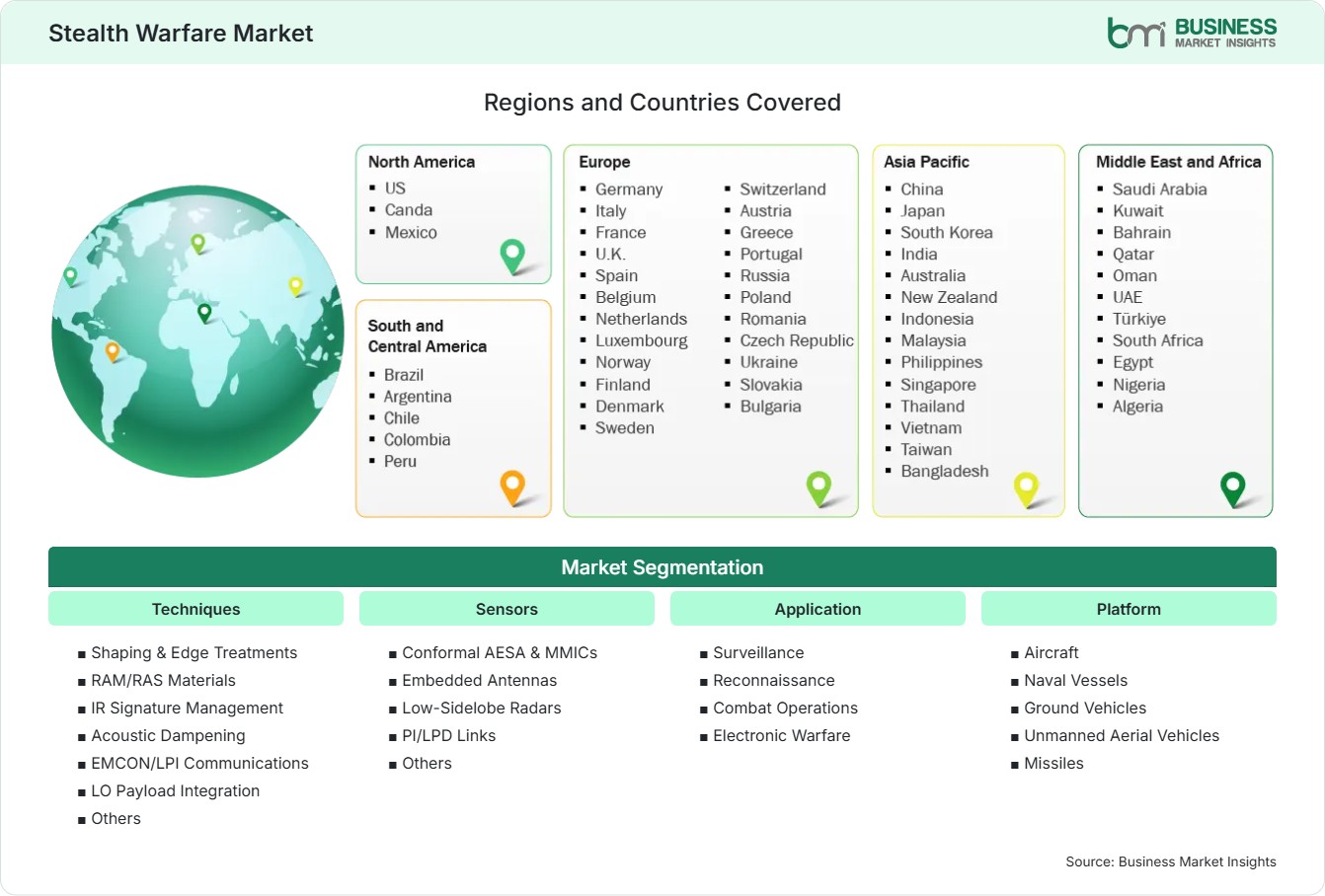
  • Techniques: Shaping & Edge Treatments, RAM/RAS Materials, IR Signature Management, Acoustic Dampening, EMCON/LPI Communications, LO Payload Integration, Others
  • Sensors: Conformal AESA & MMICs, Embedded Antennas, Low-Sidelobe Radars, PI/LPD Links, Others
  • Application: Surveillance, Reconnaissance, Combat Operations, Electronic Warfare
  • Platform: Aircraft, Naval Vessels, Ground Vehicles, Unmanned Aerial Vehicles, Missiles
US$ 51.78 Bn Market size in 2025
US$ 81.33 Bn Market Size by 2033
5.81% CAGR, 2026 - 2033
2026-2033 Forecast Period

AI Overview

Stealth Warfare Market Summary

  • North America Region: North America holds stealth warfare market share of 42%–43% in 2025, growing with a CAGR of 5.2%–5.6%, supported by fifth-generation aircraft, strategic bombers, naval radar, electronic warfare, autonomous systems, and established defense supply chains. U.S. procurement remains dominant through F-35, B-21, naval sensing, and next-generation combat-air programs. U.S. demand is modeled at 5.3%–5.7% CAGR through 2033.
  • Fastest Growing Region: Asia Pacific holds market share of 18%–20% in 2025, growing with a CAGR of 6.1%–6.5%, driven by indigenous combat aircraft, naval modernization, unmanned platforms, advanced radar, electronic warfare, and expanding national defense manufacturing capabilities.
  • Leading Segment: Aircraft holds market share of 38%–40% in 2025, growing with a CAGR of 5.7%–6.1%, supported by fifth-generation fleets, sixth-generation programs, low-observable structures, integrated sensors, advanced avionics, and survivability requirements.
  • High Growth Segment: Unmanned Aerial Vehicles holds market share of 11%–13% in 2025, growing with a CAGR of 6.4%–6.8%, supported by autonomous operations, attritable designs, distributed sensing, electronic attack, lower operating costs, and collaborative combat architectures.
  • Key Market Opportunity: Integrated signature management creates opportunities across advanced materials, conformal antennas, electronic warfare, autonomous systems, software-defined sensors, testing, sustainment, and recurring platform upgrades.
  • Major Market Players: Lockheed Martin Corporation, Northrop Grumman Corporation, The Boeing Company, RTX Corporation, BAE Systems plc, Leonardo S.p.A., Thales S.A., Saab AB, Zoho Corporation Private Limited, HENSOLDT AG.
Strategic Insights

Stealth Warfare Market: Strategic Insights

Stealth Warfare Market Strategic Framework
FREE PDF
Request your free sample
Request free sample
Stakeholder View

Key Takeaways

  • The stealth warfare market value chain is becoming more integrated as low-observable materials, sensors, electronics, software, testing, and sustainment increasingly need coordinated development and qualification.
  • Unmanned platforms provide strong upside because distributed sensing, electronic attack, decoys, and autonomous missions can expand survivability without replicating the cost of crewed aircraft.
  • Software-defined radar, adaptive electronic warfare, conformal sensing, and digital engineering are changing product development by allowing mission capabilities to evolve after platform delivery.
  • Asia Pacific offers an attractive expansion opportunity because Japan, India, South Korea, Australia, and China are simultaneously strengthening aerospace, naval, sensor, and unmanned capabilities.
  • Production capacity is becoming strategically valuable as advanced radar, semiconductor, composite, and signature-management suppliers face growing requirements for reliable high-volume manufacturing.
Geographic Outlook

Stealth Warfare Market Regional Highlights

North America Stealth Warfare Market

North America held 42%–43% share in 2025 and is modeled at 5.2%–5.6% CAGR through 2033. The region benefits from advanced aerospace infrastructure, large defense budgets, established contractors, and extensive component ecosystems. The U.S. remains the principal contributor through combat aircraft, strategic bombers, naval sensors, electronic warfare, autonomous systems, and sustainment. Its Stealth Warfare Market share reflects both platform procurement and deep supplier participation across materials, electronics, software, testing, and maintenance.

  • Fifth-generation aircraft sustain demand for low-observable structures, coatings, mission electronics, sensors, software, and specialized maintenance.
  • Strategic bomber programs support advanced manufacturing, digital engineering, signature testing, composite structures, and production-line modernization.
  • Naval modernization expands demand for advanced radar, electronic warfare, electromagnetic control, and integrated sensing systems.
  • Semiconductor availability remains important because advanced radar and electronic-warfare systems depend on specialized high-performance components.

US Stealth Warfare Market

The U.S. represented 97%–99% of North American demand in 2025 and is modeled at 5.3%–5.7% CAGR through 2033. Procurement combines aircraft, strategic strike, naval sensing, electronic warfare, unmanned platforms, and secure communications. The U.S. ecosystem supports extensive suppliers across materials, sensors, software, testing, integration, and lifecycle services, making domestic procurement the central contributor to North American demand and technology development.

  • F-35 production supports continuing requirements for low-observable structures, mission systems, software, sensors, components, and sustainment.
  • B-21 development creates long-term demand for specialized materials, digitally engineered production, signature management, testing, and integration.
  • Advanced naval radar programs increase requirements for electronically scanned arrays, semiconductor components, signal processing, and electromagnetic-spectrum capabilities.

Europe Stealth Warfare Market

Europe held 27%–30% share in 2025 and is modeled at 5.7%–6.1% CAGR through 2033. The United Kingdom, France, Germany, Italy, and Sweden are major contributors. European procurement increasingly combines aircraft modernization with radar, electronic warfare, secure communications, and industrial sovereignty. The United Kingdom, Italy, and Germany provide particularly strong opportunities through multinational combat-air development. The regional market is also supported by higher NATO defense commitments.

  • The United Kingdom is strengthening advanced radar and electronic-warfare capabilities, supporting AESA, avionics, integration, and testing suppliers.
  • Germany is expanding investment in advanced sensors, air defense, electronic warfare, and sovereign technology capabilities.
  • Italy benefits from Leonardo's aerospace and sensor expertise and participation in multinational next-generation combat-air programs.
  • Sweden remains important through Saab's combat-aircraft, radar, surveillance, and electronic-warfare capabilities.

Asia Pacific Stealth Warfare Market

The Stealth Warfare Market Forecast indicates that Asia Pacific held 18%–20% share in 2025 and is modeled at 6.1%–6.5% CAGR, making it the fastest-growing major region. China, Japan, India, South Korea, and Australia represent the principal demand centers. Indigenous aircraft programs, naval modernization, autonomous systems, advanced radar, and electronic warfare are expanding regional requirements. In Asia Pacific increasingly emphasizes sovereign manufacturing, technology partnerships, sensor integration, and resilient defense supply chains.

  • Japan is developing future combat air technologies by improving sensor, electronics, communications and aircraft technologies in the domestic domain.
  • India is building indigenous capabilities in aerospace and unmanned technologies, and hence offers an opportunity to grow radar, electronic warfare, materials and domestic manufacturing.
  • South Korea is developing advanced fighter, radar, electronic warfare and unmanned technologies for operating in contested environments.
  • Australia is building autonomous technologies, surveillance, range and alliance interoperability technologies.

Rest of World Stealth Warfare Market

South and Central America, the Middle East, and Africa represented 8%–11% share in 2025 and are modeled at 6.0%–6.4% CAGR through 2033. Saudi Arabia, UAE, Israel, Turkiye, and Brazil provide major opportunities. Middle Eastern demand emphasizes advanced aircraft, electronic warfare, sensors, and unmanned platforms, while Brazil provides Latin America's strongest aerospace opportunity. Procurement increasingly favors sophisticated surveillance, survivability, local support, and technology-transfer capabilities.

  • Gulf countries are investing in advanced aircraft, sensors, electronic warfare, and sustainment to improve survivability and operational awareness.
  • Israel remains influential in electronic warfare, unmanned systems, sensors, and countermeasure technologies.
  • Brazil provides opportunities through aerospace manufacturing, surveillance modernization, border monitoring, and advanced mission systems.
  • Turkiye is strengthening domestic aerospace and defense manufacturing, supporting indigenous platforms, sensors, electronic warfare, and exports.
Global Market Geography
FREE PDF
Request your free sample
Request free sample
Segment Analysis

Stealth Warfare Market Segmentation

Techniques

Techniques remain fundamental to platform survivability, with RAM/RAS Materials holding 24.02% share in 2025. The segment is modeled at 5.4%–5.9% CAGR through 2033 as manufacturers prioritize multispectral protection, material durability, controlled emissions, precision manufacturing, and integrated signature management across aircraft, naval vessels, vehicles, UAVs, and missiles.

  • Shaping & Edge Treatments: Geometric optimization reduces radar reflections from critical surfaces. Digital design and precision fabrication improve consistency across aircraft, missiles, naval systems, and other low-observable platforms.
  • RAM/RAS Materials: Radar-absorbing materials reduce electromagnetic returns. Durability, environmental resistance, frequency coverage, repairability, and manufacturing consistency increasingly influence procurement decisions.
  • IR Signature Management: Thermal suppression reduces infrared detectability from engines and heated structures. Cooling architectures, exhaust treatment, and advanced thermal materials improve survivability.
  • Acoustic Dampening: Acoustic reduction limits machinery, propulsion, and structural noise. Vibration isolation, propulsion improvements, and structural treatments strengthen survivability against passive detection.
  • EMCON/LPI Communications: Controlled emissions reduce detection probability while preserving connectivity. Adaptive waveforms, frequency agility, secure communications, and software-defined radios support contested-spectrum operations.
  • LO Payload Integration: Internal and conformal payload integration reduces external signatures while preserving mission capability. Modular architectures support sensors, weapons, communications, and electronic-warfare systems.

Sensors

Sensors are modeled at 5.8%–6.3% CAGR through 2033 as platforms adopt distributed apertures, conformal sensing, low-sidelobe radar, and low-probability-of-detection communications. Adoption is increasingly driven by sensor fusion, electromagnetic awareness, and multifunctional integration. The Stealth Warfare Market trends favor architectures that provide detection and communication while minimizing electromagnetic exposure and preserving platform geometry.

  • Conformal AESA & MMICs: Conformal AESA systems integrate sensing into platform surfaces. Gallium nitride electronics and digital beamforming improve coverage while reducing external signature compromises.
  • Embedded Antennas: Embedded antennas reduce protrusions while supporting sensing and communications. Adoption increases where aerodynamic efficiency, radar cross-section, and multifunctional apertures must coexist.
  • Low-Sidelobe Radars: Low-sidelobe designs reduce unintended emissions and improve resistance to hostile detection. Digital beamforming and signal processing strengthen electromagnetic control.
  • PI/LPD Links: Low-probability-of-intercept and low-probability-of-detection links preserve tactical connectivity while reducing opportunities for adversary geolocation.

Application

Applications are modeled at 5.5%–6.1% CAGR through 2033 as survivability requirements expand across surveillance, reconnaissance, combat operations, and electronic warfare. Platforms increasingly combine signature reduction with autonomous sensing, secure communications, mission software, and spectrum operations. This broadens adoption beyond traditional aircraft and creates opportunities for integrated mission-system suppliers across multiple defense platforms and operational environments.

  • Surveillance: Stealth-enabled surveillance improves persistence in defended areas by reducing exposure to radar and infrared sensors while supporting distributed sensing.
  • Reconnaissance: Low-observable reconnaissance supports intelligence collection where conventional aircraft face detection risks. Passive collection, sensor fusion, and secure communications improve mission effectiveness.
  • Combat Operations: Combat remains a principal application because reduced detectability can improve penetration, survivability, targeting flexibility, and operational options.
  • Electronic Warfare: Electronic warfare integrates passive sensing, deception, jamming, controlled emissions, and electromagnetic attack across aircraft, UAVs, naval systems, and ground platforms.

Platform

Platforms are modeled at 5.7%–6.2% CAGR through 2033 because signature technologies generate maximum value when integrated throughout complete systems. Aircraft remain dominant, while UAVs offer the strongest incremental growth. Naval and ground platforms are also incorporating radar, infrared, acoustic, and electromagnetic signature management. Platform-level integration therefore remains central to Stealth Warfare Market analysis and procurement decisions.

  • Aircraft: Aircraft remain dominant because advanced programs integrate shaping, materials, thermal management, sensors, communications, and electronic warfare.
  • Naval Vessels: Naval survivability combines radar, infrared, acoustic, and electromagnetic reduction across surface and underwater platforms.
  • Ground Vehicles: Ground vehicles increasingly use radar, infrared, acoustic, and electromagnetic signature reduction alongside active protection and electronic warfare.
  • Unmanned Aerial Vehicles: UAVs offer strong growth because autonomy, lower costs, distributed sensing, and attritable designs enable greater operational density.
  • Missiles: Reduced signatures improve penetration by limiting detection opportunities. Internal payloads, optimized shaping, materials, and controlled emissions support survivability.
Market Forces

Stealth Warfare Market Dynamics

Key Market Drivers

Rising defense expenditure supports advanced survivability procurement

Total worldwide military expenditure was US$ 2,887 billion in 2025, making it a major source of funds for advanced technologies. The pledge made by NATO that its member states would achieve the goal of allocating 5% of their gross domestic product for defense and security-related spending by 2035 will provide additional support to long-cycle modernization efforts. Such expenditure trends will ensure the development of advanced aircraft, sensor technology, electronic warfare technology, naval warfare, and autonomous systems. The stealth warfare market growth will become increasingly dependent on the ability to conduct operations in face of integrated air defenses and sensor networks.

Digital engineering improves low-observable production scalability

Digital engineering offers the ability for manufacturers to assess geometry, materials, thermal characteristics, electromagnetic characteristics, and tolerance in manufacture early in the development process. Digital-enabled design and manufacture can help avoid the need for redesign and provide better consistency for complex assemblies. This is especially true because performance characteristics depend upon tight control of interfaces between structures, finishes, apertures, wiring, propulsion, and mission systems. The Stealth Warfare Market trends are now more likely to favor suppliers that integrate digital design and automated manufacturing, inspection, testing, and maintenance. Digital engineering may also be able to offer lifecycle diagnostics and upgrades, thus offering repeat business.

Electronic warfare is becoming integral to survivability

Electronics warfare is beginning to intersect with stealth due to the need to mitigate electromagnetic exposure and to detect and attack enemy systems. The passive detection, managed emission, jamming, secure communications, and electronic protection functions are being combined into mission architectures. This results in widening the scope of suppliers from aircraft builders alone to those dealing in semiconductors, radar, software, communications and signal processing. Stealth Warfare Market growth therefore includes electromagnetic technologies along with stealth technologies. This allows for upgrades of capabilities without having to redesign the whole platform. With the advent of sophisticated enemy sensors, both technologies will continue to be vital procurement needs.

Key Market Opportunities

Autonomous platforms expand stealth adoption

The autonomous platform could enable the distribution of sensing, communication, electronic attack, decoy, and strike capabilities over multiple platforms. The result is an opening for increased operational density by not having all those capabilities reside on an expensive piloted airframe. Suppliers can pursue modular payload, autonomy software, embedded antennas, low-power sensor, secure communications, and rapid manufacturing technologies. The attritable UAV system would be especially appealing in scenarios where there is a need for persistent sensing and electronic effects in a contested environment. The mission algorithm can also create recurring revenue as it can evolve at a faster rate than the actual platform.

European sovereign capability creates supplier opportunities

European defense spending is creating more possibilities in areas of radar, electronic warfare, advanced materials, communications, and fighter jet systems. The objectives related to industrial sovereignty would prefer those suppliers who have the capability to supply key parts either regionally or through international joint ventures. Joint development programs not only help share the cost of development but also create long cycle periods for manufacturing and maintenance. Suppliers having capabilities of producing sensors, electronic warfare equipment, semiconductors, and low observable technology could get advantages from this scenario. Increased spending by NATO is also helping to increase the visibility of these programs.

Signature sustainment creates recurring revenue

Ongoing inspection, repair, calibration, testing, maintenance of coatings, and software support are necessary for low observable systems. With growth of fleet size, lifecycle services may turn out to be an important value stream besides production of new systems. Automation of inspections, digital twins, prediction of maintenance, measurements of signatures, and advanced repair technologies will help reduce downtime while retaining operational effectiveness. Supplier will be able to offer a recurring service contract on readyness, maintenance, testing, and replacement of components without producing full-scale systems. The area is especially relevant for existing fleets for which it is increasingly hard to retain original signatures.

Market Restraints and Challenges

High lifecycle costs restrict fleet scale

Factor: The need for low observable structures, special materials, precise manufacturing, signature test and maintenance requires more advanced technological capacity compared to ordinary aircrafts.

Impact: High cost of procurement and operation limits number of aircrafts in the fleet especially when it comes to nations that have limited budget for defense. Special inspections, repair and replacement of special materials as well as training of technicians throughout the lifespan of an aircraft may lead to increased costs and logistical difficulties. Authorities of procurement thus prefer small and quality fleets complemented by ordinary planes as opposed to large fleets of expensive stealth planes.

Counter-stealth sensing challenges technological advantage

Factor: The adversaries are developing multispectral sensors, passive detection, infrared sensors, low-frequency radars, networked sensors, and signal processing.

Impact: Detection will be enhanced and thus negate the operational gain from the costly process of reducing signatures. Therefore, Stealth Warfare Market will remain a dynamic process instead of being a fixed situation. Machine Learning can integrate weak observations from distributed sensors, while the network architecture will enhance classification. The suppliers have to keep improving their products, including materials, emissions management, electronic warfare, sensor integration, and software. This will create more expenditure cycles in technology.

Company Analysis

Competitive Landscape

The Stealth Warfare Market analysis shows a broad ecosystem spanning aircraft primes, radar specialists, electronic-warfare providers, sensor companies, and digital technology suppliers.

Company Name

Overview

Products and Services relevant to this market

Lockheed Martin Corporation

Major U.S. defense prime with extensive advanced aircraft, sensors, mission systems, and sustainment capabilities.

F-35, advanced aircraft, sensors, electronic warfare, mission systems, sustainment.

Northrop Grumman Corporation

U.S. defense company focused on strategic aircraft, sensors, autonomous systems, and digital engineering.

B-21, ISR systems, autonomous platforms, radar, electronic warfare, integration.

The Boeing Company

Global aerospace and defense manufacturer active in advanced aircraft, autonomous systems, and mission technologies.

F-47, MQ-28, X-37B, electronic attack, autonomous systems.

RTX Corporation

Aerospace and defense company with major radar, sensing, electronic-warfare, and missile-defense capabilities.

SPY-6 radar, naval sensors, electronic warfare, software-defined radar.

BAE Systems plc

Defense technology group active in electronic warfare, combat aircraft, sensors, avionics, and mission electronics.

EPAWSS, ECRS Mk2, electronic protection, electromagnetic attack, avionics.

Leonardo S.p.A.

European aerospace and defense company active in radar, electronics, combat-air systems, and multinational programs.

Radar, aircraft electronics, electronic warfare, sensors, GCAP technologies.

Thales S.A.

Technology group providing sensors, radar, secure communications, electronic warfare, and defense mission systems.

AESA radar, electronic warfare, surveillance, secure communications, air-defense sensors.

Saab AB

Swedish defense company specializing in combat aircraft, radar, surveillance, electronic warfare, and command systems.

Gripen, Giraffe radar, GlobalEye, electronic warfare, surveillance.

Zoho Corporation Private Limited

Enterprise technology company providing software, cloud, cybersecurity, communications, and digital-management capabilities.

Secure software, cloud applications, communications, cybersecurity, identity, data management.

HENSOLDT AG

European sensor specialist focused on radar, optronics, electronic warfare, and passive detection.

Radar, electronic warfare, optronics, passive sensors, signal intelligence.

Trust & Transparency

Research Methodology

The market analysis combines proprietary research with secondary data from government agencies, company disclosures, regulatory filings, industry databases and expert interviews. Market estimates are validated through data triangulation, cross-market benchmarking and analyst review.

View Full Research Methodology

Questions Answered

Frequently Asked Questions

What does the Stealth Warfare Market report cover?

The market report covers market size, regional trends, segmentation, technology developments, competitive landscape, growth drivers, opportunities, and challenges. It also evaluates aircraft, unmanned platforms, sensors, electronic warfare, signature-management technologies, and other key areas shaping market growth.

Why are UAVs becoming important?

UAVs distribute sensing, electronic attack, communications, decoy, and strike functions across multiple platforms. Lower operating costs and autonomous capabilities allow greater operational density than relying exclusively on crewed stealth aircraft.

Which manufacturing capabilities are most important?

Specialized composites, radar-absorbing materials, gallium nitride electronics, conformal antennas, thermal-management systems, precision fabrication, and automated inspection are important because manufacturing consistency affects signature performance.

Why are electronic warfare and stealth increasingly integrated?

Electronic warfare controls electromagnetic exposure while detecting, deceiving, or disrupting adversary systems. Combining passive sensing, controlled emissions, jamming, and secure communications improves survivability while maintaining connectivity.

How does stealth differ from radar invisibility?

Stealth warfare Market is a multispectral survivability approach covering radar, infrared, acoustic, electromagnetic, and visual signatures. Modern platforms combine shaping, materials, thermal management, controlled emissions, sensors, and electronic warfare.

Access the Full Stealth Warfare Market Report

Get segment-level forecasts, regional estimates, competitive benchmarking, company profiles and downloadable Excel datasets.

Access the full Stealth Warfare Market Report
350 pages PDF & Excel | 2026-09-15
Similar Research

Related Market Reports