Market Summary
Executive Summary and Market Analysis
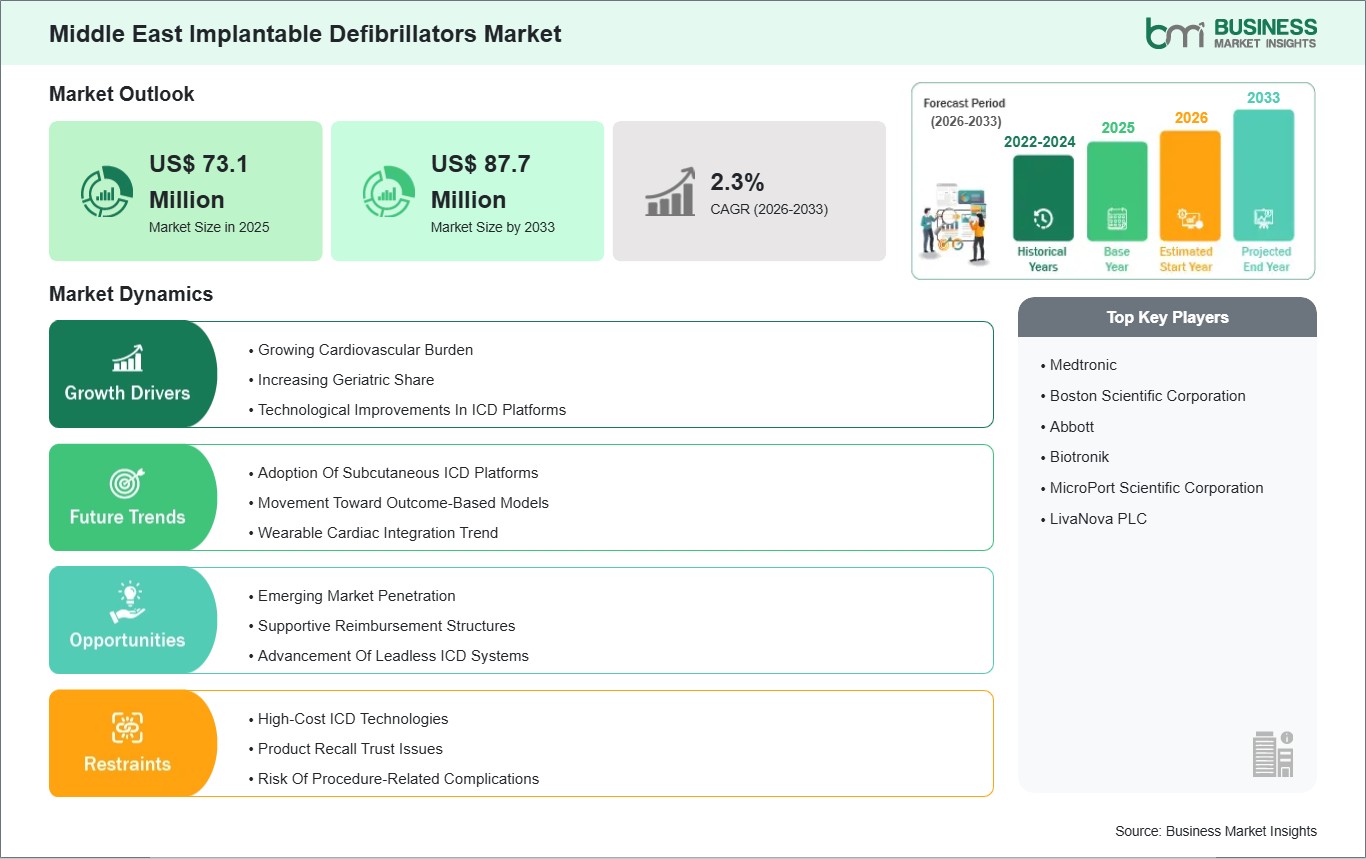
The Middle East implantable defibrillators market is driven by a growing prevalence of cardiovascular diseases, increasing awareness of sudden cardiac death prevention, and expanding infrastructure for advanced cardiac care. Across the region, countries are investing in modernizing hospitals, establishing electrophysiology labs, and training specialists to enhance access to arrhythmia management solutions. The market is supported by partnerships between international device manufacturers and regional healthcare providers, facilitating the introduction of technologically advanced ICD systems, including subcutaneous and MRI-compatible devices.
Despite these growth drivers, market adoption faces constraints. High device and implantation costs, coupled with uneven reimbursement frameworks across the region, limit accessibility in several markets. Availability of trained electrophysiologists and procedural expertise is concentrated in major urban centers, leaving smaller cities and rural areas with limited access to advanced cardiac interventions. Regulatory variations and complex approval processes across Middle Eastern countries also affect the timely introduction of new devices. Nevertheless, increasing public health initiatives focused on cardiovascular disease prevention, coupled with ongoing investments in healthcare infrastructure, provide a supportive environment for market expansion in the Middle East.
Segment Analysis
Middle East Implantable Defibrillators Market Segmentation
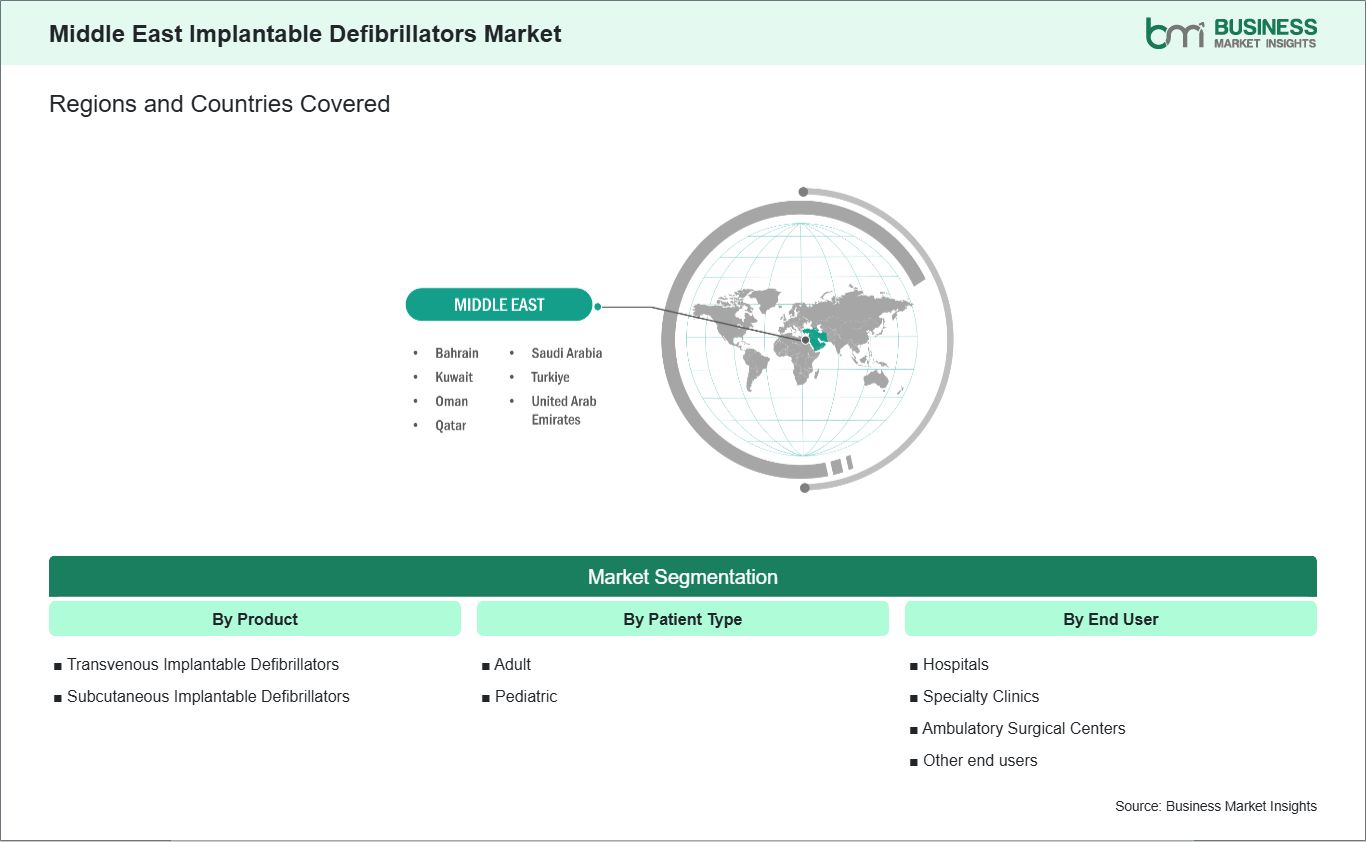
Key segments that contributed to the derivation of the Middle East Implantable Defibrillators market analysis are product type, patient type, and end user.
- By product type, the implantable defibrillators market is segmented into transvenous implantable defibrillators and subcutaneous implantable defibrillators. The transvenous implantable defibrillators segment dominated the market in 2025.
- Based on patient type, the implantable defibrillators market is classified into adult and pediatric. The adult segment dominated the market in 2025.
- In terms of end user, the implantable defibrillators market is categorized into hospitals, specialty clinics, ambulatory surgical centers, and other end users. The hospitals segment dominated the market in 2025.
Market Forces
Middle East Implantable Defibrillators Market Drivers and Opportunities
Growing Cardiovascular Burden
The Middle East is experiencing a growing burden of cardiovascular diseases, including heart failure, coronary artery disease, and life-threatening arrhythmias. Rapid urbanization, sedentary lifestyles, unhealthy diets, smoking, and increasing cases of diabetes and hypertension are contributing to this trend. These conditions place more patients at risk of sudden cardiac arrest, creating a stronger need for effective long-term treatment options such as implantable cardioverter defibrillators (ICDs).
Healthcare infrastructure in the region is improving, particularly in countries such as Saudi Arabia, the UAE, Qatar, Kuwait, Bahrain, and Oman. Many hospitals and specialized cardiac centers are equipped to perform ICD implantation procedures and provide post-procedure follow-up care. Physicians are increasingly aware of international clinical guidelines for sudden cardiac death prevention, which support the growing use of ICD therapy.
Governments and health authorities in the Middle East are prioritizing cardiovascular health through public awareness programs and national healthcare initiatives. As the prevalence of heart disease rises, hospitals are focusing on preventive and life-saving interventions. The increasing cardiovascular burden acts as a strong driver for the ICD market in the Middle East.
Supportive Reimbursement Structures
The Middle East benefits from supportive reimbursement structures that encourage the adoption of ICD therapy. Many countries in the region have public healthcare systems or mandatory insurance schemes that cover ICD implantation for eligible patients. This reduces financial barriers and ensures that patients have access to life-saving cardiac treatments.
Many patients rely on employer-based insurance or private plans that support advanced cardiac procedures. As insurance coverage expands and payment pathways become clearer, hospitals are more willing to invest in ICD technologies, increasing patient access and adoption.
Healthcare authorities are continuously implementing reforms to strengthen access to critical cardiac therapies. National policies focused on reducing mortality from cardiovascular diseases highlight ICD therapy for high-risk patients. These supportive reimbursement structures present meaningful opportunities for ICD manufacturers to expand their presence and improve treatment outcomes across the Middle East.
Size and Share Analysis
Middle East Implantable Defibrillators Market Size and Share Analysis
The Middle East implantable defibrillators market is experiencing steady growth, with market size and share analysis reflecting evolving treatment preferences and competitive dynamics among key players. The report evaluates important subsegments categorized within product type, patient type, and end user, highlighting their respective contributions to overall market performance.
By product type, the transvenous implantable defibrillators subsegment dominated the market in 2025, due to established clinical efficacy, broader physician familiarity, proven long-term outcomes, wider availability, and strong adoption in treating high-risk cardiac patients compared to newer subcutaneous options.
In terms of patient type, the adult subsegment dominated the market in 2025. This leadership is attributed to the higher prevalence of cardiac disorders in the adult population, increased awareness of sudden cardiac death prevention, and greater accessibility of advanced defibrillator therapies for adult patients.
Based on end user, the hospitals subsegment dominated the market in 2025. Hospitals remain the primary distribution channel due to their comprehensive cardiac care facilities, access to trained cardiologists and specialized technicians, advanced monitoring infrastructure, and ability to provide immediate, life-saving interventions.
Report Coverage
Middle East Implantable Defibrillators Market Report Coverage and Deliverables
The "Middle East Implantable Defibrillators Market Size and Forecast (2022–2033)" report provides a detailed analysis of the market covering below areas:
- Middle East Implantable Defibrillators market size and forecast at regional and country levels for all market segments covered under the scope
- Middle East Implantable Defibrillators market trends, as well as drivers, restraints, and opportunities
- Middle East Implantable Defibrillators market analysis covering key trends, regional framework, major players, regulations, and recent developments
- Industry landscape and competition analysis covering market concentration, heat map analysis, prominent players, and recent developments for the Middle East Implantable Defibrillators market
- Detailed company profiles, including SWOT analysis
Geographic Insights
Middle East Implantable Defibrillators Market Geographic Insights
The geographical scope of the Middle East implantable defibrillators market report is divided into: the UAE, Saudi Arabia, Bahrain, Oman, Kuwait, Qatar, and Türkiye. Türkiye held the largest share in 2025.
Türkiye dominates the Middle East implantable defibrillators market due to its mature healthcare system, well-established cardiac care infrastructure, and growing adoption of advanced ICD technologies. Major metropolitan areas such as Istanbul, Ankara, and Izmir host state-of-the-art tertiary hospitals and specialized cardiac centers, equipped with electrophysiology labs capable of performing complex ICD and CRT-D implantations. Strong collaborations between global device manufacturers and local distributors have enhanced device availability and clinical training programs, increasing clinician familiarity with next-generation defibrillator systems.
Türkiye's healthcare ecosystem benefits from government-backed insurance coverage and strategic initiatives aimed at improving cardiovascular care, which have contributed to wider ICD adoption among high-risk populations. However, challenges persist in terms of cost sensitivity and variability in access to advanced procedures outside urban hubs. Regulatory alignment with European and international standards, combined with local manufacturing capabilities, positions Türkiye as a central hub for ICD adoption in the Middle East. Continuous training programs, infrastructure development, and awareness campaigns are expected to sustain growth and maintain Türkiye's leadership within the regional implantable defibrillators market.
Industry Activity
Recent Developments
The Middle East Implantable Defibrillators market is evaluated by gathering qualitative and quantitative data post primary and secondary research, which includes important corporate publications, association data, and databases. A few of the key developments in the Middle East Implantable Defibrillators market are:
- In January 2025, Mediana announced that it participated in Arab Health 2025 in Dubai to showcase its emergency medical solutions, including AEDs and advanced monitor implantable defibrillators, to expand its customer base and presence in the Middle East emergency medical device market.
- In March 2023, Philips Healthcare announced a new defibrillator model with enhanced user interface and connectivity features in the Middle East, aimed at improving defibrillation access and integration with hospital emergency response systems, supporting infrastructure for comprehensive arrhythmia care that encompasses ICD services.
Trust & Transparency
Research Methodology
The market analysis combines proprietary research with secondary data from government agencies, company disclosures, regulatory filings, industry databases and expert interviews. Market estimates are validated through data triangulation, cross-market benchmarking and analyst
review.
View Full Research Methodology
Key Sources Referred:
The World Bank World Health Organization (WHO) Center for Disease Control and Prevention (CDC) European Database on Medical Devices (EUDAMED) European Society of Cardiology American College of Cardiology American Heart Association Company Websites Company Annual Reports Company Investor Presentations