Market Summary
Executive Summary and Market Analysis
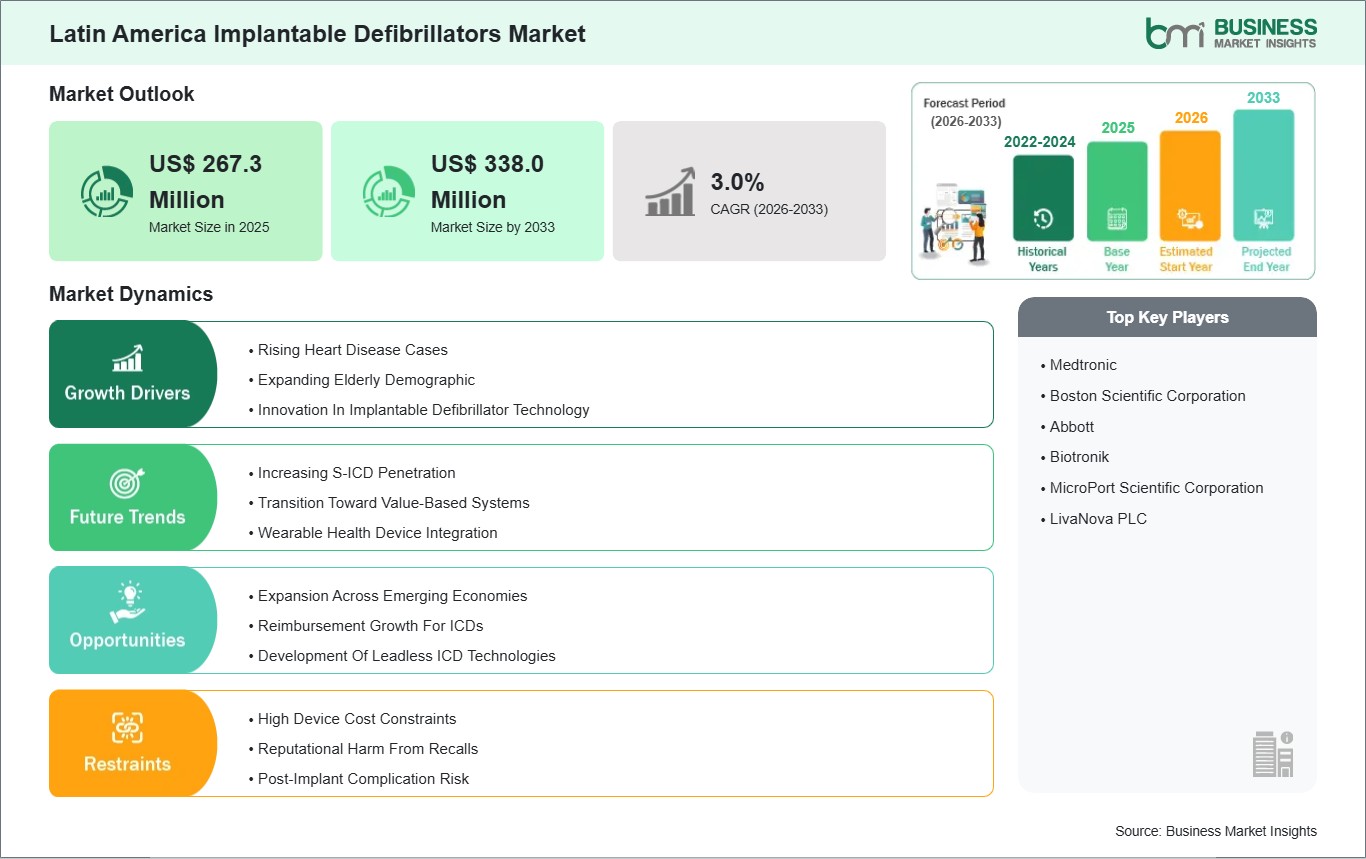
The implantable defibrillators market Latin America is witnessing gradual growth driven by rising cardiovascular disease prevalence, increasing awareness of sudden cardiac death prevention, and improving healthcare infrastructure across key economies. Urbanization, lifestyle shifts, and a growing geriatric population have heightened demand for cardiac rhythm management technologies, including ICDs and CRT-D devices. Leading private and public hospitals in the region are expanding cardiology and electrophysiology services, creating opportunities for broader device adoption. Strategic partnerships between multinational medical device manufacturers and regional distributors have also facilitated access to advanced defibrillator systems, including subcutaneous and MRI-compatible variants.
The adoption of implantable defibrillators is constrained by limited reimbursement coverage, resulting in high out-of-pocket costs for patients. Uneven healthcare infrastructure across urban and rural areas restricts access to specialized electrophysiology procedures. Regulatory complexity and longer approval timelines for medical devices in certain Latin American nations can delay market entry for next-generation ICD technologies. Nevertheless, rising patient and clinician awareness, combined with ongoing hospital modernization efforts, positions Latin America as a promising market for implantable defibrillators, with Mexico, Brazil, and Argentina emerging as strategic focal points for growth.
Segment Analysis
Latin America Implantable Defibrillators Market Segmentation
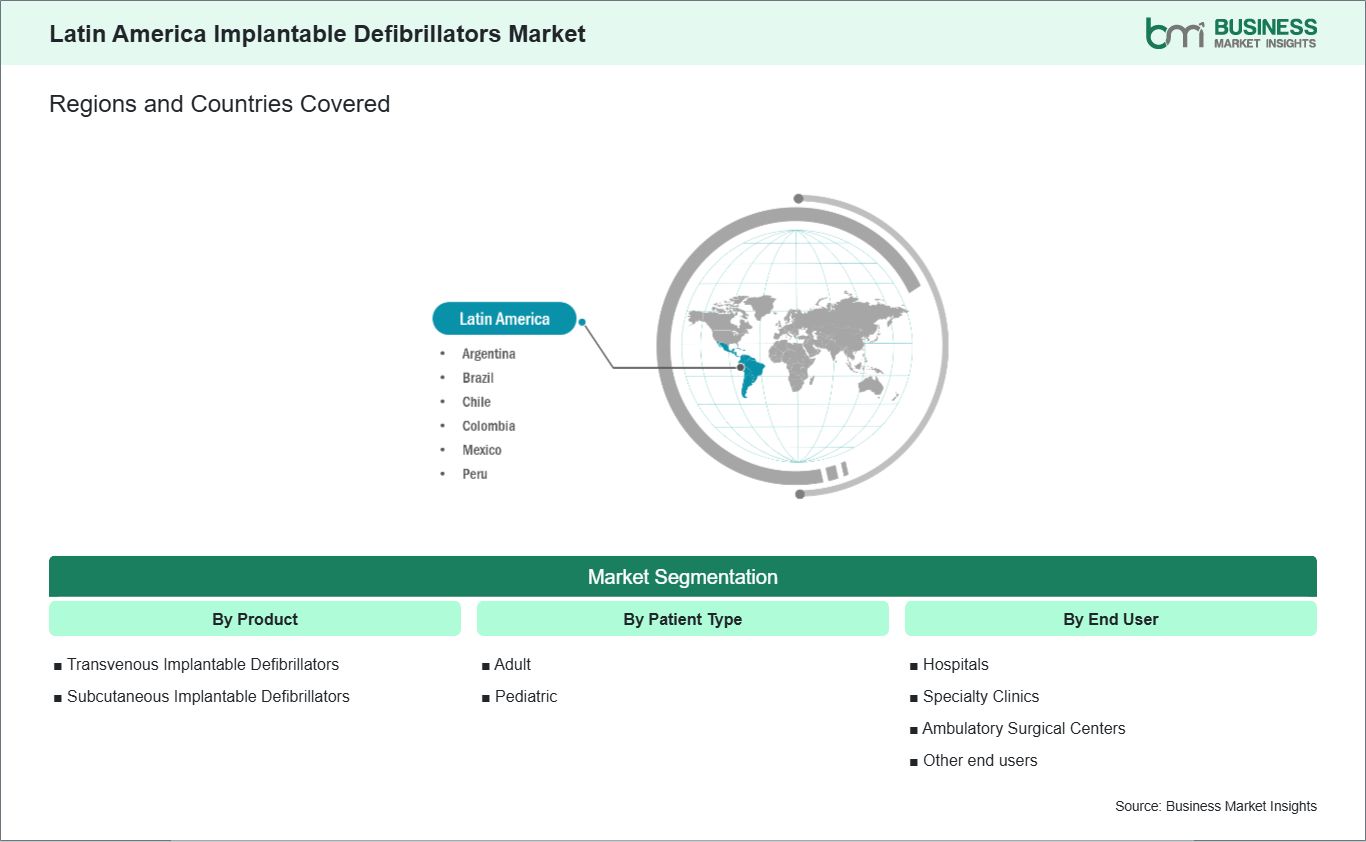
Key segments that contributed to the derivation of the Latin America Implantable Defibrillators market analysis are product type, patient type, and end user.
- By product type, the implantable defibrillators market is segmented into transvenous implantable defibrillators and subcutaneous implantable defibrillators. The transvenous implantable defibrillators segment dominated the market in 2025.
- Based on patient type, the implantable defibrillators market is classified into adult and pediatric. The adult segment dominated the market in 2025.
- In terms of end user, the implantable defibrillators market is categorized into hospitals, specialty clinics, ambulatory surgical centers, and other end users. The hospitals segment dominated the market in 2025.
Market Forces
Latin America Implantable Defibrillators Market Drivers and Opportunities
Rising Heart Disease Cases
Latin America is experiencing a rising number of heart disease cases, including coronary artery disease, heart failure, and serious heart rhythm disorders. Factors such as urbanization, unhealthy diets, high rates of obesity, smoking, and limited physical activity are contributing to the growing burden of cardiovascular conditions. Countries such as Brazil, Mexico, Argentina, and Colombia are seeing more patients diagnosed with advanced heart conditions. This increasing patient base is driving the need for effective, long-term solutions such as implantable cardioverter defibrillators (ICDs).
Healthcare systems across Latin America are improving their focus on non-communicable diseases, including heart disease. Urban hospitals and specialized cardiac centers are gradually expanding their capabilities for advanced procedures, including ICD implantation. Physicians are becoming more aware of international clinical guidelines for sudden cardiac death prevention, which supports the growing adoption of ICD therapy.
Although access to advanced cardiac care can vary between urban and rural areas, the disease burden is creating demand for reliable treatment options. As awareness improves and more high-risk patients are identified, ICD therapy is recognized as a critical intervention. The rising prevalence of heart disease thus acts as a strong driver for the ICD market in Latin America.
Reimbursement Growth for ICDs
Reimbursement for ICD therapy in Latin America is gradually improving, creating significant opportunities for market growth. Public healthcare programs in countries such as Brazil, Mexico, and Argentina are covering ICD implantation for eligible patients. This financial support helps reduce out-of-pocket costs and encourages wider adoption of these life-saving devices. Private insurance also plays a key role in the region. Many urban patients rely on private hospitals or employer-based insurance plans, which support access to advanced cardiac procedures. As insurance coverage expands, more patients gain access to ICD therapy, and hospitals are more willing to invest in advanced cardiac technologies. Governments in Latin America are also focusing on strengthening healthcare funding and improving access to critical treatments. Policies aimed at reducing mortality from cardiovascular diseases are supporting broader ICD adoption. The ongoing growth of reimbursement pathways presents a meaningful opportunity for manufacturers to expand their presence and improve patient access across the region.
Size and Share Analysis
Latin America Implantable Defibrillators Market Size and Share Analysis
The Latin America implantable defibrillators market is experiencing steady growth, with market size and share analysis reflecting evolving treatment preferences and competitive dynamics among key players. The report evaluates important subsegments categorized within product type, patient type, and end user, highlighting their respective contributions to overall market performance.
By product type, the transvenous implantable defibrillators subsegment dominated the market in 2025, due to established clinical efficacy, broader physician familiarity, proven long-term outcomes, wider availability, and strong adoption in treating high-risk cardiac patients compared to newer subcutaneous options.
In terms of patient type, the adult subsegment dominated the market in 2025. This leadership is attributed to the higher prevalence of cardiac disorders in the adult population, increased awareness of sudden cardiac death prevention, and greater accessibility of advanced defibrillator therapies for adult patients.
Based on end user, the hospitals subsegment dominated the market in 2025. Hospitals remain the primary distribution channel due to their comprehensive cardiac care facilities, access to trained cardiologists and specialized technicians, advanced monitoring infrastructure, and ability to provide immediate, life-saving interventions.
Report Coverage
Latin America Implantable Defibrillators Market Report Coverage and Deliverables
The "Latin America Implantable Defibrillators Market Size and Forecast (2022–2033)" report provides a detailed analysis of the market covering below areas:
- Latin America Implantable Defibrillators market size and forecast at regional and country levels for all market segments covered under the scope
- Latin America Implantable Defibrillators market trends, as well as drivers, restraints, and opportunities
- Latin America Implantable Defibrillators market analysis covering key trends, regional framework, major players, regulations, and recent developments
- Industry landscape and competition analysis covering market concentration, heat map analysis, prominent players, and recent developments for the Latin America Implantable Defibrillators market
- Detailed company profiles, including SWOT analysis
Geographic Insights
Latin America Implantable Defibrillators Market Geographic Insights
The geographical scope of the Latin America implantable defibrillators market report is divided into: Brazil, Mexico, Argentina, Colombia, Chile, and Peru. Brazil held the largest share in 2025.
Mexico dominates the Latin America implantable defibrillators market due to its combination of a large population, rising cardiovascular disease burden, and relatively advanced healthcare infrastructure. Major urban centers such as Mexico City, Guadalajara, and Monterrey host state-of-the-art tertiary hospitals equipped with electrophysiology labs and skilled cardiology teams capable of performing complex ICD and CRT-D implantations. Both public institutions under Seguro Popular and private healthcare providers have gradually expanded access to advanced defibrillator technologies, supported by partnerships with global device manufacturers.
Mexico's healthcare system emphasizes preventive cardiology and arrhythmia risk management, increasing clinician adoption of ICDs for high-risk patients. Local clinical training programs and participation in international cardiology research have also strengthened procedural competencies and familiarity with next-generation devices. However, challenges persist in the form of limited insurance coverage for premium ICD models, disparities between urban and rural regions, and protracted regulatory processes for device approvals. Ongoing initiatives to enhance infrastructure, expand specialist training, and increase awareness of arrhythmia management are expected to sustain ICD adoption, solidifying Mexico's position as the leading implantable defibrillator market in Latin America.
Industry Activity
Recent Developments
The Latin America implantable defibrillators market is evaluated by gathering qualitative and quantitative data post primary and secondary research, which includes important corporate publications, association data, and databases. A few of the key developments in the Latin America implantable defibrillators market are:
- In March 2025, AtaCor Medical, Inc. announced the initiation of a groundbreaking clinical study of its next‑generation extravascular implantable cardioverter defibrillator (EV‑ICD) technology in Paraguay, reinforcing Latin America's role as a key destination for early clinical research of innovative ICD solutions. This study aims to evaluate the novel EV‑ICD lead system that provides defibrillation and pacing without intracardiac hardware, accelerating product development in the region.
- In March 2025, BIOTRONIK announced that the first implantable cardioverter defibrillator (ICD) implantation had been performed on a patient enrolled in its BIOTRONIK ESCAPE‑ICD registry in Latin America, spanning Argentina, Brazil, Colombia, Chile, Mexico, and Venezuela to collect clinical evidence on sudden cardiac death risk and ICD therapy. This marks a clinical research milestone for ICD utilization in the Latin American cardiovascular care landscape.
Trust & Transparency
Research Methodology
The market analysis combines proprietary research with secondary data from government agencies, company disclosures, regulatory filings, industry databases and expert interviews. Market estimates are validated through data triangulation, cross-market benchmarking and analyst
review.
View Full Research Methodology
Key Sources Referred:
The World Bank World Health Organization (WHO) Center for Disease Control and Prevention (CDC) European Database on Medical Devices (EUDAMED) European Society of Cardiology American College of Cardiology American Heart Association Company Websites Company Annual Reports Company Investor Presentations