Market Summary
Executive Summary and Market Analysis
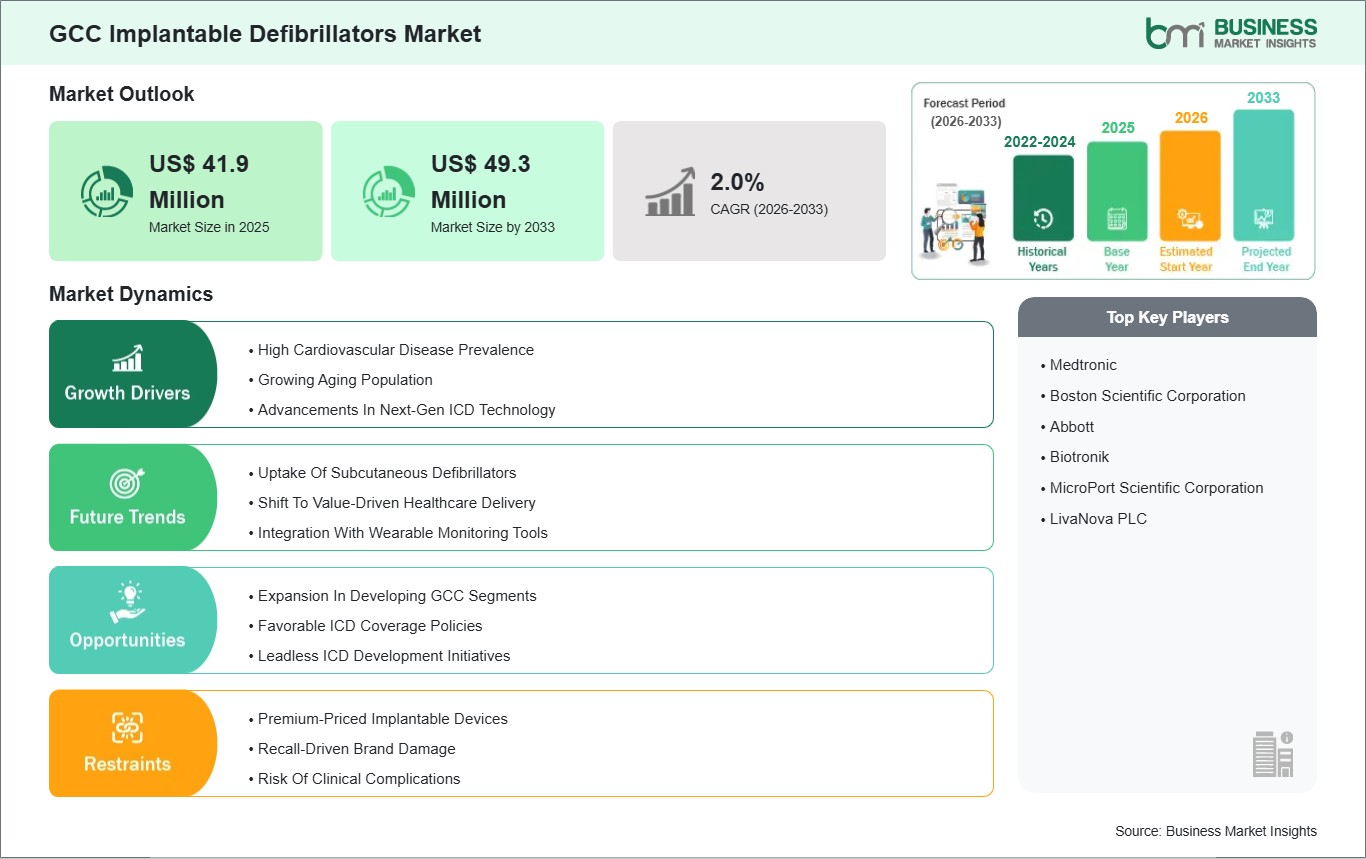
The GCC implantable defibrillators market is characterized by advanced healthcare infrastructure, strong government healthcare spending, and rising prevalence of lifestyle-related cardiovascular disorders. Saudi Arabia, UAE, Qatar, Kuwait, Oman, and Bahrain have prioritized modernization of cardiac care services as part of broader national healthcare transformation agendas. Increasing incidence of arrhythmias, ischemic heart disease, and heart failure has reinforced clinical demand for implantable cardioverter defibrillators (ICDs) as a preventive solution against sudden cardiac death. The presence of well-equipped tertiary hospitals, expanding electrophysiology labs, and high physician adoption of advanced cardiac rhythm management technologies supports steady ICD integration into treatment pathways.
The region also benefits from relatively structured reimbursement frameworks in public healthcare systems, particularly in larger economies. However, market growth is influenced by certain constraints. Dependence on imported medical devices can impact pricing dynamics and procurement timelines. Variability in specialist availability across smaller GCC nations and outside major metropolitan areas also affects procedural volumes. Furthermore, cost containment initiatives within public healthcare systems are increasingly shaping purchasing decisions, especially for premium and next-generation ICD systems. Despite these challenges, the GCC remains one of the most technologically receptive markets in the Middle East.
Segment Analysis
GCC Implantable Defibrillators Market Segmentation
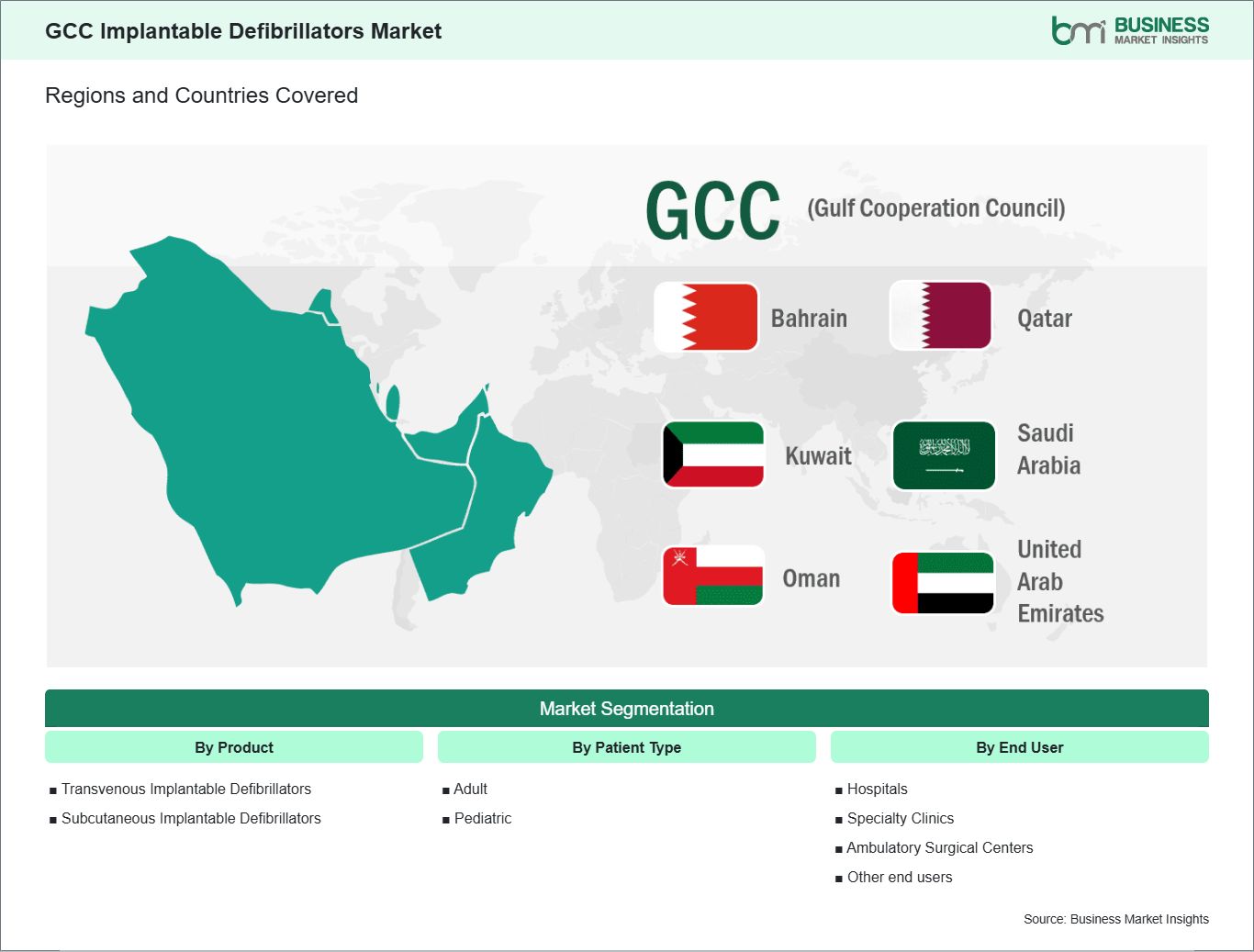
Key segments that contributed to the derivation of the GCC Implantable Defibrillators market analysis are product type, patient type, and end user.
- By product type, the implantable defibrillators market is segmented into transvenous implantable defibrillators and subcutaneous implantable defibrillators. The transvenous implantable defibrillators segment dominated the market in 2025.
- Based on patient type, the implantable defibrillators market is classified into adult and pediatric. The adult segment dominated the market in 2025.
- In terms of end user, the implantable defibrillators market is categorized into hospitals, specialty clinics, ambulatory surgical centers, and other end users. The hospitals segment dominated the market in 2025.
Market Forces
GCC Implantable Defibrillators Market Drivers and Opportunities
High Cardiovascular Disease Prevalence
GCC, including Saudi Arabia, the UAE, Qatar, Kuwait, Bahrain, and Oman, is experiencing a high prevalence of cardiovascular diseases. Rapid urbanization, sedentary lifestyles, high rates of obesity, and increasing cases of diabetes and hypertension are contributing to the growing burden of heart conditions. These factors are resulting in more patients at risk of serious heart rhythm disorders and sudden cardiac arrest. This large patient population creates strong demand for advanced cardiac rhythm management solutions, such as implantable cardioverter defibrillators (ICDs).
Healthcare infrastructure in the GCC is well developed, particularly in urban centers and leading hospitals. Many cardiac centers are equipped with modern electrophysiology labs and trained specialists capable of performing ICD implantation. Physicians in the region are aware of global treatment guidelines and the importance of preventing sudden cardiac death, which supports growing adoption of ICD therapy.
Governments and health authorities in the GCC are also focusing on improving cardiovascular outcomes as part of national health initiatives. With rising heart disease prevalence, hospitals are prioritizing long-term management solutions for high-risk patients. The high cardiovascular disease prevalence in the region acts as a key driver for ICD adoption and growth in the GCC market.
Favorable ICD Coverage Policies
The GCC benefits from favorable coverage policies for ICD therapy, which provide significant opportunities for market growth. Many countries in the region have well-structured public healthcare systems that fund ICD implantation for eligible patients. Coverage is often provided through government healthcare programs or mandatory insurance schemes, reducing financial barriers for patients and encouraging wider adoption.
Private healthcare and insurance coverage also play a strong role in GCC. Many patients rely on private hospitals or employer-based insurance plans that support advanced cardiac procedures. This combination of public and private coverage ensures that hospitals can adopt ICD technology with confidence, and more patients gain timely access to therapy.
Healthcare authorities in GCC continue to implement reforms to strengthen access to life-saving cardiac treatments. Policies aimed at reducing mortality from heart diseases emphasize ICD therapy for high-risk patients. The favorable coverage environment provides a clear opportunity for ICD manufacturers to expand their presence and improve patient access across GCC.
Size and Share Analysis
GCC Implantable Defibrillators Market Size and Share Analysis
The GCC implantable defibrillators market is experiencing steady growth, with market size and share analysis reflecting evolving treatment preferences and competitive dynamics among key players. The report evaluates important subsegments categorized within product type, patient type, and end user, highlighting their respective contributions to overall market performance.
By product type, the transvenous implantable defibrillators subsegment dominated the market in 2025, due to established clinical efficacy, broader physician familiarity, proven long-term outcomes, wider availability, and strong adoption in treating high-risk cardiac patients compared to newer subcutaneous options.
In terms of patient type, the adult subsegment dominated the market in 2025. This leadership is attributed to the higher prevalence of cardiac disorders in the adult population, increased awareness of sudden cardiac death prevention, and greater accessibility of advanced defibrillator therapies for adult patients.
Based on end user, the hospitals subsegment dominated the market in 2025. Hospitals remain the primary distribution channel due to their comprehensive cardiac care facilities, access to trained cardiologists and specialized technicians, advanced monitoring infrastructure, and ability to provide immediate, life-saving interventions.
Report Coverage
GCC Implantable Defibrillators Market Report Coverage and Deliverables
The "GCC Implantable Defibrillators Market Size and Forecast (2022–2033)" report provides a detailed analysis of the market covering below areas:
- GCC Implantable Defibrillators market size and forecast at regional and country levels for all market segments covered under the scope
- GCC Implantable Defibrillators market trends, as well as drivers, restraints, and opportunities
- GCC Implantable Defibrillators market analysis covering key trends, regional framework, major players, regulations, and recent developments
- Industry landscape and competition analysis covering market concentration, heat map analysis, prominent players, and recent developments for the GCC Implantable Defibrillators market
- Detailed company profiles, including SWOT analysis
Geographic Insights
GCC Implantable Defibrillators Market Geographic Insights
The geographical scope of the GCC Implantable Defibrillators market report is divided into: Saudi Arabia, the UAE, Qatar, Kuwait, Bahrain, and Oman. Saudi Arabia held the largest share in 2025.
Saudi Arabia dominates the GCC implantable defibrillators market, supported by its large population base, expanding cardiac care infrastructure, and ambitious healthcare transformation initiatives under Vision 2030. The country has invested in upgrading public hospitals, establishing specialized cardiac centers, and strengthening electrophysiology capabilities. Major metropolitan areas such as Riyadh, Jeddah, and Dammam host advanced tertiary institutions that perform complex ICD and CRT-D implantations, positioning Saudi Arabia as the regional leader in cardiac rhythm management.
Government-backed healthcare coverage and centralized procurement systems facilitate structured adoption of implantable defibrillators within public hospitals. Additionally, partnerships between international device manufacturers and local distributors have strengthened product availability and clinical training programs. Growing awareness of preventive cardiology and risk stratification for sudden cardiac death has supported ICD utilization among high-risk patient populations.
However, regional disparities persist between urban centers and peripheral regions in terms of specialist density and procedural capacity. Increasing emphasis on healthcare efficiency and cost optimization is also influencing procurement strategies, particularly for advanced or premium device variants. Nonetheless, Saudi Arabia continues to set the pace for ICD adoption across the GCC, serving as both the largest and most strategically important market within the bloc.
Industry Activity
Recent Developments
The GCC implantable defibrillators market is evaluated by gathering qualitative and quantitative data post primary and secondary research, which includes important corporate publications, association data, and databases. A few of the key developments in the GCC implantable defibrillators market are:
- In October 2025, Mediana announced that it had secured Saudi Food and Drug Authority clearance for multiple defibrillator models—including the A15 and A16 automated external implantable defibrillators and D100/D700 monitor‑defibrillator systems—allowing these devices to be marketed and supplied across Saudi Arabia, enhancing local access to approved defibrillation technology.
- In October 2023, Royal Philips announced that it was showcasing and advancing healthcare innovations, including connected cardiac care technologies, at the Global Health Exhibition 2023 in Riyadh, Saudi Arabia, reaffirming its local strategic commitment to support Saudi Arabia's Vision 2030 healthcare transformation agenda, highlighting the company's ongoing investment and partnerships in the region's healthcare infrastructure.
Trust & Transparency
Research Methodology
The market analysis combines proprietary research with secondary data from government agencies, company disclosures, regulatory filings, industry databases and expert interviews. Market estimates are validated through data triangulation, cross-market benchmarking and analyst
review.
View Full Research Methodology
Key Sources Referred:
The World Bank World Health Organization (WHO) Center for Disease Control and Prevention (CDC) European Database on Medical Devices (EUDAMED) European Society of Cardiology American College of Cardiology American Heart Association Company Websites Company Annual Reports Company Investor Presentations