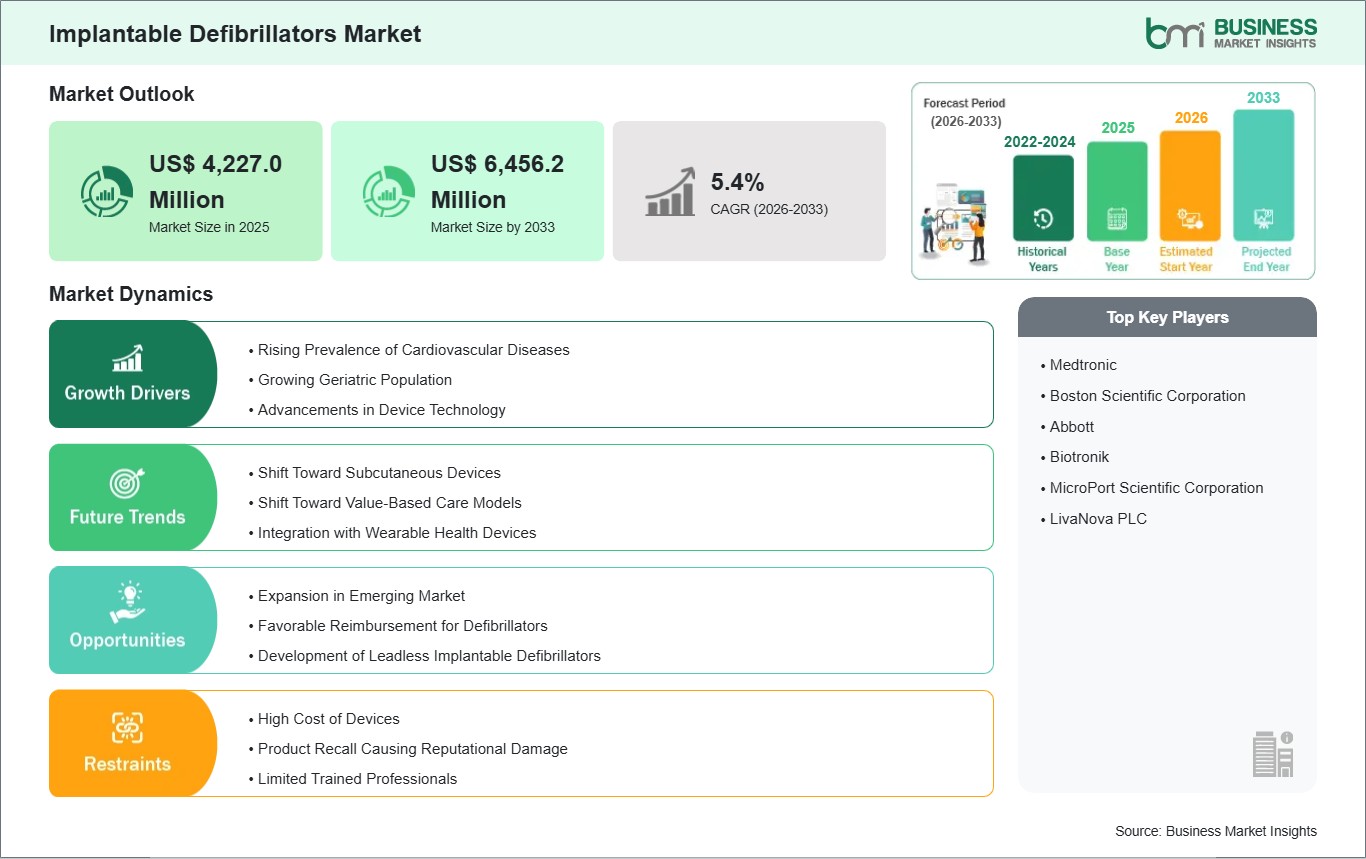
The implantable defibrillators market size is expected to reach US$ 6,456.2 million by 2033 from US$ 4,227.0 million in 2025. The market is estimated to record a CAGR of 5.4% from 2026 to 2033.
The implantable defibrillators market is expanding steadily, supported by the growing burden of cardiovascular diseases across developed and emerging countries. According to the World Health Organization, cardiovascular diseases remain the leading cause of death worldwide, highlighting the strong clinical need for effective rhythm management solutions. Implantable cardioverter defibrillators (ICDs) are crucial in preventing sudden cardiac arrest in patients with severe arrhythmias and heart failure. The rising elderly population, increasing incidence of diabetes and obesity, and sedentary lifestyles are contributing to a larger high-risk patient pool globally.
Improved diagnostic capabilities and greater awareness about early cardiac screening are enabling the timely identification of at-risk patients. Technological advancements such as MRI-compatible devices, subcutaneous ICDs, longer battery life, and remote monitoring systems are enhancing patient safety and convenience. Favorable reimbursement frameworks in developed regions and the gradual expansion of insurance coverage in emerging economies are also improving access to these life-saving devices. Additionally, growing investments in specialized cardiac centers and electrophysiology labs are supporting higher implantation rates.
High device and procedure costs continue to limit adoption in price-sensitive markets with limited reimbursement coverage. The risk of surgical complications, device malfunctions, and product recalls may also affect physician and patient confidence. Moreover, strict regulatory requirements can delay product approvals. However, continued innovation and rising clinical demand are expected to sustain long-term global market expansion.

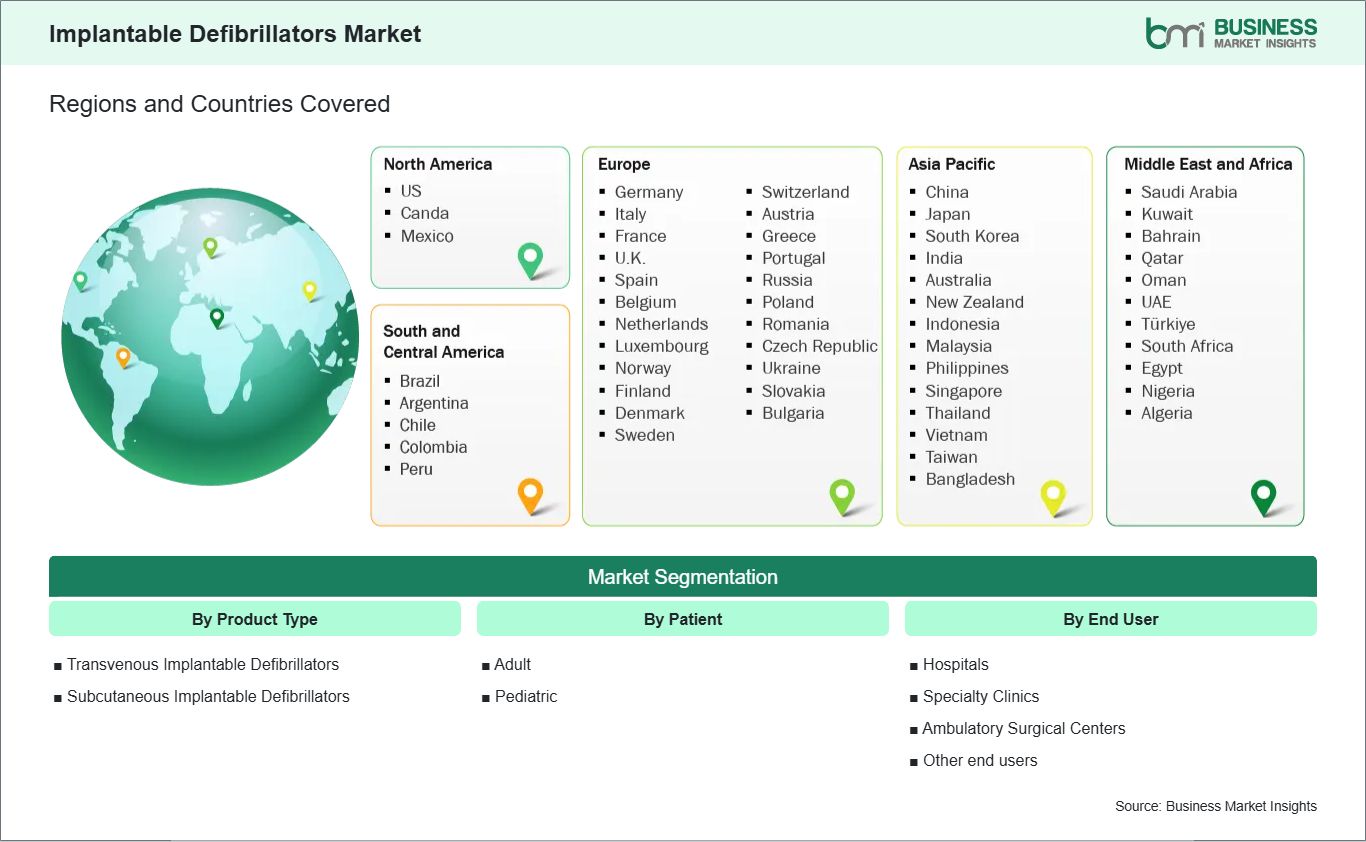
Key segments that contributed to the derivation of the implantable defibrillators market analysis are product type, patient type, and end user.
The implantable defibrillators market is driven by the rising burden of cardiovascular diseases (CVDs) worldwide. According to the World Health Organization, cardiovascular diseases are the leading cause of death globally, claiming nearly 18 million lives each year. This accounts for roughly one-third of all deaths across the world, with most of these deaths due to heart attacks and strokes. Such high mortality reflects the growing number of patients living with conditions that affect heart rhythm and heart muscle function. Many people with weakened heart function or irregular heartbeats are at higher risk of sudden cardiac arrest, making implantable defibrillators a vital part of clinical care.
As CVD prevalence rises, healthcare providers are more frequently diagnosing arrhythmias, heart failure, and other chronic heart conditions. This trend is apparent in both developed and developing regions. With better awareness, screening, and diagnostic tools, more patients who could benefit from long-term device therapy are identified early. Physicians prefer preventive treatments for high-risk individuals in addition to those who have already experienced life-threatening events such as cardiac arrest. These expand the eligible patient pool and boost demand for implantable defibrillators.
Furthermore, lifestyle shifts such as aging populations, sedentary habits, and higher rates of obesity and diabetes are fueling this rise in cardiovascular disease. As more people live longer with heart diseases, the need for reliable, long-term cardiac monitoring and therapy grows. These trends make implantable defibrillators a key technology in managing the global heart health burden and support continued expansion of the market.
Favorable reimbursement policies present a strong growth opportunity for the global implantable defibrillators market. In developed healthcare systems such as the US, Germany, France, Japan, and Canada, implantable cardioverter defibrillators are covered under public or private insurance schemes. Since these devices are high-cost, reimbursement support is crucial in patient access and hospital adoption. When insurance providers and government programs cover device cost and implantation procedures, it reduces the financial burden on patients and improves acceptance rates.
Clear clinical guidelines from cardiac societies and government bodies strengthen reimbursement decisions. When ICDs are included in standard treatment protocols for heart failure and arrhythmia management, payers are more likely to approve coverage. This structured reimbursement environment encourages hospitals to invest in advanced defibrillator technologies, including subcutaneous and MRI-compatible devices. It also supports replacement procedures when battery life ends, creating repeat demand in the market.
Emerging economies are also gradually expanding insurance coverage for cardiac procedures through public health schemes. As healthcare infrastructure improves and more patients receive financial protection, access to life-saving implantable defibrillators is expected to rise. Manufacturers that align their pricing, clinical evidence, and value proposition with payer expectations are well-positioned to benefit from this supportive reimbursement landscape.

The global implantable defibrillators market is experiencing steady growth, with market size and share analysis reflecting evolving treatment preferences and competitive dynamics among key players. The report evaluates important subsegments categorized within product type, patient type, and end user, highlighting their respective contributions to overall market performance.
By product type, the transvenous implantable defibrillators subsegment dominated the market in 2025, due to established clinical efficacy, broader physician familiarity, proven long-term outcomes, wider availability, and strong adoption in treating high-risk cardiac patients compared to newer subcutaneous options.
In terms of patient type, the adult subsegment dominated the market in 2025. This leadership is attributed to the higher prevalence of cardiac disorders in the adult population, increased awareness of sudden cardiac death prevention, and greater accessibility of advanced defibrillator therapies for adult patients.
Based on end user, the hospitals subsegment dominated the market in 2025. Hospitals remain the primary distribution channel due to their comprehensive cardiac care facilities, access to trained cardiologists and specialized technicians, advanced monitoring infrastructure, and ability to provide immediate, life-saving interventions.
| Report Attribute | Details |
|---|---|
| Market size in 2025 | US$ 4,227.0 Million |
| Market Size by 2033 | US$ 6,456.2 Million |
| Global CAGR (2026 - 2033) | 5.4% |
| Historical Data | 2022-2024 |
| Forecast period | 2026-2033 |
| Segments Covered | By By Product Type
|
|
Regions and Countries Covered
| |
| North America | US, Canada, Mexico |
| Europe | Germany, Italy, France, U.K., Spain, Belgium, Netherlands, Luxembourg, Norway, Finland, Denmark, Sweden, Switzerland, Austria, Greece, Portugal, Russia, Poland, Romania, Czech Republic, Ukraine, Slovakia, Bulgaria |
| Asia-Pacific | China, Japan, South Korea, India, Australia, New Zealand, Indonesia, Malaysia, Philippines, Singapore, Thailand, Vietnam, Taiwan, Bangladesh |
| South and Central America | Brazil, Argentina, Chile, Colombia, Peru |
| Middle East and Africa | Saudi Arabia, United Arab Emirates, Kuwait, Bahrain, Qatar, Oman, Turkiye, South Africa, Egypt, Nigeria, Algeria |
| Market leaders and key company profiles |
|
The "Implantable Defibrillators Market Size and Forecast (2022–2033)" report provides a detailed analysis of the market covering below areas:
The geographical scope of the implantable defibrillators market report is divided into: North America, Asia Pacific, Europe, Middle East & Africa, and South & Central America. North America held the largest share in 2025.
North America dominates the global implantable defibrillators market due to its advanced healthcare infrastructure and high awareness of cardiovascular risk management. The US represents the largest share within the region, supported by a strong base of cardiac specialists and well-established hospital networks. The region experiences a high prevalence of heart failure and arrhythmias, which increases demand for implantable cardioverter defibrillators as a preventive treatment against sudden cardiac arrest. Favorable reimbursement policies play a key role in regional dominance. Government programs and private insurance providers widely cover ICD implantation procedures, reducing financial burden on patients. Regulatory oversight from the US Food and Drug Administration ensures product safety and performance standards, while also supporting innovation through structured approval pathways. The presence of leading device manufacturers and continuous research activities contributes to early access to technologically advanced products.
North America also benefits from high adoption of remote patient monitoring and connected cardiac care solutions. Many hospitals and cardiac centers are equipped with specialized electrophysiology labs capable of performing complex implantation procedures. Strong clinical guidelines and preventive healthcare strategies further promote timely device adoption. These firmly position North America as the leading regional market for implantable defibrillators.

The implantable defibrillators market is evaluated by gathering qualitative and quantitative data post primary and secondary research, which includes important corporate publications, association data, and databases. A few of the key developments in the Implantable Defibrillators market are:
The Implantable Defibrillators Market is valued at US$ 4,227.0 Million in 2025, it is projected to reach US$ 6,456.2 Million by 2033.
As per our report Implantable Defibrillators Market, the market size is valued at US$ 4,227.0 Million in 2025, projecting it to reach US$ 6,456.2 Million by 2033. This translates to a CAGR of approximately 5.4% during the forecast period.
The Implantable Defibrillators Market report typically cover these key segments-
The historic period, base year, and forecast period can vary slightly depending on the specific market research report. However, for the Implantable Defibrillators Market report:
The Implantable Defibrillators Market is populated by several key players, each contributing to its growth and innovation. Some of the major players include:
The Implantable Defibrillators Market report is valuable for diverse stakeholders, including:
Essentially, anyone involved in or considering involvement in the Implantable Defibrillators Market value chain can benefit from the information contained in a comprehensive market report.
Please tell us your area of interest
(Market Segments/ Regions and Countries/ Companies)