ASEAN Implantable Defibrillators Market (2022-2033)

Historic Data: 2022-2024   |   Base Year: 2025   |   Forecast Period: 2026-2033
Report Content: Market Scope, Market Segmentation, Market Dynamics, and Competitive Analysis

Report Coverage:
  • Product (Transvenous Implantable Defibrillators, Subcutaneous Implantable Defibrillators)
  • Patient Type (Adult, Pediatric)
  • End User (Hospitals, Specialty Clinics, Ambulatory Surgical Centers, Other end users)

No. of Pages: 150
Report Code: BMIPUB00034914
Category: Life Sciences
ASEAN Implantable Defibrillators Market

The ASEAN defibrillators market size is expected to reach US$ 183.4 million by 2033 from US$ 124.3 million in 2025. The market is estimated to record a CAGR of 5.0% from 2026 to 2033.

Executive Summary and ASEAN Implantable Defibrillators Market Analysis:

The ASEAN implantable defibrillators market is shaped by shifting cardiovascular disease profiles, rapid urbanization, and a diversified healthcare ecosystem across Southeast Asia. Rising incidence of heart rhythm disorders and sudden cardiac death risk factors is elevating clinical demand for advanced cardiac rhythm management solutions, including ICDs. The market's evolution is linked to expanding private healthcare infrastructure, especially in regional hubs, and increasing clinician awareness of arrhythmia management pathways. Modern hospital upgrades, cross-border medical collaborations, and tele-health support tools are progressively bridging gaps in procedural capabilities and care delivery across ASEAN healthcare settings.

Regulatory frameworks and approval timelines vary significantly across member nations, complicating product launch strategies for global manufacturers. Adoption of ICDs still trails far behind other cardiovascular technologies in many ASEAN countries due to cost sensitivity, limited reimbursement support, and disparities in specialist availability outside metropolitan centers. Additionally, low levels of patient awareness on preventive arrhythmia care often result in delayed clinical intervention decisions, constraining broader uptake of implantable defibrillators in the region.

ASEAN Implantable Defibrillators Market - Strategic Insights:

global-market-strategic-framework
Get more information on this report

ASEAN Implantable Defibrillators Market Segmentation Analysis:

Key segments that contributed to the derivation of the ASEAN Implantable Defibrillators market analysis are product type, patient type, and end user.

  • By product type, the implantable defibrillators market is segmented into transvenous implantable defibrillators and subcutaneous implantable defibrillators. The transvenous implantable defibrillators segment dominated the market in 2025.
  • Based on patient type, the implantable defibrillators market is classified into adult and pediatric. The adult segment dominated the market in 2025.
  • In terms of end user, the implantable defibrillators market is categorized into hospitals, specialty clinics, ambulatory surgical centers, and other end users. The hospitals segment dominated the market in 2025.

ASEAN Implantable Defibrillators Market Drivers and Opportunities:

Growing Burden of Cardiovascular Diseases

ASEAN countries are witnessing a rise in cardiovascular diseases (CVDs, driven by rapid economic growth, urban lifestyles, and demographic aging. Nations such as Indonesia, Thailand, Malaysia, and Vietnam are reporting increasing incidence of coronary artery disease, arrhythmias, and sudden cardiac arrest, particularly in densely populated urban areas, including Jakarta, Bangkok, and Kuala Lumpur. Dietary changes, sedentary behavior, smoking prevalence, and rising diabetes rates are exacerbating cardiovascular risk across the region.

Healthcare systems are responding by strengthening acute cardiac care infrastructure, particularly in tertiary hospitals and urban medical centers. Public and private hospitals are expanding coronary care units and emergency departments, with increased deployment of AEDs and implantable cardioverter defibrillators (ICDs). Countries such as Singapore and Malaysia have made notable progress in integrating defibrillation into emergency response protocols, supported by improved clinical guidelines and advanced life support training.

Despite these advancements, disparities persist between urban and rural areas across ASEAN. Limited access to specialized cardiac care and emergency medical services in remote provinces of Indonesia, the Philippines, and Myanmar can delay life-saving interventions. Governments and regional health authorities are prioritizing public access defibrillation programs, ambulance upgrades, and community training initiatives to improve survival outcomes and address the uneven burden of cardiovascular disease across the region.

Increasing Adoption of Home Defibrillator Devices

ASEAN is seeing growing awareness and acceptance of home defibrillator devices, particularly among high-risk cardiac patients. Rising middle-class populations and improved health literacy in countries such as Singapore, Thailand, and Malaysia are encouraging households to invest in portable AEDs for personal use. Families with elderly members or patients with prior cardiac events are viewing home defibrillators as an essential safety measure rather than a specialized medical device.

The expansion of home healthcare services and digital health platforms is supporting this trend. Cardiologists and primary care providers are more frequently recommending home-use AEDs alongside chronic disease management plans, often paired with remote monitoring and caregiver training. In urban ASEAN settings where traffic congestion and variable ambulance response times can delay emergency care, immediate access to defibrillation at home is viewed as a critical survival advantage.

However, adoption remains uneven across the region due to cost sensitivity and varying levels of healthcare infrastructure. In lower-income ASEAN markets, affordability and limited insurance coverage continue to restrict household uptake of home defibrillators. Initiatives by private healthcare providers, community health programs, and regional distributors to offer financing options, training, and awareness campaigns are expected to gradually improve accessibility, positioning home defibrillators as an emerging segment in the ASEAN defibrillators market.

ASEAN Implantable Defibrillators Market Size and Share Analysis:

The ASEAN implantable defibrillators market is experiencing steady growth, with market size and share analysis reflecting evolving treatment preferences and competitive dynamics among key players. The report evaluates important subsegments categorized within product type, patient type, and end user, highlighting their respective contributions to overall market performance.

By product type, the transvenous implantable defibrillators subsegment dominated the market in 2025, due to established clinical efficacy, broader physician familiarity, proven long-term outcomes, wider availability, and strong adoption in treating high-risk cardiac patients compared to newer subcutaneous options.

In terms of patient type, the adult subsegment dominated the market in 2025. This leadership is attributed to the higher prevalence of cardiac disorders in the adult population, increased awareness of sudden cardiac death prevention, and greater accessibility of advanced defibrillator therapies for adult patients.

Based on end user, the hospitals subsegment dominated the market in 2025. Hospitals remain the primary distribution channel due to their comprehensive cardiac care facilities, access to trained cardiologists and specialized technicians, advanced monitoring infrastructure, and ability to provide immediate, life-saving interventions.

ASEAN Implantable Defibrillators Market Report Highlights:

Report Attribute Details
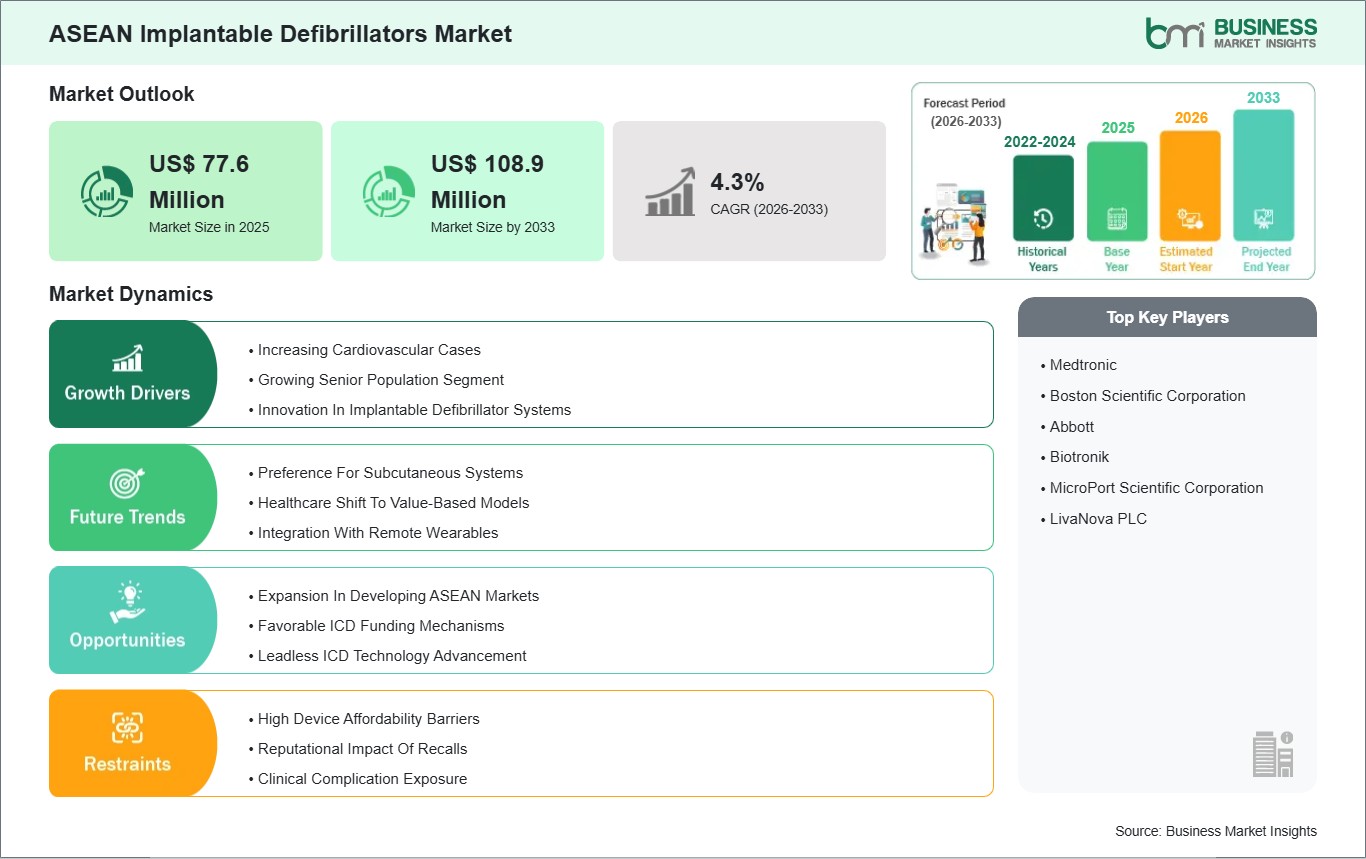
Market size in 2025 US$ 77.6 Million
Market Size by 2033 US$ 108.9 Million
CAGR (2026 - 2033)4.3%
Historical Data 2022-2024
Forecast period 2026-2033
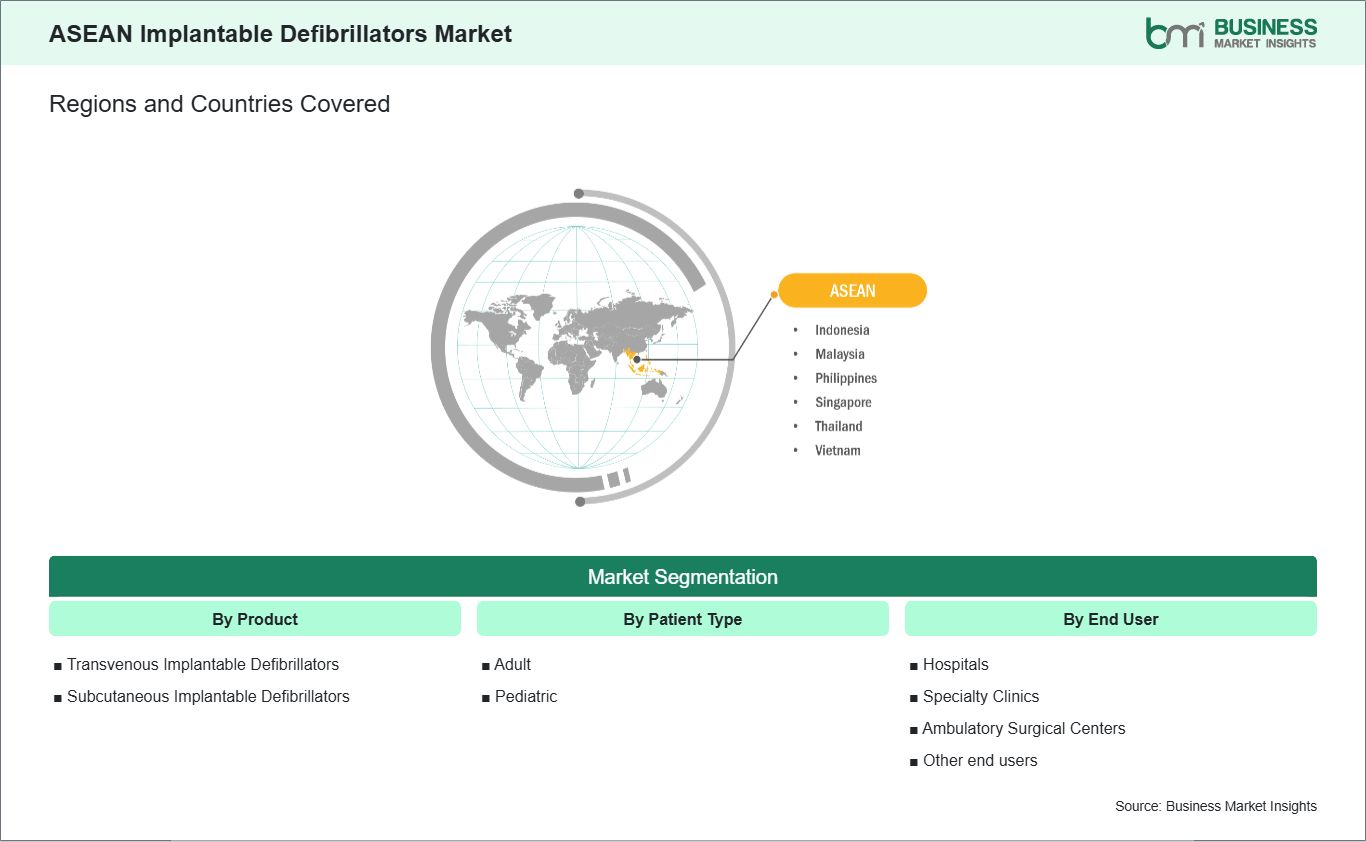
Segments Covered By Product
  • Transvenous Implantable Defibrillators
  • Subcutaneous Implantable Defibrillators
By Patient Type
  • Adult
  • Pediatric
By End User
  • Hospitals
  • Specialty Clinics
  • Ambulatory Surgical Centers
  • Other end users
Regions and Countries Covered
ASEAN Indonesia, Malaysia, Philippines, Singapore, Thailand, Vietnam
Market leaders and key company profiles
  • Medtronic
  • Boston Scientific Corporation
  • Abbott
  • Biotronik
  • MicroPort Scientific Corporation
  • LivaNova PLC
Get more information on this report

ASEAN Implantable Defibrillators Market Report Coverage and Deliverables:

The "ASEAN Implantable Defibrillators Market Size and Forecast (2022–2033)" report provides a detailed analysis of the market covering below areas:

  • ASEAN Implantable Defibrillators market size and forecast at regional and country levels for all market segments covered under the scope
  • ASEAN Implantable Defibrillators market trends, as well as drivers, restraints, and opportunities
  • ASEAN Implantable Defibrillators market analysis covering key trends, regional framework, major players, regulations, and recent developments
  • Industry landscape and competition analysis covering market concentration, heat map analysis, prominent players, and recent developments for the ASEAN Implantable Defibrillators market
  • Detailed company profiles, including SWOT analysis

ASEAN Implantable Defibrillators Market Geographic Insights:

The geographical scope of the ASEAN Defibrillators market report is divided into: Indonesia, Malaysia, the Philippines, Singapore, Thailand, and Vietnam. Indonesia held the largest share in 2025.

Indonesia dominates the ASEAN External Defibrillators market due to its expanding healthcare system and rising prioritization of emergency medical preparedness. Growing awareness of cardiac emergencies and increasing demand for advanced acute care equipment have driven the procurement of external defibrillators across public and private healthcare institutions. The private healthcare sector plays a central role in upgrading cardiac care capabilities, incorporating advanced biphasic defibrillators and integrated monitoring systems into clinical practice.

Institutional adoption is extending beyond hospitals into corporate facilities, hospitality establishments, and transportation infrastructure as part of enhanced safety compliance measures. However, market penetration remains influenced by budget prioritization within public healthcare systems, where primary care services take precedence over emergency equipment expansion. Logistical complexity related to device distribution and maintenance presents operational challenges. Additionally, public awareness and structured training programs for defibrillator use are developing. Despite these restraints, ongoing healthcare reforms and increasing emphasis on improving survival outcomes in cardiac emergencies reinforce Indonesia’s leadership within the ASEAN external defibrillators market.

global-market-geography
Get more information on this report

ASEAN Implantable Defibrillators Market Research Report Guidance:

  • The report includes qualitative and quantitative data in the ASEAN Implantable Defibrillators market across product type, patient type, end user, and geography.
  • The report starts with the key takeaways (chapter 2), highlighting the key trends and outlook of the ASEAN Implantable Defibrillators market.
  • Chapter 3 focuses on the research methodology of the study.
  • Chapter 4 includes ecosystem analysis.
  • Chapter 5 highlights the major industry dynamics in the ASEAN Implantable Defibrillators market, including factors that are driving the market, prevailing deterrents, potential opportunities, as well as future trends. Impact analysis of these drivers and restraints is also covered in this section.
  • Chapter 6 discusses the ASEAN Implantable Defibrillators market scenario, in terms of historical market revenues, and forecast till the year 2033.
  • Chapters 7 to 10 cover the ASEAN Implantable Defibrillators market segments by product type, patient type, end user, and geography across Indonesia, Malaysia, the Philippines, Singapore, Thailand, and Vietnam. They cover the market revenue, forecast, and factors driving the market.
  • Chapter 11 describes the competitive analysis along with the heat map analysis for the key players operating in the market.
  • Chapter 12 describes the industry landscape analysis. It provides detailed descriptions of business activities such as market initiatives, new developments, mergers, and joint ventures globally, along with a competitive landscape.
  • Chapter 13 provides detailed profiles of the major companies operating in the ASEAN Implantable Defibrillators market. Companies have been profiled on the basis of their key facts, business descriptions, products, financial overview, SWOT analysis, and key developments.
  • Chapter 14, i.e., the appendix, is inclusive of a brief overview of the company, list of abbreviations, and disclaimer.

ASEAN Implantable Defibrillators Market News and Key Development:

The ASEAN Defibrillators market is evaluated by gathering qualitative and quantitative data post primary and secondary research, which includes important corporate publications, association data, and databases. A few of the key developments in the ASEAN Defibrillators market are:

  • In June 2024, Stryker announced that it had released the LIFEPAK 35 monitor/defibrillator, a clinically advanced monitor/defibrillator platform designed to provide connected data and streamlined workflows for emergency responders and healthcare professionals across global markets, including Asia Pacific.
  • In December 2023, BIOTRONIK announced that it had opened a new Asia-Pacific Manufacturing and Research Hub in Singapore, a 20,000 m² facility that integrates manufacturing, research & development, quality, and sales functions for advanced cardiac rhythm management devices, including implantable defibrillators.

Key Sources Referred:

  • The World Bank
  • World Health Organization (WHO)
  • Center for Disease Control and Prevention (CDC)
  • European Database on Medical Devices (EUDAMED)
  • European Society of Cardiology
  • American College of Cardiology
  • American Heart Association
  • Company Websites
  • Company Annual Reports
  • Company Investor Presentations
The List of Companies - ASEAN Implantable Defibrillators Market
  • Medtronic
  • Boston Scientific Corporation
  • Abbott
  • Biotronik
  • MicroPort Scientific Corporation
  • LivaNova PLC
Frequently Asked Questions
How big is the ASEAN Implantable Defibrillators Market?

The ASEAN Implantable Defibrillators Market is valued at US$ 77.6 Million in 2025, it is projected to reach US$ 108.9 Million by 2033.

What is the CAGR for ASEAN Implantable Defibrillators Market by (2026 - 2033)?

As per our report ASEAN Implantable Defibrillators Market, the market size is valued at US$ 77.6 Million in 2025, projecting it to reach US$ 108.9 Million by 2033. This translates to a CAGR of approximately 4.3% during the forecast period.

What segments are covered in this report?

The ASEAN Implantable Defibrillators Market report typically cover these key segments-

  • Product (Transvenous Implantable Defibrillators, Subcutaneous Implantable Defibrillators)
  • Patient Type (Adult, Pediatric)
  • End User (Hospitals, Specialty Clinics, Ambulatory Surgical Centers, Other end users)

What is the historic period, base year, and forecast period taken for ASEAN Implantable Defibrillators Market?

The historic period, base year, and forecast period can vary slightly depending on the specific market research report. However, for the ASEAN Implantable Defibrillators Market report:

  • Historic Period : 2022-2024
  • Base Year : 2025
  • Forecast Period : 2026-2033
  • Who are the major players in ASEAN Implantable Defibrillators Market?

    The ASEAN Implantable Defibrillators Market is populated by several key players, each contributing to its growth and innovation. Some of the major players include:

  • Medtronic
  • Boston Scientific Corporation
  • Abbott
  • Biotronik
  • MicroPort Scientific Corporation
  • LivaNova PLC
  • Who should buy this report?

    The ASEAN Implantable Defibrillators Market report is valuable for diverse stakeholders, including:

    • Investors: Provides insights for investment decisions pertaining to market growth, companies, or industry insights. Helps assess market attractiveness and potential returns.
    • Industry Players: Offers competitive intelligence, market sizing, and trend analysis to inform strategic planning, product development, and sales strategies.
    • Suppliers and Manufacturers: Helps understand market demand for components, materials, and services related to concerned industry.
    • Researchers and Consultants: Provides data and analysis for academic research, consulting projects, and market studies.
    • Financial Institutions: Helps assess risks and opportunities associated with financing or investing in the concerned market.

    Essentially, anyone involved in or considering involvement in the ASEAN Implantable Defibrillators Market value chain can benefit from the information contained in a comprehensive market report.

    Available Report Formats

    pdf-format excel-format pptx-format
    Buy Now
    Sales Assistance
    +1 646 791 7070 (US & UK)
    Customization Form

    Please tell us your area of interest
    (Market Segments/ Regions and Countries/ Companies)