Market Summary
Executive Summary and Market Analysis
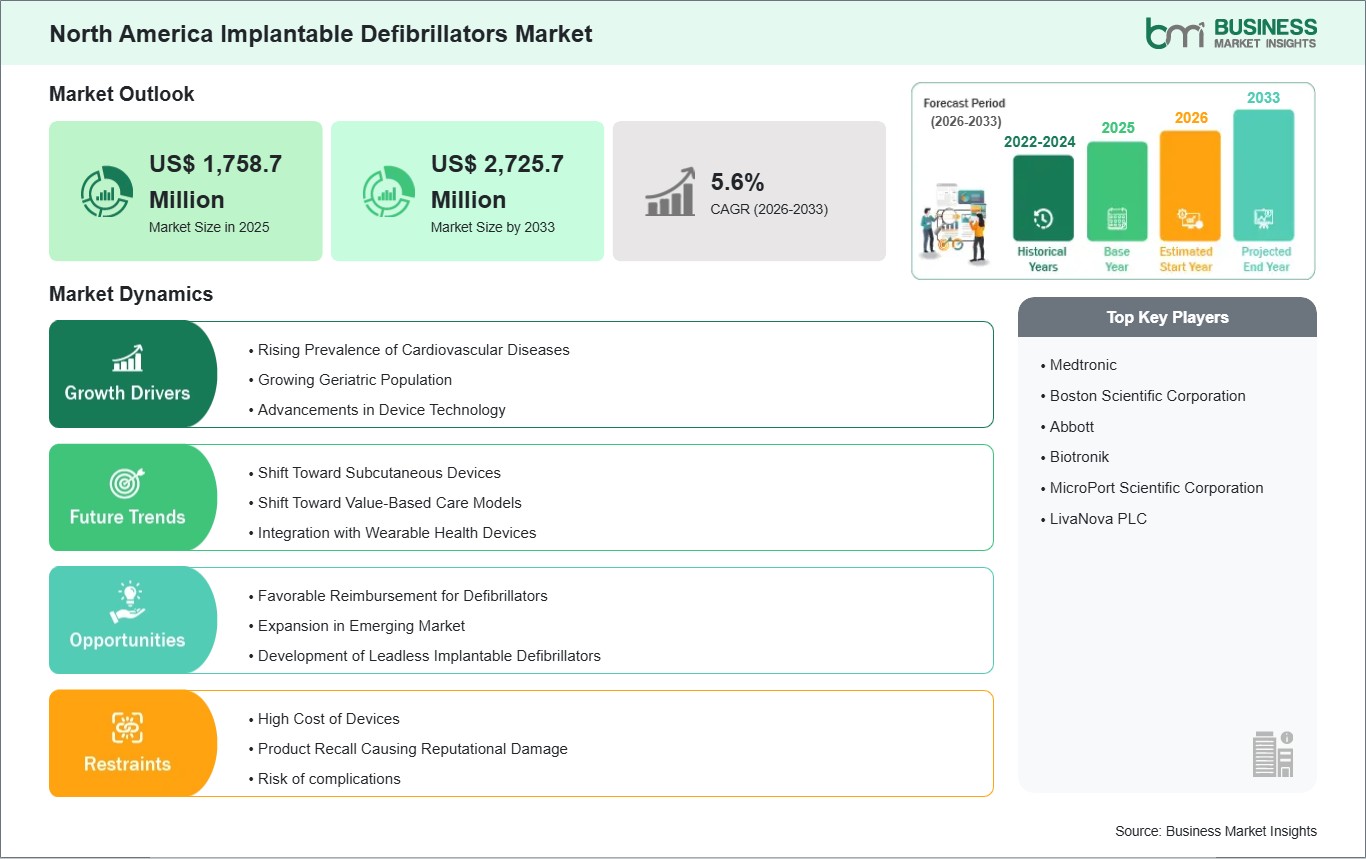
The North America implantable defibrillators market reflects a strong focus on advanced cardiac care driven by the rising prevalence of sudden cardiac arrest, expanding geriatric population, and well-established healthcare infrastructure. A combination of high awareness among clinicians, widespread adoption of guideline-based therapy, and strong health insurance coverage support consistently high utilization rates of implantable cardioverter defibrillators (ICDs) and cardiac resynchronization therapy defibrillators (CRT-Ds). Continuous innovations such as leadless and MRI-compatible ICDs, remote patient monitoring, and improved device longevity incentivize adoption among cardiologists and electrophysiologists. Market growth is reinforced by proactive screening and early intervention strategies embedded in structured cardiac care protocols.
Certain constraints temper growth across the region. Procedural costs, particularly in private healthcare settings, coupled with concerns related to device recalls and complications such as lead failures, intermittently influence physician preference and patient confidence. Additionally, reimbursement nuances in rural and semi-urban regions create variability in access to advanced electrophysiology services. Despite these challenges, strong clinical evidence, ongoing technological advancements, and continuous investment in cardiac specialty care position North America as a global leader in the implantable defibrillators market.
Segment Analysis
North America Implantable Defibrillators Market Segmentation
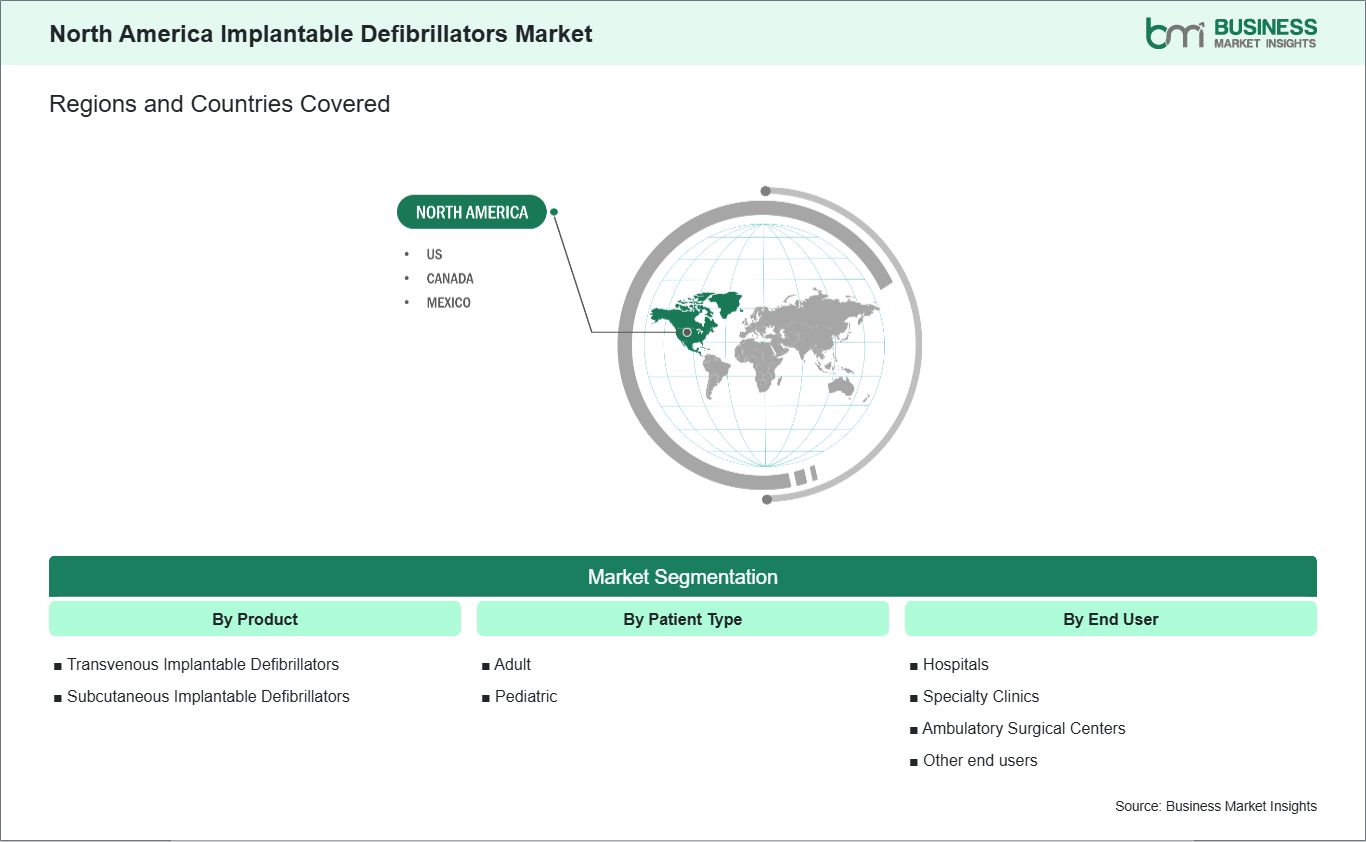
Key segments that contributed to the derivation of the North America Implantable Defibrillators market analysis are product type, patient type, and end user.
- By product type, the implantable defibrillators market is segmented into transvenous implantable defibrillators and subcutaneous implantable defibrillators. The transvenous implantable defibrillators segment dominated the market in 2025.
- Based on patient type, the implantable defibrillators market is classified into adult and pediatric. The adult segment dominated the market in 2025.
- In terms of end user, the implantable defibrillators market is categorized into hospitals, specialty clinics, ambulatory surgical centers, and others. The hospitals segment dominated the market in 2025.
Market Forces
North America Implantable Defibrillators Market Drivers and Opportunities
Rising Prevalence of Cardiovascular Diseases
North America faces a significant challenge with cardiovascular diseases, which continue to be a leading cause of mortality across the region. The high prevalence of heart conditions, combined with lifestyle factors such as sedentary behavior and dietary patterns, has increased the urgency for rapid-response medical devices. As a result, both hospitals and emergency services are placing greater emphasis on the availability and use of implantable defibrillators to manage sudden cardiac events effectively.
Hospitals, clinics, and emergency medical services in North America are integrating advanced defibrillation technology into their standard protocols. Implantable defibrillators are being used more widely to ensure timely intervention during cardiac emergencies. The emphasis on early detection and immediate response is reshaping how cardiac care is delivered in both urban centers and smaller communities, highlighting the critical role of these devices.
Innovation in device design and functionality has also accelerated in response to the cardiovascular burden. Modern implantable defibrillators are becoming smarter, more reliable, and easier to operate, enabling quicker life-saving interventions. With aging populations in Canada and the US, the demand for both hospital-based and portable defibrillation solutions is expected to continue rising, making North America a key focus region in the implantable defibrillator market.
Favorable Reimbursement for Defibrillators
In North America, reimbursement policies for cardiac devices are more developed and supportive compared to many other regions. Both public and private payers recognize the clinical value of implantable defibrillators in preventing sudden cardiac death. Coverage guidelines in the US and Canada include implantable defibrillators as part of standard care for eligible patients. This supportive reimbursement environment reduces financial barriers for patients and healthcare providers, making it easier for more people to access these life-saving devices.
Healthcare providers in the region are encouraged to recommend implantable defibrillators when patients meet clinical criteria because reimbursement is generally predictable and reliable. Hospitals and cardiac centers can plan treatments knowing that payers will cover device costs and associated procedures. This certainty creates confidence among clinicians and health systems to adopt defibrillator therapies. It also means that more patients who can benefit from these devices are likely to receive them, further strengthening market growth.
The favorable reimbursement scenario also attracts device manufacturers to invest in the North American market. Companies see a stable environment where innovative implantable defibrillators have a clear pathway to adoption and payment. This stimulates competition and encourages local development of advanced technologies tailored to regional needs. Strong reimbursement support in North America presents a significant opportunity for the implantable defibrillators market to expand and reach more patients in need of effective cardiac care.
Size and Share Analysis
North America Implantable Defibrillators Market Size and Share Analysis
The North America implantable defibrillators market is experiencing steady growth, with market size and share analysis reflecting evolving treatment preferences and competitive dynamics among key players. The report evaluates important subsegments categorized within product type, patient type, and end user, highlighting their respective contributions to overall market performance.
By product type, the transvenous implantable defibrillators subsegment dominated the market in 2025, due to established clinical efficacy, broader physician familiarity, proven long-term outcomes, wider availability, and strong adoption in treating high-risk cardiac patients compared to newer subcutaneous options.
In terms of patient type, the adult subsegment dominated the market in 2025. This leadership is attributed to the higher prevalence of cardiac disorders in the adult population, increased awareness of sudden cardiac death prevention, and greater accessibility of advanced defibrillator therapies for adult patients.
Based on end user, the hospitals subsegment dominated the market in 2025. Hospitals remain the primary distribution channel due to their comprehensive cardiac care facilities, access to trained cardiologists and specialized technicians, advanced monitoring infrastructure, and ability to provide immediate, life-saving interventions.
Report Coverage
North America Implantable Defibrillators Market Report Coverage and Deliverables
The "North America Implantable Defibrillators Market Size and Forecast (2022-2033)" report provides a detailed analysis of the market covering below areas:
- North America Implantable Defibrillators market size and forecast at regional and country levels for all market segments covered under the scope
- North America Implantable Defibrillators market trends, as well as drivers, restraints, and opportunities
- North America Implantable Defibrillators market analysis covering key trends, regional framework, major players, regulations, and recent developments
- Industry landscape and competition analysis covering market concentration, heat map analysis, prominent players, and recent developments for the North America Implantable Defibrillators market
- Detailed company profiles, including SWOT analysis
Geographic Insights
North America Implantable Defibrillators Market Geographic Insights
The geographical scope of the North America implantable defibrillators market report is divided into: The US, Canada, and Mexico. The US held the largest share in 2025.
The US represents the dominant market within North America, supported by a mature, innovation-driven healthcare ecosystem and a high burden of cardiovascular disease. Clinicians prioritize early risk stratification and interventional management, leading to widespread integration of ICD and CRT-D therapies across tertiary hospitals, academic medical centers, and specialized cardiac institutes. A well-defined reimbursement framework, including Medicare and private insurers covering guideline-based indications, sustains procedural volumes and ensures consistent adoption. The country also demonstrates strong uptake of next-generation technologies such as subcutaneous ICDs and advanced remote monitoring platforms that enhance post-implant patient management.
Innovation remains a defining characteristic of the US market, with close collaboration between electrophysiologists and device manufacturers driving refinements in battery longevity, shock reduction algorithms, and device miniaturization. Medical technology hubs foster rapid clinical validation and commercialization of new solutions, strengthening the country's leadership position. Nevertheless, disparities in access to electrophysiology expertise persist in rural and underserved communities, where infrastructure and reimbursement dynamics may influence timing and choice of device implantation. Despite these localized challenges, the US continues to shape regional clinical standards and technological advancement within the implantable defibrillators market.
Industry Activity
Recent Developments
The North America implantable defibrillators market is evaluated by gathering qualitative and quantitative data post primary and secondary research, which includes important corporate publications, association data, and databases. A few of the key developments in the North America Implantable Defibrillators market are:
- In April 2025, Medtronic announced that it received US FDA approval for its OmniaSecure defibrillation lead for placement in the right ventricle, which is a new small-diameter ICD lead designed to connect to implantable defibrillators and treat life-threatening ventricular arrhythmias in adults and adolescent patients.
- In November 2025, Medtronic announced strong real-world clinical outcomes from its Aurora EV-ICD system and sustained performance of the OmniaSecure defibrillation lead at three years in key post-market and pivotal studies, underscoring expanded clinical evidence and adoption of its implantable defibrillator technologies in North America and beyond.
Trust & Transparency
Research Methodology
The market analysis combines proprietary research with secondary data from government agencies, company disclosures, regulatory filings, industry databases and expert interviews. Market estimates are validated through data triangulation, cross-market benchmarking and analyst
review.
View Full Research Methodology
Key Sources Referred:
The World Bank World Health Organization (WHO) Center for Disease Control and Prevention (CDC) European Database on Medical Devices (EUDAMED) European Society of Cardiology American College of Cardiology American Heart Association Company Websites Company Annual Reports Company Investor Presentations