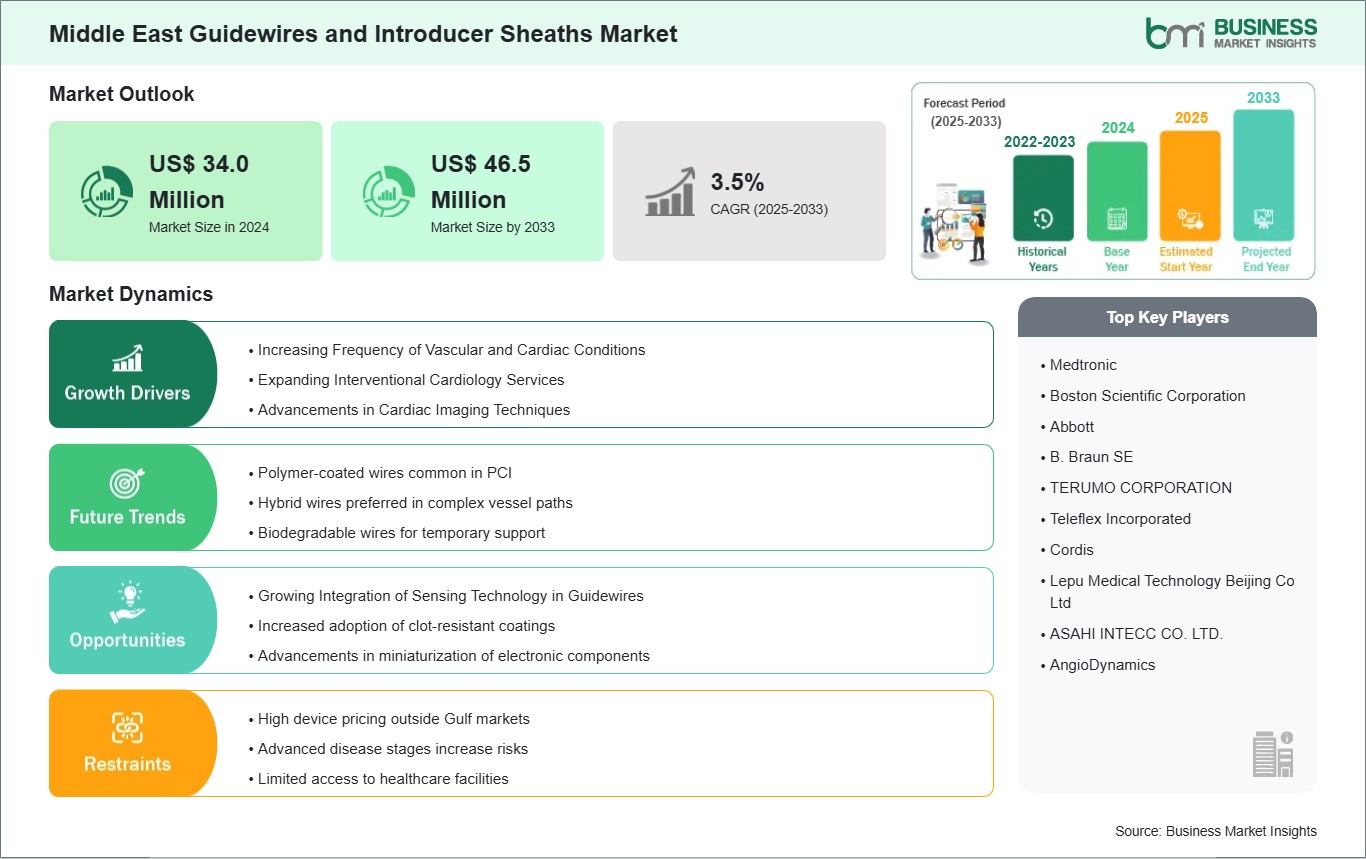
The Middle East guidewires and introducer sheaths market size is expected to reach US$ 46.5 million by 2033 from US$ 34.0 million in 2024. The market is estimated to record a CAGR of 3.5% from 2025 to 2033.
The Middle East guidewires and introducer sheaths market is undergoing rapid transformation, driven by government‑backed healthcare modernization, rising cardiovascular disease prevalence, and the establishment of advanced catheterization labs across the region. Hospitals are adopting consumables that support minimally invasive procedures, emphasizing patient safety, efficiency, and alignment with international standards. A distinctive driver is the region's ambition to reduce outbound medical tourism by offering world‑class interventional care locally, which accelerates the adoption of advanced guidewires and introducer sheaths. Procurement is often centralized, with ministries of health and large private hospital groups negotiating long‑term contracts, ensuring standardized device use and supply chain stability.
The integration of digital health and quality governance, in Gulf states and Turkey, where consumables are tracked against outcome dashboards and replenishment cycles. Market restraints include reliance on imported consumables, regulatory variations across countries, and cost‑containment pressures in public systems that can slow adoption of premium consumables. Despite these challenges, the Middle East benefits from strong government funding, private sector investment, and international partnerships that embed simulation‑led education and technical support. Hospitals remain the dominant end users, while specialized centers and diagnostic networks contribute by standardizing imaging‑led triage into interventional pathways. Vendors that localize service models and align with country‑specific procurement strategies are best positioned to capture sustained growth across this diverse Middle Eastern landscape.

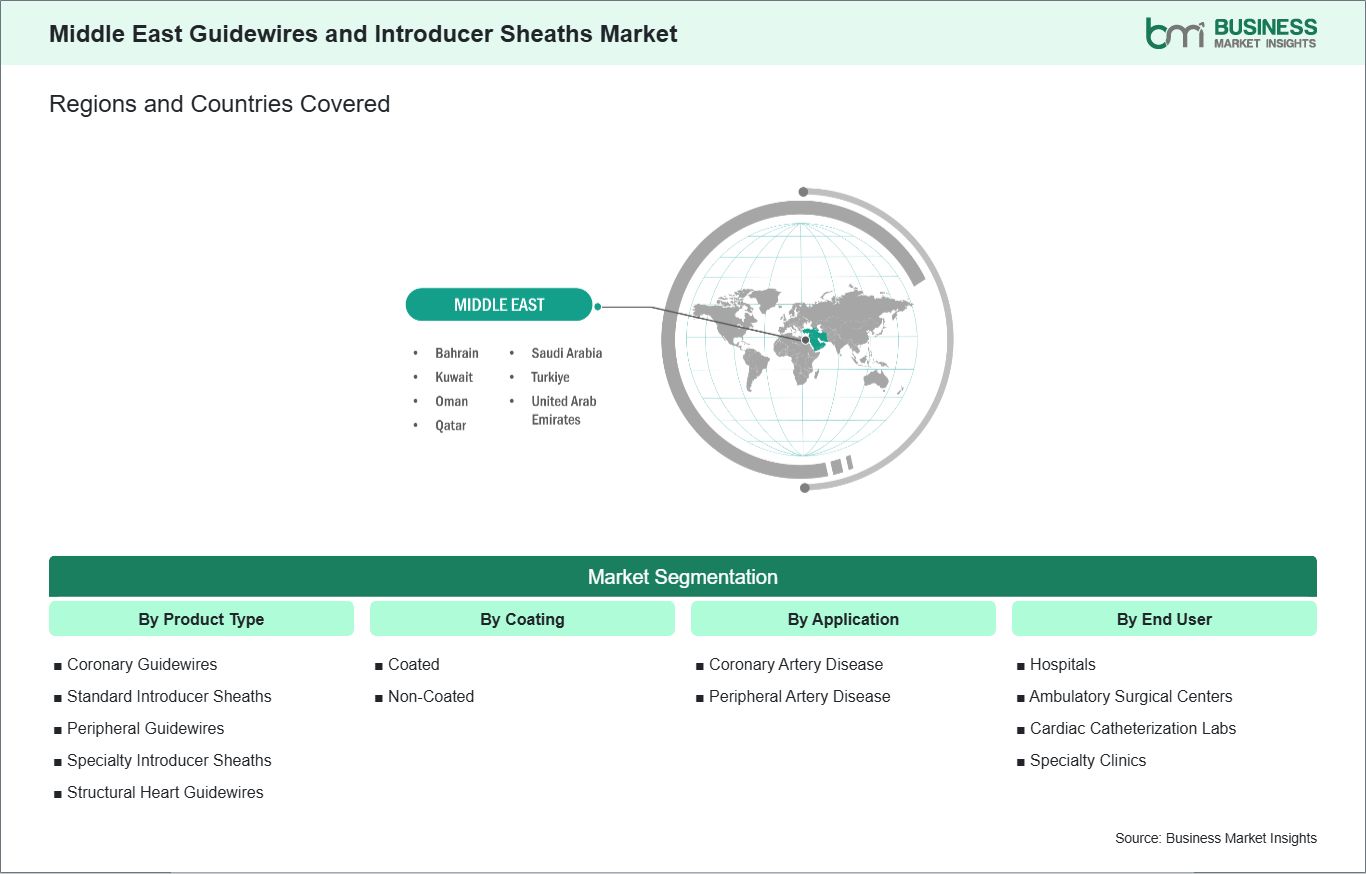
Key segments that contributed to the derivation of the Middle East guidewires and introducer sheaths market analysis are product type, coating, application, and end user.
The Middle East is experiencing a sharp increase in cardiovascular disease (CVD) prevalence, driven by high rates of diabetes, obesity, smoking, and sedentary lifestyles. Countries such as Saudi Arabia, the UAE, and Kuwait report some of the world's highest diabetes and metabolic syndrome rates, elevating the risk of coronary artery disease and peripheral vascular disorders. As a result, hospitals across the Gulf Cooperation Council (GCC) and parts of North Africa are facing a growing volume of patients requiring diagnostic angiography and interventional procedures, which has boosted demand for guidewires and introducer sheaths.
Healthcare systems in the Middle East are responding to this burden by rapidly expanding interventional cardiology capacity. Large tertiary hospitals in cities such as Riyadh, Dubai, Abu Dhabi, and Doha are investing heavily in state-of-the-art catheterization laboratories and hybrid operating rooms. These facilities are focused on minimally invasive cardiac and endovascular procedures to reduce hospital stays and complications. Guidewires and introducer sheaths form the backbone of these procedures, enabling safe and precise navigation through complex vascular anatomy in high-risk patients with multi-vessel disease.
Government-led healthcare transformation programs, such as Saudi Arabia's Vision 2030 and the UAE's national health strategies, are also accelerating access to advanced cardiovascular care. These initiatives prioritize early diagnosis, interventional treatment, and the localization of high-quality medical services, reducing reliance on overseas treatment. As more patients undergo percutaneous coronary interventions, structural heart procedures, and peripheral vascular therapies within the region, the need for reliable, high-performance guidewires and introducer sheaths continues to rise. This trend is creating a strong, sustainable foundation for long-term market growth across the Middle East.
The Middle East is adopting sensor-enabled guidewires as part of its broader push toward precision medicine and digital healthcare. Leading cardiac centers in the UAE, Saudi Arabia, and Qatar are integrating pressure- and flow-sensing guidewires into routine practice, for evaluating coronary artery disease and guiding complex interventions. These devices allow cardiologists to assess the functional significance of arterial blockages in real time, improving decision-making and helping to avoid unnecessary stent placements.
Hospitals in the region are especially drawn to sensor-enabled guidewires because of their ability to improve clinical outcomes while supporting cost-effective care. By providing objective physiological data, these devices help physicians select the most appropriate treatment strategy, which reduces complications and repeat procedures. In high-volume centers such as the Cleveland Clinic Abu Dhabi and King Faisal Specialist Hospital in Riyadh, these technologies are used in advanced coronary and peripheral interventions, reinforcing their clinical and economic value.
The adoption of sensor-enabled guidewires is further supported by partnerships between global medical device manufacturers and regional distributors, as well as by strong investment in clinician training. Many Middle Eastern countries host international cardiology conferences and hands-on workshops, accelerating the transfer of advanced interventional techniques. As the region continues to position itself as a hub for high-quality, technologically advanced healthcare, sensor-enabled guidewires are expected to gain wider acceptance. This trend not only elevates the standard of cardiovascular care but also strengthens the Middle East's role as a high-growth market for innovative guidewire and introducer sheath technologies.

The Middle East Guidewires and Introducer Sheaths market demonstrates steady growth, with size and share analysis highlighting evolving trends and competitive dynamics among key players. The report further examines subsegments categorized within product type, coating, application, and end user, offering insights into their contribution to overall market performance.
By product type, the coronary guidewires subsegment dominated the market in 2024. Coronary guidewires dominate due to their critical role in minimally invasive procedures, the rising prevalence of coronary artery disease, and technological advancements ensuring precision, safety, and improved patient outcomes in cardiovascular interventions.
Based on coating, the coated subsegment dominated the market in 2024. Coated guidewires led the market as surface coatings enhance durability, reduce friction, improve navigation through complex vessels, and minimize complications, making them the preferred choice among physicians for efficiency and patient safety.
In terms of application, the coronary artery disease subsegment dominated the market in 2024. The coronary artery disease segment dominated as increasing global incidence, lifestyle risk factors, and demand for advanced interventional cardiology solutions drove adoption of guidewires and sheaths tailored for coronary procedures.
By end user, the hospitals subsegment dominated the market in 2024. Hospitals dominated the market since they handle the majority of complex cardiovascular interventions, offer advanced infrastructure, skilled specialists, and comprehensive patient care, making them the primary setting for guidewire and sheath usage.
| Report Attribute | Details |
|---|---|
| Market size in 2024 | US$ 34.0 Million |
| Market Size by 2033 | US$ 46.5 Million |
| CAGR (2025 - 2033) | 3.5% |
| Historical Data | 2022-2023 |
| Forecast period | 2025-2033 |
| Segments Covered | By By Product Type
|
| Regions and Countries Covered | Middle East
|
| Market leaders and key company profiles |
|
The "Middle East Guidewires and Introducer Sheaths Market Size and Forecast (2022–2033)" report provides a detailed analysis of the market covering below areas:
The geographical scope of the Middle East Guidewires and Introducer Sheaths market report is divided into: the UAE, Saudi Arabia, Bahrain, Oman, Kuwait, Qatar, and Turkiye. Turkiye held the largest share in 2024.
Turkiye dominates the Middle East market due to its advanced hospital infrastructure, strong academic research ecosystem, and strategic role as a medical tourism hub. Hospitals in Istanbul, Ankara, and Izmir are equipped with state‑of‑the‑art catheterization labs, driving demand for guidewires and introducer sheaths that support high procedural volumes and complex interventions. A distinctive feature of Turkiye's market is its integration of medical tourism with domestic healthcare. International patients seeking cardiovascular and vascular procedures encourage hospitals to adopt consumables aligned with global standards. Procurement is shaped by a mix of government tenders and private hospital negotiations, with distributors ensuring reliable supply across the country's diverse regions. Growth is reinforced by partnerships with international vendors who establish training centers and simulation labs, elevating clinician proficiency and accelerating adoption of advanced consumables. Constraints include regulatory approval timelines, price sensitivity in public hospitals, and the challenge of balancing rapid modernization with equitable access across urban and rural areas.
Nonetheless, Turkiye benefits from strong demand driven by its large patient base, rising cardiovascular disease prevalence, and expanding private healthcare infrastructure. Hospitals remain the primary end users, while diagnostic centers support imaging‑led triage into interventional care. Vendors that align product design, training, and supply chain strategies with Turkiye's procurement models and clinical workflows are best positioned to sustain share and deepen adoption in this dominant Middle Eastern market.

The Middle East Guidewires and Introducer Sheaths market is evaluated by gathering qualitative and quantitative data post primary and secondary research, which includes important corporate publications, association data, and databases. A few of the key developments in the Middle East guidewires and introducer sheaths market are:
The Middle East Guidewires and Introducer Sheaths Market is valued at US$ 34.0 Million in 2024, it is projected to reach US$ 46.5 Million by 2033.
As per our report Middle East Guidewires and Introducer Sheaths Market, the market size is valued at US$ 34.0 Million in 2024, projecting it to reach US$ 46.5 Million by 2033. This translates to a CAGR of approximately 3.5% during the forecast period.
The Middle East Guidewires and Introducer Sheaths Market report typically cover these key segments-
The historic period, base year, and forecast period can vary slightly depending on the specific market research report. However, for the Middle East Guidewires and Introducer Sheaths Market report:
The Middle East Guidewires and Introducer Sheaths Market is populated by several key players, each contributing to its growth and innovation. Some of the major players include:
The Middle East Guidewires and Introducer Sheaths Market report is valuable for diverse stakeholders, including:
Essentially, anyone involved in or considering involvement in the Middle East Guidewires and Introducer Sheaths Market value chain can benefit from the information contained in a comprehensive market report.
Please tell us your area of interest
(Market Segments/ Regions and Countries/ Companies)