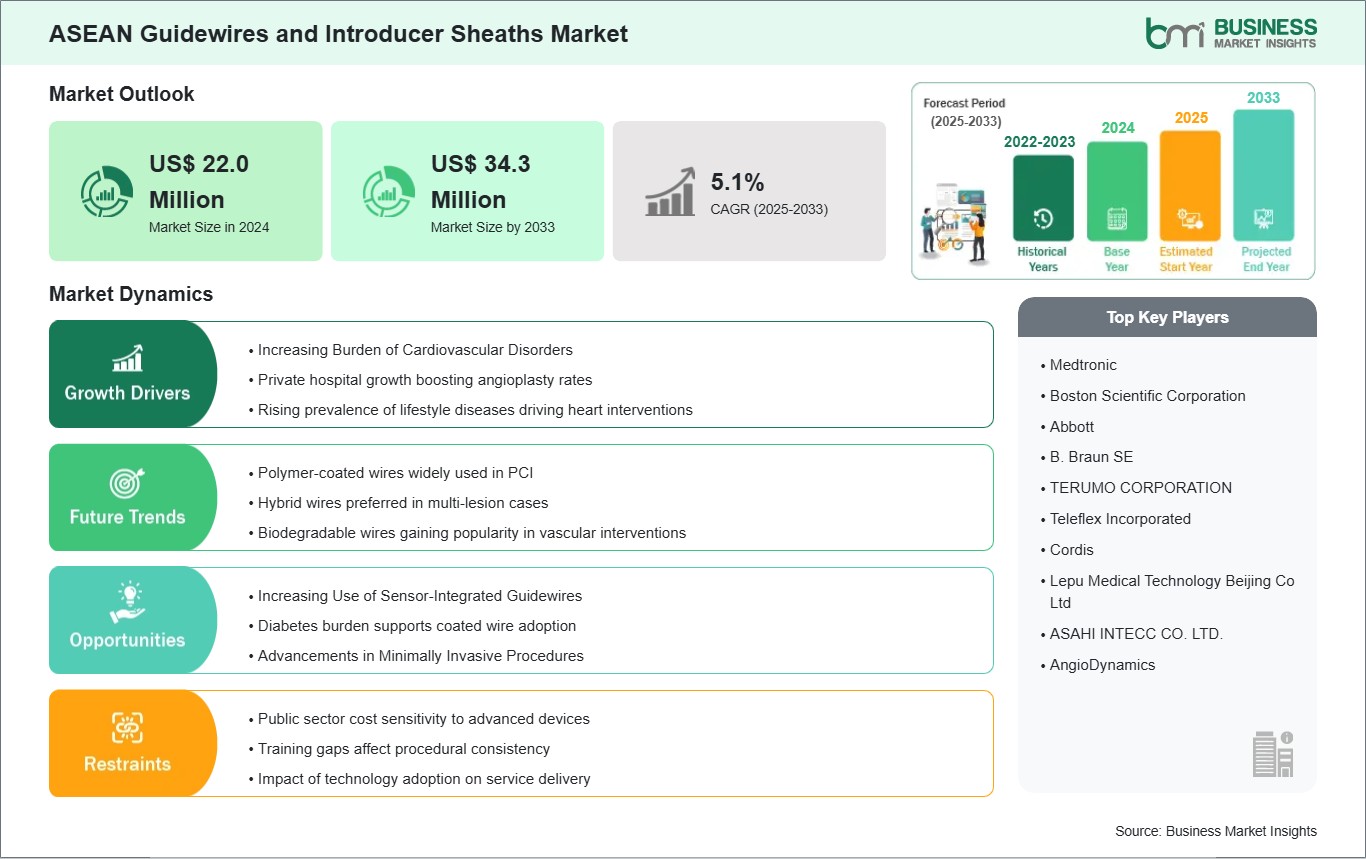
The ASEAN guidewires and introducer sheaths market size is expected to reach US$ 34.3 million by 2033 from US$ 22.0 million in 2024. The market is estimated to record a CAGR of 5.1% from 2025 to 2033.
The ASEAN guidewires and introducer sheaths market is evolving rapidly, shaped by the region's growing investment in cardiovascular and peripheral vascular care. Rising prevalence of lifestyle‑related diseases, coupled with expanding access to advanced interventional procedures, is fueling demand for versatile guidewire portfolios and introducer sheaths optimized for minimally invasive approaches. Hospitals across ASEAN are adopting hydrophilic‑coated guidewires for complex anatomies and low‑profile introducer sheaths that support radial access, reflecting a regional shift toward patient‑centric outcomes and shorter recovery times. Private healthcare networks and public sector modernization programs are driving procurement, with distributors ensuring device availability across diverse geographies. A key driver is the region's emphasis on medical tourism, which encourages hospitals to align with international standards and adopt advanced consumables to attract foreign patients. However, challenges remain in the form of uneven reimbursement frameworks, varying regulatory timelines, and disparities in clinician training across member states.
Despite these restraints, ASEAN's market momentum is reinforced by collaborative initiatives, cross‑border distributor partnerships, and structured clinical education programs that elevate procedural consistency. Hospitals remain the dominant end users, while diagnostic centers play a growing role in imaging‑led triage that feeds into interventional pathways. Vendors that tailor product portfolios to ASEAN's diverse procurement models and align training with local clinical workflows are best positioned to capture sustained growth.

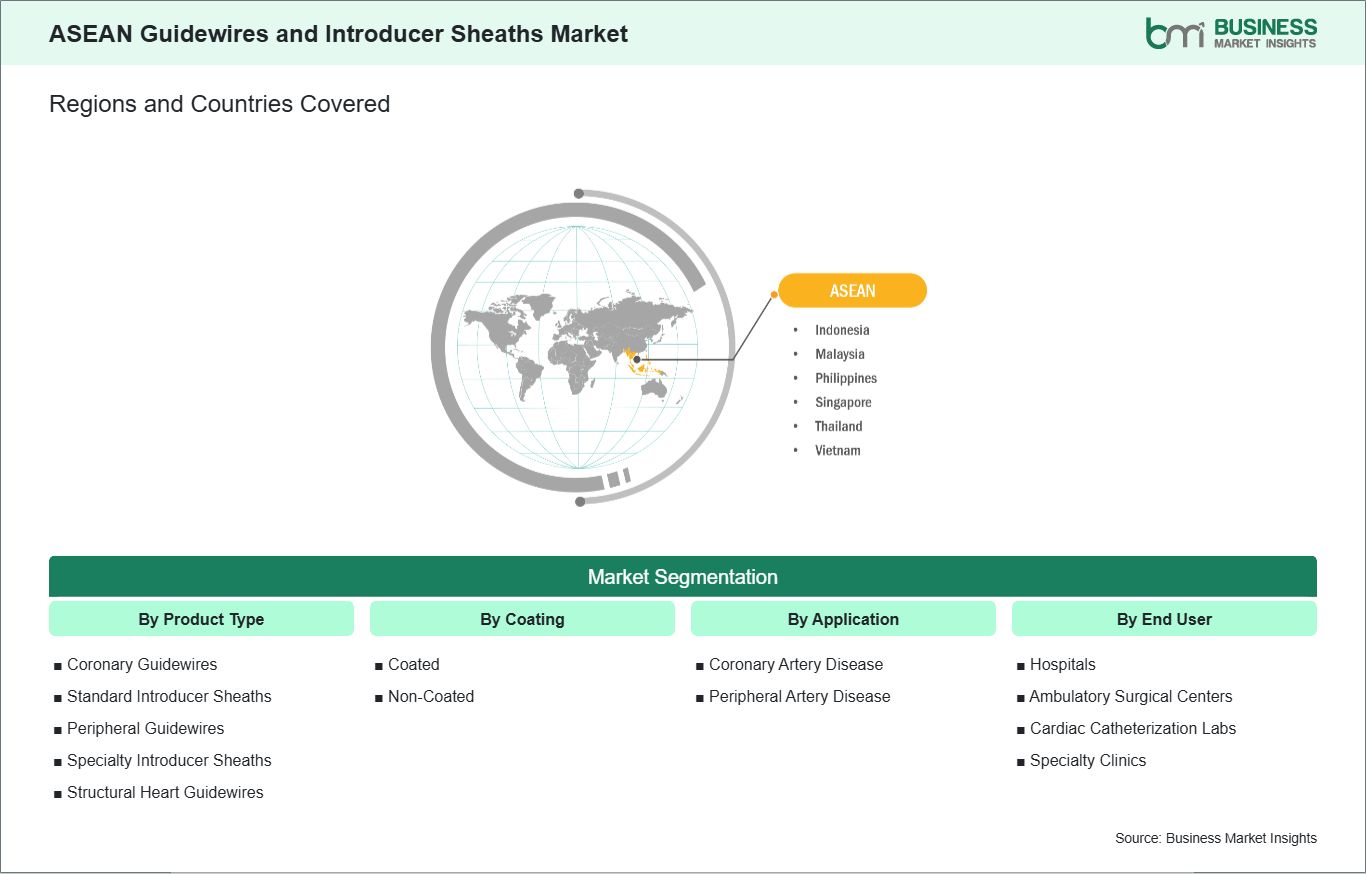
Key segments that contributed to the derivation of the ASEAN guidewires and introducer sheaths market analysis are product type, coating, application, and end user.
Cardiovascular diseases are escalating across ASEAN due to lifestyle transitions, urbanization, and rising rates of obesity and diabetes. Indonesia, Thailand, and the Philippines report significant increases in coronary artery disease and stroke, particularly among adults aged 40–65. This trend has amplified the need for minimally invasive cardiac procedures, driving steady demand for guidewires and introducer sheaths.
Healthcare infrastructure in ASEAN is adapting to this growing burden. Singapore and Malaysia have expanded high-volume catheterization laboratories, while Vietnam and Indonesia are upgrading tertiary hospitals to perform complex interventions. Such expansions translate into higher utilization of guidewires and introducer sheaths, which are critical for both diagnostic and therapeutic procedures.
Awareness among patients is shifting toward less invasive options, with urban populations showing a preference for procedures that reduce hospitalization time and recovery periods. This shift, combined with increasing procedural volumes in major cities such as Bangkok and Jakarta, underscores the growing strategic importance of guidewires and introducer sheaths in ASEAN's evolving cardiac care landscape.
The ASEAN market is witnessing the gradual adoption of sensor-enabled guidewires, particularly in leading cardiology centers. By providing real-time pressure and flow data, these devices allow cardiologists to optimize procedural decisions and improve treatment precision. Hospitals in Singapore, Bangkok, and Kuala Lumpur are early adopters, integrating this technology into complex coronary interventions.
Sensor-enabled guidewires offer tangible clinical benefits in a region where late-stage presentation of cardiovascular disease is common. These devices help physicians accurately determine lesion severity and reduce unnecessary stent deployment, minimizing complications and enhancing patient recovery. Their integration aligns with ASEAN hospitals' increasing emphasis on outcome-driven care and procedural efficiency.
gradually. Furthermore, global MedTech companies are expanding partnerships with regional distributors and local healthcare institutions, offering training and support for sensor-enabled technologies. This approach is increasing market penetration beyond metropolitan hospitals, paving the way for broader adoption. As ASEAN healthcare systems continue modernizing, sensor-enabled guidewires are poised to become a key driver of growth in the region's guidewires and introducer sheaths market.

The ASEAN Guidewires and Introducer Sheaths market demonstrates steady growth, with size and share analysis highlighting evolving trends and competitive dynamics among key players. The report further examines subsegments categorized within product type, coating, application, and end user, offering insights into their contribution to overall market performance.
By product type, the coronary guidewires subsegment dominated the market in 2024. Coronary guidewires dominate due to their critical role in minimally invasive procedures, the rising prevalence of coronary artery disease, and technological advancements ensuring precision, safety, and improved patient outcomes in cardiovascular interventions.
Based on coating, the coated subsegment dominated the market in 2024. Coated guidewires led the market as surface coatings enhance durability, reduce friction, improve navigation through complex vessels, and minimize complications, making them the preferred choice among physicians for efficiency and patient safety.
In terms of application, the coronary artery disease subsegment dominated the market in 2024. The coronary artery disease segment dominated as increasing global incidence, lifestyle risk factors, and demand for advanced interventional cardiology solutions drove adoption of guidewires and sheaths tailored for coronary procedures.
By end user, the hospitals subsegment dominated the market in 2024. Hospitals dominated the market since they handle the majority of complex cardiovascular interventions, offer advanced infrastructure, skilled specialists, and comprehensive patient care, making them the primary setting for guidewire and sheath usage.
| Report Attribute | Details |
|---|---|
| Market size in 2024 | US$ 22.0 Million |
| Market Size by 2033 | US$ 34.3 Million |
| CAGR (2025 - 2033) | 5.1% |
| Historical Data | 2022-2023 |
| Forecast period | 2025-2033 |
| Segments Covered | By By Product Type
|
| Regions and Countries Covered | ASEAN
|
| Market leaders and key company profiles |
|
The "ASEAN Guidewires and Introducer Sheaths Market Size and Forecast (2022–2033)" report provides a detailed analysis of the market covering below areas:
The geographical scope of the ASEAN Guidewires and Introducer Sheaths market report is divided into: Indonesia, Malaysia, the Philippines, Singapore, Thailand, and Vietnam. Indonesia held the largest share in 2024.
Indonesia dominates the ASEAN market due to its large population, expanding healthcare infrastructure, and rising investments in tertiary care facilities. The country's hospitals are equipped with catheterization labs, supporting higher procedural volumes and driving demand for torque‑responsive stainless steel guidewires and polymer‑coated variants suited for complex vascular pathways. Clinicians show growing preference for introducer sheaths designed for radial access, aligning with global best practices and reducing patient recovery times. Procurement is centralized through government initiatives and large private hospital groups, with distributors playing a critical role in ensuring supply chain reliability across Indonesia's archipelago. Growth is reinforced by national health insurance programs that broaden access to interventional procedures, alongside medical tourism initiatives that encourage adoption of advanced consumables. Constraints include logistical challenges in distributing specialty devices across remote islands, variability in reimbursement for premium consumables, and uneven clinician training outside major urban centers. Nonetheless, Indonesia's market benefits from structured education programs, partnerships with international vendors, and government‑backed modernization of healthcare facilities. Hospitals remain the primary end users, while diagnostic centers support imaging‑led triage into interventional care. Vendors that align inventory management, training, and product breadth with Indonesia's procurement models and clinical workflows are well-positioned to sustain share and deepen adoption.

The ASEAN Guidewires and Introducer Sheaths market is evaluated by gathering qualitative and quantitative data post primary and secondary research, which includes important corporate publications, association data, and databases. A few of the key developments in the ASEAN guidewires and introducer sheaths market are:
The ASEAN Guidewires and Introducer Sheaths Market is valued at US$ 22.0 Million in 2024, it is projected to reach US$ 34.3 Million by 2033.
As per our report ASEAN Guidewires and Introducer Sheaths Market, the market size is valued at US$ 22.0 Million in 2024, projecting it to reach US$ 34.3 Million by 2033. This translates to a CAGR of approximately 5.1% during the forecast period.
The ASEAN Guidewires and Introducer Sheaths Market report typically cover these key segments-
The historic period, base year, and forecast period can vary slightly depending on the specific market research report. However, for the ASEAN Guidewires and Introducer Sheaths Market report:
The ASEAN Guidewires and Introducer Sheaths Market is populated by several key players, each contributing to its growth and innovation. Some of the major players include:
The ASEAN Guidewires and Introducer Sheaths Market report is valuable for diverse stakeholders, including:
Essentially, anyone involved in or considering involvement in the ASEAN Guidewires and Introducer Sheaths Market value chain can benefit from the information contained in a comprehensive market report.
Please tell us your area of interest
(Market Segments/ Regions and Countries/ Companies)