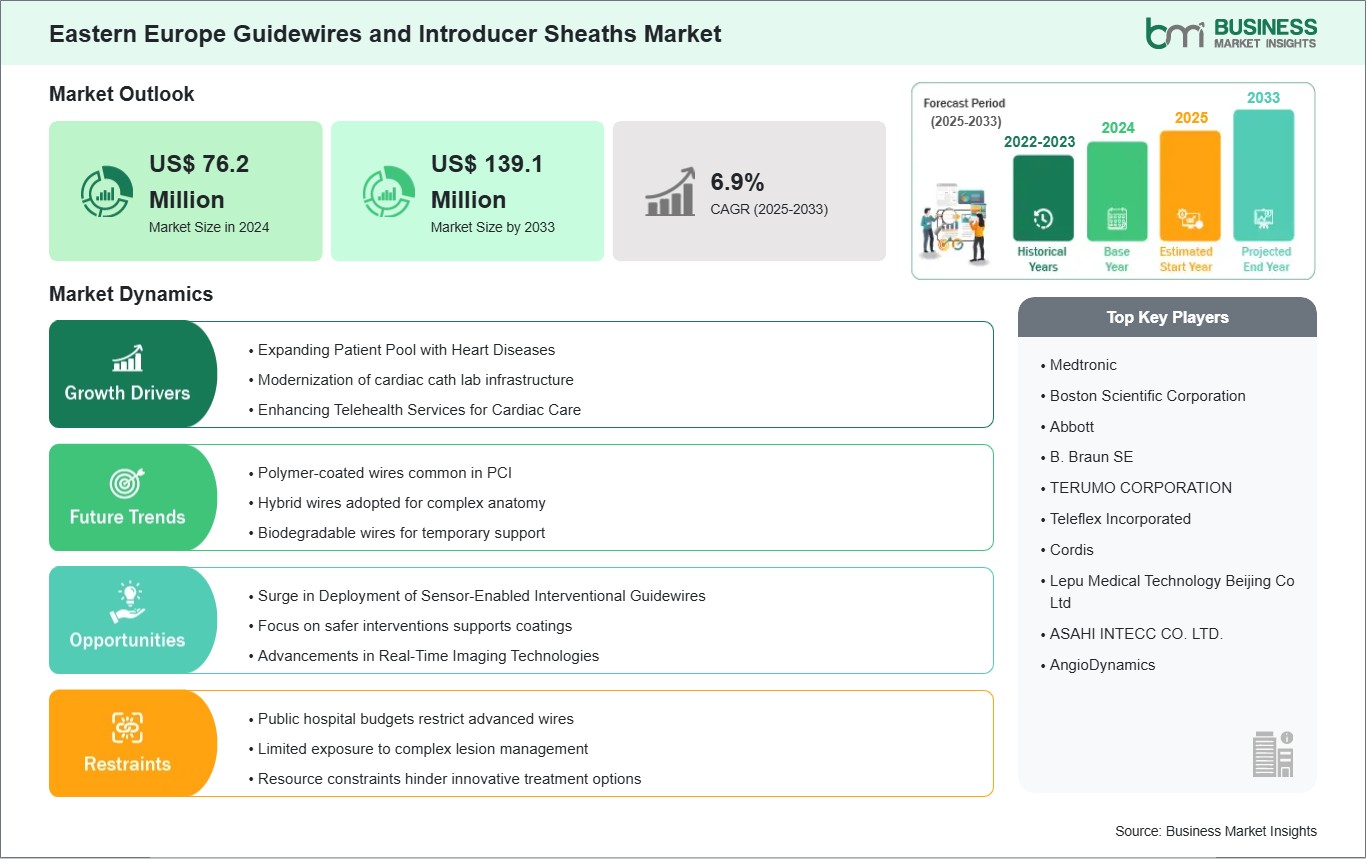
The Eastern Europe guidewires and introducer sheaths market size is expected to reach US$ 139.1 million by 2033 from US$ 76.2 million in 2024. The market is estimated to record a CAGR of 6.9% from 2025 to 2033.
The Eastern Europe guidewires and introducer sheaths market is witnessing steady growth due to rising demand for minimally invasive procedures and expanding interventional cardiology and radiology services. Hospitals and healthcare facilities are investing in modern catheterization labs and surgical suites, which rely on high-quality guidewires and introducer sheaths. The growing prevalence of cardiovascular diseases, peripheral vascular conditions, and neurovascular disorders is driving device utilization across major urban centers. Physician expertise in complex interventions is improving, supporting adoption. Market growth is, however, constrained by uneven reimbursement frameworks, limited procedural capacity in smaller or rural hospitals, and cost sensitivity among healthcare buyers. These factors slow the adoption of advanced devices and create disparities between urban and regional facilities. Despite these challenges, gradual infrastructure improvements, increasing procedural volumes, and the focus on endovascular interventions are providing consistent opportunities for market expansion. The region reflects a maturing healthcare landscape where investment in interventional tools and procedural efficiency is becoming a priority, setting the stage for steady adoption of guidewires and introducer sheaths in both diagnostic and therapeutic applications.

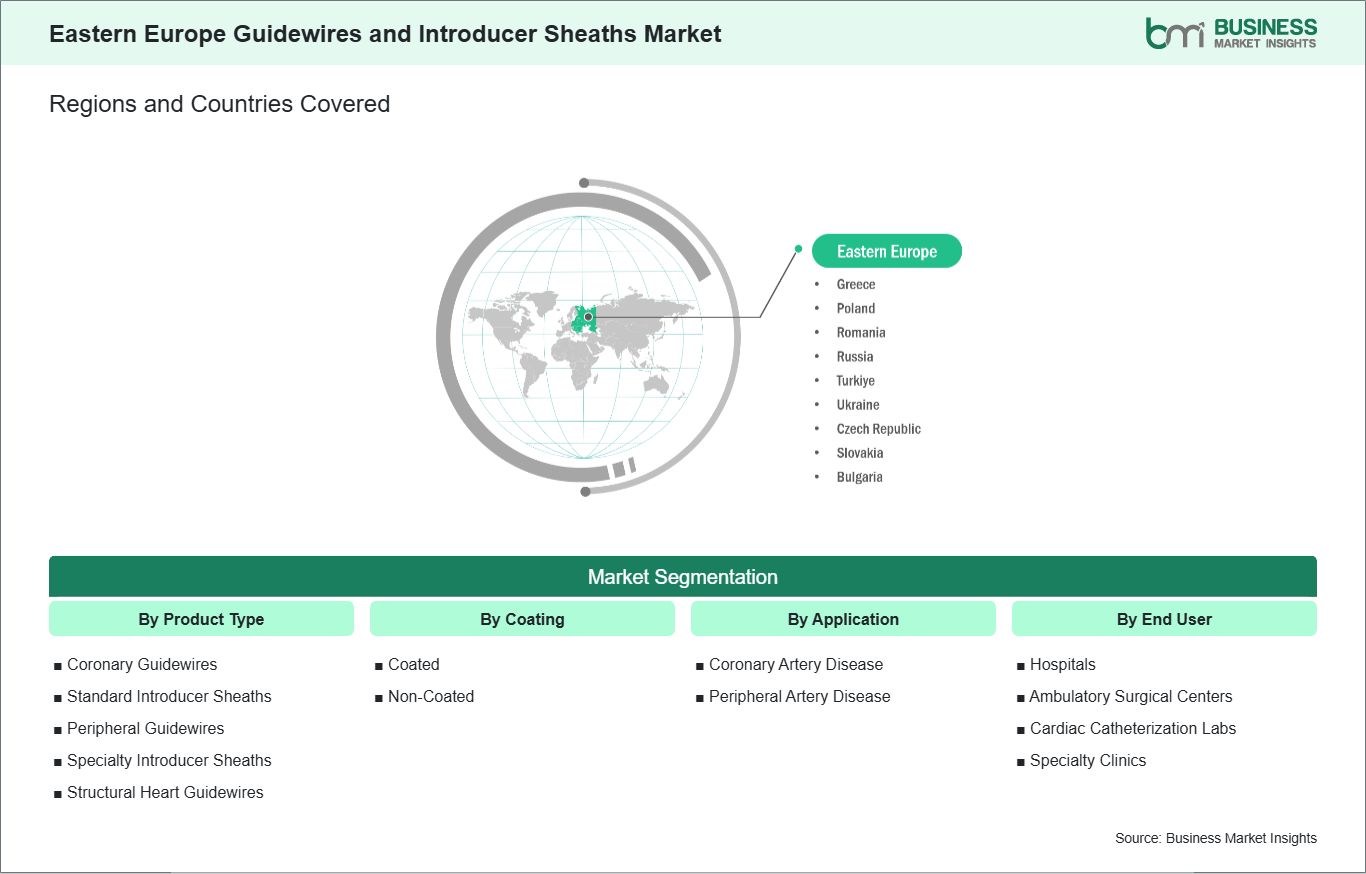
Key segments that contributed to the derivation of the Eastern Europe guidewires and introducer sheaths market analysis are product type, coating, application, and end user.
Eastern Europe has witnessed a steady rise in cardiovascular disease prevalence, driven by lifestyle changes, dietary habits, and aging populations. This growing burden has created significant demand for advanced interventional cardiology solutions. Healthcare systems across countries such as Poland, Hungary, and Romania are prioritizing early diagnosis and minimally invasive treatment options, positioning guidewires as essential tools in managing coronary and peripheral artery conditions.
As cardiovascular diseases become more widespread, hospitals and cardiac centers in Eastern Europe are investing in modern catheterization labs and expanding their interventional capabilities. This expansion fuels the adoption of guidewires and introducer sheaths, as physicians rely on these devices for precision and safety during complex procedures. The rising prevalence also encourages governments and private healthcare providers to allocate resources toward improving access to advanced cardiovascular care, strengthening market demand.
The growing awareness among patients about minimally invasive procedures has accelerated acceptance of guidewire‑based interventions. With cardiovascular diseases being a leading cause of morbidity, the need for reliable, high‑quality devices is paramount. This trend not only drives immediate demand but also sets the stage for long‑term market growth, as Eastern Europe continues to align its healthcare infrastructure with global standards in interventional cardiology.
Eastern Europe is gradually embracing sensor‑enabled guidewires, which represent technological advancement in interventional cardiology. These devices provide real‑time physiological data, enhancing procedural accuracy and improving patient outcomes. As healthcare providers in the region seek to modernize their practices, sensor‑enabled guidewires are emerging as a key opportunity for differentiation and improved clinical efficiency.
Hospitals and cardiac centers in Eastern Europe are increasingly recognizing the value of sensor‑enabled guidewires in complex interventions, particularly for coronary artery disease. Their ability to measure parameters such as pressure gradients and vessel characteristics allows physicians to make informed decisions during procedures. This capability reduces complications, shortens recovery times, and aligns with the region's growing emphasis on evidence‑based medicine. The adoption of these advanced devices also reflects a broader trend toward digital integration in healthcare, where data‑driven insights are becoming central to clinical practice.
The opportunity is amplified by collaborations between global MedTech companies and local distributors, ensuring availability and training for sensor‑enabled technologies. As Eastern Europe continues to invest in upgrading healthcare infrastructure, these devices are expected to gain traction among leading hospitals and specialized clinics. The growing adoption not only enhances patient care but also positions the region as a promising market for innovative cardiovascular technologies, paving the way for sustained growth in the guidewires and introducer sheaths segment.

The Eastern Europe Guidewires and Introducer Sheaths market demonstrates steady growth, with size and share analysis highlighting evolving trends and competitive dynamics among key players. The report further examines subsegments categorized within product type, coating, application, and end user, offering insights into their contribution to overall market performance.
By product type, the coronary guidewires subsegment dominated the market in 2024. Coronary guidewires dominate due to their critical role in minimally invasive procedures, the rising prevalence of coronary artery disease, and technological advancements ensuring precision, safety, and improved patient outcomes in cardiovascular interventions.
Based on coating, the coated subsegment dominated the market in 2024. Coated guidewires led the market as surface coatings enhance durability, reduce friction, improve navigation through complex vessels, and minimize complications, making them the preferred choice among physicians for efficiency and patient safety.
In terms of application, the coronary artery disease subsegment dominated the market in 2024. The coronary artery disease segment dominated as increasing global incidence, lifestyle risk factors, and demand for advanced interventional cardiology solutions drove adoption of guidewires and sheaths tailored for coronary procedures.
By end user, the hospitals subsegment dominated the market in 2024. Hospitals dominated the market since they handle the majority of complex cardiovascular interventions, offer advanced infrastructure, skilled specialists, and comprehensive patient care, making them the primary setting for guidewire and sheath usage.
| Report Attribute | Details |
|---|---|
| Market size in 2024 | US$ 76.2 Million |
| Market Size by 2033 | US$ 139.1 Million |
| CAGR (2025 - 2033) | 6.9% |
| Historical Data | 2022-2023 |
| Forecast period | 2025-2033 |
| Segments Covered | By By Product Type
|
| Regions and Countries Covered | Eastern Europe
|
| Market leaders and key company profiles |
|
The "Eastern Europe Guidewires and Introducer Sheaths Market Size and Forecast (2022–2033)" report provides a detailed analysis of the market covering below areas:
The geographical scope of the Eastern Europe Guidewires and Introducer Sheaths market report is divided into: Russia, Poland, Romania, the Czech Republic, Ukraine, Romania, Greece, Slovakia, and Bulgaria. Russia held the largest share in 2024.
Russia is the dominant country in the Eastern Europe Guidewires and Introducer Sheaths market, driven by its large population and growing demand for interventional procedures. Cardiovascular diseases are a major clinical concern, creating consistent use of guidewires and introducer sheaths in diagnostic angiography, percutaneous interventions, and neurovascular treatments. Major metropolitan hospitals in Moscow and St. Petersburg show high adoption rates of advanced devices, whereas smaller regional hospitals focus on cost-effective essential tools due to budget constraints. Domestic manufacturing is increasing, supported by government initiatives to enhance local supply, which has improved the competitive landscape alongside established international suppliers. Regulatory policies and healthcare spending priorities influence product availability, emphasizing devices that meet reimbursement standards and deliver reliable performance in various procedures. Investment in hospital infrastructure, procedural capacity, and physician training has strengthened demand in urban centers, while rural and smaller hospitals continue to face adoption barriers. Russia's strategic focus on healthcare expansion, local manufacturing, and procedural growth positions it as the leading contributor to the Eastern Europe market, providing a robust foundation for both diagnostic and therapeutic interventions.

The Eastern Europe Guidewires and Introducer Sheaths market is evaluated by gathering qualitative and quantitative data post primary and secondary research, which includes important corporate publications, association data, and databases. A few of the key developments in the Eastern Europe guidewires and introducer sheaths market are:
The Eastern Europe Guidewires and Introducer Sheaths Market is valued at US$ 76.2 Million in 2024, it is projected to reach US$ 139.1 Million by 2033.
As per our report Eastern Europe Guidewires and Introducer Sheaths Market, the market size is valued at US$ 76.2 Million in 2024, projecting it to reach US$ 139.1 Million by 2033. This translates to a CAGR of approximately 6.9% during the forecast period.
The Eastern Europe Guidewires and Introducer Sheaths Market report typically cover these key segments-
The historic period, base year, and forecast period can vary slightly depending on the specific market research report. However, for the Eastern Europe Guidewires and Introducer Sheaths Market report:
The Eastern Europe Guidewires and Introducer Sheaths Market is populated by several key players, each contributing to its growth and innovation. Some of the major players include:
The Eastern Europe Guidewires and Introducer Sheaths Market report is valuable for diverse stakeholders, including:
Essentially, anyone involved in or considering involvement in the Eastern Europe Guidewires and Introducer Sheaths Market value chain can benefit from the information contained in a comprehensive market report.
Please tell us your area of interest
(Market Segments/ Regions and Countries/ Companies)