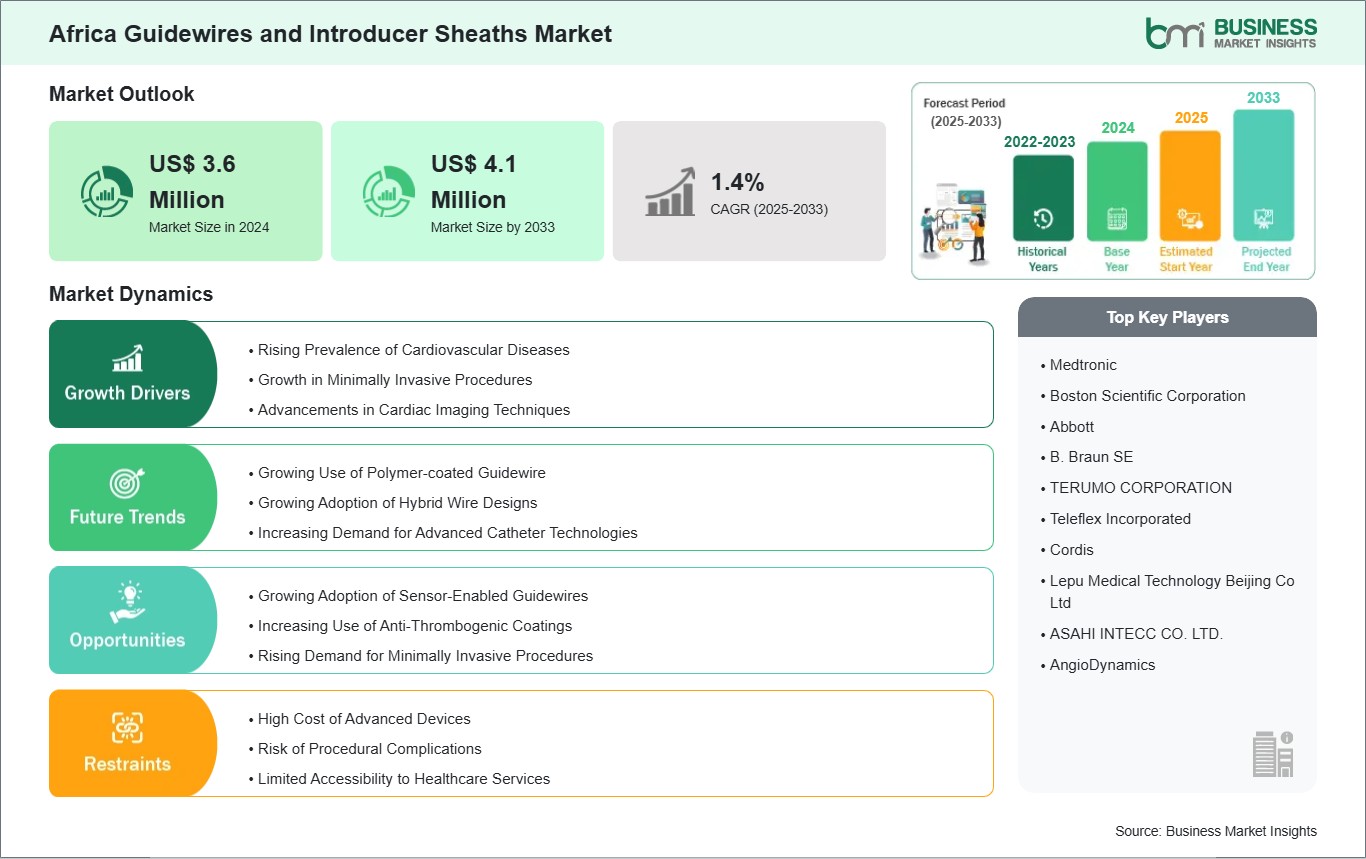
The Africa guidewires and introducer sheaths market size is expected to reach US$ 4.1 million by 2033 from US$ 3.6 million in 2024. The market is estimated to record a CAGR of 1.4% from 2025 to 2033.
Africa's guidewires and introducer sheaths market is propelled by the expansion of interventional cardiology and peripheral vascular services in urban hubs, alongside the gradual modernization of public hospitals and steady growth in private networks. Demand is concentrated in high‑volume centers that prioritize minimally invasive procedures, favoring torque‑responsive stainless-steel guidewires for control and polymer‑coated options for trackability through tortuous anatomy. Introducer sheaths with low profiles and radial‑friendly designs are preferred to reduce access‑site complications and support faster patient turnover. Distributors play a pivotal role in training and last‑mile logistics, ensuring device availability beyond capital cities and harmonizing product use across diverse clinical settings. Key growth drivers include rising noncommunicable disease burdens, investments in catheterization labs, and structured clinician education that improves procedural consistency. Restraints stem from uneven reimbursement, import dependence, and variability in technical proficiency, which can slow adoption of advanced coatings and specialty wires in lower‑resource facilities.
Hospitals remain the primary end users, with diagnostic centers supporting imaging‑led triage into interventional pathways. Vendors that pair robust clinical support with adaptable product portfolios—spanning stainless steel and polymer‑coated guidewires, and introducer sheaths optimized for radial and femoral access—are best positioned to capture demand. Success hinges on aligning inventory, training, and procurement strategies to country‑specific workflows and regulatory timelines across the continent.

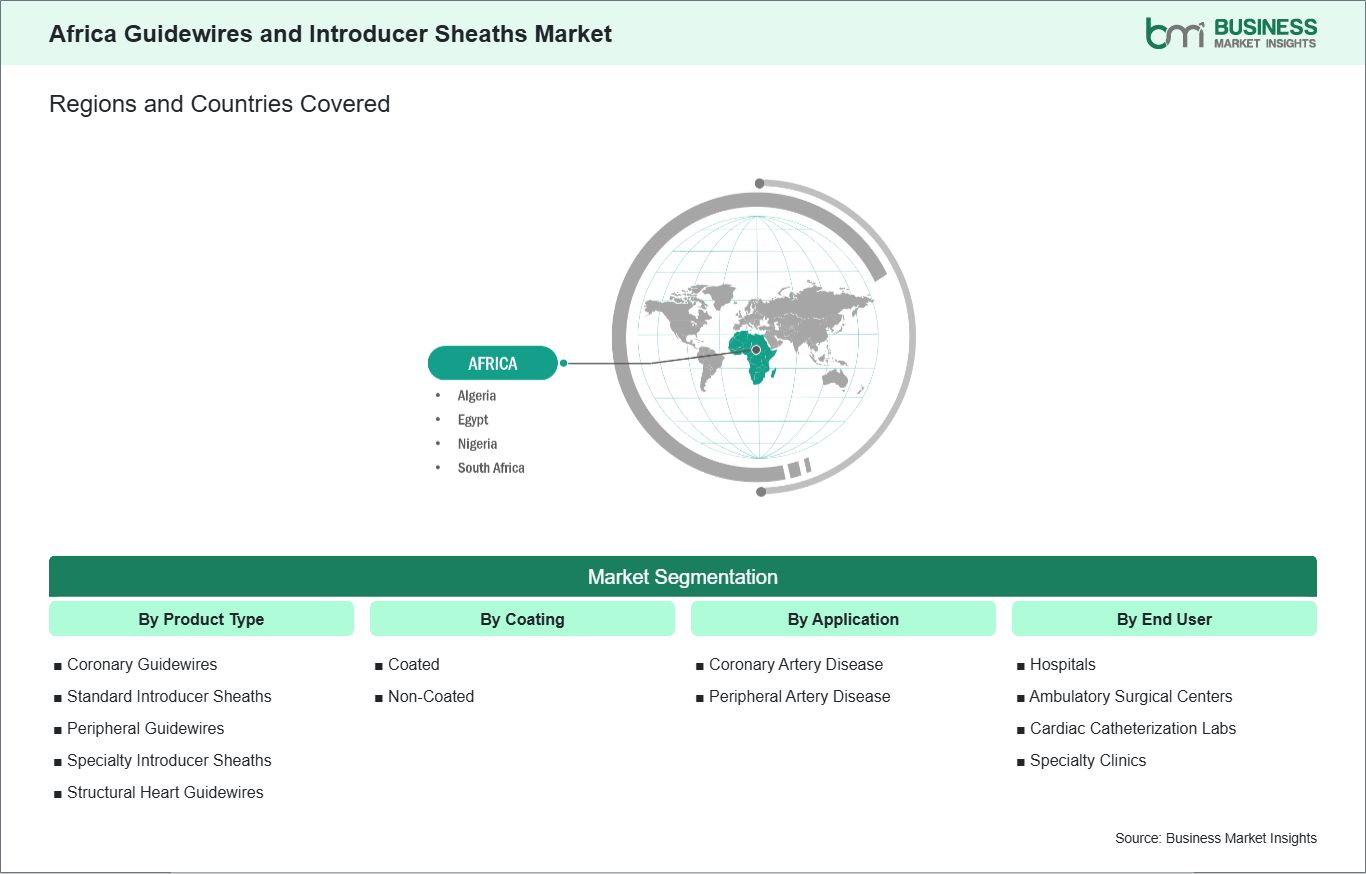
Key segments that contributed to the derivation of the Africa guidewires and introducer sheaths market analysis are product type, coating, application, and end user.
Africa is experiencing a rapid epidemiological transition, with cardiovascular diseases (CVDs) rising sharply due to urbanization, changing diets, tobacco use, and increasing life expectancy. Countries such as South Africa, Egypt, Nigeria, and Morocco are reporting a higher incidence of hypertension, ischemic heart disease, and stroke, placing a growing strain on stretched healthcare systems. This expanding disease burden is driving demand for interventional cardiology procedures, where guidewires and introducer sheaths are critical in accessing coronary and peripheral vessels safely and efficiently.
As CVD cases rise, major tertiary hospitals and cardiac centers across Africa are expanding their catheterization laboratory capabilities. Private hospital chains in South Africa, Egypt, and Kenya are investing in angiography suites and minimally invasive treatment programs to meet the needs of a cardiac-risk population. These investments translate into higher consumption of guidewires and introducer sheaths, which are indispensable for angioplasty, stent placement, and diagnostic catheterization procedures.
Governments and international health organizations are prioritizing noncommunicable disease management through funding, training, and infrastructure upgrades. Initiatives to improve access to cardiac care in countries such as Rwanda, Ghana, and Ethiopia are increasing procedural volumes in public hospitals. As awareness of minimally invasive cardiac treatments grows among both physicians and patients, the demand for high-quality, reliable guidewires and introducer sheaths is expected to strengthen, supporting long-term market expansion across Africa.
Africa's leading cardiac centers are beginning to adopt sensor-enabled guidewires as part of a broader push toward advanced, data-driven interventional cardiology. These guidewires provide real-time measurements of pressure and flow within blood vessels, enabling clinicians to assess lesion severity more accurately and tailor interventions accordingly. Hospitals in South Africa, Egypt, and Tunisia, which host some of the continent's most advanced Cath labs, are at the forefront of introducing these technologies into routine practice.
The clinical value of sensor-enabled guidewires is significant in Africa, where late presentation of coronary artery disease is common. By offering precise physiological insights during procedures, these devices help physicians decide whether a lesion requires stenting or can be managed medically, reducing unnecessary implants and improving patient outcomes. This capability is attractive to private hospitals and cardiac institutes that are focused on improving procedural efficiency, lowering complication rates, and delivering outcomes that meet international benchmarks.
Global medical device manufacturers are strengthening their partnerships with African distributors and training centers to support the rollout of sensor-enabled technologies. Educational programs, on-site demonstrations, and bundled equipment offerings are making these advanced guidewires more accessible to cardiologists across key urban markets. As Africa continues to modernize its cardiovascular care infrastructure, the growing use of sensor-enabled guidewires is expected to create a high-value growth avenue within the guidewires and introducer sheaths market.

The Africa Guidewires and Introducer Sheaths market demonstrates steady growth, with size and share analysis highlighting evolving trends and competitive dynamics among key players. The report further examines subsegments categorized within product type, coating, application, and end user, offering insights into their contribution to overall market performance.
By product type, the coronary guidewires subsegment dominated the market in 2024. Coronary guidewires dominate due to their critical role in minimally invasive procedures, the rising prevalence of coronary artery disease, and technological advancements ensuring precision, safety, and improved patient outcomes in cardiovascular interventions.
Based on coating, the coated subsegment dominated the market in 2024. Coated guidewires led the market as surface coatings enhance durability, reduce friction, improve navigation through complex vessels, and minimize complications, making them the preferred choice among physicians for efficiency and patient safety.
In terms of application, the coronary artery disease subsegment dominated the market in 2024. The coronary artery disease segment dominated as increasing global incidence, lifestyle risk factors, and demand for advanced interventional cardiology solutions drove adoption of guidewires and sheaths tailored for coronary procedures.
By end user, the hospitals subsegment dominated the market in 2024. Hospitals dominated the market since they handle the majority of complex cardiovascular interventions, offer advanced infrastructure, skilled specialists, and comprehensive patient care, making them the primary setting for guidewire and sheath usage.
| Report Attribute | Details |
|---|---|
| Market size in 2024 | US$ 3.6 Million |
| Market Size by 2033 | US$ 4.1 Million |
| CAGR (2025 - 2033) | 1.4% |
| Historical Data | 2022-2023 |
| Forecast period | 2025-2033 |
| Segments Covered | By By Product Type
|
| Regions and Countries Covered | Africa
|
| Market leaders and key company profiles |
|
The "Africa Guidewires and Introducer Sheaths Market Size and Forecast (2022–2033)" report provides a detailed analysis of the market covering below areas:
The geographical scope of the Africa Guidewires and Introducer Sheaths market report is divided into Nigeria, Egypt, South Africa, and Algeria. South Africa held the largest share in 2024.
South Africa leads the regional market due to its mature private hospital systems, advanced tertiary centers, and ongoing upgrades in public facilities that sustain high procedural volumes. Clinicians adopt hydrophilic‑coated guidewires for complex anatomies and prefer introducer sheaths designed for radial access to minimize complications and enable shorter stays, reflecting a strong tilt toward minimally invasive care. Procurement is split between direct purchasing by large hospital groups and established distributors that provide technical support, in‑service training, and a reliable supply of specialty SKUs, ensuring consistency across provinces. Growth is reinforced by investments in catheterization labs, structured training pathways, and multidisciplinary teams that standardize device selection for cardiovascular and peripheral interventions. Constraints include budget variability in public institutions, reimbursement differences for advanced consumables, and occasional supply chain friction that encourages dual sourcing and inventory buffers. South Africa's market also benefits from data‑driven planning and clinical governance that refine product mix, balancing torque‑responsive stainless steel wires with polymer‑coated variants for trackability, and selecting sheath profiles that match access strategies. Hospitals remain the dominant end users, while diagnostic centers support imaging‑led triage into interventional care. Vendors that align education, inventory management, and product breadth with South Africa's procurement models and clinical workflows are best placed to deepen adoption and sustain share.

The Africa Guidewires and Introducer Sheaths market is evaluated by gathering qualitative and quantitative data post primary and secondary research, which includes important corporate publications, association data, and databases. A few of the key developments in the Africa guidewires and introducer sheaths market are:
The Africa Guidewires and Introducer Sheaths Market is valued at US$ 3.6 Million in 2024, it is projected to reach US$ 4.1 Million by 2033.
As per our report Africa Guidewires and Introducer Sheaths Market, the market size is valued at US$ 3.6 Million in 2024, projecting it to reach US$ 4.1 Million by 2033. This translates to a CAGR of approximately 1.4% during the forecast period.
The Africa Guidewires and Introducer Sheaths Market report typically cover these key segments-
The historic period, base year, and forecast period can vary slightly depending on the specific market research report. However, for the Africa Guidewires and Introducer Sheaths Market report:
The Africa Guidewires and Introducer Sheaths Market is populated by several key players, each contributing to its growth and innovation. Some of the major players include:
The Africa Guidewires and Introducer Sheaths Market report is valuable for diverse stakeholders, including:
Essentially, anyone involved in or considering involvement in the Africa Guidewires and Introducer Sheaths Market value chain can benefit from the information contained in a comprehensive market report.
Please tell us your area of interest
(Market Segments/ Regions and Countries/ Companies)