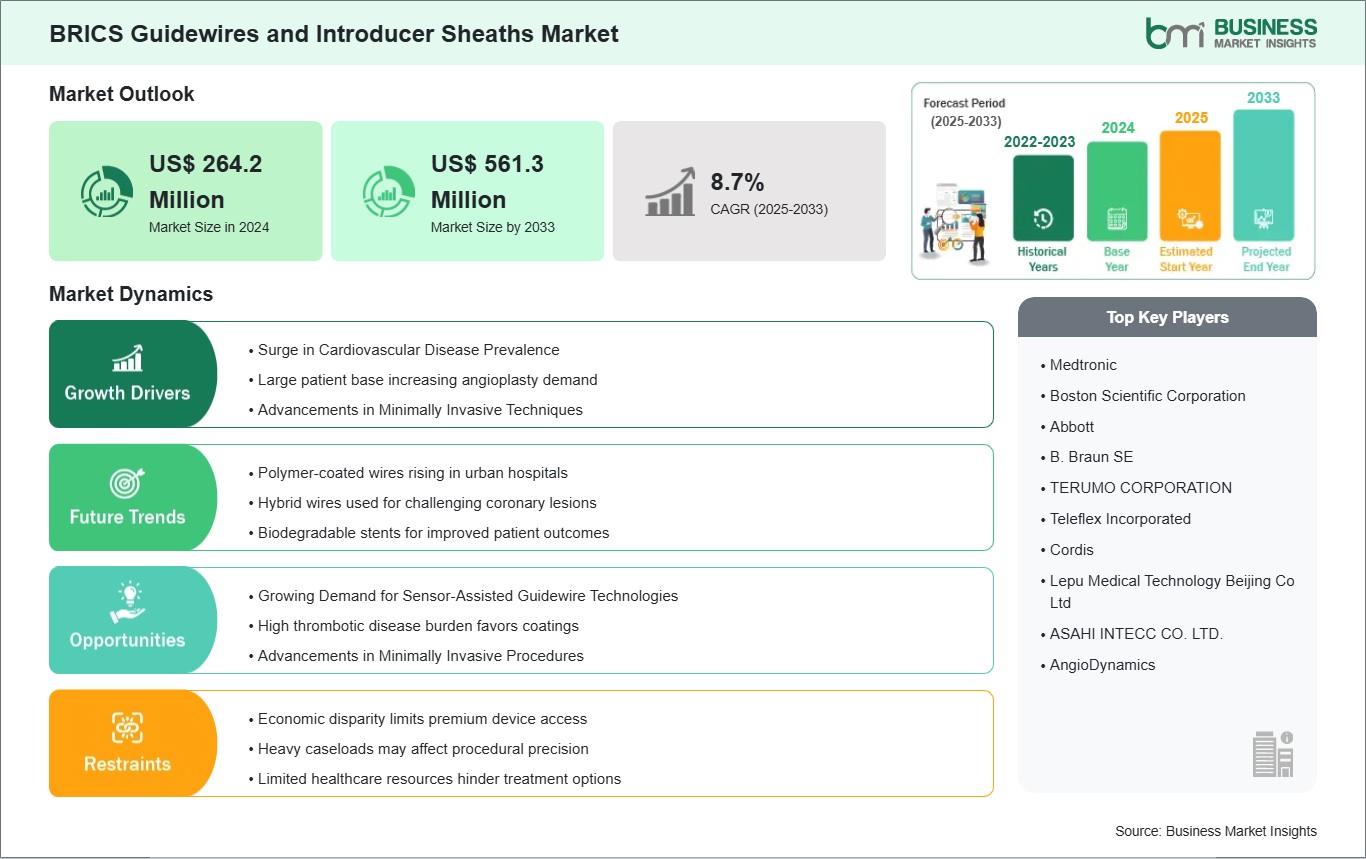
The BRICS guidewires and introducer sheaths market size is expected to reach US$ 561.3 million by 2033 from US$ 264.2 million in 2024. The market is estimated to record a CAGR of 8.7% from 2025 to 2033.
The BRICS guidewires and introducer sheaths market presents a diverse landscape shaped by rapid healthcare modernization, rising cardiovascular disease burdens, and expanding access to minimally invasive procedures. Each country contributes unique momentum: Brazil's private hospital networks drive adoption through medical tourism; Russia emphasizes government‑backed procurement and centralized training; India's fast‑growing cath lab ecosystem fuels demand for versatile consumables; and China leverages scale and domestic manufacturing to dominate regional supply. BRICS nations are investing in hybrid operating rooms, catheterization labs, and advanced imaging systems, which elevate demand for guidewires and introducer sheaths that support complex interventions and efficient workflows. A key driver is the demographic shift toward aging populations and lifestyle‑related conditions, which increases procedural volumes across cardiovascular and peripheral domains. Restraints include regulatory heterogeneity, uneven reimbursement frameworks, and supply chain challenges that vary by geography.
Despite these hurdles, BRICS markets benefit from strong government initiatives, private sector investment, and international vendor partnerships that bring advanced technologies and training into hospitals. Hospitals remain the primary end users, while diagnostic centers and specialized institutes contribute by standardizing imaging‑led triage into interventional pathways. Vendors that tailor product portfolios to country‑specific procurement models and embed clinical education into service agreements are best positioned to capture sustained growth across this diverse bloc.

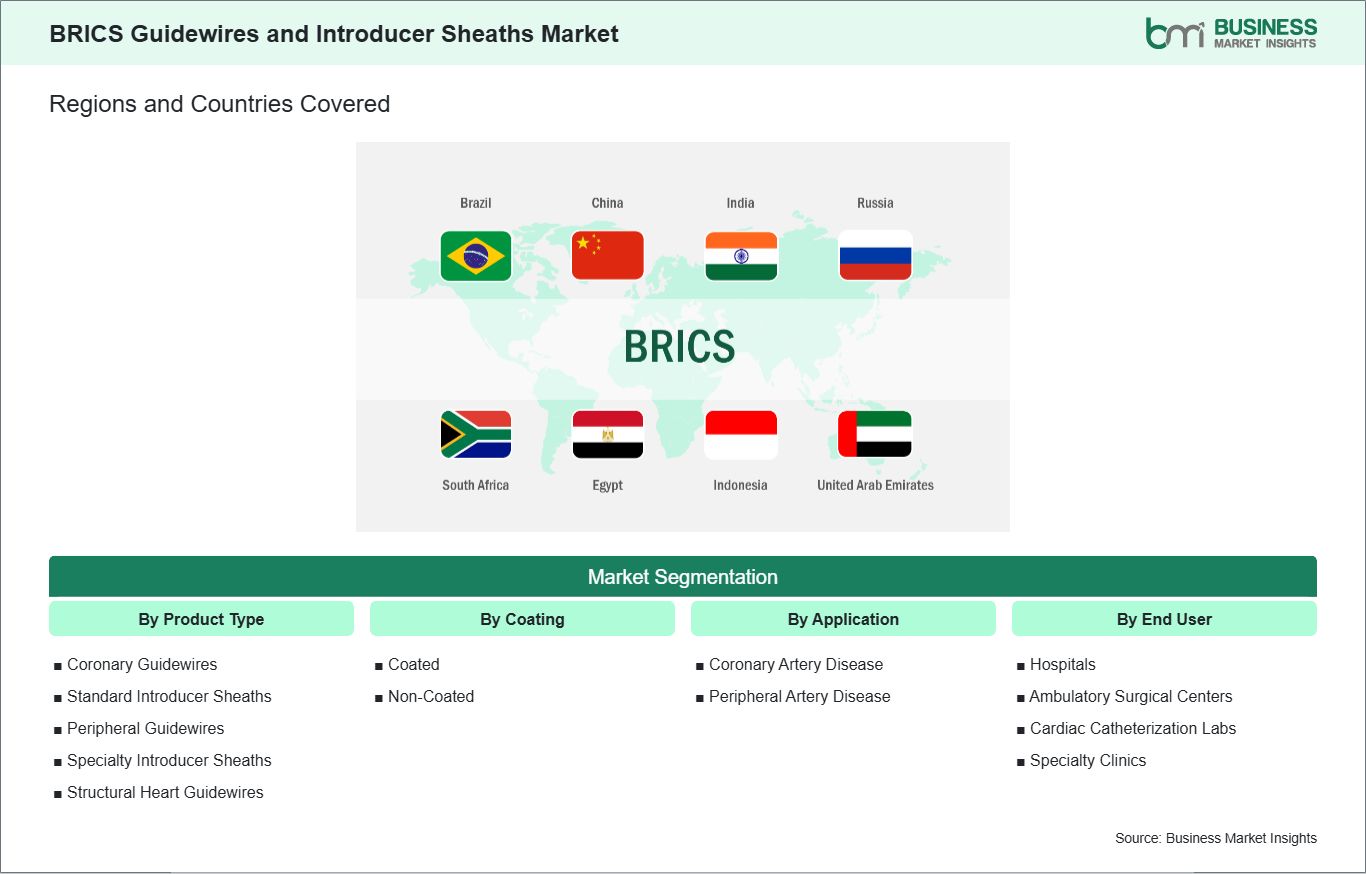
Key segments that contributed to the derivation of the BRICSS guidewires and introducer sheaths market analysis are product type, coating, application, and end user.
The BRICS nations are witnessing a substantial surge in cardiovascular diseases, driven by urbanization, lifestyle shifts, and rising rates of diabetes and obesity. China and India report rapidly increasing cases of coronary artery disease, while Brazil and Russia observe growing incidences of hypertension-related complications. This expanding disease burden is creating strong demand for minimally invasive interventional procedures, particularly those requiring guidewires and introducer sheaths.
Hospitals across BRICS countries are expanding their cardiac care infrastructure to manage rising procedural volumes. Major cardiac centers in Shanghai, Mumbai, São Paulo, and Moscow are investing in high-capacity catheterization labs and modern angiography suites. These developments boost the consumption of guidewires and introducer sheaths, as physicians rely on these devices for precise navigation and safe delivery of therapeutic tools in complex procedures.
Government programs promoting early diagnosis, preventive cardiology, and reimbursement support are further stimulating market growth. For example, China's national healthcare initiatives are improving access to interventional cardiology in tier-2 and tier-3 cities, while India and Brazil are upgrading public hospitals to handle high procedural demand. This combination of growing patient awareness, increasing hospital capacity, and policy support is positioning the BRICS market for sustained long-term growth.
Sensor-enabled guidewires are gaining traction across BRICS countries as hospitals seek to improve procedural precision and outcomes. These devices provide real-time physiological feedback, allowing clinicians to assess lesion severity, vessel characteristics, and flow dynamics during interventions. Leading cardiac centers in Beijing, Delhi, São Paulo, and Moscow are beginning to adopt this technology, particularly for complex coronary and peripheral procedures.
The clinical advantages of sensor-enabled guidewires are valuable in BRICS, where late-stage presentation and complex multivessel disease are common. By enabling data-driven decision-making, these devices help physicians optimize stent placement, reduce unnecessary interventions, and improve recovery times. Their adoption aligns with growing emphasis on outcome-based cardiology and cost-efficient treatment in both private and public healthcare systems.
MedTech companies are actively expanding distribution networks, training programs, and demonstration workshops across BRICS nations to support adoption. Partnerships with local hospitals and educational initiatives are increasing awareness and clinician proficiency, accelerating market penetration. As healthcare infrastructure continues to evolve, sensor-enabled guidewires are expected to become a key driver of innovation and market expansion in the BRICS guidewires and introducer sheaths segment.

The BRICSS Guidewires and Introducer Sheaths market demonstrates steady growth, with size and share analysis highlighting evolving trends and competitive dynamics among key players. The report further examines subsegments categorized within product type, coating, application, and end user, offering insights into their contribution to overall market performance.
By product type, the coronary guidewires subsegment dominated the market in 2024. Coronary guidewires dominate due to their critical role in minimally invasive procedures, the rising prevalence of coronary artery disease, and technological advancements ensuring precision, safety, and improved patient outcomes in cardiovascular interventions.
Based on coating, the coated subsegment dominated the market in 2024. Coated guidewires led the market as surface coatings enhance durability, reduce friction, improve navigation through complex vessels, and minimize complications, making them the preferred choice among physicians for efficiency and patient safety.
In terms of application, the coronary artery disease subsegment dominated the market in 2024. The coronary artery disease segment dominated as increasing global incidence, lifestyle risk factors, and demand for advanced interventional cardiology solutions drove adoption of guidewires and sheaths tailored for coronary procedures.
By end user, the hospitals subsegment dominated the market in 2024. Hospitals dominated the market since they handle the majority of complex cardiovascular interventions, offer advanced infrastructure, skilled specialists, and comprehensive patient care, making them the primary setting for guidewire and sheath usage.
| Report Attribute | Details |
|---|---|
| Market size in 2024 | US$ 264.2 Million |
| Market Size by 2033 | US$ 561.3 Million |
| CAGR (2025 - 2033) | 8.7% |
| Historical Data | 2022-2023 |
| Forecast period | 2025-2033 |
| Segments Covered | By By Product Type
|
| Regions and Countries Covered | BRICS
|
| Market leaders and key company profiles |
|
The "BRICSS Guidewires and Introducer Sheaths Market Size and Forecast (2022–2033)" report provides a detailed analysis of the market covering below areas:
The geographical scope of the BRICS Guidewires and Introducer Sheaths market report is divided into: Russia, Brazil, South Africa, India, China, Egypt, Indonesia, Saudi Arabia, and the UAE. China held the largest share in 2024.
China dominates the regional market through scale, speed of cath lab deployment, and a strong emphasis on domestically engineered consumables that meet national procurement priorities. Hospitals adopt standardized device kits—guidewires, introducer sheaths, and ancillary accessories pre‑configured for coronary, neurovascular, or peripheral pathways—to reduce variability and accelerate turnover in busy centers. Clinical teams favor sheath platforms that integrate reliable hemostasis valves, smooth dilator transitions, and packaging designed for rapid sterile field setup, reflecting a system‑wide focus on efficiency and predictable workflows. Centralized tenders shape procurement and volume‑based purchasing alliances, which reward manufacturers that demonstrate consistent batch performance, robust post‑market surveillance, and responsive technical service. A notable feature is the integration of digital traceability—QR‑coded consumables linked to hospital quality systems—enabling real‑time monitoring of device usage, adverse events, and replenishment cycles. Growth is reinforced by national training networks, fellowship exchanges, and simulation labs that codify escalation strategies and access planning across diverse anatomies. Constraints include periodic price compression from bulk tenders, documentation demands for localized clinical evidence, and regional disparities in operator experience that necessitate on‑site proctoring. Diagnostic centers contribute by standardizing imaging protocols that inform access site selection and device kit composition, improving downstream cath lab efficiency. Vendors that localize product design, invest in field education, and align with China's data‑driven procurement and quality governance are best placed to deepen adoption and sustain share.

The BRICS Guidewires and Introducer Sheaths market is evaluated by gathering qualitative and quantitative data post primary and secondary research, which includes important corporate publications, association data, and databases. A few of the key developments in the BRICS guidewires and introducer sheaths market are:
The BRICS Guidewires and Introducer Sheaths Market is valued at US$ 264.2 Million in 2024, it is projected to reach US$ 561.3 Million by 2033.
As per our report BRICS Guidewires and Introducer Sheaths Market, the market size is valued at US$ 264.2 Million in 2024, projecting it to reach US$ 561.3 Million by 2033. This translates to a CAGR of approximately 8.7% during the forecast period.
The BRICS Guidewires and Introducer Sheaths Market report typically cover these key segments-
The historic period, base year, and forecast period can vary slightly depending on the specific market research report. However, for the BRICS Guidewires and Introducer Sheaths Market report:
The BRICS Guidewires and Introducer Sheaths Market is populated by several key players, each contributing to its growth and innovation. Some of the major players include:
The BRICS Guidewires and Introducer Sheaths Market report is valuable for diverse stakeholders, including:
Essentially, anyone involved in or considering involvement in the BRICS Guidewires and Introducer Sheaths Market value chain can benefit from the information contained in a comprehensive market report.
Please tell us your area of interest
(Market Segments/ Regions and Countries/ Companies)