Market Summary
Executive Summary and Market Analysis
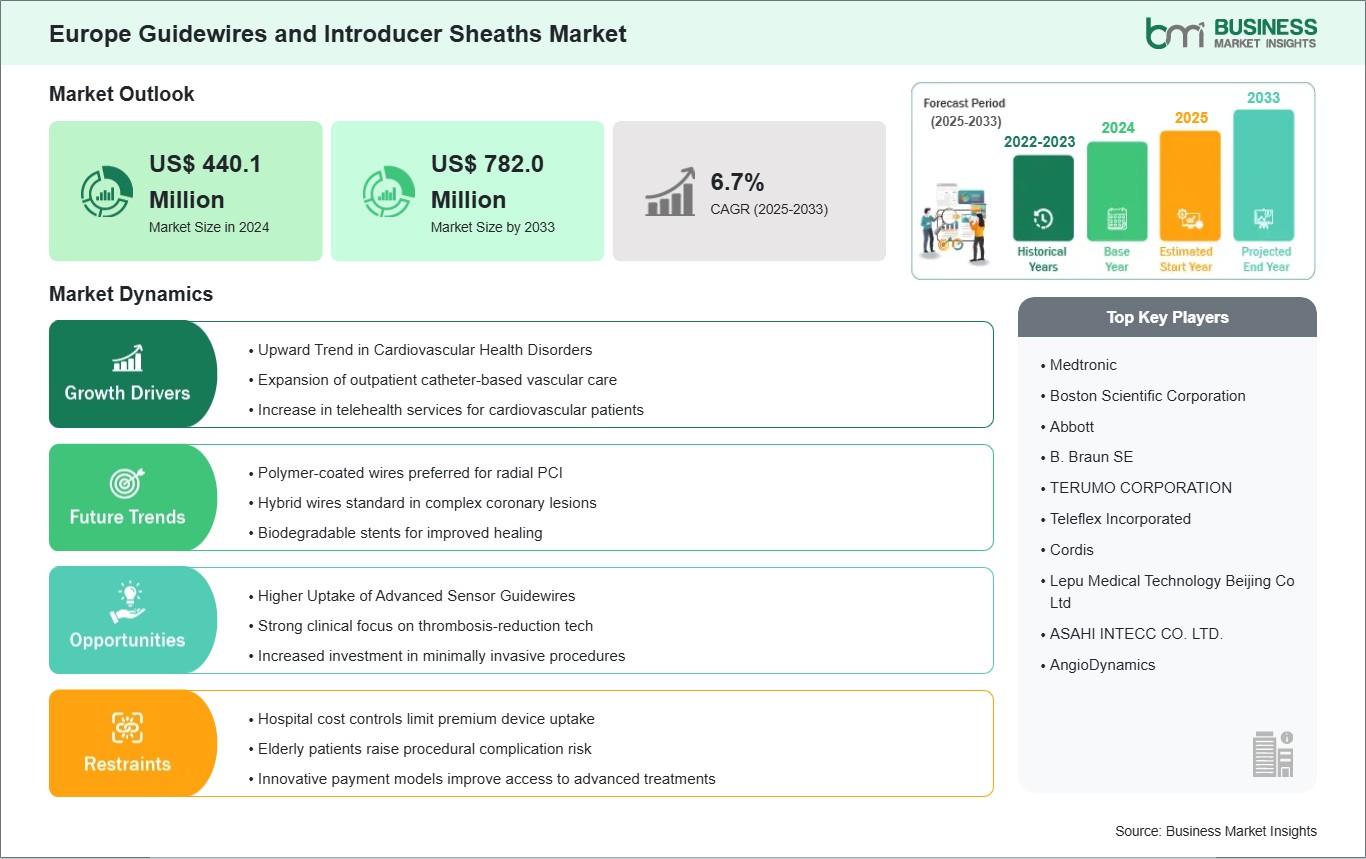
Europe guidewires and introducer sheaths market is distinguished by its mature healthcare infrastructure, strong regulatory frameworks, and emphasis on evidence‑based adoption of interventional technologies. Hospitals across the continent are deeply invested in minimally invasive procedures, supported by advanced imaging systems and well‑established catheterization labs. A key driver is the region's aging population, which has led to rising cardiovascular and peripheral vascular disease burdens, fueling demand for consumables that support complex interventions with predictable outcomes. Another unique factor is Europe's collaborative procurement models, where hospital consortia and national health systems negotiate long‑term contracts, ensuring standardized device use and cost efficiency.
Academic hospitals and research institutes play a pivotal role in shaping device preferences, often piloting new technologies and generating clinical data that influence broader adoption. Market restraints include stringent regulatory approval processes under MDR (Medical Device Regulation), which extend timelines for product launches, and cost‑containment pressures from public health systems that limit uptake of premium consumables. Despite these challenges, Europe benefits from strong investments in hybrid operating rooms, digital health integration, and sustainability initiatives that influence packaging and supply chain practices. Hospitals remain the dominant end users, while specialized cardiovascular centers and diagnostic networks contribute by standardizing imaging‑led triage into interventional pathways. Vendors that align with Europe's regulatory rigor, sustainability goals, and evidence‑driven procurement strategies are best positioned to sustain growth and deepen market penetration.
Segment Analysis
Europe Guidewires and Introducer Sheaths Market Segmentation
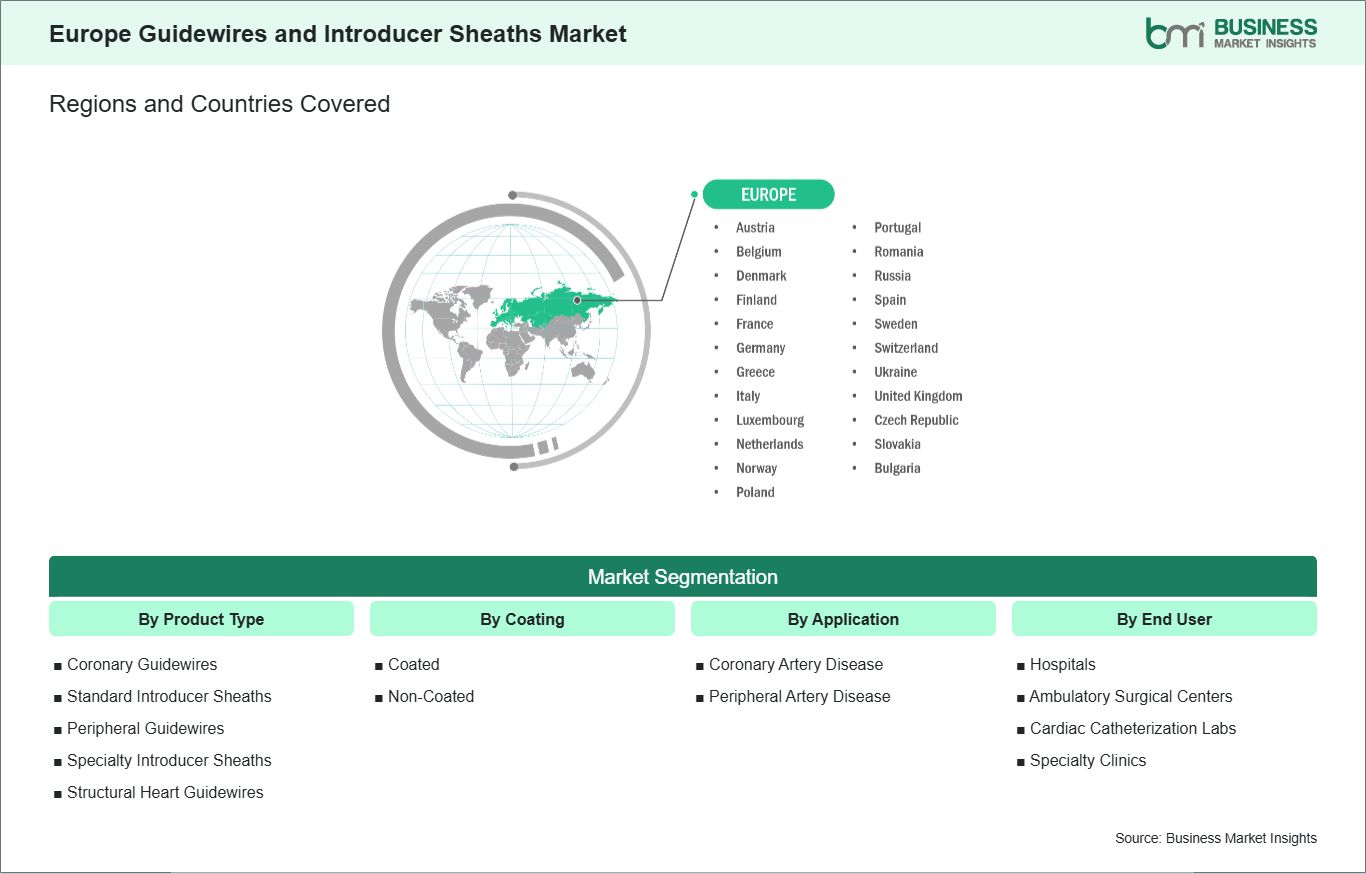
Key segments that contributed to the derivation of the Europe guidewires and introducer sheaths market analysis are product type, coating, application, and end user.
- By product type, the guidewires and introducer sheaths market is segmented into coronary guidewires, standard introducer sheaths, peripheral guidewires, specialty introducer sheaths, and structural heart guidewires. The coronary guidewires segment dominated the market in 2024.
- By coating, the guidewires and introducer sheaths market is bifurcated into coated and non-coated. The coated segment dominated the market in 2024.
- By application, the guidewires and introducer sheaths market is segmented into coronary artery disease, peripheral artery disease, and structural heart disease. The coronary artery disease segment dominated the market in 2024.
- By end user, the guidewires and introducer sheaths market is segmented into hospitals, ambulatory surgical centers, cardiac catheterization labs, and specialty clinics. The hospitals segment dominated the market in 2024.
Market Forces
Europe Guidewires and Introducer Sheaths Market Drivers and Opportunities
Rising Prevalence of Cardiovascular Diseases
Europe is managing one of the world's most significant burdens of cardiovascular disease (CVD), which remains the leading cause of mortality and morbidity across the continent. According to a report by Eurostat in December 2025, diseases of the circulatory system accounted for ~1.68 million deaths in the EU annually, representing ~32.7% of all deaths. This high prevalence—particularly in aging populations where the standardized death rate for those over 65 is 39 times higher than for younger cohorts—has generated a robust and sustained demand for advanced interventional tools such as guidewires and introducer sheaths.
Healthcare systems in Western Europe are increasingly shifting toward outpatient and minimally invasive interventions to alleviate the strain on hospital infrastructure. This expansion in specialized peripheral tools is a direct response to the rising incidence of peripheral artery disease (PAD), which necessitates high-precision access devices to ensure procedural safety and reduce the length of hospital stays.
The European market is shaped by clinical consensus and updated care standards. In August 2024, the European Society of Cardiology (ESC) released updated guidelines on Chronic Coronary Syndromes (CCS), which emphasized a more comprehensive diagnostic approach and a class 1 recommendation for invasive coronary functional testing. This clinical shift has influenced hospital procurement patterns, as the need to confirm or rule out obstructive CAD requires a higher volume of diagnostic guidewires and specialized introducer systems. As European nations continue to align their healthcare spending with these evidence-based protocols, the market for reliable, high-performance vascular access devices remains a critical growth segment.
Growing Adoption of Sensor-Enabled Guidewires
Europe is at the forefront of the global transition toward "smart" interventional cardiology, driven by a regional emphasis on diagnostic accuracy and cost-efficiency. In March 2025, Abbott Laboratories received CE Mark approval for its next-generation Absolute Quadra Guidewire, featuring advanced sensor technologies designed to improve tracking and provide real-time physiological feedback during complex procedures. This adoption of sensor-enabled wires allows European clinicians to move beyond simple visual assessments to precise, data-driven measurements of pressure gradients and flow reserve, which is essential for treating multi-vessel disease.
The integration of these devices is supported by updated clinical recommendations that favor functional assessment over simple angiography. In August 2024, the European Society of Cardiology (ESC) released updated Guidelines for the Management of Chronic Coronary Syndromes, which gave a Class 1 recommendation for the use of invasive functional testing (such as FFR or iFR) to evaluate the significance of coronary lesions. This endorsement ensures that sensor-enabled guidewires are no longer viewed as optional luxuries but as essential diagnostic tools for modern interventional practice.
Strategic advancements by major medical technology firms are further accelerating the availability and sophistication of these "smart" wires. Recent developments have focused on improving the steerability of sensor-tipped wires, allowing them to function both as a high-quality diagnostic tool and a primary workhorse wire for complex procedures. As European hospitals continue to invest in digital health infrastructure, the synergy between these sensor-enabled devices and real-time analytical software is expected to refine the efficiency and success rates of cardiovascular interventions.
Size and Share Analysis
Europe Guidewires and Introducer Sheaths Market Size and Share Analysis
The Europe Guidewires and Introducer Sheaths market demonstrates steady growth, with size and share analysis highlighting evolving trends and competitive dynamics among key players. The report further examines subsegments categorized within product type, coating, application, and end user, offering insights into their contribution to overall market performance.
By product type, the coronary guidewires subsegment dominated the market in 2024. Coronary guidewires dominate due to their critical role in minimally invasive procedures, the rising prevalence of coronary artery disease, and technological advancements ensuring precision, safety, and improved patient outcomes in cardiovascular interventions.
Based on coating, the coated subsegment dominated the market in 2024. Coated guidewires led the market as surface coatings enhance durability, reduce friction, improve navigation through complex vessels, and minimize complications, making them the preferred choice among physicians for efficiency and patient safety.
In terms of application, the coronary artery disease subsegment dominated the market in 2024. The coronary artery disease segment dominated as increasing global incidence, lifestyle risk factors, and demand for advanced interventional cardiology solutions drove adoption of guidewires and sheaths tailored for coronary procedures.
By end user, the hospitals subsegment dominated the market in 2024. Hospitals dominated the market since they handle the majority of complex cardiovascular interventions, offer advanced infrastructure, skilled specialists, and comprehensive patient care, making them the primary setting for guidewire and sheath usage.
Report Coverage
Europe Guidewires and Introducer Sheaths Market Report Coverage and Deliverables
The "Europe Guidewires and Introducer Sheaths Market Size and Forecast (2022–2033)" report provides a detailed analysis of the market covering below areas:
- Europe Guidewires and Introducer Sheaths market size and forecast at the regional and country levels for key market segments covered under the scope
- Europe Guidewires and Introducer Sheaths market trends, as well as market dynamics such as drivers, restraints, and key opportunities
- Europe Guidewires and Introducer Sheaths market analysis covering key market trends, regional framework, major players, regulations, and recent market developments
- Industry landscape and competition analysis covering market concentration, heat map analysis, prominent players, and recent developments for the Europe Guidewires and Introducer Sheaths market
- Detailed company profiles, including SWOT analysis
Geographic Insights
Europe Guidewires and Introducer Sheaths Market Geographic Insights
The geographical scope of the Europe Guidewires and Introducer Sheaths market report is divided into: Germany, Italy, France, the UK, Spain, Belgium, the Netherlands, Luxembourg, Norway, Finland, Denmark, Sweden, Austria, Switzerland, Russia, Romania, Greece, the Czech Republic, Portugal, Ukraine, Poland, Slovakia, and Bulgaria. Germany held the largest share in 2024.
Germany dominates the European market due to its extensive hospital infrastructure, strong academic research ecosystem, and leadership in cardiovascular innovation. German hospitals are early adopters of hybrid operating rooms and advanced catheterization labs, which demand guidewires and introducer sheaths optimized for multi‑disciplinary workflows. Procurement is highly structured, with hospital consortia and statutory health insurers favoring vendors that demonstrate robust clinical evidence, sustainability in packaging, and transparent post‑market surveillance. Clinicians in Germany emphasize reproducibility and precision, selecting devices that integrate seamlessly into standardized care pathways and support rapid patient recovery. A distinctive feature of the German market is its alignment with medical technology research. University hospitals often pilot new consumables, generating data that informs national procurement strategies. Growth is reinforced by the country's strong focus on digital health, where device traceability and integration with electronic health records enhance quality monitoring and supply chain efficiency. Constraints include strict cost‑effectiveness evaluations, which can limit the adoption of premium consumables, and the need for vendors to comply with rigorous environmental and sustainability standards. Nonetheless, Germany benefits from a culture of innovation, collaborative procurement, and patient‑centric care models. Vendors that invest in localized training, sustainability initiatives, and evidence‑driven product positioning are best placed to deepen adoption and sustain share in this dominant European market.
Industry Activity
Recent Developments
The Europe Guidewires and Introducer Sheaths market is evaluated by gathering qualitative and quantitative data post primary and secondary research, which includes important corporate publications, association data, and databases. A few of the key developments in the Europe guidewires and introducer sheaths market are:
- In December 2024, Teleflex Incorporated announced the launch of its new Pressure Injectable Arrowg+ard Blue Plus MSB Procedure Kit in Europe, the Middle East, and Africa (EMEA). This kit is a major addition to their vascular access portfolio, featuring a kink-resistant Nitinol guidewire and a specialized dilator that reduces vessel penetration force by up to 72% compared to standard models, facilitating safer and more efficient sheath introduction for critically ill patients.
- In November 2024, APT Medical announced that its Braidin Pro adjustable valve large sheath and Distail microcatheter successfully received CE certification under the European Union Medical Device Regulation (MDR). The Braidin Pro is designed for complex peripheral and structural heart interventions, offering an adjustable hemostasis valve that allows for the delivery of various device sizes while maintaining effective sealing and minimizing vascular trauma.
Trust & Transparency
Research Methodology
The market analysis combines proprietary research with secondary data from government agencies, company disclosures, regulatory filings, industry databases and expert interviews. Market estimates are validated through data triangulation, cross-market benchmarking and analyst
review.
View Full Research Methodology
Key Sources Referred:
The World Bank World Health Organization (WHO) Center for Disease Control and Prevention (CDC) European Society of Cardiology American College of Cardiology American Heart Association Asian Pacific Society of Interventional Cardiology Company Websites Company Annual Reports Company Investor Presentations