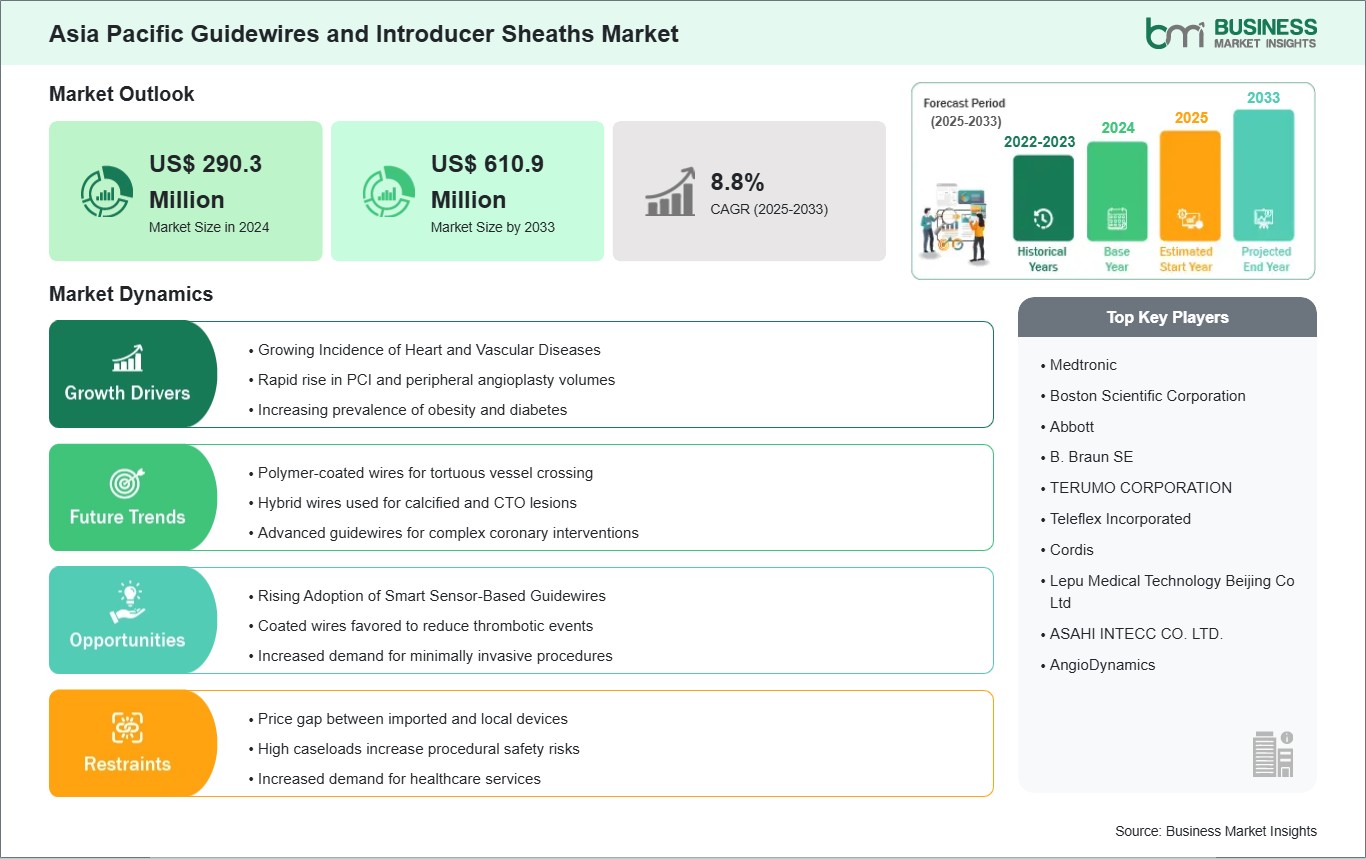
The Asia Pacific guidewires and introducer sheaths market size is expected to reach US$ 610.9 million by 2033 from US$ 290.3 million in 2024. The market is estimated to record a CAGR of 8.8% from 2025 to 2033.
Asia Pacific guidewires and introducer sheaths market is defined by high procedural diversity—from complex coronary interventions in advanced centers to expanding peripheral programs in emerging health systems—underpinned by rapid imaging adoption, cross‑border training ecosystems, and hospital consolidation. Demand is shaped by the region's push for day‑care interventional models, where device choices emphasize smooth vessel navigation, consistent tactile feedback, and sheath designs that minimize tissue trauma while supporting swift turnover. Procurement strategies vary widely: integrated hospital groups in developed markets favor standardized formularies and vendor scorecards, while fast‑growing systems in Southeast and South Asia rely on agile distributors to bridge inventory gaps and provide on‑site proctoring. A distinct driver is the surge in hybrid ORs and cath labs that blend cardiovascular and endovascular workflows, prompting hospitals to prefer multi‑indication guidewire families and sheath platforms compatible with varied access strategies.
Restraints include fragmented reimbursement for consumables, uneven sterilization and reprocessing protocols, and regulatory heterogeneity that complicates synchronized product launches. The competitive edge hinges on clinical education embedded within service contracts, device traceability for quality governance, and packaging that supports sterile field efficiency. Hospitals remain the core end users, with specialized centers accelerating adoption through protocolized pathways and outcome benchmarking. Vendors that align portfolio breadth with country‑specific clinical pathways, while optimizing training and logistics for high‑throughput environments, are best positioned to sustain momentum across Asia Pacific.

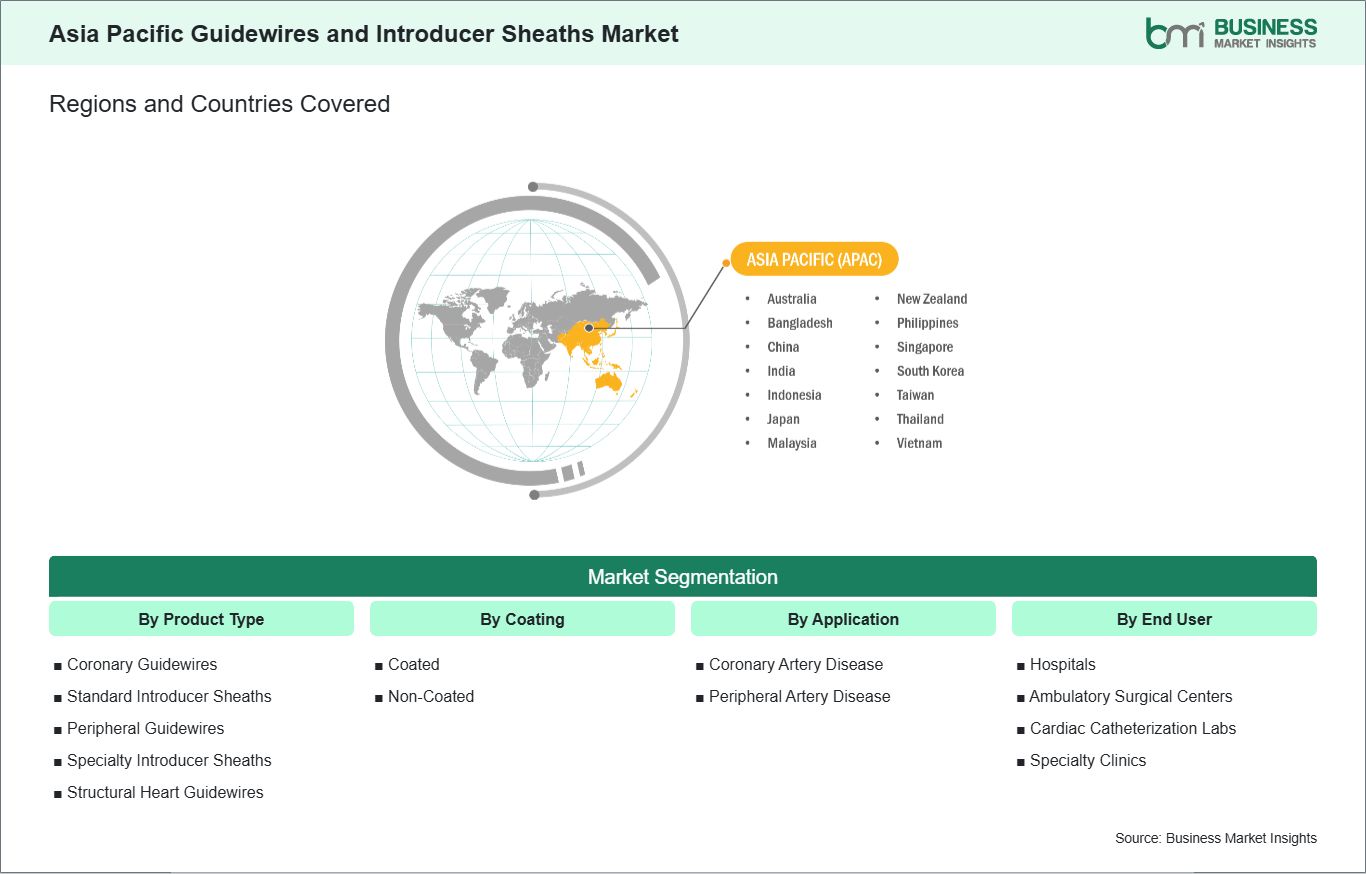
Key segments that contributed to the derivation of the Asia Pacific guidewires and introducer sheaths market analysis are product type, coating, application, and end user.
Asia Pacific has emerged as the global epicenter of cardiovascular disease (CVD) burden. According to a forecast analysis published in The Lancet Regional Health, Southeast Asia in August 2024, the crude prevalence of CVDs in Asia is projected to reach 729.5 million cases by 2050, representing a 109% increase from 2025 levels. This staggering rise is driven by aging populations in East Asia and rapid urbanization in South Asia. Consequently, healthcare systems are prioritizing the procurement of essential interventional tools, with guidewires and introducer sheaths seeing high-volume adoption to manage ischemic heart disease and peripheral artery conditions.
To combat this rising mortality, regional healthcare providers are aggressively expanding their interventional capabilities. In October 2025, Terumo India announced the launch of the FineCross M3 Coronary Micro-Guide Catheter, a device specifically engineered to enhance navigability and guidewire support during complex percutaneous coronary interventions (PCI). Such developments reflect a broader regional trend where medical device manufacturers are tailoring high-performance access tools to the complex vascular anatomies found in the region's aging and diabetic patient cohorts.
The shift toward minimally invasive surgery (MIS) continues to gain momentum across the region. In October 2025, Boston Scientific announced the global launch of the Journey Guidewire, a specialized 0.014-inch tool designed for challenging small-vessel peripheral angioplasty. This launch, which targeted major Asian medical hubs, underscores the critical role of advanced guidewire technology in meeting the demand for limb-salvage and complex vascular procedures. As governments in China and India continue to expand insurance coverage for these minimally invasive techniques, the demand for reliable, high-quality introducer sheaths and guidewires is expected to remain a cornerstone of the regional market.
Asia Pacific is witnessing a rapid transition toward "smart" cardiology, characterized by the growing adoption of sensor-enabled guidewires that provide real-time physiological data. In March 2025, Abbott introduced an upgraded FFR (Fractional Flow Reserve) guidewire system specifically designed to enhance diagnostic precision in complex coronary lesions. By integrating miniaturized sensors directly into the guidewire, this technology allows physicians in high-volume Asian cath labs to make data-driven decisions on stenting, thereby reducing procedural complications and optimizing hospital resources.
The demand for these advanced diagnostic tools is strong in Japan and South Korea, where evidence-based medicine is central to clinical practice. A market report from Data Bridge Market Research in November 2025 highlighted that flexible-tipped pressure guidewires held a dominant market share of 52.8% within the pressure wire segment, owing to their superior performance in navigating the tortuous coronary arteries common in elderly patients. This trend is being bolstered by clinical validation; for instance, a multi-center study involving Japanese researchers validated new diastolic pressure ratio (dPR) workflows, which simplify the use of sensor-enabled wires in daily practice.
Strategic partnerships are also playing a vital role in localizing these advanced technologies. In February 2024, BIOTRONIK collaborated with IMDS to launch the micro Rx catheter, designed to work in tandem with high-performance guidewires for interventional cardiac applications. Additionally, in September 2024, Viz.ai partnered with Cleerly to develop an AI-based platform for heart disease diagnosis, which integrates with data from interventional devices. As Asia Pacific continues to modernize its healthcare infrastructure, the integration of sensor-enabled guidewires with digital diagnostic platforms is positioning the region as a leader in the global shift toward precision interventional cardiology.

The Asia Pacific Guidewires and Introducer Sheaths market demonstrates steady growth, with size and share analysis highlighting evolving trends and competitive dynamics among key players. The report further examines subsegments categorized within product type, coating, application, and end user, offering insights into their contribution to overall market performance.
By product type, the coronary guidewires subsegment dominated the market in 2024. Coronary guidewires dominate due to their critical role in minimally invasive procedures, the rising prevalence of coronary artery disease, and technological advancements ensuring precision, safety, and improved patient outcomes in cardiovascular interventions.
Based on coating, the coated subsegment dominated the market in 2024. Coated guidewires led the market as surface coatings enhance durability, reduce friction, improve navigation through complex vessels, and minimize complications, making them the preferred choice among physicians for efficiency and patient safety.
In terms of application, the coronary artery disease subsegment dominated the market in 2024. The coronary artery disease segment dominated as increasing global incidence, lifestyle risk factors, and demand for advanced interventional cardiology solutions drove adoption of guidewires and sheaths tailored for coronary procedures.
By end user, the hospitals subsegment dominated the market in 2024. Hospitals dominated the market since they handle the majority of complex cardiovascular interventions, offer advanced infrastructure, skilled specialists, and comprehensive patient care, making them the primary setting for guidewire and sheath usage.
| Report Attribute | Details |
|---|---|
| Market size in 2024 | US$ 290.3 Million |
| Market Size by 2033 | US$ 610.9 Million |
| CAGR (2025 - 2033) | 8.8% |
| Historical Data | 2022-2023 |
| Forecast period | 2025-2033 |
| Segments Covered | By By Product Type
|
| Regions and Countries Covered | Asia Pacific
|
| Market leaders and key company profiles |
|
The "Asia Pacific Guidewires and Introducer Sheaths Market Size and Forecast (2022–2033)" report provides a detailed analysis of the market covering below areas:
The geographical scope of the Asia Pacific Guidewires and Introducer Sheaths market report is divided into: China, Japan, South Korea, India, Australia, New Zealand, Indonesia, Malaysia, the Philippines, Singapore, Thailand, Vietnam, Taiwan, Bangladesh, and the Rest of Asia. China held the largest share in 2024.
China dominates the regional market through scale, speed of cath lab deployment, and a strong emphasis on domestically engineered consumables that meet national procurement priorities. Hospitals adopt standardized device kits—guidewires, introducer sheaths, and ancillary accessories pre‑configured for coronary, neurovascular, or peripheral pathways—to reduce variability and accelerate turnover in busy centers. Clinical teams favor sheath platforms that integrate reliable hemostasis valves, smooth dilator transitions, and packaging designed for rapid sterile field setup, reflecting a system‑wide focus on efficiency and predictable workflows. Centralized tenders shape procurement and volume‑based purchasing alliances, which reward manufacturers that demonstrate consistent batch performance, robust post‑market surveillance, and responsive technical service. A notable feature is the integration of digital traceability—QR‑coded consumables linked to hospital quality systems—enabling real‑time monitoring of device usage, adverse events, and replenishment cycles. Growth is reinforced by national training networks, fellowship exchanges, and simulation labs that codify escalation strategies and access planning across diverse anatomies. Constraints include periodic price compression from bulk tenders, documentation demands for localized clinical evidence, and regional disparities in operator experience that necessitate on‑site proctoring. Diagnostic centers contribute by standardizing imaging protocols that inform access site selection and device kit composition, improving downstream cath lab efficiency. Vendors that localize product design, invest in field education, and align with China's data‑driven procurement and quality governance are best placed to deepen adoption and sustain share.

The Asia Pacific Guidewires and Introducer Sheaths market is evaluated by gathering qualitative and quantitative data post primary and secondary research, which includes important corporate publications, association data, and databases. A few of the key developments in the Asia Pacific guidewires and introducer sheaths market are:
The Asia Pacific Guidewires and Introducer Sheaths Market is valued at US$ 290.3 Million in 2024, it is projected to reach US$ 610.9 Million by 2033.
As per our report Asia Pacific Guidewires and Introducer Sheaths Market, the market size is valued at US$ 290.3 Million in 2024, projecting it to reach US$ 610.9 Million by 2033. This translates to a CAGR of approximately 8.8% during the forecast period.
The Asia Pacific Guidewires and Introducer Sheaths Market report typically cover these key segments-
The historic period, base year, and forecast period can vary slightly depending on the specific market research report. However, for the Asia Pacific Guidewires and Introducer Sheaths Market report:
The Asia Pacific Guidewires and Introducer Sheaths Market is populated by several key players, each contributing to its growth and innovation. Some of the major players include:
The Asia Pacific Guidewires and Introducer Sheaths Market report is valuable for diverse stakeholders, including:
Essentially, anyone involved in or considering involvement in the Asia Pacific Guidewires and Introducer Sheaths Market value chain can benefit from the information contained in a comprehensive market report.
Please tell us your area of interest
(Market Segments/ Regions and Countries/ Companies)