
Micro Electric Vehicles (EV) Market Outlook: Size, Share, Trends, Growth Analysis, Competitive Landscape & Forecast, 2026-2033

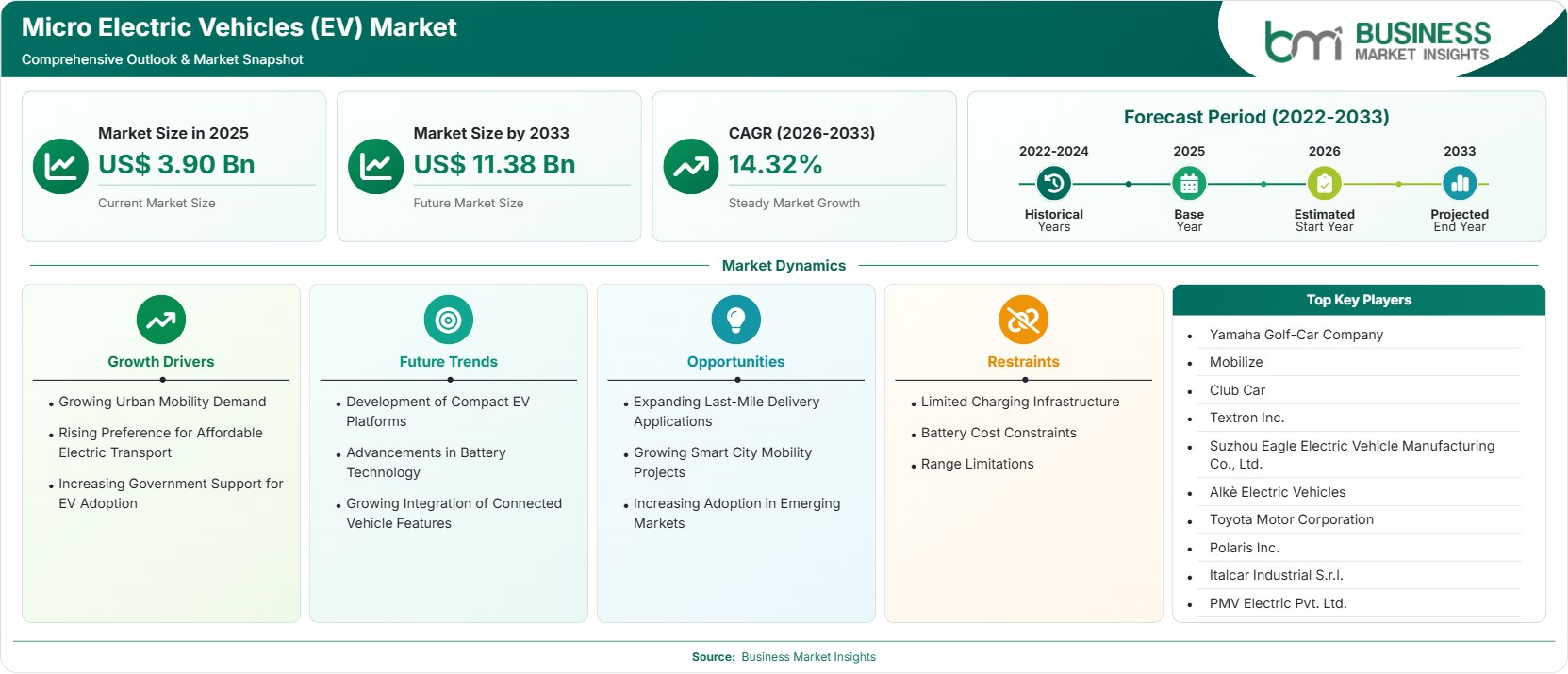
The Micro Electric Vehicles (EV) Market size was valued at US$ 3.90 Billion in 2025 and is projected to reach US$ 11.38 Billion by 2033, growing at a CAGR of 14.32% during 2026–2033, driven by compact mobility demand, electrification, lower operating costs, urban access, fleet efficiency, smart-city applications, and emerging last-mile transportation opportunities.

Report Coverage
  • Type: Quadricycle, Golf Carts
  • Battery Type: Lead-acid, Lithium-ion
  • Application: Commercial Use, Personal Use, Public Utilities
US$ 3.90 Bn Market size in 2025
US$ 11.38 Bn Market Size by 2033
14.32% CAGR, 2026 - 2033
2026-2033 Forecast Period

01 AI Overview

Micro Electric Vehicles (EV) Market Summary

  • North America Region: North America holds an estimated 30%–34% share in 2025, growing at a 12%–14% CAGR during 2026–2033, supported by golf-cart adoption, compact commercial mobility, fleet electrification, recreational applications, and demand for efficient low-speed transportation. The U.S. represents the dominant national market within North America, with an estimated 13%–15% CAGR during 2026–2033, supported by established golf-cart ecosystems, commercial campuses, retirement communities, resorts, and localized electric mobility programs.
  • Fastest Growing Region: Asia Pacific accounts for an estimated 25%–29% share in 2025, expanding at a 16%–19% CAGR during 2026–2033, supported by dense urban environments, affordable vehicle requirements, expanding electric mobility manufacturing, last-mile delivery opportunities, and increasing adoption of compact transportation.
  • Leading Segment: Golf Carts represent an estimated 55%–60% share in 2025, with a 12%–15% CAGR during 2026–2033, supported by established recreational use, commercial campuses, resorts, institutional facilities, neighborhood mobility, and growing interest in electric utility vehicles.
  • High Growth Segment: Lithium-ion batteries represent an estimated 42%–47% share in 2025, with a 17%–20% CAGR during 2026–2033, driven by weight advantages, charging characteristics, usable range, lower maintenance requirements, and suitability for higher-utilization commercial applications.
  • Key Market Opportunity: Compact electric platforms can expand beyond recreation into delivery, campuses, hospitality, utilities, gated communities, and urban services, creating opportunities for modular vehicles, fleet leasing, battery services, connected mobility, and specialized body configurations.
  • Major Market Players: Yamaha Golf-Car Company, Mobilize, Club Car, Textron Inc., Suzhou Eagle Electric Vehicle Manufacturing Co., Ltd., Alkè Electric Vehicles, Toyota Motor Corporation, Polaris Inc., Italcar Industrial S.r.l., and PMV Electric Pvt. Ltd.
02 Strategic Insights

Micro Electric Vehicles (EV) Market: Strategic Insights

Micro Electric Vehicles (EV) Market Strategic Framework
FREE PDF
Request your free sample
Request free sample
03 Stakeholder View

Key Takeaways

  • The value chain is evolving from conventional golf-cart manufacturing toward integrated electric mobility platforms involving battery suppliers, drivetrain specialists, charging providers, vehicle software developers, body manufacturers, fleet operators, and specialized distributors.
  • Commercial Use provides the strongest avenue for incremental demand because vehicles can be deployed repeatedly within defined operating environments. Delivery compounds, hospitality properties, industrial campuses, educational facilities, resorts, and institutional sites.
  • Batteries are becoming one of the most important considerations in product development. The lithium-ion batteries are used in vehicles where there is need for weight reduction, frequent recharging, longer life cycle, and energy savings whereas lead acid batteries are still relevant.
  • Asia Pacific region represents an ideal expansion territory where the need for compact transportation solutions and urbanized areas exists and there is also a need for electric mobility solution.
  • Investment strategies should increasingly emphasize platform scalability rather than individual vehicle models. Partnerships involving vehicle manufacturers, battery providers, fleet operators, charging companies, and mobility service providers can accelerate commercialization.
04 Geographic Outlook

Micro Electric Vehicles (EV) Market Regional Highlights

North America Micro Electric Vehicles (EV) Market

North America represents an estimated 30%–34% share in 2025, with a 12%–14% CAGR during 2026–2033. Established golf-cart usage provides a mature foundation, while commercial campuses, resorts, communities, and institutional facilities create additional demand. The regional Micro Electric Vehicles (EV) Market share reflects established recreational demand alongside emerging commercial mobility requirements.

  • Established golf-cart ecosystems provide manufacturers with distribution, servicing, and customer familiarity advantages while creating a natural pathway toward utility-oriented electric platforms for commercial and institutional environments.
  • Fleet operators increasingly value compact electric vehicles where routes are predictable, operating speeds are controlled, and frequent short-distance movement makes larger passenger vehicles operationally inefficient.
  • Hospitality properties represent an important application because compact vehicles can support guest transportation, maintenance activities, internal logistics, and service operations across large facilities.
  • Product development is increasingly focused on modular platforms that can accommodate passenger seating, cargo bodies, utility equipment, and specialized configurations without requiring completely separate vehicle architectures.

US Micro Electric Vehicles (EV) Market

The U.S. accounts for an estimated 22%–25% of the regional market in 2025, expanding at a 13%–15% CAGR during 2026–2033. Demand benefits from established golf-cart use, recreational mobility, institutional campuses, hospitality facilities, and community transportation. The U.S. market also provides a strong testing environment for specialized configurations, including utility, passenger, cargo, and low-speed neighborhood transportation applications.

  • Golf-cart familiarity reduces barriers to adoption because users, distributors, technicians, and fleet operators already understand basic electric vehicle operation, maintenance requirements, charging practices, and service models.
  • Resort and hospitality applications create recurring demand for passenger and utility vehicles operating within controlled environments, where compact dimensions provide maneuverability advantages over conventional automobiles and vans.
  • Commercial campuses can deploy compact vehicles for internal logistics, employee movement, security, maintenance, and material transportation, supporting higher utilization than recreational-only applications.

Europe Micro Electric Vehicles (EV) Market

Europe represents an estimated 21%–25% share in 2025, with a 13%–16% CAGR during 2026–2033. France and Germany provide important adoption environments, while Italy offers strong relevance for compact mobility and specialized electric vehicles. Higher-growth opportunities are concentrated in applications where vehicle size, maneuverability, and operating efficiency matter more than high-speed performance, supporting gradual expansion of specialized electric platforms across commercial and personal transportation.

  • France provides opportunities for compact electric mobility through urban and localized transportation requirements, particularly where vehicle dimensions and operating flexibility are important considerations for users.
  • Germany offers potential across commercial facilities, campuses, industrial environments, and specialized mobility applications where compact electric platforms can complement rather than replace conventional vehicles.
  • Italy provides a strong application environment for compact vehicle formats, with opportunities across hospitality, tourism, personal mobility, and specialized commercial transportation.
  • European product strategies increasingly emphasize efficient packaging, modularity, practical range, and application-specific configurations rather than maximizing vehicle size or performance.

Asia Pacific Micro Electric Vehicles (EV) Market

Asia Pacific represents an estimated 25%–29% share in 2025, growing at a 16%–19% CAGR during 2026–2033, making it the fastest-growing regional opportunity. China, Japan, and India represent leading opportunity centers, while India and selected Southeast Asian markets offer higher-growth potential for compact electric transportation. The regional Micro Electric Vehicles (EV) Market growth is supported by the ability to adapt vehicles to localized payload, route, charging, and affordability requirements.

  • China offers broad manufacturing and application opportunities, particularly for compact commercial transportation, utility vehicles, and localized mobility platforms requiring flexible configurations and competitive production economics.
  • Japan provides opportunities through compact mobility requirements, established vehicle engineering capabilities, controlled-speed transportation applications, and demand for practical vehicles operating within constrained environments.
  • India presents strong potential for affordable electric mobility, especially in commercial transportation, institutional environments, gated communities, and applications where compact dimensions reduce operating complexity.
  • Southeast Asian markets can support adoption through tourism, hospitality, industrial campuses, and short-distance commercial transportation, creating opportunities for specialized vehicle distributors and fleet operators.

Rest of World Micro Electric Vehicles (EV) Market

South and Central America represent an emerging opportunity supported by tourism, hospitality, gated communities, industrial facilities, and localized commercial transportation. The Middle East and Africa offer additional potential through resorts, industrial facilities, planned communities, airports, and utility applications. Overall, Rest of World accounts for an estimated 14%–18% share in 2025, with a 13%–17% CAGR during 2026–2033.

  • Brazil can support commercial and recreational adoption through tourism, hospitality, private communities, industrial facilities, and applications requiring practical short-distance transportation.
  • Middle Eastern markets provide opportunities in resorts, planned communities, large facilities, and controlled environments where compact electric vehicles can support passenger movement and maintenance activities.
  • African markets can develop specialized applications around campuses, hospitality properties, industrial facilities, and localized utility operations where conventional vehicle deployment may be inefficient.
  • Regional growth depends strongly on distributor capability, charging access, after-sales service, replacement-battery availability, and vehicle configurations adapted to local operating conditions.
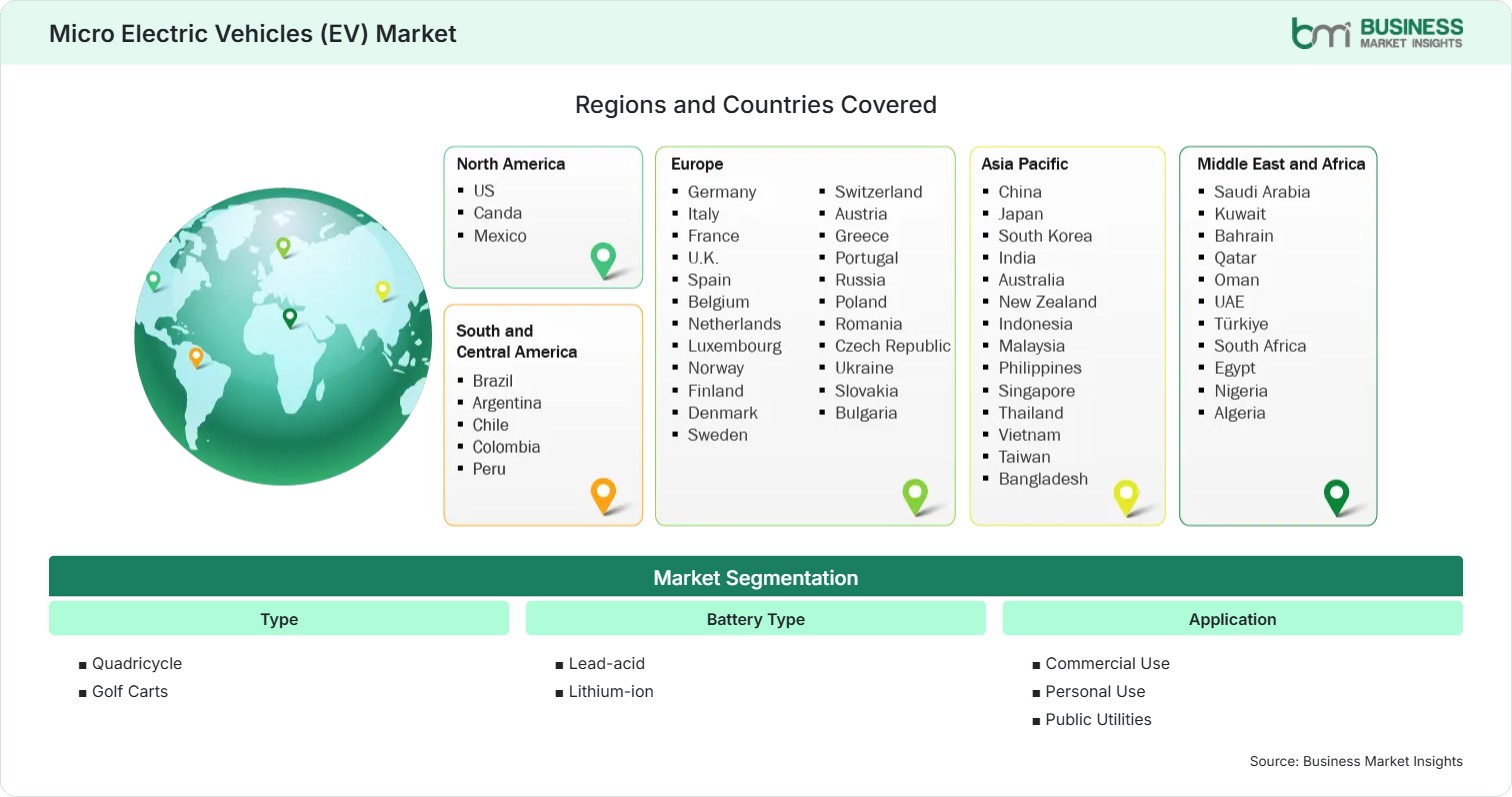
Global Market Geography
FREE PDF
Request your free sample
Request free sample
05 Segment Analysis

Micro Electric Vehicles (EV) Market Segmentation

Type

The Type segment is led by Golf Carts, representing an estimated 55%–60% share in 2025 and a 12%–15% CAGR during 2026–2033. The Micro Electric Vehicles (EV) Market scope increasingly spans recreational, commercial, institutional, and localized transportation requirements, encouraging manufacturers to develop differentiated platforms around payload, seating, speed, range, maneuverability, and operating environment.

  • Quadricycle: Compact dimensions support personal transportation, localized urban movement, community mobility, and short-distance applications. Adoption can increase as users seek practical electric alternatives with lower operating complexity and adaptable vehicle configurations.
  • Golf Carts: Established recreational demand provides a strong foundation, while hospitality, campuses, resorts, communities, and commercial facilities expand utility applications. Electric drivetrains support quiet operation and repeated short-distance transportation.

Battery Type

The Battery Type segment is shifting toward lithium-ion platforms, which represent an estimated 42%–47% share in 2025 and a 17%–20% CAGR during 2026–2033. Lead-acid remains relevant for cost-sensitive applications and established vehicle fleets. Battery selection influences vehicle weight, charging behavior, maintenance, usable operating cycles, and total ownership economics, making battery architecture increasingly important to the Micro Electric Vehicles (EV) Market trends.

  • Lead-acid: Established supply chains, familiar servicing practices, and comparatively straightforward replacement models support continued adoption in recreational and cost-sensitive applications where maximum energy density is not essential.
  • Lithium-ion: Lower weight, efficient energy utilization, charging flexibility, and suitability for frequent-use commercial fleets support adoption. The technology is particularly relevant for vehicles requiring repeated operating cycles and practical payload capacity.

Application

The Application segment is led by Commercial Use, supported by recurring fleet requirements across hospitality, campuses, logistics, industrial facilities, and service operations. Commercial Use represents an estimated 45%–50% share in 2025 with a 15%–18% CAGR during 2026–2033. Personal Use and Public Utilities provide additional applications as manufacturers tailor platforms to passenger, utility, cargo, and service requirements.

  • Commercial Use: Repetitive short-distance routes, predictable operating environments, and fleet utilization create attractive economics. Applications include hospitality, campuses, logistics, industrial facilities, resorts, and localized service transportation.
  • Personal Use: Compact electric vehicles appeal to users seeking convenient short-distance mobility, particularly within communities, recreational environments, private properties, and other settings where full-size vehicles provide excess capacity.
  • Public Utilities: Municipal, institutional, and facility-management applications can use specialized platforms for maintenance, security, internal transport, and service operations. Purpose-built bodies increase functional value beyond conventional passenger transportation.
06 Market Forces

Micro Electric Vehicles (EV) Market Dynamics

Key Market Drivers

Growing Urban Mobility Demand

Urban and localized mobility requirements favor smaller vehicles that can maneuver efficiently through constrained environments and complete short routes with limited energy consumption. Micro Electric Vehicles (EV) Market growth is driven by demand in communities, campus, hospitality, and small-scale commercial establishments. Small-sized vehicles will require less space for parking and will enable easier transportation. Their potential will be greatest in circumstances in which route distances are predictable and there is no need for high speed. Such an environment enables their further use outside the scope of recreation. Manufacturers are designing modular systems, different seating arrangements, cargo setups, and utility vans.

Rising Preference for Affordable Electric Transport

Cost-sensitive buyers increasingly evaluate transportation according to acquisition cost, operating requirements, maintenance complexity, and vehicle utilization rather than headline performance. Compact electric platforms can address these concerns by sizing the vehicle in accordance with the needs of short-range mobility. From an operator perspective, the financial viability could become more attractive where the vehicles do repetitive trips during the operating period. Battery choice will continue to be critical, as the right battery chemistry could have an impact on the weight of the vehicle, charge cycle, maintenance, and operation cycles.

Increasing Government Support for EV Adoption

Public-sector electrification initiatives can improve the operating environment for compact electric mobility where regulations and incentives recognize appropriate low-speed applications. As for manufacturers, alignment of the policy can favor localized production, technology investments, and cooperation with fleet owners. Implementation becomes highly important in cases where public administration wants to have clean transport within an operational area such as campus, municipality, tourist location, and so forth. The Micro Electric Vehicles (EV) Market trends do not rely only on the demand from consumers, but on how mobility rules define vehicle categories, operating permissions, charging requirements, and public-space access.

Key Market Opportunities

Expanding Last-Mile Delivery Applications

Last-mile logistics provides a strong opportunity for compact electric platforms because delivery operations frequently involve short routes, repeated stops, and constrained access areas. Purpose-built cargo designs can enhance the agility of the vehicle without the burden of extra capacity associated with bigger vehicles. Operators of fleets can be able to choose the battery and payload depending on the type of route, making it possible for manufacturers to come up with modular bodies and standardized chassis. This Micro Electric Vehicles (EV) Market Forecast can go beyond just the delivery of parcels to include food transport, facility services, retail resupply, hospitality logistics, and campus transportation. Models such as leasing and fleet management can lower the barrier of entry, as vehicle purchase becomes an expense of operations.

Growing Smart City Mobility Projects

Smart-city initiatives can create controlled environments for compact electric mobility through community transportation, facility services, parking operations, public-space maintenance, and localized passenger movement. Compact vehicles can serve to supplement large-scale public transport instead of acting as rivals. Manufacturers can design platforms with capabilities to monitor routes, analyze utilization, manage charging, and conduct preventive maintenance. Fleet managers can leverage operation information to ensure that car specifications coincide with real-time vehicle utilization, thus helping to minimize the surplus capacity of cars. Specialized configurations can also create the context of demonstrations in collaboration with the public sector. The opportunity is high when compact vehicles are integrated into broader mobility systems.

Increasing Adoption in Emerging Markets

Emerging markets offer opportunities for compact electric transportation because affordability, maneuverability, localized manufacturing, and short-distance mobility requirements can align closely with micro-vehicle characteristics. Seating capacity, body shape, battery placement, and functionality can all be customized for local application and do not need to mimic that of existing passenger vehicles. Cooperation with regional distributors will enhance services as well as parts distribution while contributing to market awareness. Fleet vehicles represent an especially appealing opportunity since central purchasing enables manufacturers to showcase the economics of the vehicles through many different use cycles. Ultimately, the success in the fleet market can result in a secondary demand from individuals, organizations, and hospitality providers.

Market Restraints and Challenges

Limited Charging Infrastructure

Factor: Inconsistent charging availability can restrict vehicle utilization, particularly for commercial operators requiring predictable daily operating cycles. Impact: Fleet managers may delay the purchasing process or opt for traditional cars as back-up units, thereby limiting the level of efficiency that could be gained from the use of electric vehicles. The demand for charging will also differ depending on the battery, the vehicle duty cycle, schedule of operation, and fleet size. Fleet operations involving more than one unit will require dedicated electrical power, charging devices, parking arrangements, and processes.

Battery Cost Constraints

Factor: Battery systems remain a material component of vehicle economics, particularly for configurations requiring greater usable energy, frequent operation, or longer service cycles. Impact: High battery costs may contribute to higher acquisition costs and payback times for price-sensitive users. The lithium-ion platform is capable of offering an operational edge, but it must be determined whether or not it offsets the investment and replacement cost incurred by the buyer. Lead-acid batteries continue to be favored where their lower acquisition costs are more important than their added weight and servicing needs. Battery choice becomes a matter of procurement strategy rather than one of technical selection.

07 Company Analysis

Competitive Landscape

The competitive environment is characterized by established golf-cart manufacturers, diversified mobility companies, specialized electric-vehicle producers, and automotive groups. The Micro Electric Vehicles (EV) Market analysis indicates that competition is increasingly shaped by platform versatility, battery technology, application specialization, distribution capability, after-sales support, and the ability to adapt vehicles for commercial and utility use.

Company Name

Overview

Products and Services relevant to this market

Yamaha Golf-Car Company

Established mobility specialist with strong relevance to golf-cart and compact transportation applications across recreational and commercial environments.

Golf carts, utility vehicles, electric mobility platforms, fleet support, and application-specific transportation solutions.

Mobilize

Mobility-focused company positioned around compact transportation and evolving urban mobility requirements.

Compact mobility concepts, electric transportation solutions, mobility services, and vehicle platforms for localized transportation needs.

Club Car

Established compact vehicle manufacturer serving recreational, commercial, institutional, and utility transportation requirements.

Golf carts, utility vehicles, commercial transport platforms, personal mobility vehicles, and fleet-oriented solutions.

Textron Inc.

Diversified industrial company with mobility-related operations serving specialized transportation applications.

Golf and utility vehicles, compact transportation platforms, fleet solutions, and related mobility services.

Suzhou Eagle Electric Vehicle Manufacturing Co., Ltd.

Specialized electric-vehicle manufacturer focused on compact electric transportation and application-specific vehicle configurations.

Electric golf carts, utility vehicles, passenger vehicles, sightseeing platforms, and customized electric transportation solutions.

Alkè Electric Vehicles

Specialist electric-vehicle producer emphasizing compact utility transportation for commercial and operational environments.

Electric utility vehicles, transport platforms, cargo configurations, municipal vehicles, and specialized fleet applications.

Toyota Motor Corporation

Global automotive company with capabilities relevant to electrified mobility and compact transportation development.

Electrified mobility technologies, compact vehicle solutions, transportation systems, and specialized electric mobility applications.

Polaris Inc.

Powersports and specialty-vehicle company serving recreational, utility, and off-road mobility requirements.

Electric utility vehicles, recreational platforms, neighborhood transportation, and specialized mobility products.

Italcar Industrial S.r.l.

Specialist manufacturer focused on compact electric vehicles and customized mobility solutions.

Electric golf carts, passenger vehicles, utility platforms, and customized compact transportation configurations.

PMV Electric Pvt. Ltd.

Electric mobility company focused on compact transportation and accessible urban mobility solutions.

Small electric vehicles, personal mobility platforms, urban transportation solutions, and compact electric mobility products.

10 Trust & Transparency

Research Methodology

The market analysis combines proprietary research with secondary data from government agencies, company disclosures, regulatory filings, industry databases and expert interviews. Market estimates are validated through data triangulation, cross-market benchmarking and analyst review.

View Full Research Methodology

11 Questions Answered

Frequently Asked Questions

How can businesses evaluate a Micro Electric Vehicles (EV) Market Report?

A useful report should connect vehicle type, battery architecture, application, regional demand, competitive positioning, and adoption constraints. It should also distinguish recreational demand from commercial fleet opportunities and assess how each configuration fits its intended operating environment.

What product-development strategy can manufacturers prioritize?

Manufacturers can prioritize modular platforms that support passenger, cargo, utility, and recreational configurations. Common chassis architectures can reduce development complexity while allowing products to address different operating requirements.

Which application has the strongest commercial potential?

Commercial Use offers strong potential because vehicles can operate repeatedly across predictable routes in hospitality, campuses, logistics, industrial facilities, and service environments.

How does battery selection influence purchasing decisions?

Battery selection affects acquisition economics, vehicle weight, charging requirements, maintenance, usable operating cycles, and fleet suitability. Lead-acid remains relevant for cost-sensitive applications, while lithium-ion is better suited to frequent-use and performance-oriented requirements.

What vehicle type currently provides the strongest opportunity within the Micro Electric Vehicles (EV) Market?

Golf Carts provide the strongest current opportunity because of their established application base across recreation, hospitality, campuses, communities, and commercial environments.

Access the Full Micro Electric Vehicles (EV) Market Report

Get segment-level forecasts, regional estimates, competitive benchmarking, company profiles and downloadable Excel datasets.

Access the full Micro Electric Vehicles (EV) Market Report
350 pages PDF & Excel | 2026-08-19