Market Summary
Executive Summary and Global Market Analysis
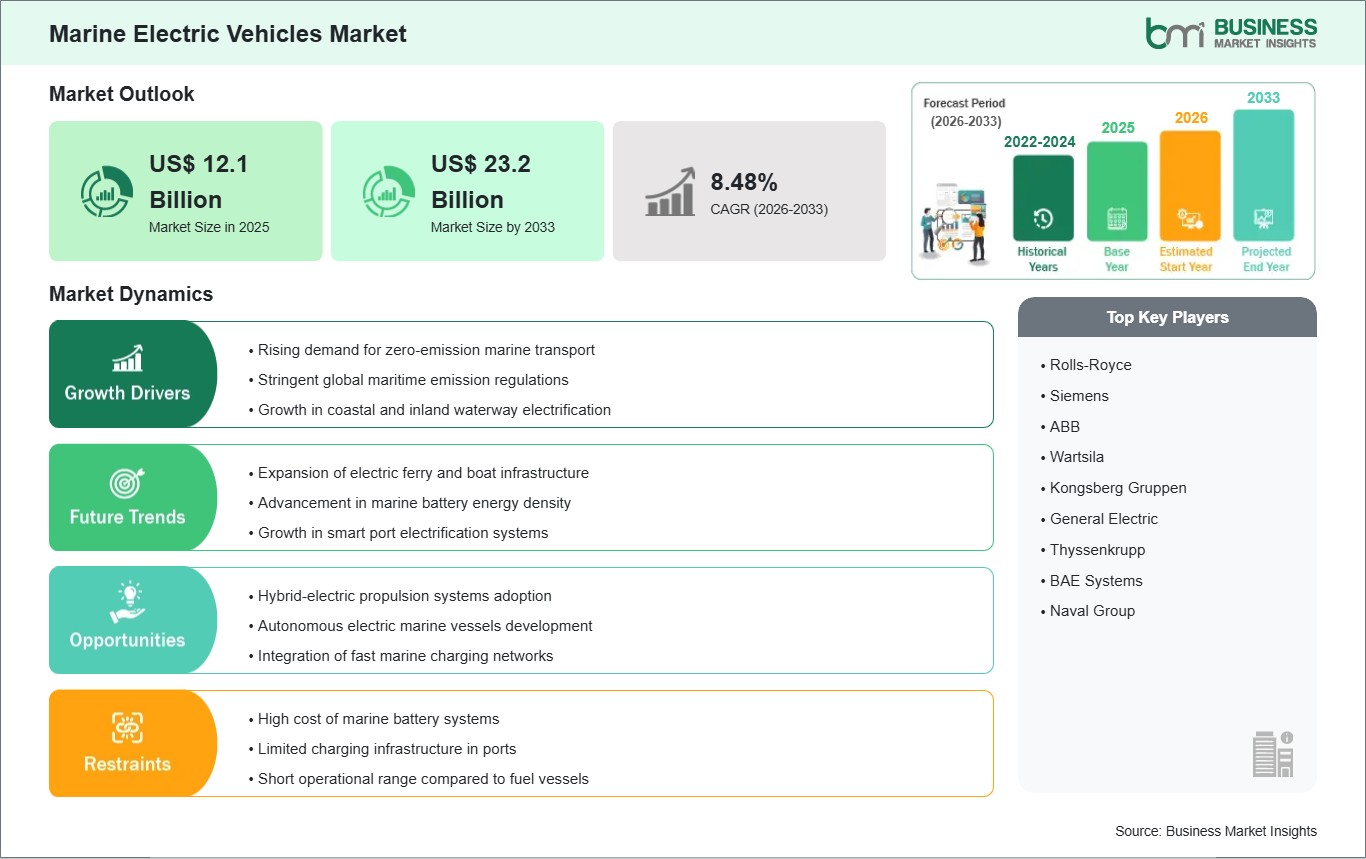
Marine electric vehicles are waterborne craft that use battery-based or hybrid propulsion systems to reduce fuel reliance and onboard emissions. These vessels span surface and underwater platforms, serving commercial tasks, defense operations, tourism services, and specialized missions requiring quieter and more efficient marine mobility. Their technical value lies in combining electric propulsion, energy storage, and vessel control systems within constrained marine operating conditions.
Deployment is broadening as vessel operators respond to emission control measures, fuel cost exposure, and the need for lower-noise maritime transport. Electric and hybrid architectures are gaining attention where route predictability, port operations, and mission-specific energy planning support practical integration. Interest is also increasing in segments where conventional propulsion creates maintenance burdens or operational constraints in sensitive marine environments.
The segmentation profile shows a market shaped by propulsion format, platform type, and craft application. Battery electric vessels align with short-range and low-noise requirements, while plug-in hybrid and hybrid electric formats suit applications needing extended endurance or flexible power management. On-water craft represent a broader operational base, whereas underwater platforms address defense, inspection, and exploration missions with distinct system integration needs.
Technology evolution is centered on battery efficiency, charging interfaces, lightweight materials, propulsion control software, and mission management systems for autonomous platforms. Improvements in these areas are enhancing range planning, onboard energy balancing, and vessel responsiveness under variable marine loads. This progression is widening the addressable use base from leisure boats and work craft to underwater vehicles with higher navigational precision.
Competitive activity is defined by propulsion innovation, integration capability, charging compatibility, and application-specific vessel design. Participants differentiate through modular systems, platform customization, and alignment with use cases such as tourism fleets, naval programs, and autonomous subsea operations. As procurement decisions become more performance-led, the industry increasingly rewards suppliers that combine engineering reliability with operational adaptability.
Segment Analysis
Marine Electric Vehicles Market Segmentation
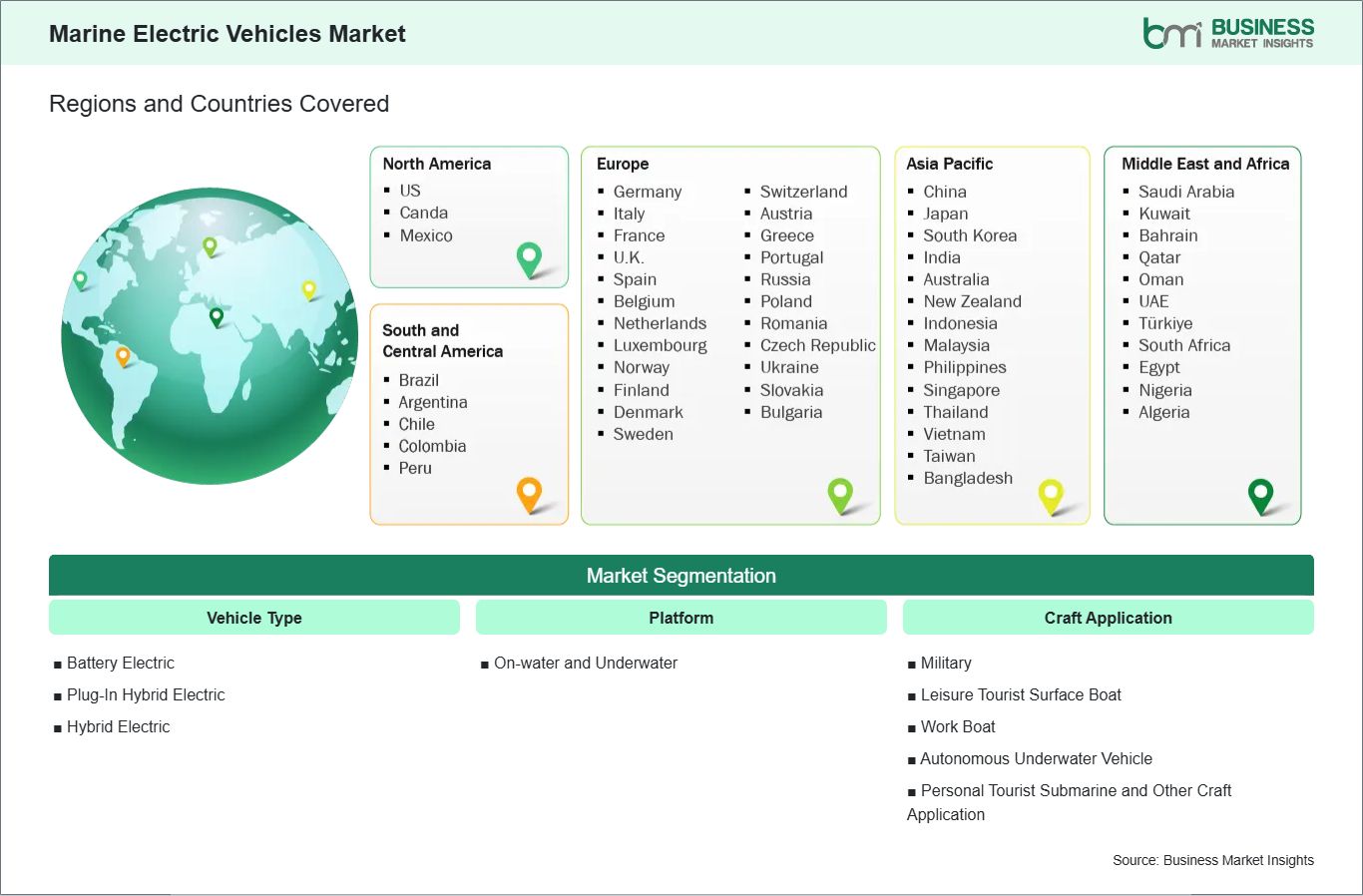
The market is segmented by vehicle type, platform, and craft application, reflecting distinct propulsion demands and mission profiles.
By Vehicle Type
- Battery Electric: Preferred for low-noise routes with defined charging intervals.
- Plug-In Hybrid Electric: Fits vessels requiring flexible range and shore-powered operation.
- Hybrid Electric: Supports mixed-duty cycles across demanding marine service conditions.
By Platform
- On-water: Leads deployment across transport, tourism, patrol, and utility operations.
- Underwater: Expands in inspection, defense, and autonomous subsea mission settings.
By Craft Application
- Military: Values stealth, endurance management, and reduced acoustic signature.
- Leisure Tourist Surface Boat: Benefits from quiet cruising and lower operating disruption.
- Work Boat: Aligns with repetitive duty cycles and fuel-efficiency priorities.
- Autonomous Underwater Vehicle (AUV): Serves data-led missions with electric autonomy advantages.
- Personal Tourist Submarine: Attracts interest through low-noise underwater excursion capability.
- other craft Application: Covers emerging formats tailored to specialized marine tasks.
Market Forces
Marine Electric Vehicles Market Drivers and Opportunities
Stricter Emission Compliance and Lower-Noise Vessel Operation Requirements
Maritime operators face tighter environmental compliance expectations across ports, inland waterways, tourism zones, and defense applications. This creates a clear need for propulsion systems that reduce exhaust output and onboard noise without compromising maneuverability. Marine electric vehicles address this requirement through battery-supported or hybrid powertrains that suit routes and missions where energy use can be planned with greater operational precision.
The impact extends beyond compliance, influencing vessel design choices, maintenance planning, and service positioning across commercial and institutional fleets. In tourism and defense contexts, quieter propulsion adds operational relevance where passenger experience or acoustic discretion matters. This makes the driver especially important in applications where environmental performance and functional efficiency now shape procurement direction.
Advances in Autonomous Underwater Systems and Marine Energy Management
A notable opportunity is emerging from improvements in autonomous navigation, compact batteries, and intelligent energy management for underwater and surface craft. These advances are enabling electric marine systems to serve inspection, research, tourism, and utility roles with stronger mission control and lower operating complexity. The opportunity is particularly visible where operators seek cleaner propulsion alongside digital vessel functionality.
Future scope includes wider platform diversification, better shore charging alignment, and deeper use of electric systems in autonomous subsea craft. Expansion potential also extends to personal underwater tourism formats and specialized work boats that benefit from predictable duty cycles. As these capabilities mature, the market can broaden across commercial, defense, and recreational settings with stronger operational impact.
Size and Share Analysis
Marine Electric Vehicles Market Size and Share Analysis
The Marine Electric Vehicles market size is projected to grow from US$ 12.1 Billion in 2025 to US$ 23.2 Billion by 2033, registering a CAGR of 8.48% during 2026 - 2033. This trajectory indicates a sector undergoing propulsion transition across marine applications where emissions control, lower noise, and energy-efficient vessel design are becoming more commercially relevant.
Among vehicle type segments, battery electric vessels hold a visible position where short-distance deployment, quieter operation, and simplified propulsion architecture align with operator priorities. Plug-in hybrid electric and hybrid electric formats remain significant for missions needing greater range flexibility and onboard power balancing. This mix shows that propulsion selection is closely linked to route profile, duty cycle, and platform purpose.
By application, leisure tourist surface boats command notable attention because quiet cruising and lower operating disturbance align well with customer-facing marine experiences. Work boats and military craft also retain strategic relevance as operators assess fuel use, acoustic signature, and maintenance efficiency. The application structure highlights a market serving both visible passenger activities and specialized mission-oriented marine operations.
Report Coverage
Marine Electric Vehicles Market Report Coverage and Deliverables
The "Marine Electric Vehicles Market Size and Forecast (2022–2033)" report provides a detailed analysis of the market covering below areas:
- Market size and forecast at global, regional, and country levels for all the key market segments covered under the scope
- Market trends, as well as market dynamics such as drivers, restraints, and key opportunities
- Market analysis covering key market trends, global and regional framework, major players, regulations, and recent market developments
- Industry landscape and competition analysis covering market concentration, heat map analysis, prominent players, and recent developments for the market
- Detailed company profiles, including SWOT analysis
Geographic Insights
Marine Electric Vehicles Market Geographic Insights
The Marine Electric Vehicles market shows diverse regional adoption patterns influenced by port electrification priorities, tourism models, defense modernization, and local vessel operating economics. At a global level, the industry reflects uneven infrastructure readiness, with adoption moving faster where charging access, policy support, and fleet renewal cycles create stronger implementation conditions. Surface craft currently define the broader commercial footprint, while underwater applications remain more specialized and mission-specific.
North America benefits from active product commercialization, marina electrification initiatives, and defense interest in autonomous and low-signature marine systems. Buyers in this region often emphasize propulsion reliability, charging compatibility, and platform integration across leisure, patrol, and subsea applications. Procurement decisions also reflect a practical focus on lifecycle efficiency, making hybrid and battery-electric formats relevant across both public and private marine fleets.
Asia Pacific is strengthening its position through coastal tourism development, commercial vessel activity, and rising attention to cleaner harbor operations. The region presents favorable conditions for on-water electric craft because many deployments align with short-distance routes and concentrated service areas. Interest is also expanding in underwater and autonomous systems as maritime monitoring, offshore activity, and technology localization become more prominent across regional marine programs.
Europe maintains strong relevance through decarbonization-oriented vessel strategies, inland waterway innovation, and established demand for premium low-emission leisure craft. Emerging markets in the Middle East and Africa and South and Central America are also creating openings as tourism diversification, port development, and specialized marine services encourage interest in alternative propulsion. Across these regions, uptake improves when vessel design is matched carefully to route conditions, energy access, and maintenance capability.
Industry Activity
Recent Developments
The Marine Electric Vehicles market is evaluated by gathering qualitative and quantitative data post primary and secondary research, which includes important corporate publications, association data, and databases. A few of the key developments in the Marine Electric Vehicles market are.
- In June 2026, General Heavy Marine introduced a new range of SANY electric forklifts aimed at improving efficiency and sustainability in material handling operations. The forklifts are equipped with advanced lithium-ion battery technology, offering higher energy efficiency, reduced emissions, and lower operating costs compared to conventional diesel-powered models. The launch reflects the growing shift toward electrification in port and industrial logistics applications, supporting cleaner and more sustainable equipment adoption in heavy-duty material handling environments.
- In May 2026, Aqua superPower installed and activated a marine fast charger at Marina Park in Newport Beach, California, marking the first high-power electric boat charging station in Southern California. The CCS-standard charger delivers up to 24 kW of power and is designed for harsh marine environments, supporting both recreational and commercial electric vessels. The system enables real-time availability tracking, payment, and remote monitoring through the Aqua superPower app and Neptune platform, helping expand electric boating infrastructure and reduce emissions across Newport Harbor.
Trust & Transparency
Research Methodology
The market analysis combines proprietary research with secondary data from government agencies, company disclosures, regulatory filings, industry databases and expert interviews. Market estimates are validated through data triangulation, cross-market benchmarking and analyst
review.
View Full Research Methodology
Key Sources Referred:
World Bank – Global Trade Indicators World Trade Organization (WTO) (International Monetary Fund )IMF International Trade Administration (ITA) Company website Company annual reports Company investor presentations