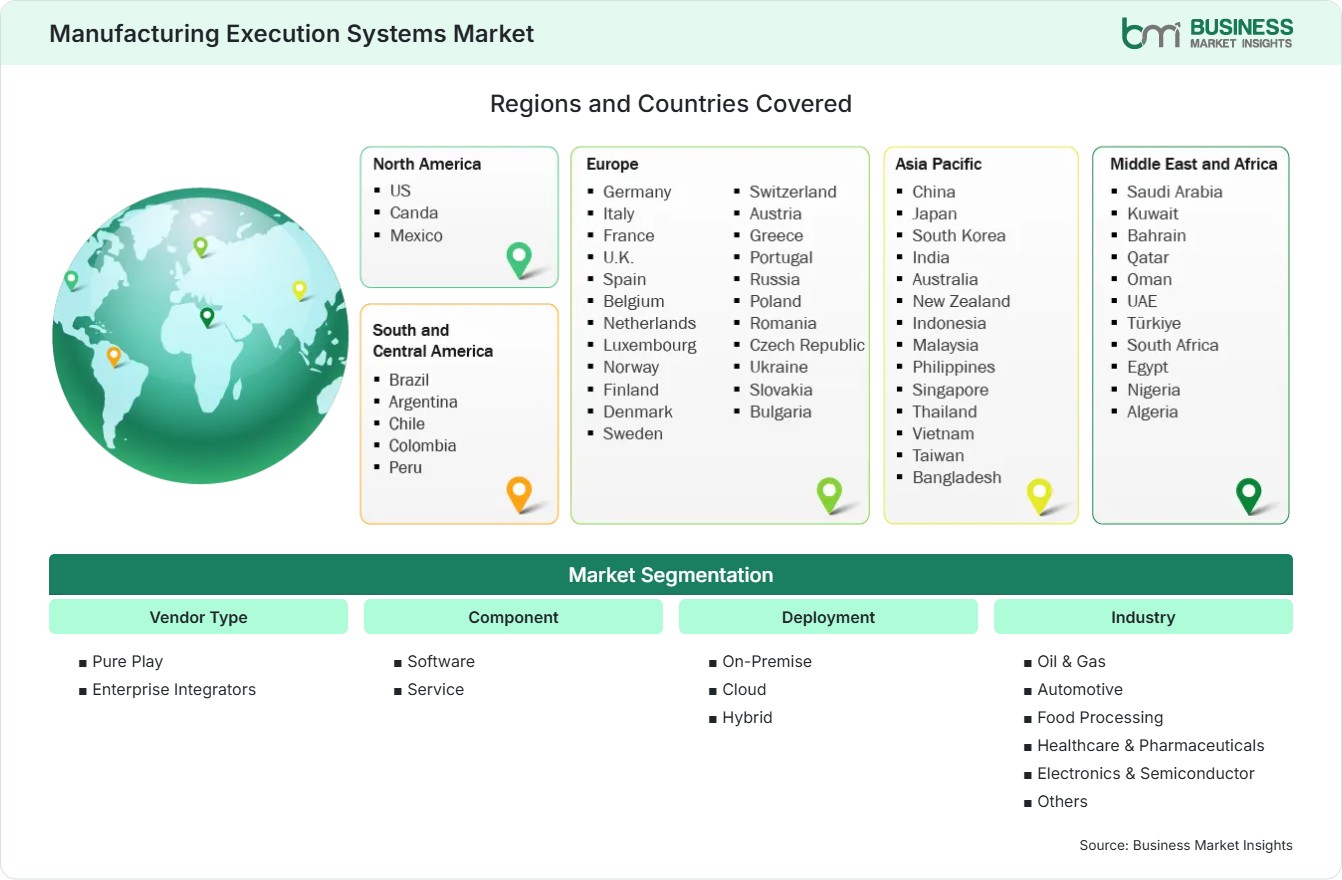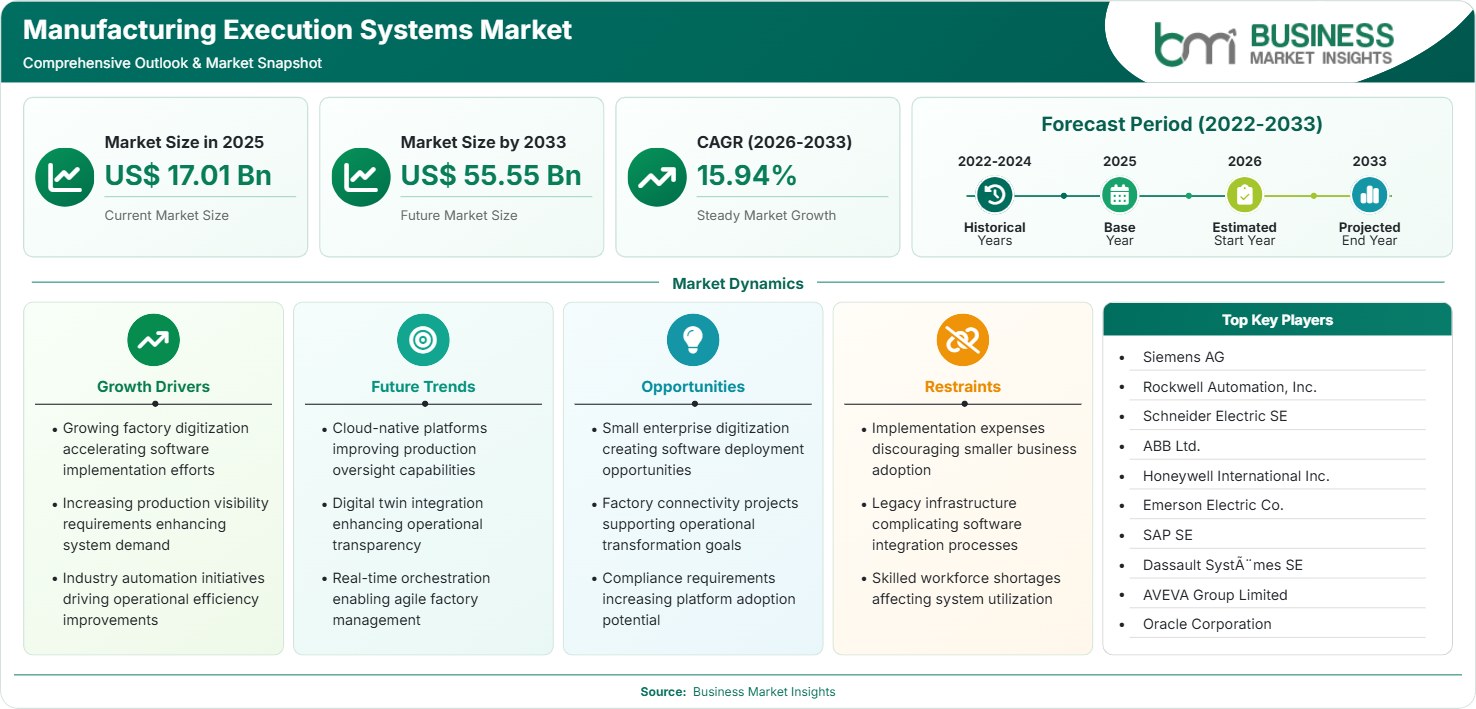
Manufacturing Execution Systems Market Regional Highlights
North America Manufacturing Execution Systems Market
North America accounts for approximately 34%–37% Manufacturing Execution Systems Market share in 2025 and is projected to grow at a CAGR of 14%–16% through 2033. This area is blessed with the latest industrial automation systems, high software usage, and major investment in smart manufacturing projects. The manufacturing units in automotive, aerospace, pharmaceutical, and food processing industries keep on focusing on real-time visibility of their processes.
- The investment in smart factories in the United States and Canada promotes operational transparency, enables quality tracking, encourages the adoption of predictive maintenance, and leads to improvements in manufacturing efficiency in a wide range of industrial sectors and at advanced production facilities.
- The ability to collect data is still growing as a result of industrial IoT integration, and this is at the same time enhancing production scheduling, performance monitoring, and the use of assets in connected manufacturing environments.
- Increasingly, pharmaceutical manufacturers are using execution platforms to improve batch traceability, comply with regulatory requirements, ensure the accuracy of their documentation, and enhance their quality management processes.
- The facilities involved in the production of motor vehicles are expanding their digital manufacturing initiatives to increase throughput, decrease downtime, and improve the synchronization of production across a number of sites.
US Manufacturing Execution Systems Market
The United States represents roughly 78%–82% of the regional Manufacturing Execution Systems Market and records a CAGR of 14%–16% during the forecast period. Industrial software investment, automation, and government programs that foster manufacturing innovation facilitate adoption. Big businesses are increasingly adopting analytics, robotics, and execution tools to gain efficiency and robustness.
- The increase in investments in semiconductor fabrication leads to a greater demand for real-time process control, production monitoring, defect reduction, and traceability systems that support advanced manufacturing environments.
- Aerospace manufacturers make quality assurance frameworks and digital production validation platforms a priority to meet their complex operational requirements and comply with the relevant standards.
- The use of cloud-based industrial software enables having a clear view of multiple facilities and facilitates collaborative production management in manufacturing operations that are located in different parts of the world.
Europe Manufacturing Execution Systems Market
Europe holds 25%–28% market share in 2025 and is expected to expand at a CAGR of 14%–15% through 2033. Germany leads regional adoption with strong Industry 4.0 implementation, while Eastern European countries demonstrate accelerating deployment rates. Manufacturers emphasize sustainability, energy efficiency, and digital production management.
- Germany is still the largest national market, due to its advanced factory automation programs and the widespread use of digital manufacturing technologies.
- Poland and the Czech Republic are showing more robust growth, their estimated growth rates being in the higher part of the regional range as a result of their industrial modernization programs.
- The requirements for sustainability reporting promote investment in abilities related to monitoring production, tracking resource efficiency, and managing operational performance.
- The need for standardized execution platforms and for a single view of operations across various facilities rises due to cross-border manufacturing networks.
Asia Pacific Manufacturing Execution Systems Market
Asia Pacific commands 28%–31% share in 2025 and achieves the fastest CAGR of 17%–19% through 2033. However, China is still the biggest regional player, whereas India and the nations from Southeast Asia are growing very fast. The development of industry through digitalization with government support, automation, and manufacturing expansion adds up to the demand. The region’s Manufacturing Execution Systems Market growth reflects increasing digital transformation across export-oriented manufacturing environments.
- China is leading the way in terms of adoption by making extensive investments in smart manufacturing and by carrying out modernization projects in its high-volume industrial production facilities.
- India is showing strong momentum as a result of its industrial digitalisation programmes, the production-linked incentives it has introduced, and its initiatives aimed at expanding manufacturing capacity.
- There are significant opportunities for advanced execution platforms as a result of semiconductor investments in Taiwan, South Korea and Southeast Asia.
- Electronics manufacturers stress the importance of achieving real-time production visibility, effective quality management, and yield optimization to stay competitive.
Rest of World Manufacturing Execution Systems Market
The Rest of World region accounts for 9%–11% Manufacturing Execution Systems Market share in 2025 and progresses at a CAGR of 15%–17% through 2033. South and Central America benefit from food processing and automotive manufacturing modernization initiatives. Meanwhile, the Middle East and Africa are investing in industrial diversification strategies, digital infrastructure, and production efficiency programs.
- Brazil is continuing its efforts to advance industrial digitalization in the automotive, mining, and food processing manufacturing sectors.
- Mexico takes advantage of the nearshoring trends and the expansion of its manufacturing investments, which is leading to greater adoption of advanced production management technology.
- Saudi Arabia is carrying out strategies aimed at industrial diversification, which in turn creates a demand for connected manufacturing platforms and automation technologies.
- The industrial development programs based in the UAE promote investment in smart production facilities and operational intelligence systems.