Air Pollution Control Systems Market Regional Highlights
North America Air Pollution Control Systems Market
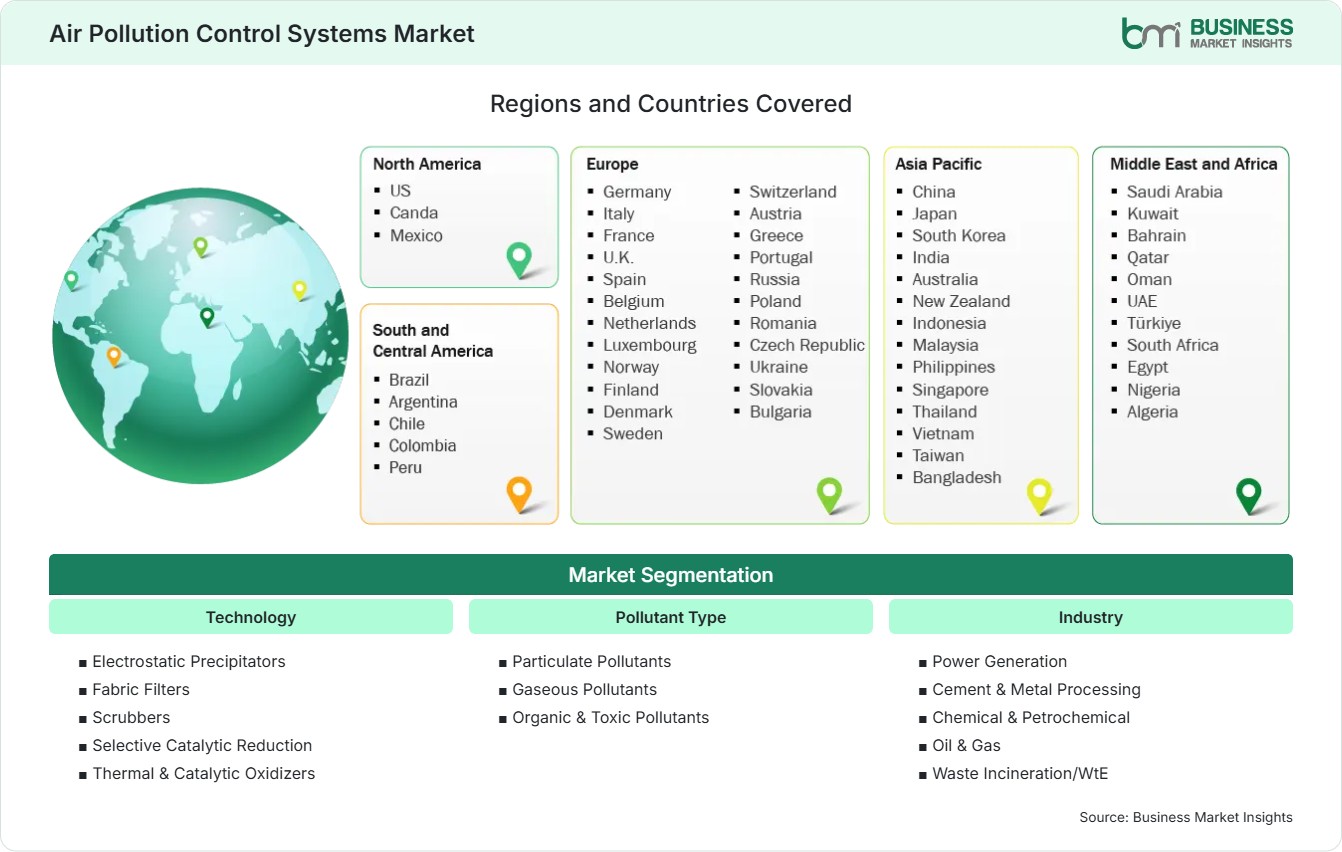
North America holds a 29%–32% share in 2025 and records a 6.7%–7.4% CAGR during 2026–2033. The region benefits from established environmental regulations, mature industrial infrastructure, sophisticated engineering capabilities, and significant installed equipment requiring replacement or modernization. The United States remains the principal market, while Canada contributes through oil and gas, mining, utilities, pulp and paper, and industrial manufacturing. Air Pollution Control Systems Market share is concentrated across power generation, refining, chemicals, cement, waste management, and heavy manufacturing.
- Emission control upgrades in conjunction with life extension for power plants in the United States results in increased demand for replacement parts, enhanced ESPs, SCRs, scrubbers, and environmental equipment services.
- Efficient control of sulfur-containing substances, particulate matter, VOCs, and combustion emissions from refineries and petrochemical plants is required, thus boosting demand for wet gas scrubbers and oxidation processes.
- Equipment efficiency becomes a key factor for industrial facilities because pressure drop, fan energy use, reagents utilization, and maintenance directly affect operational expenses and environmental compliance.
- Waste-to-energy facilities need advanced flue gas cleaning technology to handle various pollutants including acid gases, particulate matter, nitrogen oxides, heavy metals, etc.
US Air Pollution Control Systems Market
The U.S. represents 82%–86% of North American demand in 2025 and records a 6.8%–7.5% CAGR during 2026–2033. Market advantages include a high level of industrial infrastructure, an existing permitting process, a large refining and chemicals industry, complex utility systems, and continued equipment upgrades. Replacement will be especially significant since older air quality systems may need to improve their efficiencies, upgrade controls and monitors, and replace components. Environmental equipment is now being assessed for industrial clients along with overall plant modernizations.
- Power generators continue investing in emission-management upgrades where existing assets require improved SOx, NOx, particulate, and mercury control or greater operating flexibility.
- Refineries are increasing investments in wet gas scrubbing and related technologies to address sulfur dioxide and particulate emissions from complex combustion and catalytic processes in Air Pollution Control Systems Market.
- Cement, metals, chemical, and manufacturing facilities are adopting higher-performance filtration, catalytic control, oxidation, and continuous monitoring technologies as permitting requirements become more demanding.
Europe Air Pollution Control Systems Market
Europe holds a 25%–28% share in 2025 and records a 6.4%–7.1% CAGR during 2026–2033. Germany, France, the United Kingdom, Italy, Spain, the Netherlands, and Nordic countries remain important demand centers. European customers operate within mature environmental frameworks that increasingly address industrial emissions, energy efficiency, resource use, and climate transition simultaneously.
- Germany provides demand through power, chemicals, metals, cement, waste management, and advanced manufacturing, where integrated emission management is increasingly linked with energy efficiency in Air Pollution Control Systems Market.
- Industrial modernization in France and Italy offers business potential through waste-to-energy technologies, cement plants, chemical and process industries having tough environmental performance standards.
- The United Kingdom is still engaged in reducing industrial emissions, waste management, refining, energy infrastructures, and optimizing processes.
- Nordic countries focus on efficient environmental technology, energy recovery, sustainable industrial processes, and digital control of complex emission systems.
Asia Pacific Air Pollution Control Systems Market
Asia Pacific holds a 36%–40% share in 2025 and records an 8.2%–9.1% CAGR during 2026–2033, making it the fastest-growing region. China, India, Japan, South Korea, Australia, and Southeast Asia account for major demand. Rapid industrialization is increasing requirements for particulate, SOx, NOx, VOC, and toxic-emission controls.
- China provides substantial demand through power generation, steel, cement, chemicals, waste treatment, industrial manufacturing, and increasingly stringent environmental requirements.
- India offers major growth potential through thermal-power emission-control retrofits, cement, metals, refining, chemicals, and industrial environmental modernization.
- Japan and South Korea provide premium opportunities for high-efficiency control technologies, digital monitoring, advanced catalysts, industrial combustion optimization, and lifecycle upgrades in Air Pollution Control Systems Market.
- Southeast Asia is expanding industrial capacity across power, cement, refining, manufacturing, and waste management, creating demand for scalable emission-control systems and environmental engineering services.
Rest of World Air Pollution Control Systems Market
Rest of World holds a 14%–17% share in 2025 and records a 5.5%–6.4% CAGR during 2026–2033. Latin America provides opportunities through mining, cement, power, refining, metals, chemicals, and waste infrastructure, with Brazil and Mexico representing major markets.
- Brazil provides demand across mining, steel, cement, power, refining, pulp and paper, and waste treatment, with modernization projects supporting sophisticated filtration and gas-treatment systems.
- Mexico benefits from manufacturing, refining, cement, power, and petrochemical investment, creating opportunities for particulate, NOx, SOx, and VOC control technologies in Air Pollution Control Systems Market.
- Gulf markets provide premium opportunities through refining, petrochemical, power, desalination, waste-to-energy, and large industrial developments requiring integrated environmental systems.
- African markets provide long-term opportunities across mining, cement, power, and metals, although project financing, technical skills, and environmental enforcement remain uneven.