
Learning Management System Market Outlook: Size, Share, Trends, Growth Analysis, Competitive Landscape & Forecast, 2026-2033

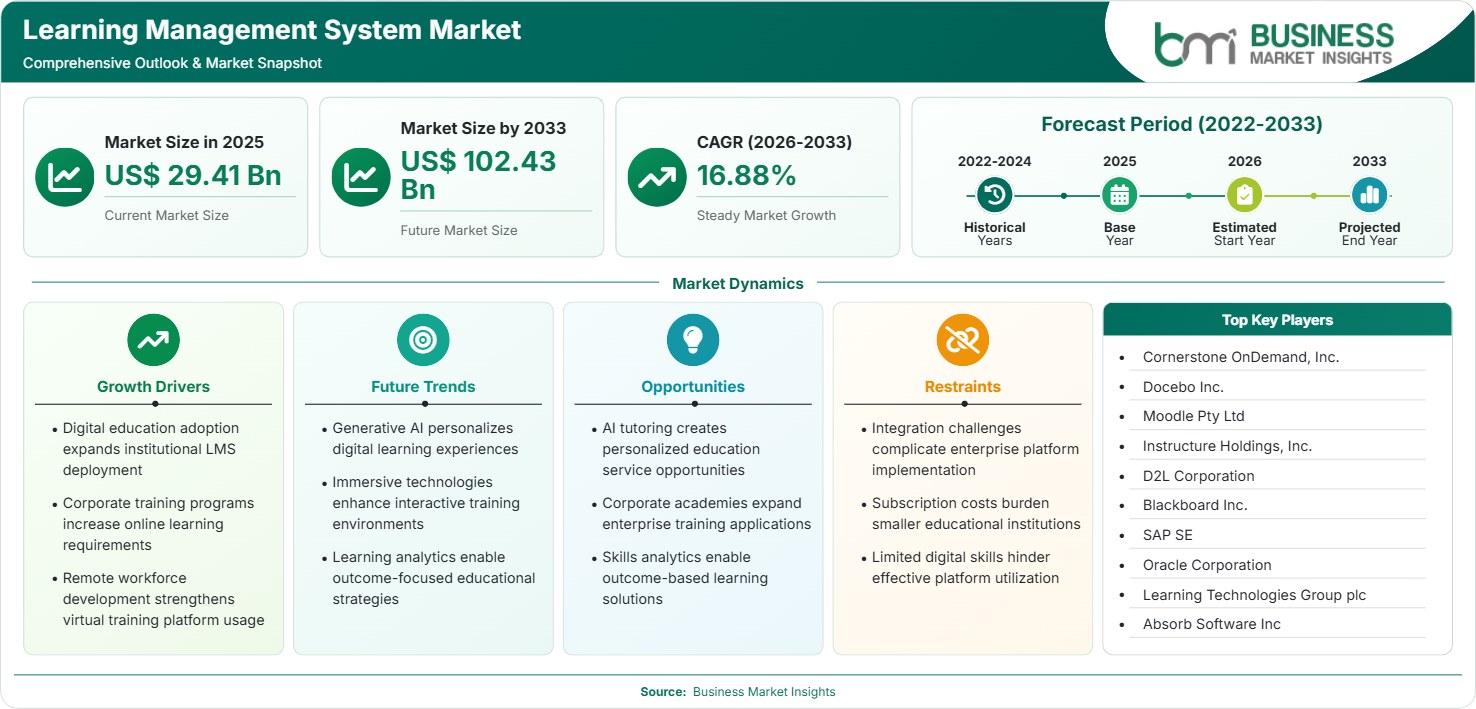
The Learning Management System Market was valued at US$ 29.41 Billion in 2025 and is projected to reach US$ 102.43 Billion by 2033, growing at a CAGR of 16.88% during 2026–2033. Key drivers include AI-enabled personalized learning, enterprise workforce reskilling, cloud adoption, compliance training needs, and digital education expansion. Opportunities stem from skills intelligence platforms, immersive learning technologies, and emerging-market digital transformation initiatives.

Report Coverage
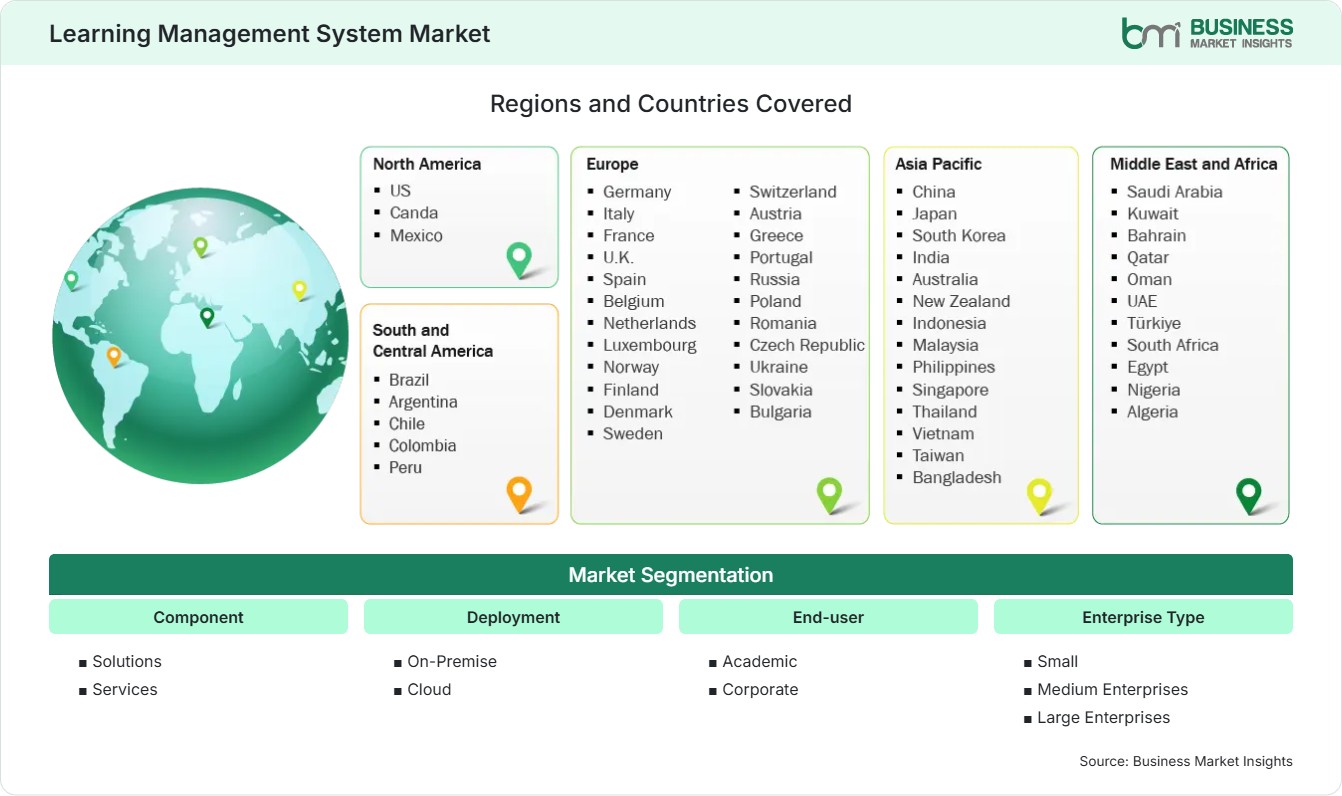
  • Component: Solutions, Services
  • Deployment: On-Premise, Cloud
  • End-user: Academic, Corporate
  • Enterprise Type: Small, Medium Enterprises, Large Enterprises
  • Delivery Mode: Distance Learning, Instructor-led Training, Blended Training
US$ 29.41 Bn Market size in 2025
US$ 102.43 Bn Market Size by 2033
16.88% CAGR, 2026 - 2033
2026-2033 Forecast Period

AI Overview

Learning Management System Market Summary

  • North America Region: North America holds a market share of 36%–39% in 2025, growing at a CAGR of 15.5%–16.5% during 2026–2033. Growth is supported by enterprise digital learning investments, AI-driven training platforms, compliance requirements, hybrid workforce development, cloud migration strategies, skills-based workforce planning, analytics adoption, educational technology modernization, and continuous learning cultures. The U.S. remains dominant due to strong enterprise software spending and workforce digitization, expanding at 15.8%–16.8% CAGR.
  • Fastest Growing Region: Asia Pacific holds a Learning Management System Market share of 25%–28% in 2025, growing at a CAGR of 18.5%–19.8% during 2026–2033. Expansion is driven by digital education initiatives, corporate upskilling demand, mobile learning adoption, government technology investments, remote workforce training, cloud infrastructure deployment, startup ecosystems, multilingual content development, and rising internet accessibility.
  • Leading Segment: Cloud deployment accounts for 68%–72% share in 2025 and advances at a 17.5%–18.5% CAGR. Adoption benefits from scalability, subscription pricing models, seamless integration capabilities, remote accessibility, AI-powered learning delivery, lower maintenance requirements, rapid deployment timelines, centralized administration, stronger analytics functionality, and organizational agility.
  • High Growth Segment: Solutions account for 62%–66% share in 2025 and expand at a 18.0%–19.0% CAGR. Demand rises through advanced content delivery, learner analytics, personalized pathways, skills tracking frameworks, compliance automation, assessment management, collaboration features, AI-assisted course development, workflow integration capabilities, and measurable learning outcomes.
  • Key Market Opportunity: Enterprises increasingly seek skills intelligence ecosystems connecting learning outcomes with workforce planning, performance management, internal mobility, certification tracking, and AI-based competency mapping across global employee populations.
  • Major Market Players: Cornerstone OnDemand, Inc., Docebo Inc., Moodle Pty Ltd, Instructure Holdings, Inc., D2L Corporation, Blackboard Inc., SAP SE, Oracle Corporation, Learning Technologies Group plc, Absorb Software Inc.
Strategic Insights

Learning Management System Market: Strategic Insights

Learning Management System Market Strategic Framework
FREE PDF
Request your free sample
Request free sample
Stakeholder View

Key Takeaways

  • The industry ecosystem increasingly connects content creators, cloud providers, analytics vendors, HR technology platforms, certification bodies, and enterprise learning departments through integrated digital learning value chains.
  • Corporate training applications present the strongest upside as organizations expand reskilling, onboarding, compliance management, leadership development, and partner education initiatives to address workforce transformation requirements.
  • Innovation is shifting toward AI-powered recommendations, skills intelligence frameworks, microlearning delivery, immersive simulations, and predictive analytics that improve learner outcomes and organizational performance visibility.
  • Asia Pacific presents a compelling investment case due to expanding digital education programs, strong enterprise modernization spending, and widespread mobile learning adoption across developing economies.
  • Strategic acquisitions increasingly focus on learning experience platforms, skills management technologies, workforce analytics providers, and content development capabilities that strengthen end-to-end talent development portfolios.
  • Integration between learning systems and workforce planning applications is becoming a critical competitive differentiator as enterprises prioritize measurable skills development and talent mobility.
Geographic Outlook

Learning Management System Market Regional Highlights

North America Learning Management System Market

North America accounted for approximately 36%–39% of the Learning Management System Market share in 2025 and is projected to expand at 15.5%–16.5% CAGR through 2033. Strong enterprise software spending, mature cloud infrastructure, widespread hybrid work models, and compliance-focused training requirements support regional leadership. Large employers increasingly connect learning systems with talent management and workforce analytics platforms. Educational institutions continue investing in digital learning ecosystems, while AI-enabled personalization and skills intelligence capabilities influence purchasing decisions among enterprises seeking measurable workforce productivity improvements.

  • Enterprises increasingly prioritize skills-based workforce strategies, creating demand for integrated learning and talent intelligence solutions.
  • AI-supported content generation and adaptive learning pathways improve learner engagement and administrative efficiency.
  • Regulated industries invest heavily in compliance-focused learning environments that automate certification management and reporting.
  • Universities and colleges expand platform adoption to support hybrid, remote, and lifelong learning programs.
  • Strategic partnerships between LMS providers and HR technology vendors strengthen ecosystem capabilities and customer retention.

US Learning Management System Market

The U.S. is expected to account for 74%–78% of the regional market and grow at a CAGR of 15.8%–16.8%. Its uptake continues to be driven by heavy training spending by large enterprises, robust digital infrastructure, and wide adoption of technology. The increasing use of AI-enabled learning platforms has become necessary due to labor shortages and the evolving skill sets businesses require. Corporate learning professionals focus on outcome-oriented metrics in training, whereas educational institutions work on technologies that engage students.

  • Large enterprises increasingly link training outcomes with workforce performance metrics and succession planning initiatives.
  • Public and private educational institutions accelerate adoption of advanced learning engagement technologies.
  • Federal and industry compliance mandates sustain spending on certification and workforce readiness programs.
  • Technology sector employers drive experimentation with personalized and skills-based learning architectures.

Europe Learning Management System Market

The Europe region commanded a market share of around 24%-27% in 2025 and is expected to grow at a CAGR of 15.0%-16.0% for the period 2023-2033 in terms of the Learning Management System Market. The growth drivers include initiatives such as workforce reskilling programs, digital learning, and strict compliance standards. In addition, companies are focusing on employee development and continuous learning to stay ahead of the competition. Germany is leading the region, while the adoption rate in Eastern Europe is higher than in Western Europe. Increased integration with HR systems, multilingual content requirements, and data governance priorities continue shaping purchasing decisions throughout the region.

  • Germany leads regional demand, supported by industrial workforce development and enterprise digital transformation spending.
  • Poland and Romania display higher growth momentum, benefiting from technology investment and workforce modernization initiatives.
  • GDPR compliance considerations influence vendor selection, deployment models, and data-management practices.
  • Cross-border workforce training programs increase demand for multilingual learning delivery capabilities.
  • Skills shortages encourage broader adoption of structured employee development and certification platforms.

Asia Pacific Learning Management System Market

Asia Pacific had a market share of 25%–28% in 2025 and is estimated to have a compound annual growth rate of 18.5%–19.8%. This region is anticipated to be the fastest-growing owing to government digitization initiatives, investments in educational technology, and increasing adoption of enterprise learning. Countries like China and India remain the largest sources of revenue, while Southeast Asian economies show a rapid adoption rate of platforms. Rising demand for scalable and affordable training solutions creates attractive opportunities for local and international providers.

  • India benefits from large-scale digital education initiatives and strong corporate training demand.
  • China maintains significant adoption levels through enterprise digitization and technology-enabled education expansion.
  • Indonesia and Vietnam exhibit high-growth potential driven by digital workforce development programs.
  • Smartphone penetration supports accessible mobile learning experiences across diverse user groups.
  • Growing startup ecosystems encourage innovation in content delivery, assessment, and learner engagement technologies.

Rest of World Learning Management System Market

The Rest of World category had a 10%-12% share in 2025 and is estimated to grow at a 16.5%-17.5% CAGR. Growth in South & Central America is driven by rising digital training expenditure and workforce modernization initiatives, whereas adoption in the Middle East & Africa is spurred by government digital transformation initiatives, education reforms, and enterprise cloud adoption. Brazil is the most prominent market in Latin America, while the UAE and Saudi Arabia have the greatest growth potential, fueled by technology investment programs.

  • Brazil leads regional adoption through corporate digitization and educational technology investments.
  • Mexico experiences increased demand from manufacturing, services, and workforce upskilling applications.
  • Saudi Arabia supports implementation through national digital transformation and workforce development strategies.
  • The UAE promotes digital education ecosystems and enterprise learning modernization initiatives.
  • Expanding cloud infrastructure reduces deployment barriers and improves platform accessibility across developing markets.
Global Market Geography
FREE PDF
Request your free sample
Request free sample
Segment Analysis

Learning Management System Market Segmentation

Component

The component solutions accounted for around 62% to 66% market share in 2025, and the overall segment will grow at a CAGR of 18.0% to 19.0%. Businesses are looking for comprehensive learning platforms that can deliver content, measure performance, manage certifications, and offer other capabilities. The demand for these platforms is driven by digital transformation, learning needs, and the need to measure the effectiveness of training programs.

  • Solutions: Core platforms provide content management, assessment tools, collaboration capabilities, reporting functionality, and AI-enabled personalization supporting scalable training programs across educational institutions and enterprises.
  • Services: Consulting, implementation, integration, customization, and support services help organizations maximize platform value while improving deployment efficiency and long-term operational performance.

Deployment

The Deployment section sheds light on the broad scope of the Learning Management System Market, where cloud-based systems hold 68% to 72% market share in 2025 and exhibit a CAGR of 17.5% to 18.5%. Scalable architectures that reduce infrastructure requirements and enable remote access have gained increasing popularity.

  • On-Premise: Preferred among organizations requiring extensive customization, strict data governance controls, or sector-specific compliance responsibilities across sensitive learning environments.
  • Cloud: Enables scalable learning delivery, centralized administration, rapid updates, flexible integration, and global accessibility for distributed workforces and learners.

End-user

The end user's requirements depend on the growth of digital learning within educational establishments and corporate entities. The contribution of corporations to revenue generation is greater, as these entities have ongoing employee training requirements.

  • Academic: Educational institutions deploy platforms to manage courses, assessments, virtual classrooms, and learner engagement initiatives across multiple delivery environments.
  • Corporate: Enterprises utilize systems for onboarding, compliance training, leadership development, partner education, and workforce reskilling programs.

Enterprise Type

Enterprise adoption trends vary with company size, budget, and training challenges. The larger enterprises remain significant spenders due to their large employee counts and international training needs. Nevertheless, more affordable pricing is becoming an essential factor for smaller companies.

  • Small and Medium Enterprises (SMEs): Cloud-based platforms provide cost-efficient learning management capabilities, enabling workforce development without significant infrastructure investments.
  • Large Enterprises: Complex learning requirements drive adoption of advanced analytics, skills intelligence tools, compliance management, and global training capabilities.

Delivery Mode

Learning Management System Market Trends reveal a rising trend towards adopting more flexible delivery models that blend online and instructor-led methodologies. Organizations are now striking the right balance between self-paced learning and collaborative learning models.

  • Distance Learning: Supports geographically dispersed learners through virtual content delivery, assessments, certifications, and asynchronous engagement features.
  • Instructor-led Training: Facilitates structured learning experiences where direct trainer interaction enhances knowledge transfer and performance outcomes.
  • Blended Training: Combines digital learning flexibility with instructor guidance, improving engagement, completion rates, and practical skill development.
Market Forces

Learning Management System Market Dynamics

Key Market Drivers

Enterprise Reskilling and Workforce Transformation Demand

The global labor market is going through rapid changes in the skills cycle due to automation, AI, and digital transformation initiatives. Based on various international workforce reports and studies by bodies such as the World Economic Forum, organizations have begun to focus more on upskilling. This directly favors platform use, as companies need platforms that are sufficiently scalable to provide learning solutions, track competence, and measure performance. The Learning Management System Market growth has grown due to the need to manage large-scale workforces and ensure that training efforts align with company objectives.

Cloud-Based Learning Ecosystem Expansion

Cloud infrastructure implementation continues to alter enterprise software spending trends globally. Firms are opting for flexible deployment models to reduce IT complexity and increase employee access. Cloud infrastructure makes it easy for firms to integrate with HR, collaboration, analytics, and workforce planning systems. Subscription services make it easier for organizations to use software without incurring high initial installation costs. Other factors, such as automatic updates, mobile-friendly access, consolidated data management, and storage capabilities, make it easier for firms to adopt cloud computing. The widespread adoption of cloud infrastructure in educational institutions and corporations makes it a key driver of industry growth.

AI-Powered Personalization and Analytics Adoption

The capabilities of artificial intelligence are revolutionizing digital learning experiences through adaptive paths, recommendation systems, content generation, and predictive analytics. Organizations are increasingly looking for learning systems that can identify skill gaps and provide personalized learning content and performance data. The use of machine learning technology enhances learners' interactions while reducing administrative responsibilities. The emergence of skills intelligence platforms indicates a growing trend toward incorporating data-driven models. This makes it possible for firms to channel their training investments in accordance with the requirements of the business and workforce. Innovation in AI learning experiences creates a competitive edge.

Key Market Opportunities

Skills Intelligence and Workforce Planning Integration

Organizations increasingly need connected ecosystems where learning outcomes can be aligned with workforce planning, performance management, and talent mobility programs. This offers providers the opportunity to venture beyond course management and deliver enterprise-wide skills intelligence platforms. The need for software that can map competencies, conduct gap analyses, develop development paths, and support strategic workforce planning is increasing. The Learning Management System Market forecasts show increasing demand for frameworks to measure employee development programs. Providers who can link learning metrics to business metrics are set to benefit from premium investments in their software and to build customer relationships.

Immersive Learning and Extended Reality Applications

The combination of virtual reality, augmented reality, and simulation-based education offers promising prospects for developing learning environments. Manufacturing, health care, aviation, energy, and defense industries, among others, are progressively demanding the development of skills in a controlled digital environment. The use of immersive learning technology will ensure effective knowledge retention while also reducing the risks associated with training exercises. This is due to reduced hardware costs and greater ease of use. Companies are now scaling from pilots to enterprise-level implementations. Learning platform providers with extended reality solutions can cater to specific workforce training needs.

Emerging Market Digital Education Expansion

Emerging countries continue to invest in connectivity, educational technologies, and workforce development programs. The governments of various emerging regions, such as Asia, Latin America, Africa, and the Middle East, are increasingly adopting digital learning ecosystems to enhance access to education and develop workforce competencies. The increase in internet penetration rates, along with a growing number of mobile users, enables scalable business models. The investments made by private-sector organizations in employee training expand the total addressable market. Localization, multi-language services, and cloud delivery features help vendors gain a competitive advantage in these regions.

Market Restraints and Challenges

Data Privacy and Cybersecurity Risks

Factor: Learning management systems handle vast amounts of employee, student, performance, and certification data, exposing organizations to cybersecurity and compliance risks. Impact: It takes time for organizations to conduct comprehensive procurement and security audits before adopting learning management systems, lengthening sales cycles and adding deployment complexities. Emerging privacy laws, such as the GDPR, and industry-specific privacy laws add to compliance issues for providers, resulting in increased costs. Security vulnerabilities may affect a business's reputation and carry legal implications. Such issues necessitate ongoing efforts to ensure encryption, access management, governance, and security monitoring, all of which affect decisions about platform profitability and adoption.

Integration Complexity Across Enterprise Systems

Factor: Many businesses have fragmented technology environments that include human resources systems, productivity tools, content systems, and workforce management systems. Impact: Integrating these tools with the learning tool could be complicated and require significant technological effort. Complicated implementations could delay implementation timelines and reduce ROI expectations. Data consistency, workflow, and interoperability problems could arise during the migration to other tools. Small companies with insufficient technical skills within their organizations could face additional obstacles. These complications would lead people to postpone purchase decisions and even maintain their older solutions.

Company Analysis

Competitive Landscape

The Learning Management System Market analysis indicates competition is centered on AI capabilities, cloud scalability, integration ecosystems, analytics functionality, and skills intelligence innovation.

Company Name

Overview

Products and Services relevant to this market

Cornerstone OnDemand, Inc.

Enterprise learning and talent experience specialist serving global organizations with workforce development solutions.

Learning management, content delivery, skills intelligence, talent mobility, compliance training, analytics.

Docebo Inc.

AI-focused learning platform provider supporting employee, customer, and partner training initiatives.

Cloud LMS, AI content tools, virtual coaching, learning analytics, extended enterprise learning.

Moodle Pty Ltd

Leading open-source learning technology provider with global academic and enterprise adoption.

Open-source LMS, workplace learning solutions, course management, assessments, integrations.

Instructure Holdings, Inc.

Education technology company widely recognized for Canvas learning ecosystem offerings.

Canvas LMS, digital learning tools, assessment platforms, analytics, academic engagement solutions.

D2L Corporation

Learning technology vendor emphasizing outcomes-based education and workforce development.

Brightspace platform, analytics, competency tracking, content management, learner engagement tools.

Blackboard Inc.

Established provider serving higher education and institutional learning environments.

Blackboard Learn, virtual learning management, assessments, collaboration, course administration.

SAP SE

Enterprise software leader integrating learning with workforce and HR management systems.

SAP SuccessFactors Learning, talent management, compliance education, workforce development tools.

Oracle Corporation

Global enterprise software provider offering integrated learning and workforce solutions.

Oracle Learning, talent management, skills development, analytics, cloud learning services.

Learning Technologies Group plc

Corporate learning specialist with extensive content and technology capabilities.

Learning platforms, digital content, consulting, workforce development, training services.

Absorb Software Inc.

Cloud-based LMS provider targeting enterprise and midmarket learning requirements.

Absorb LMS, reporting, learner engagement tools, compliance management, training administration.

Trust & Transparency

Research Methodology

The market analysis combines proprietary research with secondary data from government agencies, company disclosures, regulatory filings, industry databases and expert interviews. Market estimates are validated through data triangulation, cross-market benchmarking and analyst review.

View Full Research Methodology

Questions Answered

Frequently Asked Questions

What insights does a Learning Management System Market Report provide?

It evaluates industry size, competitive positioning, technology developments, deployment patterns, investment opportunities, regional demand trends, customer adoption behavior, and strategic growth prospects across educational and corporate applications.

How do learning platforms support corporate talent strategies?

They help organizations manage onboarding, leadership development, reskilling, compliance education, performance improvement programs, competency tracking, and workforce readiness initiatives through centralized digital learning environments.

Why are cloud deployments preferred over on-premise solutions?

Cloud platforms offer faster deployment, lower infrastructure investment, easier updates, better accessibility, scalable resources, and stronger integration capabilities compared with traditional on-premises implementations.

What role does artificial intelligence play in modern learning platforms?

AI enables personalized learning paths, automated content creation, recommendation engines, predictive analytics, skills mapping, learner engagement optimization, and administrative process automation, improving training effectiveness and scalability.

Which industries generate the strongest demand for learning management systems?

Healthcare, financial services, manufacturing, technology, education, retail, and government sectors remain major adopters due to compliance requirements, workforce development initiatives, certification management, and continuous employee training needs.

Access the Full Learning Management System Market Report

Get segment-level forecasts, regional estimates, competitive benchmarking, company profiles and downloadable Excel datasets.

Access the full Learning Management System Market Report
350 pages PDF & Excel | 2026-09-16
Similar Research

Related Market Reports