
Clinical Trial Management System Market Outlook: Size, Share, Trends, Growth Analysis, Competitive Landscape & Forecast, 2026–2033

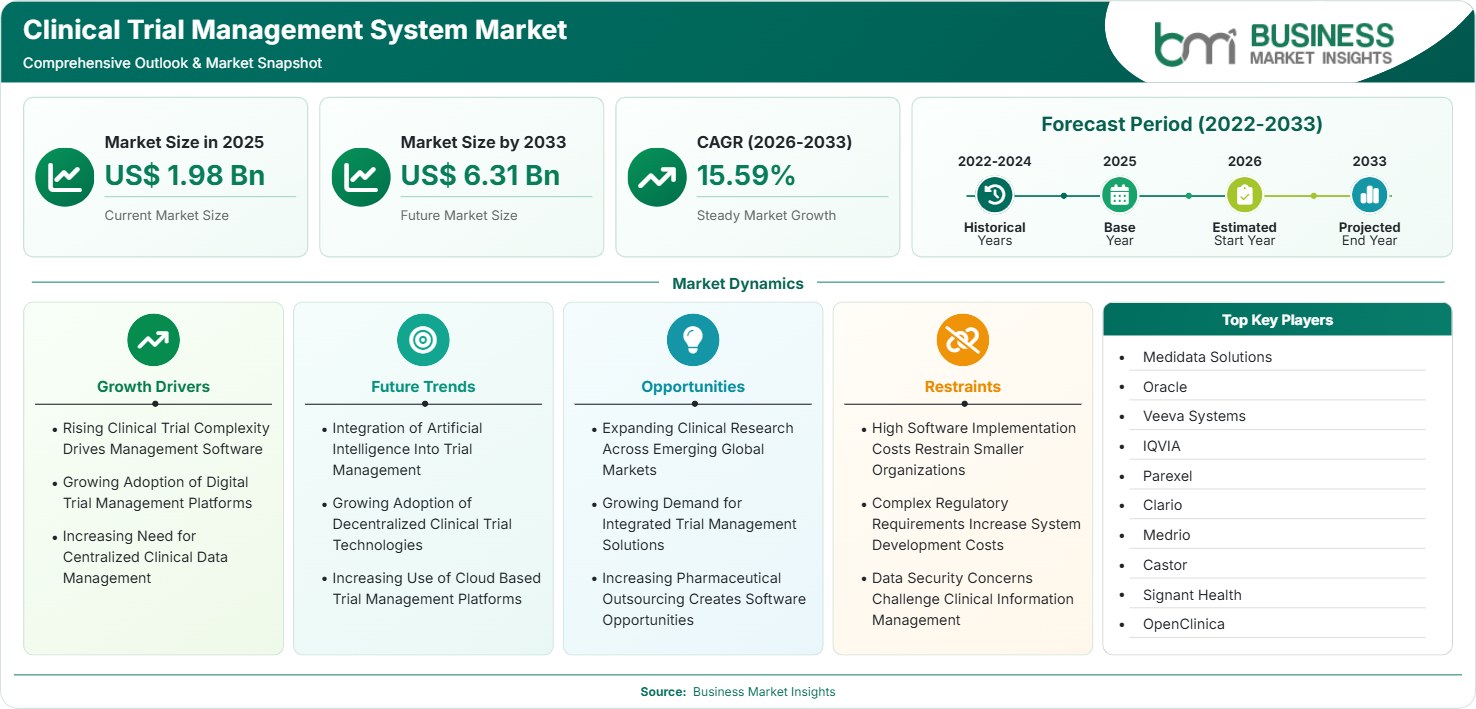
The Clinical Trial Management System Market size was valued at US$ 1.98 billion in 2025 and is projected to reach US$ 6.31 billion by 2033, growing at a CAGR of 15.59% during 2026–2033. Increasing trial complexity, digital transformation, centralized oversight, cloud adoption, and demand for integrated clinical operations are creating new opportunities.

Report Coverage
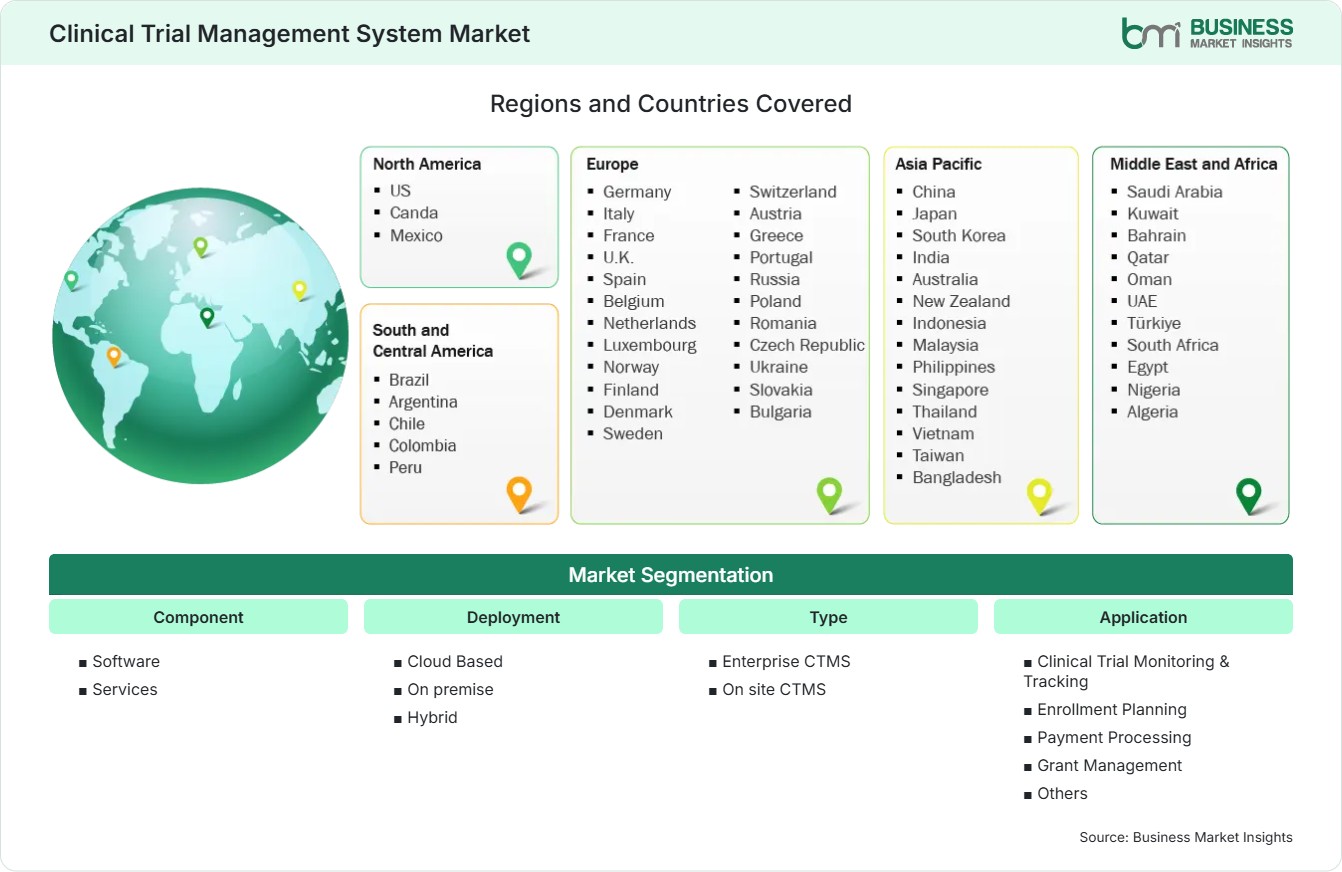
  • Component: Software, Services
  • Deployment: Cloud Based, On premise, Hybrid
  • Type: Enterprise CTMS, On site CTMS
  • Application: Clinical Trial Monitoring & Tracking, Enrollment Planning, Payment Processing, Grant Management, Others
  • End User: Pharmaceutical & Biotechnology Companies, Medical Device Manufactures, CROs, Others
US$ 1.98 Bn Market size in 2025
US$ 6.31 Bn Market Size by 2033
15.59% CAGR, 2026 - 2033
2026-2033 Forecast Period

AI Overview

Clinical Trial Management System Market Summary

  • North America Region: North America holds a 32%–36% share in 2025 and is projected to grow at a CAGR of 14.8%–16.0% through 2033, supported by mature clinical research infrastructure, technology adoption, regulatory compliance requirements, centralized trial oversight, and demand for integrated workflows. The United States remains the principal regional contributor, supported by sophisticated pharmaceutical and CRO ecosystems.
  • Fastest Growing Region: Asia Pacific holds a 24%–28% share in 2025 and is projected to grow at a CAGR of 17.2%–19.0% through 2033, supported by expanding clinical research activity, growing pharmaceutical outsourcing, increasing technology investment, broader CRO participation, and improving digital healthcare infrastructure.
  • Leading Segment: Software holds a 56%–60% Clinical Trial Management System Market share in 2025 and is projected to grow at a CAGR of 14.5%–15.7% through 2033, supported by centralized trial management, workflow automation, data visibility, resource planning, monitoring capabilities, and integration with complementary clinical systems.
  • High Growth Segment: Cloud Based deployment is projected to expand at a CAGR of 18.0%–19.5% through 2033, supported by scalable infrastructure, remote accessibility, simplified system administration, distributed trial operations, faster implementation, and demand for connected clinical research environments.
  • Key Market Opportunity: Integrated CTMS platforms, emerging clinical research hubs, cloud deployment, CRO outsourcing, decentralized trial workflows, and interoperability with EDC, eConsent, EHR, and financial systems create attractive opportunities for technology providers.
  • Major Market Players: Medidata Solutions; Oracle Corporation; Veeva Systems Inc.; IQVIA Inc.; Parexel International Corporation; Clario, Inc.; Medrio, Inc.; Castor; Signant Health; OpenClinica, LLC.
Strategic Insights

Clinical Trial Management System Market: Strategic Insights

Clinical Trial Management System Market Strategic Framework
FREE PDF
Request your free sample
Request free sample
Stakeholder View

Key Takeaways

  • The value chain is becoming more integrated as sponsors, CROs, technology providers, research sites, and clinical service organizations increasingly coordinate through shared digital workflows.
  • Cloud deployment, enterprise software, monitoring applications, and integrated financial management represent high-upside areas as trial operators seek greater operational visibility and scalable infrastructure.
  • Product innovation is moving toward artificial intelligence-assisted workflows, predictive analytics, automated reporting, interoperability, centralized dashboards, and configurable trial-management architectures.
  • Asia Pacific presents a compelling expansion opportunity as pharmaceutical outsourcing, investigator networks, biotechnology activity, and digital clinical research infrastructure continue developing.
  • Investment priorities are shifting toward platform integration and ecosystem connectivity, encouraging vendors to strengthen partnerships, application programming interfaces, analytics capabilities, and complementary clinical technology offerings.
  • Competitive differentiation increasingly depends on implementation flexibility, regulatory readiness, user experience, data interoperability, and the ability to support both traditional and decentralized clinical research models.
Geographic Outlook

Clinical Trial Management System Market Regional Highlights

North America Clinical Trial Management System Market

North America accounts for a 35%–39% share in 2025 and is projected to grow at a CAGR of 14.5%–16.0% through 2033. The region benefits from mature clinical research infrastructure, extensive pharmaceutical activity, advanced digital adoption, and strong demand for centralized study management.

  • Pharmaceutical and biotechnology companies are expanding digital trial operations to coordinate complex multicenter studies and improve visibility across research activities.
  • CROs are adopting integrated platforms to manage distributed studies, investigator coordination, monitoring workflows, and sponsor reporting requirements.
  • Cloud-based deployments are gaining traction as sponsors seek scalable systems supporting collaboration across geographically dispersed clinical teams.
  • Increasing emphasis on data integrity and regulatory compliance is encouraging investment in structured clinical trial management technologies.

US Clinical Trial Management System Market

The United States represents approximately 75%–80% of North American Clinical Trial Management System Market demand in 2025 and is projected to grow at a CAGR of 14.8%–16.2% through 2033. Its established research ecosystem and strong pharmaceutical pipeline support sustained technology adoption.

  • Pharmaceutical sponsors are adopting CTMS platforms to improve study planning, monitoring, enrollment coordination, and operational visibility.
  • CROs are using centralized management systems to coordinate geographically dispersed research activities and improve sponsor communication.
  • Cloud deployment is supporting collaboration among sponsors, investigators, CROs, and other trial stakeholders.
  • Increasing regulatory and data-management requirements are encouraging structured digital management of clinical research workflows.

Europe Clinical Trial Management System Market

Europe holds a 25%–29% share in 2025 and is expected to expand at a CAGR of 14.0%–15.5% through 2033. Germany, the United Kingdom, France, and other established research markets support adoption, while emerging countries provide additional opportunities.

  • Pharmaceutical companies are strengthening digital capabilities for multicountry clinical trials and standardized operational management.
  • CRO expansion is supporting demand for centralized systems that improve coordination across sponsors, investigators, and research sites.
  • Cloud-based CTMS solutions are gaining acceptance as organizations seek flexible infrastructure for increasingly distributed trials.
  • Germany and the United Kingdom remain important research markets, while Poland and Spain provide attractive expansion opportunities.
  • Greater attention to data quality and compliance is supporting investment in advanced clinical trial management platforms.

Asia Pacific Clinical Trial Management System Market

Asia Pacific represents a 28%–32% share in 2025 and is projected to grow at a CAGR of 16.0%–17.5% through 2033. China, Japan, India, South Korea, and Southeast Asian markets are strengthening demand through expanding research activity and outsourcing.

  • Increasing clinical trial activity is creating demand for centralized platforms supporting complex study coordination and operational visibility.
  • Pharmaceutical outsourcing growth is encouraging CROs to deploy scalable digital trial management technologies across regional research networks.
  • China and Japan remain major contributors, while India and Southeast Asia provide higher-growth opportunities through expanding research capabilities.
  • Growing participation in multinational studies is increasing requirements for standardized clinical operations and centralized reporting.
  • Technology adoption among pharmaceutical and biotechnology organizations is supporting broader digital transformation of research workflows.

Rest of World Clinical Trial Management System Market

Rest of World accounts for an 8%–12% share in 2025 and is forecast to grow at a CAGR of 13.0%–14.5% through 2033. Latin America, the Middle East, and Africa are gradually strengthening clinical research capabilities and digital infrastructure.

Latin American markets are benefiting from expanding research outsourcing and pharmaceutical activity, while Middle Eastern and African markets are developing clinical research infrastructure and technology-enabled healthcare systems.

  • Brazil and Mexico are important Latin American markets, while Saudi Arabia and the United Arab Emirates are developing opportunities through healthcare modernization.
  • CRO expansion is improving access to clinical trial management technologies across developing research markets.
  • Increasing international trial participation is creating demand for standardized study management, monitoring, and reporting systems.
  • Healthcare digitalization is supporting broader adoption of cloud-based clinical research technologies.
Global Market Geography
FREE PDF
Request your free sample
Request free sample
Segment Analysis

Clinical Trial Management System Market Segmentation

Component

Software holds a 56%–60% share in 2025 and is projected to grow at a CAGR of 14.5%–15.7% through 2033. Centralized study management, workflow automation, monitoring, reporting, and integration capabilities support software leadership, while services remain important for implementation and optimization.

  • Software: Software provides centralized trial planning, monitoring, enrollment, reporting, resource management, and workflow coordination, supporting demand for integrated clinical operations platforms.
  • Services: Services support implementation, configuration, integration, training, validation, maintenance, and ongoing optimization, helping organizations adapt platforms to complex operational requirements.

Deployment

Cloud Based deployment represents the fastest-growing deployment model, expanding at a CAGR of 18.0%–19.5% through 2033. Scalability, remote access, simplified infrastructure management, and distributed research workflows support adoption, while on-premise and hybrid models remain relevant for organizations with specific control requirements.

  • Cloud Based: Cloud platforms enable flexible access, scalable infrastructure, centralized updates, and remote collaboration across sponsors, CROs, investigators, and distributed research teams.
  • On premise: On-premise systems provide greater infrastructure control for organizations with established internal technology environments and specific data-management or governance requirements.
  • Hybrid: Hybrid deployment combines cloud flexibility with controlled infrastructure, supporting organizations transitioning from legacy systems while maintaining selected internal technology environments.

Type

Enterprise CTMS maintains a leading position because complex sponsors and CROs require centralized management across portfolios, sites, budgets, resources, and operational activities. On site CTMS addresses more focused research-site requirements and supports localized study administration.

  • Enterprise CTMS: Enterprise platforms coordinate multiple studies, sites, users, budgets, workflows, and reporting requirements, supporting large research organizations with complex portfolios.
  • On site CTMS: On site platforms support investigator-level study coordination, site activities, scheduling, documentation, and operational visibility across individual research environments.

Application

Clinical Trial Monitoring & Tracking represents a major application because sponsors and CROs require continuous visibility into site performance, enrollment progress, milestones, resources, and operational risks. Broader financial and planning functions are expanding platform value.

  • Clinical Trial Monitoring & Tracking: Monitoring capabilities improve study visibility by coordinating milestones, site performance, trial activities, deviations, and operational reporting.
  • Enrollment Planning: Enrollment planning tools help research teams coordinate recruitment targets, site capacity, patient timelines, and study-level enrollment requirements.
  • Payment Processing: Payment functionality supports controlled management of investigator and site payments while improving financial visibility and reducing manual administrative processes.
  • Grant Management: Grant management tools coordinate budgets, funding allocations, site agreements, and financial documentation across clinical research programs.

End User

Pharmaceutical & Biotechnology Companies represent a leading end-user group because these organizations manage complex research portfolios requiring centralized study oversight, resource coordination, and compliance-oriented workflows. CROs also provide strong demand as outsourced clinical development expands.

  • Pharmaceutical & Biotechnology Companies: These organizations use CTMS platforms to coordinate clinical operations, study portfolios, sites, resources, monitoring activities, and financial workflows.
  • Medical Device Manufactures: Medical device manufacturers use trial-management technologies to organize study activities, investigator relationships, documentation, monitoring, and regulatory requirements.
  • CROs: CROs require flexible systems that can manage multiple sponsors, protocols, sites, operational workflows, and reporting requirements across diverse clinical programs.
  • Others: Academic institutions, research organizations, and specialized clinical groups use CTMS platforms for structured study coordination, documentation, scheduling, and operational management.
Market Forces

Clinical Trial Management System Market Dynamics

Key Market Drivers

Rising Clinical Trial Complexity Drives Management Software

Clinical trials have become increasingly operationally challenging as research projects have a wider geographic scope, involve more researchers, handle larger volumes of data, and use multiple technology systems. It becomes necessary for sponsors to have centralized systems to organize and control sites, timelines, recruitment, monitoring, budgets, and documentation, rather than relying on disparate manual procedures. Decentralized components have also increased the need for coordinated workflows and remote access. The Clinical Trial Management System Market growth is driven by the increasing need for technology that reduces paperwork and improves study management.

Growing Adoption of Digital Trial Management Platforms

Discrete spreadsheets and older workflows are being replaced by technology platforms that can coordinate clinical trial activities from centralized environments. Access from the cloud is especially important when teams of researchers and clinical staff are operating from multiple locations. The technology platforms can also centralize schedules, sites, recruitment, finance,, and monitoring workflows and provide greater access to up-to-date information on clinical operations. Automation is being utilized for routine administrative tasks, reporting, and data reconciliation. The Clinical Trial Management System Market trend is therefore toward platforms that integrate with other systems.

Increasing Need for Centralized Clinical Data Management

The importance of a centralized clinical data management system is growing, as trial programs produce increasing amounts of data on research conducted at the operational, participant, and site levels. The use of an integrated system facilitates sponsor coordination of trials, improves data visibility, streamlines workflow, and ensures consistent decision-making. The Clinical Trial Management System Market forecast suggests high demand for solutions capable of connecting clinical operations to the overall digital research platform. Interoperability, workflow automation, real-time reporting, and centralization are factors influencing how products are developed as sponsors seek to simplify their administrative processes without losing control of study operations.

Key Market Opportunities

Expanding Clinical Research Across Emerging Global Markets

The rise of clinical research development in emerging countries has created a need for technology that is capable of coordinating investigator sites and operational teams that may be geographically dispersed. The increasing trend of outsourcing in the pharmaceutical industry, along with the growing involvement of organizations in international clinical trials, has created a need for technology that can be configured to fit different organizational structures. The use of cloud-based technology will enable organizations to extend their reach without having to build extensive local infrastructure. There are several ways in which vendors can capitalize on this.

Growing Demand for Integrated Trial Management Solutions

It is becoming common for sponsors and CROs to seek platforms that enable the integration of clinical operations, rather than using separate software solutions for monitoring, recruitment, financial management, site management, and reporting. Such platforms can help avoid redundant data entry, enhance workflow consistency, and provide a more coherent view of trial status. This offers opportunities to vendors with interoperable platforms and connections to relevant clinical solutions. Analytics and automation solutions can also be incorporated to add more value to the platform by converting raw operational data into insights.

Increasing Pharmaceutical Outsourcing Creates Software Opportunities

Growing reliance on contract research organizations is increasing the need for technology that can support collaboration between sponsors, CROs, investigators, and external service providers. Outsourced trial management creates operational complexity because responsibilities, data ownership, reporting structures, and workflows may differ across organizations. CTMS platforms can provide common operational environments that improve coordination and establish consistent processes. Vendors can target this opportunity by developing multi-organization access controls, configurable workflows, sponsor reporting, financial coordination, and integration capabilities. Flexible licensing models can also help CROs deploy systems across different sponsor programs.

Market Restraints and Challenges

High Software Implementation Costs Restrain Smaller Organizations

Factor: Advanced CTMS platforms can require substantial spending on configuration, integration, validation, migration, training, and ongoing technical support. Impact: Smaller biotechnology companies, research institutions, and limited-budget organizations may delay implementation or select narrower solutions with fewer capabilities. Cost pressures can also increase scrutiny of implementation timelines and expected operational returns. Vendors must therefore provide scalable architectures, modular functionality, streamlined deployment, and flexible commercial models. Standardized implementation templates can reduce customization requirements, while cloud-based delivery can lower infrastructure burdens for some users. Balancing comprehensive functionality with accessible implementation economics remains a central adoption challenge.

Complex Regulatory Requirements Increase System Development Costs

Factor: Clinical technology must support stringent requirements involving data integrity, electronic records, audit trails, access controls, validation, privacy, and controlled system changes. Impact: Compliance requirements increase development, testing, documentation, validation, and maintenance costs for CTMS providers and users. Platforms serving multinational research programs must also accommodate different regulatory expectations and organizational policies. Vendors need robust quality-management processes and configurable compliance controls to maintain system reliability across changing requirements. Regulatory complexity can extend procurement and implementation cycles because organizations must evaluate system controls alongside functionality and usability.

Company Analysis

Competitive Landscape

The competitive environment is shaped by cloud migration, clinical workflow integration, interoperability, analytics, automation, implementation expertise, and support for complex multi-site research. The Clinical Trial Management System Market analysis indicates that vendors are increasingly differentiating through connected clinical platforms, configurable workflows, centralized reporting, and integration with adjacent research technologies.

Company Name

Overview

Products and Services relevant to this market

Medidata Solutions

Clinical technology provider serving pharmaceutical, biotechnology, and research organizations with digital clinical development capabilities.

Clinical trial management, clinical operations platforms, study oversight, site management, analytics, and integrated clinical technology workflows.

Oracle Corporation

Enterprise technology provider offering healthcare and life sciences software supporting complex clinical research environments.

Clinical trial management, clinical research technology, data management, analytics, financial coordination, and enterprise integration.

Veeva Systems Inc.

Life sciences technology company focused on cloud software supporting clinical, regulatory, quality, and commercial operations.

CTMS, clinical operations management, site collaboration, study management, document workflows, and connected clinical applications.

IQVIA Inc.

Global healthcare technology and research organization combining clinical research services with technology-enabled solutions.

Clinical trial management, site management, analytics, clinical operations, data services, and technology-enabled research solutions.

Parexel International Corporation

Clinical research organization providing technology-enabled services across pharmaceutical and biotechnology development programs.

Clinical operations management, study planning, site coordination, trial monitoring, and technology-supported clinical research services.

Clario, Inc.

Clinical technology company focused on technology-enabled endpoint collection and decentralized research capabilities.

Clinical trial technology, patient data collection, site support, decentralized trial tools, and connected study-management capabilities.

Medrio, Inc.

Clinical research technology provider specializing in flexible digital platforms for clinical study management and data capture.

CTMS, electronic data capture, eConsent, study management, clinical data workflows, and research technology services.

Castor

Clinical research technology provider offering digital tools for trial data and study workflow management.

Clinical trial management, electronic data capture, study workflows, patient engagement, and research data management.

Signant Health

Technology provider supporting decentralized and hybrid clinical trial execution through patient and site solutions.

Clinical trial technology, patient engagement, electronic assessments, decentralized study tools, and operational data workflows.

OpenClinica, LLC

Clinical research technology company providing configurable cloud-based solutions for study management and data collection.

CTMS capabilities, electronic data capture, eConsent, study management, data workflows, and clinical research software.

Trust & Transparency

Research Methodology

The market analysis combines proprietary research with secondary data from government agencies, company disclosures, regulatory filings, industry databases and expert interviews. Market estimates are validated through data triangulation, cross-market benchmarking and analyst review.

View Full Research Methodology

Questions Answered

Frequently Asked Questions

What does the Clinical Trial Management System Market report indicate about future competition?

The report indicates that competition will increasingly center on interoperability, cloud architecture, workflow automation, analytics, regulatory readiness, implementation flexibility, and integration with broader clinical technology ecosystems. Providers capable of supporting complex studies while maintaining usability and scalable deployment can strengthen their competitive positioning.

Why is pharmaceutical outsourcing creating new opportunities for CTMS providers?

Pharmaceutical outsourcing increases coordination requirements among sponsors, CROs, investigators, and external service providers. CTMS platforms can establish common workflows, reporting structures, access controls, and operational visibility, helping organizations coordinate responsibilities across multiple parties while maintaining consistent study-management processes.

How are cloud technologies influencing CTMS adoption?

Cloud technologies are improving accessibility, scalability, remote collaboration, deployment flexibility, and system administration. They allow organizations to support geographically distributed clinical teams without maintaining extensive local infrastructure, while also facilitating centralized updates and integration with other cloud-based clinical research applications.

Which applications present the strongest opportunity in the market?

Clinical trial monitoring and tracking, enrollment planning, payment processing, and integrated study management present strong opportunities. These applications address operational complexity by improving visibility, coordinating distributed teams, and connecting critical workflows across sponsors, CROs, investigators, and research sites.

What factors are improving Clinical Trial Management System Market return on investment?

Centralized trial oversight, workflow automation, cloud deployment, improved resource coordination, reduced administrative duplication, and stronger visibility across study operations can improve return on investment. Organizations can also gain value through better coordination of sites, enrollment, monitoring, financial activities, documentation, and reporting.

Access the Full Clinical Trial Management System Market Report

Get segment-level forecasts, regional estimates, competitive benchmarking, company profiles and downloadable Excel datasets.

Access the full Clinical Trial Management System Market Report
350 pages PDF & Excel | 2026-08-19
Similar Research

Related Market Reports