
Machine Learning Market Outlook: Size, Share, Trends, Growth Analysis, Competitive Landscape & Forecast, 2026–2033

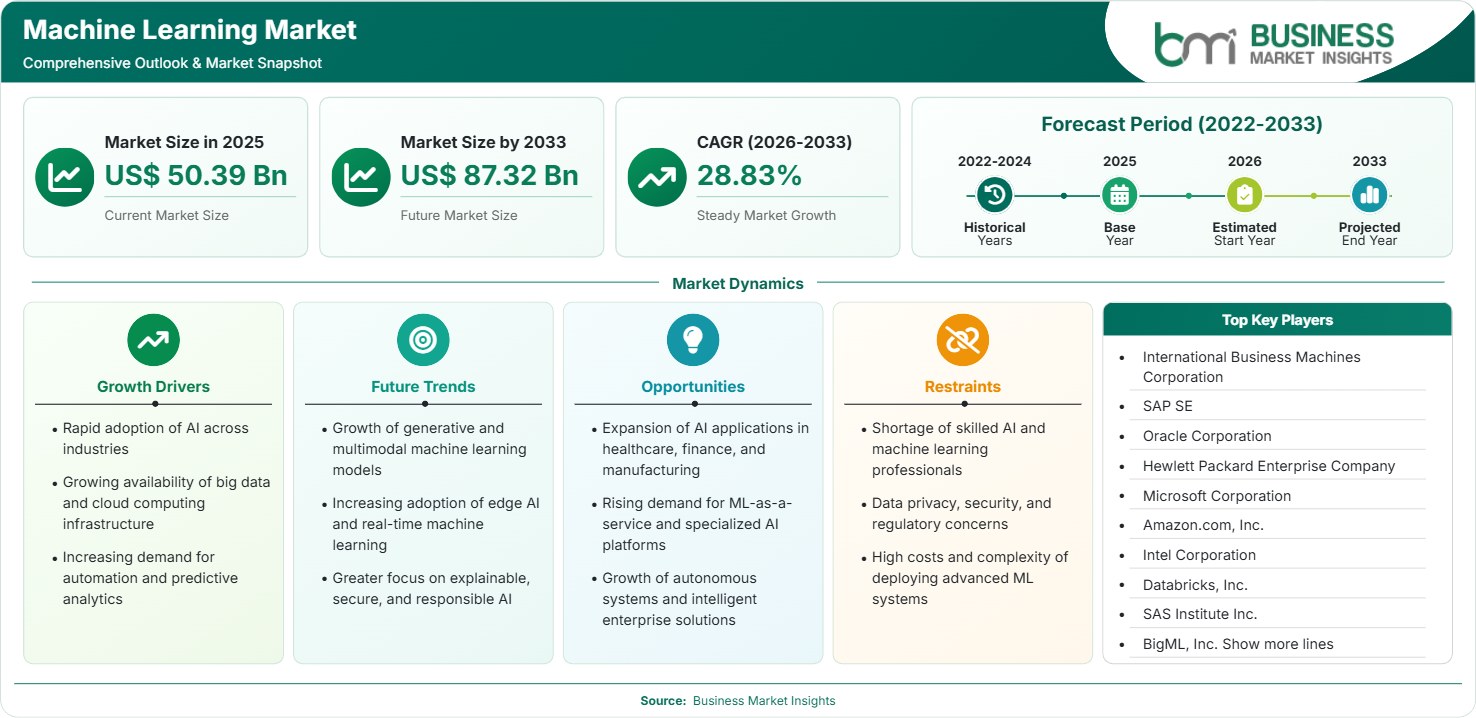
The Machine Learning Market size was valued at US$ 50.39 Billion in 2025 and is projected to reach US$ 87.32 Billion by 2033, growing at a CAGR of 28.83% during 2026–2033, driven by cloud adoption, automation, AI integration, enterprise analytics, and industry-specific applications.

Report Coverage
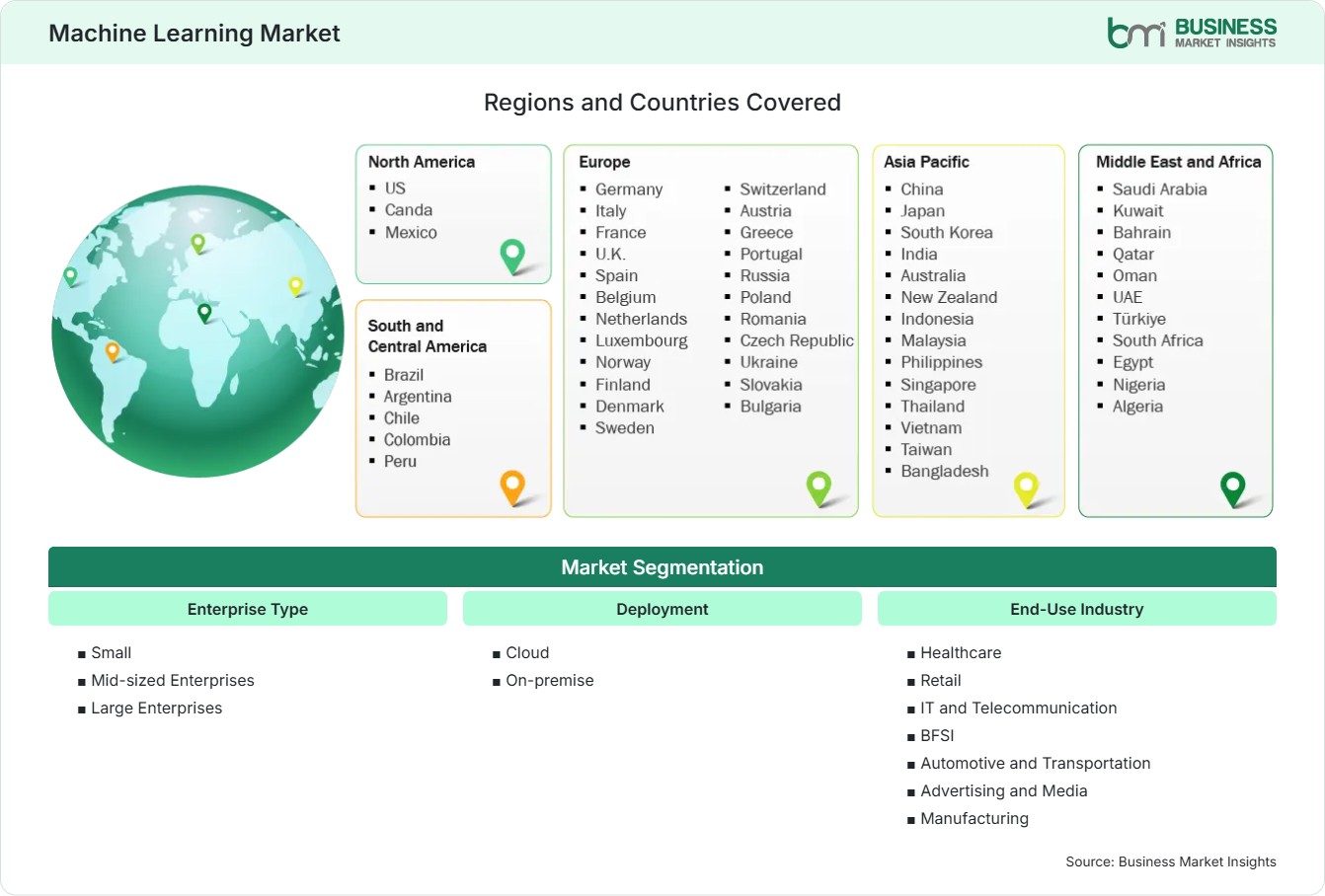
  • Enterprise Type: Small, Mid-sized Enterprises, Large Enterprises
  • Deployment: Cloud, On-premise
  • End-Use Industry: Healthcare, Retail, IT and Telecommunication, BFSI, Automotive and Transportation, Advertising and Media, Manufacturing
US$ 50.39 Bn Market size in 2025
US$ 87.32 Bn Market Size by 2033
28.83% CAGR, 2026 - 2033
2026-2033 Forecast Period

AI Overview

Machine Learning Market Summary

  • North America Region: North America holds Machine Learning Market share of 35%–38% in 2025, growing at a CAGR of 27%–29% during 2026–2033, supported by hyperscaler investment, enterprise AI adoption, advanced computing infrastructure, software ecosystems, and strong research capabilities. The US remains the primary demand center, supported by cloud infrastructure, enterprise software modernization, financial analytics, healthcare AI, semiconductor investment, and expanding production workloads, with a 27%–29% CAGR during 2026–2033.
  • Fastest Growing Region: Asia Pacific holds market share of 27%–30% in 2025, expanding at a CAGR of 31%–34% during 2026–2033, driven by manufacturing automation, cloud migration, digital payments, telecommunications, e-commerce, public AI programs, and expanding technology investment.
  • Leading Segment: Large Enterprises hold market share of 64%–67% in 2025, expanding at a CAGR of 27%–29% during 2026–2033, supported by extensive datasets, dedicated technology teams, larger AI budgets, governance capabilities, and diversified production workloads.
  • High Growth Segment: Cloud deployment holds market share of 58%–62% in 2025, expanding at a CAGR of 31%–34% during 2026–2033, supported by elastic computing, managed platforms, faster experimentation, distributed data access, consumption-based pricing, and simplified infrastructure management.
  • Key Market Opportunity: Vertical AI, edge inference, synthetic data, auto-model creation, and enterprise platforms enable the chance to capitalize on niche workloads and increase speed, efficiency, security, and measurable outcomes.
  • Major Market Players: International Business Machines Corporation, SAP SE, Oracle Corporation, Hewlett Packard Enterprise Company, Microsoft Corporation, Amazon.com, Inc., Intel Corporation, Databricks, Inc., SAS Institute Inc., and BigML, Inc.
Strategic Insights

Machine Learning Market: Strategic Insights

Machine Learning Market Strategic Framework
FREE PDF
Request your free sample
Request free sample
Stakeholder View

Key Takeaways

  • The value chain is converging on data platforms, accelerated computing, model development, deployment coordination, governance, and application connectivity, benefiting vendors who operate within compatible ecosystems.
  • Cloud deployment has significant upside potential as it allows dynamic scaling of computing, use of managed development tools, and decreased infrastructure procurement needs.
  • Innovation is moving toward automated machine learning, efficient models, foundation model adaptation, retrieval systems, synthetic data, specialized inference, and continuous model monitoring.
  • Asia Pacific offers an attractive investment case because manufacturing digitization, financial technology, e-commerce, telecommunications, and government AI programs are expanding enterprise demand.
  • Investment activity is increasingly focused on AI infrastructure, data intelligence, model operations, specialized applications, and technologies that improve deployment economics and enterprise distribution.
Geographic Outlook

Machine Learning Market Regional Highlights

North America Machine Learning Market

North America held 35%–38% share in 2025 and is projected to grow at a 27%–29% CAGR through 2033. The region benefits from mature cloud infrastructure, advanced semiconductor capabilities, enterprise software ecosystems, deep technology investment, and strong research networks. The US dominates Machine Learning Market regional demand, while Canada contributes through financial services, healthcare analytics, technology development, and public-sector modernization. Enterprise readiness for production deployment supports recurring demand across data platforms, infrastructure, applications, and governance.

  • Investment in cloud infrastructure ensures scalability for training, inferencing, data processing, and deployment in big enterprise environments.
  • The finance industry continues using predictive models in areas such as fraud detection, credit scoring, customer segmentation, risk management, and compliance.
  • The healthcare industry continues extending use cases to include image analysis, clinical trials, risk prediction, operations analytics, and administration.
  • Ecosystems for advanced computing improve regional competitiveness through increased performance in training and inferencing processes.

US Machine Learning Market

The US represented 29%–32% global share in 2025 and is projected to grow at a 27%–29% CAGR during 2026–2033. Demand for artificial intelligence will be driven by hyperscaler investments, enterprise modernization, financial analytics, healthcare applications, government initiatives, and robust technology investments. Big technology companies are continuing to build AI infrastructure, while enterprises are incorporating models into their production pipelines. The synergy of sophisticated consumers, robust developer community, powerful cloud capabilities, and robust technology budgets will keep the US relevant.

  • Financial services use machine learning for fraud prevention, underwriting, customer analytics, risk management, and transaction monitoring.
  • Technology companies are expanding investment in model infrastructure, data engineering, inference optimization, and enterprise AI development platforms.
  • Healthcare applications include imaging, clinical support, drug discovery, patient prediction, and administrative automation requiring secure deployment.

Europe Machine Learning Market

Europe held 20%–23% share in 2025 and is projected to expand at a 25%–28% CAGR through 2033. Germany, the UK, France, and the Netherlands represent key markets; the Nordic economies and Ireland present further prospects. Factors that influence demand include industrial automation, financial analytics, digitization of the healthcare industry, and regulatory requirements. The focus of regulation on accountable AI makes additional demands regarding documentation, explainability, privacy, monitoring, and model management.

  • Germany leads in industry through analytics, manufacturing engineering, quality control, predictive maintenance, and supply chain management.
  • The UK benefits from finance technology, health technology, enterprise software, and a robust technology start-up ecosystem.
  • France is seeing growth in applications in manufacturing, transport, government services, military, and enterprise automation.
  • The Nordic nations and Holland offer a wide array of opportunities in logistics, energy, telecommunications, e-commerce, and advanced analytics.

Asia Pacific Machine Learning Market

Asia Pacific captured 27%–30% share in 2025 and is projected to grow at a 31%–34% CAGR through 2033. China, Japan, South Korea, India, Singapore, and Australia form the core regional markets. Manufacturing modernization, telecommunications, digital commerce, financial technology, cloud adoption, and government programs are expanding deployment. Machine Learning Market in India and Southeast Asia offer particularly strong opportunities as enterprises modernize infrastructure and adopt scalable cloud-based analytics, automation, and industry-specific machine learning applications.

  • China continues to be an important market through manufacturing automation, telecommunication, fintech, consumer apps, robotics, and AI infrastructure.
  • India continues to adopt AI across digital payments, e-commerce, software services, health care technology, telecommunications, and digital infrastructure for governments.
  • Japan and South Korea benefit due to the use cases in automotive, electronics, robotics, semiconductors, and industrial automation.
  • Singapore and Australia provide regional hubs for financial services, logistics, healthcare, cybersecurity, cloud infrastructure, and enterprise workload services.

Rest of World Machine Learning Market

Machine Learning Market in South and Central America represented 5%–7% share in 2025 and are projected to grow at a 25%–28% CAGR through 2033. Brazil and Mexico lead adoption through financial technology, retail, manufacturing, agriculture, telecommunications, and logistics. Chile and Colombia provide additional opportunities as cloud infrastructure and digital services expand. Applications increasingly focus on fraud prevention, customer engagement, forecasting, resource optimization, and operational automation.

Middle East and Africa accounted for 7%–9% share in 2025 and are projected to grow at a 28%–31% CAGR. The UAE, Saudi Arabia, Israel, and South Africa lead adoption through smart infrastructure, energy analytics, financial services, healthcare, cybersecurity, and national digital transformation programs.

  • Brazil is leveraging its big data capabilities and digitalization to enhance AI adoption in banking, retail, agriculture, logistics, and telecommunications.
  • Mexico is benefiting from manufacturing, finance, retail, and North American technology ecosystems integrations.
  • Countries of the Gulf region are making efforts in AI infrastructure, intelligent services, energy analysis, and government reform.
  • Israel and South Africa offer unique prospects in cybersecurity, health care, financial services, defense tech, and analysis.
Global Market Geography
FREE PDF
Request your free sample
Request free sample
Segment Analysis

Machine Learning Market Segmentation

Enterprise Type

Large Enterprises held 64%–67% share in 2025 and are projected to grow at a 27%–29% CAGR through 2033. These large volumes of data, IT staff, AI budgets, governance models, and varied workload help with wide adoption. The SMEs are now adopting managed platforms that reduce the requirements for infrastructure and manpower, hence widening the customer base.

  • Small & Mid-sized Enterprises (SMEs): Managed platforms reduce infrastructure complexity, enabling predictive analytics, automation, personalization, forecasting, and customer intelligence without extensive internal machine learning teams.
  • Large Enterprises: Extensive datasets, dedicated AI teams, governance frameworks, and diversified workloads support applications across operations, risk, customer analytics, supply chains, and automation.

Deployment

Cloud deployment held 58%–62% share in 2025 and is projected to grow at a 31%–34% CAGR through 2033. Elastic infrastructure, managed services, consumption-based economics, and rapid deployment favor cloud adoption. On-premise environments remain relevant where security, sovereignty, latency, intellectual property, or specialized workloads require direct infrastructure control. The Machine Learning Market scope is therefore expanding across cloud and controlled enterprise environments.

  • Cloud: Elastic computing, managed development environments, integrated data services, scalable inference, and consumption-based economics accelerate enterprise adoption and deployment.
  • On-premise: Direct infrastructure control supports sensitive datasets, low-latency workloads, regulatory requirements, intellectual property protection, and specialized computing environments.

End-Use Industry

BFSI represented the leading end-use industry in the Machine Learning Market, accounting for 20%–23% share in 2025 and projected to grow at a CAGR of 29%–31% through 2033. High volumes of transactional data, fraud detection requirements, credit risk modeling, underwriting automation, customer analytics, and regulatory compliance continue to drive adoption. Financial institutions remain among the earliest and largest users of production-grade machine learning solutions.

  • Healthcare: Medical imaging, clinical research, patient prediction, drug discovery, and operational analytics are expanding demand for governed machine learning.
  • Retail: Recommendation systems, demand forecasting, pricing, inventory optimization, fraud detection, and customer segmentation support continuous model deployment.
  • IT and Telecommunication: Network optimization, cybersecurity, capacity planning, predictive maintenance, and customer analytics create large recurring workloads.
  • BFSI: Fraud detection, underwriting, credit scoring, risk analytics, compliance, and personalization require high-volume predictive processing.
  • Automotive and Transportation: Driver assistance, predictive maintenance, route optimization, fleet management, and manufacturing quality control support real-time inference.
  • Advertising and Media: Audience segmentation, content recommendation, campaign optimization, churn prediction, and measurement depend on behavioral datasets.
  • Manufacturing: Predictive maintenance, visual inspection, robotics, process optimization, forecasting, and digital twins are increasing industrial deployment.
Market Forces

Machine Learning Market Dynamics

Key Market Drivers

Enterprise AI Productionization

Organizations are shifting from experimental projects toward production-grade machine learning embedded within business workflows. This transition requires automated pipelines, monitoring, governance, security, retraining, and observability. Machine Learning Market growth therefore increasingly depends on recurring production workloads rather than pilot activity. Models are used by banks for fraud detection and risk management, by retailers for personalization and forecasting, and by manufacturers for quality management and predictive maintenance. Cloud services make it easier to adopt these technologies by bringing together compute, data, development, and deployment services on a single platform. Thus, vendors are now competing in lifecycle functionality. The purchase decision is now more about integration, reliability, governance, and cost.

Accelerated Computing and Model Efficiency

Growing computational requirements are increasing demand for GPUs, specialized accelerators, optimized inference systems, and distributed training architectures. Model efficiency is becoming strategically important because organizations must manage latency, energy consumption, throughput, and infrastructure costs. Machine Learning Market trends increasingly favor optimized architectures, smaller specialized models, quantization, and workload-specific acceleration alongside large models. Low-latency inference on the edge is useful for automotive, telecommunications, manufacturing, and retail uses. Optimization of the data center is becoming equally essential, especially as enterprise loads continue to increase. Those who can enhance performance per compute unit can enhance customer economics while alleviating infrastructure pressure.

Data Infrastructure Modernization

Machine learning Market outcomes increasingly depend on data quality, accessibility, lineage, and governance. Organizations are innovating in their warehouses, lakehouses, streaming infrastructures, feature stores, metadata repositories, and data quality solutions in order to enable reliable development. Unified solutions help eliminate redundancy and speed up progress from analysis of data to application development. There is an increasing demand for solutions related to privacy, synthetic data, automated labeling, and governance. These needs extend the scope of technological solutions from model development to data engineering, security, observability, and life cycle management. Companies are looking for solutions that can handle structured, unstructured, streaming, and multimodal data with access control and reliability across distributed machine learning environments.

Key Market Opportunities

Verticalized Machine Learning Platforms

Machine Learning Market Forecasts indicate expanding opportunities for vertical AI platforms, edge intelligence, enterprise governance, and managed machine learning services as adoption moves toward production workloads. Vertical solutions may offer proprietary data, custom models, process orchestration, governance and domain applications, which lead to increased differentiation. Investment cases in verticals tend to be more interesting when there are high entry barriers, such as regulations and domain expertise. Monetization can take place through subscriptions, pay-per-inference, consulting services and advanced governance capabilities. Verticalization can speed up deployment and make solutions more relevant, explainable and adoptable. Best investment cases lie where machine learning makes an impact on the bottom line.

Edge Intelligence and Real-Time Inference

Connected devices are creating opportunities to move inference closer to physical operations. Automotive systems, industrial machinery, telecommunications, retail solutions, and smart infrastructure need more low latency decision-making. Edge deployment helps to minimize network traffic, improves the response time, and works well in situations where the connectivity is not guaranteed. There are several potential areas for investment in the space, including processor optimization, smaller-form-factor designs, edge orchestration, device management, and hybrid cloud-edge solutions. The combination of distributed inference and centralized governance helps to solve the problem of enterprise security and life cycle management.

Enterprise Model Governance and Security

As machine learning becomes embedded in critical decisions, organizations require stronger controls over access, data lineage, testing, explainability, model risk, security, and performance drift. Governance is emerging as an operation need as opposed to an additional compliance activity. There are several ways vendors can realize value by using automation for documentation, modeling inventories, monitoring, policy enforcement, audit trail, and risk categorization. The regulated industries offer plenty of opportunity due to the direct impact that accountability and quality of decisions have on exposure to operational risk. The privacy technologies and secure deployment practices offer even more opportunity. Governance platforms that integrate governance into development and deployment can make adoption easier.

Market Restraints and Challenges

Infrastructure Cost and Compute Availability

Factor: Training and inference workloads can require substantial accelerator capacity, memory, storage, networking, and energy, particularly for complex models at enterprise scale. Impact: Increased investment in infrastructure might lead to project delays, reduced experimentation, and poor return on investment computations. For small companies, managed services or more specific applications might be the choice rather than infrastructure. In some cases, compute availability might affect the schedule if specialized equipment is limited. However, vendors have been trying to cope with that through models tuning, inference acceleration, workload scheduling, and pay-per-use approach. Enterprises should always find the right balance between accuracy, latency, throughput, and costs.

Data Quality, Governance, and Regulatory Complexity

Factor: Machine learning depends on representative, accessible, well-governed data, while privacy, security, intellectual property, and regulatory requirements increase operational complexity. Impact: Data quality problems might affect the reliability of models, while fragmented ownership and compliance procedures could prolong the development process and raise the cost of implementation. Validation, documentation, monitoring, and accountability are some of the pre-requisites for the deployment of regulated applications. Data limitations across boundaries might pose additional challenges for multinationals. This is why enterprises need not only development tools but also governance features. Such requirements might hinder adoption in cases where specialized staff is lacking. However, companies which make these processes easier can facilitate adoption.

Company Analysis

Competitive Landscape

The Market analysis shows competition across cloud infrastructure, enterprise software, data platforms, analytics, accelerated computing, and automated machine learning. Leading providers differentiate through integrated ecosystems, industry solutions, data management, model lifecycle capabilities, infrastructure optimization, governance, and enterprise support.

Company Name

Overview

Products and Services relevant to this market

International Business Machines Corporation

Enterprise technology provider focused on AI, hybrid cloud, automation, consulting, and governed enterprise transformation.

watsonx, AI development, hybrid cloud, data platforms, governance, automation, and enterprise machine learning services.

SAP SE

Enterprise software provider integrating AI, analytics, data, automation, and intelligence into business processes.

Business AI, SAP Business Technology Platform, analytics, data management, machine learning, and automation.

Oracle Corporation

Technology provider combining cloud infrastructure, databases, enterprise applications, analytics, and AI capabilities.

Oracle Cloud Infrastructure, AI services, database machine learning, analytics, data management, and accelerated computing.

Hewlett Packard Enterprise Company

Enterprise technology provider delivering compute, networking, hybrid cloud, and AI infrastructure.

HPE GreenLake, AI servers, high-performance computing, networking, accelerated computing, and enterprise AI infrastructure.

Microsoft Corporation

Global software and cloud provider integrating AI, analytics, developer tools, and enterprise infrastructure.

Azure Machine Learning, Azure AI, cloud infrastructure, data platforms, developer tools, governance, and deployment.

Amazon.com, Inc.

Cloud and technology provider supporting enterprise machine learning through infrastructure, data, and developer services.

Amazon SageMaker, AWS AI services, accelerated computing, analytics, MLOps, and cloud machine learning infrastructure.

Intel Corporation

Semiconductor provider supplying processors, accelerators, networking technologies, and AI optimization capabilities.

Xeon processors, AI accelerators, edge technologies, developer software, inference optimization, and data-center infrastructure.

Databricks, Inc.

Data and AI platform provider focused on lakehouse architecture, engineering, analytics, and machine learning.

Lakehouse Platform, MLflow, Mosaic AI, data engineering, governance, model management, and AI development.

SAS Institute Inc.

Analytics specialist providing predictive modeling, decision intelligence, risk management, and industry analytics.

SAS Viya, predictive analytics, automated machine learning, model management, fraud analytics, and risk solutions.

BigML, Inc.

Machine learning platform specialist focused on automated model development, deployment, and predictive applications.

Automated machine learning, predictive analytics, APIs, anomaly detection, classification, regression, and workflow automation.

Trust & Transparency

Research Methodology

The market analysis combines proprietary research with secondary data from government agencies, company disclosures, regulatory filings, industry databases and expert interviews. Market estimates are validated through data triangulation, cross-market benchmarking and analyst review.

View Full Research Methodology

Questions Answered

Frequently Asked Questions

How do enterprises measure machine learning returns?

Organizations increasingly evaluate fraud losses avoided, forecast accuracy, processing time, conversion, maintenance costs, customer retention, productivity, infrastructure utilization, and revenue impact.

What is the role of model observability?

Observability identifies model drift, data anomalies, latency changes, accuracy deterioration, infrastructure inefficiencies, and unexpected behavior after deployment.

How does synthetic data support adoption?

Synthetic data can expand training datasets where real-world information is sensitive, scarce, expensive, or difficult to label, provided organizations validate quality and representativeness.

Why are hybrid architectures relevant?

Hybrid environments combine cloud scalability with controlled execution where latency, sovereignty, security, intellectual property, or specialized infrastructure requirements affect workload placement.

What does this report cover?

This Machine Learning Market Report provides market size, regional share analysis, segmentation, competitive landscape, key trends, growth drivers, opportunities, restraints, and forecasts through 2033.

Access the Full Machine Learning Market Report

Get segment-level forecasts, regional estimates, competitive benchmarking, company profiles and downloadable Excel datasets.

Access the full Machine Learning Market Report
350 pages PDF & Excel | 2026-09-15
Similar Research

Related Market Reports