Market Summary
Executive Summary and Global Market Analysis
People counting systems are sensor-based and analytics-enabled solutions designed to measure, monitor, and interpret human movement across physical environments. These technologies capture occupancy levels, visitor flows, entry-exit activity, and spatial utilization patterns, enabling organizations to improve operational planning and resource allocation. Their deployment has expanded across retail stores, transportation facilities, commercial properties, healthcare institutions, and public infrastructure.
Operational efficiency requirements continue to encourage investment in occupancy intelligence platforms. Organizations increasingly rely on real-time movement data to optimize staffing schedules, enhance customer experiences, manage facility capacity, and support safety compliance objectives. The transition toward data-centric decision-making has strengthened the business case for accurate people flow monitoring across multiple sectors.
Segmentation patterns reveal broad applicability across technology categories, deployment models, and end-user environments. Video-based systems remain prominent where detailed analytics are required, while thermal imaging and infrared solutions address specialized monitoring requirements. Component demand spans hardware installations, analytical software platforms, and service-based implementation support.
Technological advancement continues to reshape system capabilities through artificial intelligence, edge processing, machine vision, and cloud-connected analytics. Modern platforms increasingly combine occupancy monitoring with behavioral insights, queue analysis, space optimization, and predictive reporting functions. Enhanced processing accuracy and privacy-focused architectures further support adoption across regulated environments.
Competition within this sector is characterized by continuous product enhancement, integration capabilities, and analytical sophistication. Market participants focus on improving detection precision, deployment flexibility, and interoperability with broader smart building ecosystems. Strategic investments in intelligent sensing technologies and advanced data interpretation tools continue to influence competitive positioning throughout the industry.
Segment Analysis
People Counting System Market Segmentation
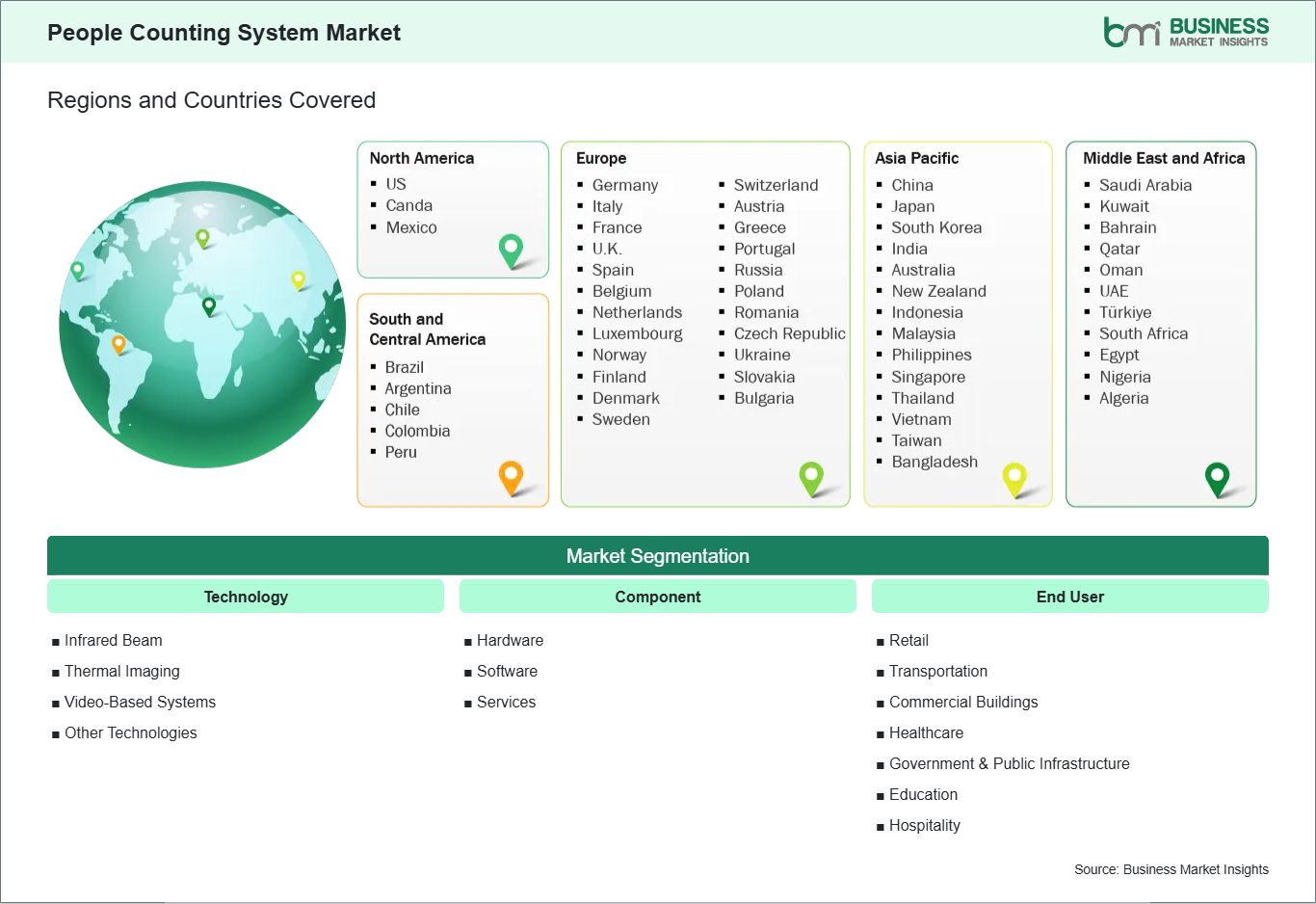
The people counting system market is segmented based on technology, component, and end user, reflecting its critical role in driving operational efficiency and optimizing space utilization across global industries.
By Technology
- Infrared Beam: Preferred for straightforward entry and exit monitoring applications.
- Thermal Imaging: Performs effectively under challenging lighting conditions.
- Video-Based Systems: Delivers advanced analytics beyond basic occupancy measurement.
- Other Technologies: Supports specialized deployment environments and unique monitoring requirements.
By Component
- Hardware: Forms the foundational infrastructure for traffic measurement systems.
- Software: Enables reporting, visualization, and analytical interpretation.
- Services: Assists implementation, calibration, maintenance, and optimization activities.
By End User
- Retail: Utilizes visitor insights for merchandising and staffing decisions.
- Transportation: Monitors passenger movement across transit environments.
- Commercial Buildings: Enhances workspace planning and occupancy management.
- Healthcare: Supports patient flow assessment and facility coordination.
- Government & Public Infrastructure: Strengthens crowd monitoring and resource planning.
- Education: Tracks campus occupancy and facility utilization.
- Hospitality: Improves guest experience through traffic pattern evaluation.
Market Forces
People Counting System Market Drivers and Opportunities
Rising Need for Data-Driven Space Utilization and Occupancy Intelligence
Organizations increasingly seek measurable insights into how physical spaces are utilized throughout operational hours. Traditional observation methods often lack consistency, creating demand for automated monitoring systems capable of delivering reliable occupancy information. As facilities become more complex, decision-makers require accurate movement data to support staffing, security planning, and customer experience optimization.
The resulting operational visibility improves resource allocation and strengthens performance management practices. Retailers, transportation operators, healthcare facilities, and public institutions benefit from actionable occupancy intelligence that supports informed decision-making. This relevance continues to expand as organizations prioritize efficiency, accountability, and measurable outcomes across facility operations.
Expansion of AI-Enabled Analytics Across Smart Infrastructure
Artificial intelligence integration is transforming people counting systems from measurement tools into analytical intelligence platforms. Advanced algorithms can interpret movement patterns, identify congestion trends, and generate actionable insights in real time. These innovations enable organizations to move beyond simple occupancy reporting toward predictive operational management.
Future development opportunities extend across smart buildings, connected transportation networks, digital campuses, and intelligent public infrastructure. As interoperability improves, people counting technologies may become embedded within broader ecosystem architectures. This evolution creates opportunities for expanded functionality, deeper analytics, and enhanced operational outcomes across diverse deployment environments.
Size and Share Analysis
People Counting System Market Size and Share Analysis
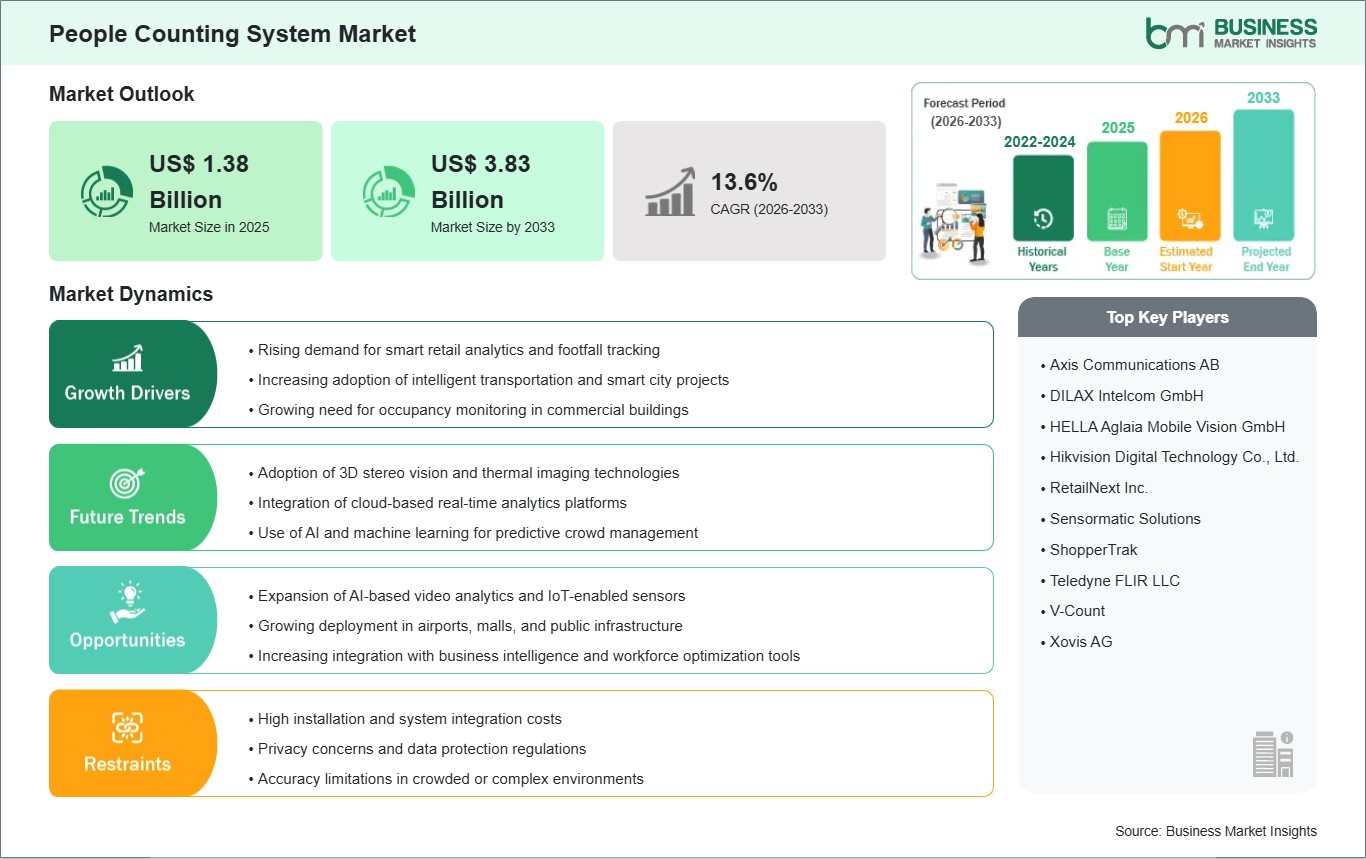
The people counting system market was valued at USD 1.38 Billion in 2025 and is projected to reach USD 3.83 Billion by 2033, registering a CAGR of 13.6% during 2026 - 2033. This growth trajectory reflects expanding deployment across commercial, institutional, and public environments where occupancy intelligence supports operational efficiency and strategic planning.
Among technology categories, video-based solutions maintain a strong market position due to their advanced analytical capabilities and ability to generate detailed behavioral insights. Software platforms continue gaining importance as organizations place greater emphasis on visualization, reporting, and integrated decision-support functions.
Retail remains a prominent application area owing to continuous focus on customer traffic assessment and store performance optimization. Transportation facilities, commercial buildings, healthcare institutions, and public infrastructure projects also contribute substantially through their increasing reliance on occupancy-driven operational management.
Report Coverage
People Counting System Market Report Coverage and Deliverables
The "People Counting System Market Size and Forecast (2022:2033)" report provides a detailed analysis of the market covering below areas:
- Market size and forecast at global, regional, and country levels for all market segments covered under the scope
- Market trends, as well as drivers, restraints, and opportunities
- Market analysis covering key trends, global and regional framework, major players, regulations, and recent developments
- Industry landscape and competition analysis covering market concentration, heat map analysis, prominent players, and recent developments for the market
- Detailed company profiles, including SWOT analysis
Geographic Insights
People Counting System Market Geographic Insights
The People Counting System market shows diverse regional adoption patterns influenced by infrastructure modernization priorities, digital transformation strategies, regulatory frameworks, and operational efficiency objectives. Across global markets, organizations increasingly incorporate occupancy intelligence into broader facility management initiatives. The convergence of analytics, automation, and connected infrastructure continues to expand deployment opportunities across both public and private sectors.
North America maintains a well-established ecosystem supported by advanced commercial infrastructure and extensive technology integration. Retail chains, transportation operators, healthcare providers, and enterprise facilities utilize occupancy analytics to improve service delivery and operational coordination. Strong emphasis on measurable performance outcomes encourages continued investment in intelligent monitoring technologies throughout the region.
Asia Pacific demonstrates substantial momentum as urban development projects incorporate smart infrastructure capabilities. Large transportation networks, commercial complexes, educational institutions, and public facilities increasingly deploy people counting solutions to improve utilization planning and crowd management. Digitalization initiatives and expanding smart city programs contribute to sustained implementation across both developed and emerging economies.
Europe benefits from widespread interest in intelligent building management and resource optimization. Organizations seek solutions that balance analytical depth with privacy-conscious deployment approaches. Meanwhile, Latin America, the Middle East, and Africa present expanding opportunities as infrastructure investments, commercial development projects, and modernization programs encourage broader implementation of occupancy monitoring technologies. These regions continue progressing toward more connected and data-informed operational environments.
Industry Activity
Recent Developments
The people counting system market is evaluated by gathering qualitative and quantitative data post primary and secondary research, which includes important corporate publications, association data, and databases. A few of the key developments in the people counting system market are:
- September 2025, March Networks introduced the AI3 Counting Camera at GSX 2025. The new solution combines 360° video surveillance with edge-based people counting, queue monitoring, dwell-time analysis, and demographic analytics for retail, banking, transit, and QSR environments.
- July 2025, Sensormatic Solutions unveiled next-generation people-counting technology featuring Re-Identification (Re-ID) and deep-learning AI. The platform enables retailers to track unique visitors, dwell time, shopper movement patterns, and conversion metrics with improved accuracy.
Trust & Transparency
Research Methodology
The market analysis combines proprietary research with secondary data from government agencies, company disclosures, regulatory filings, industry databases and expert interviews. Market estimates are validated through data triangulation, cross-market benchmarking and analyst
review.
View Full Research Methodology
Key Sources Referred:
World Bank – Global Trade Indicators World Trade Organization (WTO) (International Monetary Fund )IMF International Trade Administration (ITA) Company website Company annual reports Company investor presentations