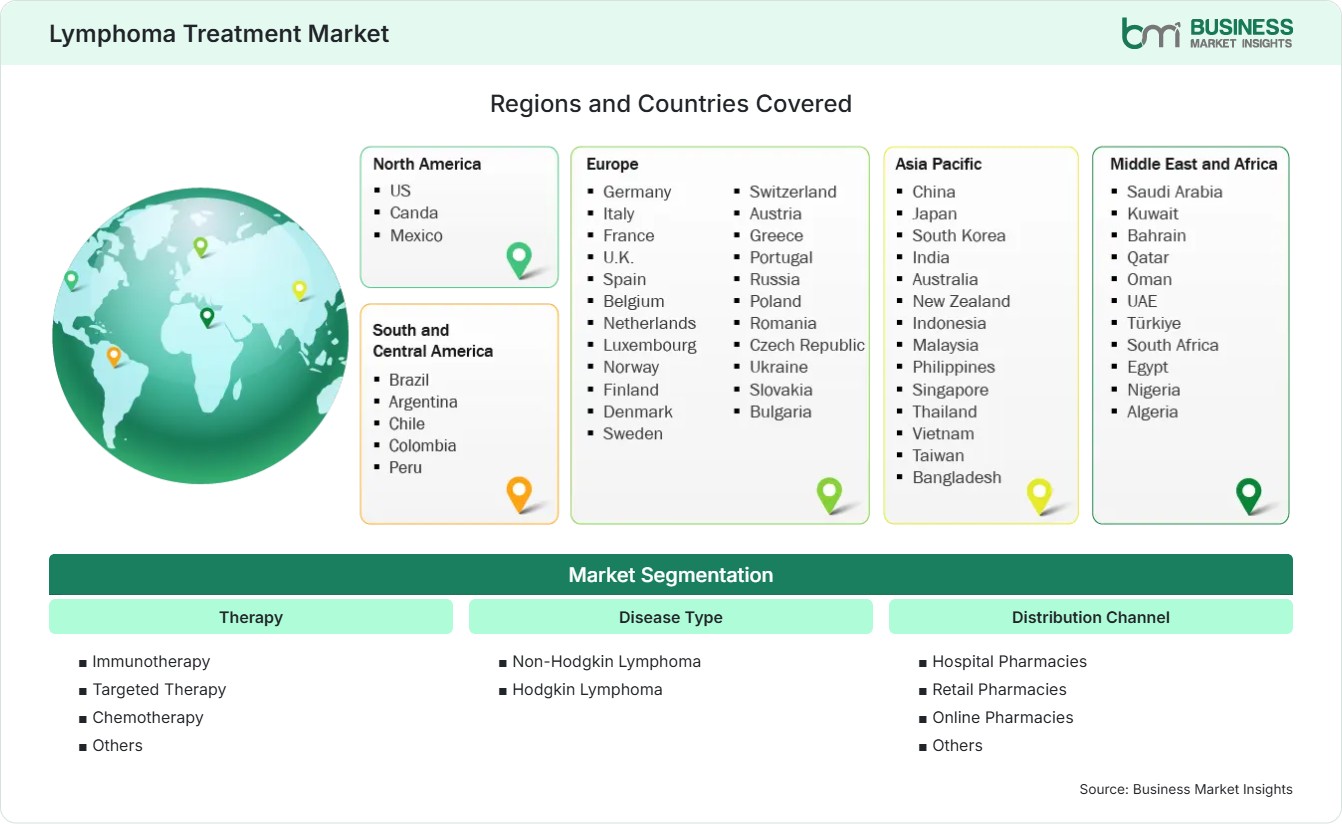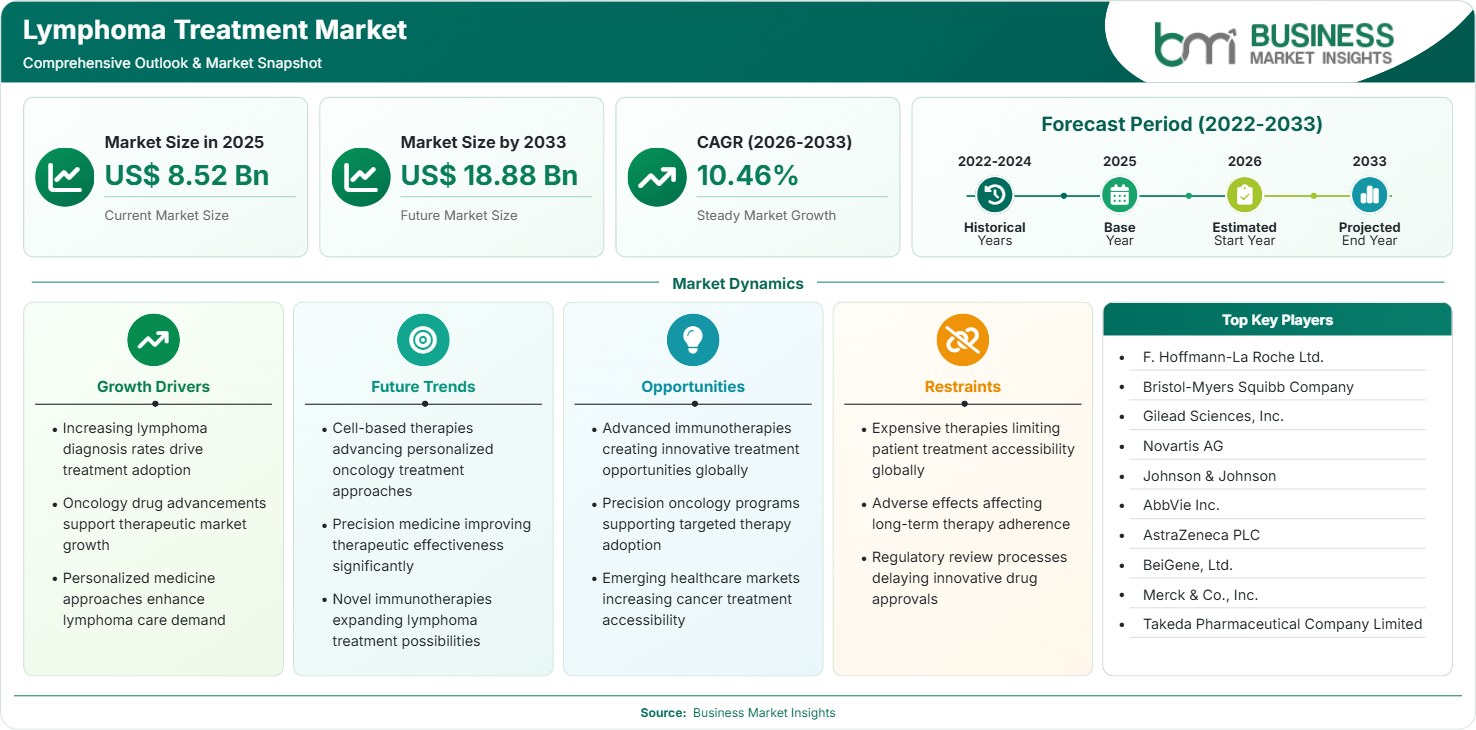
Lymphoma Treatment Market Regional Highlights
North America Lymphoma Treatment Market
North America accounts for 34%–38% of the Lymphoma Treatment Market in 2025 and is projected to expand at a 9.7%–10.3% CAGR through 2033. The region benefits from advanced cancer centers, strong clinical research infrastructure, reimbursement mechanisms, specialist availability, and rapid uptake of cellular and immune-based therapies. The US represents the dominant national market, while Canada contributes through established public oncology systems. Commercial expansion increasingly depends on outpatient delivery, evidence generation, specialist capacity, reimbursement access, and treatment-site optimization.
- Advanced cancer centers support CAR T-cell therapy, bispecific antibodies, antibody-drug conjugates, and complex combination regimens, strengthening the region's specialized treatment ecosystem.
- Pharmaceutical investment remains concentrated in hematologic oncology, with companies pursuing earlier-line indications, administration improvements, combination strategies, and differentiated mechanisms.
- Specialty pharmacies and hospital systems increasingly coordinate high-cost therapies, reimbursement authorization, patient monitoring, adverse-event management, and treatment scheduling.
- Regulatory expansion of indications creates incremental patient populations, particularly in relapsed or refractory disease, where therapeutic alternatives remain clinically differentiated.
US Lymphoma Treatment Market
The United States makes up around 28%-32% of the North American market in 2025 and is estimated to register a CAGR of 9.5%-10.2% from 2026-2033. The reasons behind its market position include innovative capabilities in pharmaceuticals, specialty hematology practices, clinical studies, advanced diagnostics, and approved treatments. FDA approvals keep increasing the options for patients. In December 2025, lisocabtagene maraleucel received approval for adults with relapsed or refractory marginal zone lymphoma after at least two previous systemic treatments.
- Academic medical centers and community oncology networks are expanding access to advanced immune therapies, although treatment complexity continues influencing site-of-care selection and patient eligibility.
- Bispecific antibodies are increasingly positioned as practical immune-mediated treatment options, particularly where outpatient administration can reduce logistical requirements.
- Molecular testing and disease characterization are becoming increasingly important as treatment selection depends on lymphoma subtype, antigen expression, previous therapy, and patient-specific clinical factors.
Europe Lymphoma Treatment Market
Europe holds a 27%–31% share of the Lymphoma Treatment Market in 2025 and is expected to grow at a 9.7%–10.3% CAGR through 2033. Germany, France, Italy, the United Kingdom, and Spain remain important markets because of established hematology networks and specialist oncology centers. Germany provides substantial treatment capacity, while Spain and Italy offer expanding opportunities for advanced therapies. The United Kingdom continues to emphasize the adoption of evidence-based healthcare. Differences in reimbursement, health technology assessment, and specialist availability influence country-level treatment access and launch timing.
- Germany's specialist oncology infrastructure supports the adoption of sophisticated biologics, cellular therapies, diagnostics, and clinical-trial programs across major lymphoma centers.
- France and the United Kingdom maintain established hematology networks while emphasizing evidence generation, treatment protocols, health economics, and appropriate resource utilization.
- Spain and Italy offer expansion opportunities as advanced therapies become progressively incorporated into specialist treatment networks and regional oncology systems.
- Subcutaneous and outpatient formulations can improve healthcare utilization by reducing infusion duration and potentially shifting appropriate treatment toward lower-intensity administration settings.
Asia Pacific Lymphoma Treatment Market
Asia Pacific accounts for 20%–24% of the Lymphoma Treatment Market in 2025 and is projected to record the fastest regional expansion, at an 11.7%–12.4% CAGR. China, Japan, South Korea, India, and Australia represent major commercial markets, while India and China offer substantial expansion potential due to large patient populations and expanding oncology infrastructure. Japan remains a mature innovation market, whereas India and Southeast Asia are increasing specialist treatment capacity. Domestic pharmaceutical development is also strengthening competition and improving the availability of selected oncology medicines.
- China combines a large oncology population with expanding domestic biologics development, regulatory modernization, and increasing availability of innovative hematologic medicines.
- Japan maintains a sophisticated hematology infrastructure and contributes a substantial demand for advanced therapies supported by established specialist treatment pathways.
- India provides a significant long-term opportunity as cancer centers, diagnostic capabilities, specialty pharmacies, insurance coverage, and private oncology networks expand.
- South Korea and Australia offer technologically advanced treatment environments and established clinical research capabilities, supporting uptake of innovative biologics and cellular therapies.
Rest of World Lymphoma Treatment Market
Rest of World represents approximately 11%–15% of the 2025 Lymphoma Treatment Market and is expected to grow at a 10.0%–11.0% CAGR. South and Central America are led by Brazil and Mexico, where oncology capacity is concentrated in major urban centers. Chile and Colombia provide additional opportunities as specialist services develop. In the Middle East and Africa, Saudi Arabia, the United Arab Emirates, and South Africa are important treatment hubs. Uneven reimbursement, specialist availability, and treatment infrastructure continue influencing access.
Brazil and Mexico are expanding their oncology networks, whereas the Gulf states are focusing on building up their hospitals and centers of oncology excellence, as well as infrastructure for precision medicine. Both Saudi Arabia and the UAE can assist the uptake of more complex treatments through healthcare investments. South Africa continues to be a major market for advanced oncology services.
- Brazil's specialist cancer centers provide a foundation for advanced lymphoma treatment, although affordability and regional healthcare disparities influence access.
- Mexico offers expansion opportunities through private oncology networks, specialist hospitals, and increasing demand for innovative hematologic treatments.
- Gulf markets are investing in precision oncology, advanced hospitals, and international clinical partnerships, supporting the adoption of higher-complexity therapies.
- South Africa's specialist oncology infrastructure supports regional referral activity, although medicine affordability and healthcare-resource constraints influence treatment availability.