Allergy Treatment Market Outlook (2022-2033)

Historic Data: 2022 - 2024   |   Base Year: 2025   |   Forecast Period: 2026-2033
Report Content: Market Scope, Market Segmentation, Market Dynamics, and Competitive Analysis

Report Coverage:
  • Allergy Type (Eye Allergy, Allergic Rhinitis, Skin Allergy, Food Allergy, Other Allergy Types)
  • Treatment Type (Anti-Allergy Drugs, Immunotherapy)
  • Distribution Channel (Hospital Pharmacies, Online Pharmacies, Retail Pharmacies)

No. of Pages: 400
Report Code: BMIPUB00032646
Category: Life Sciences
Allergy Treatment Market

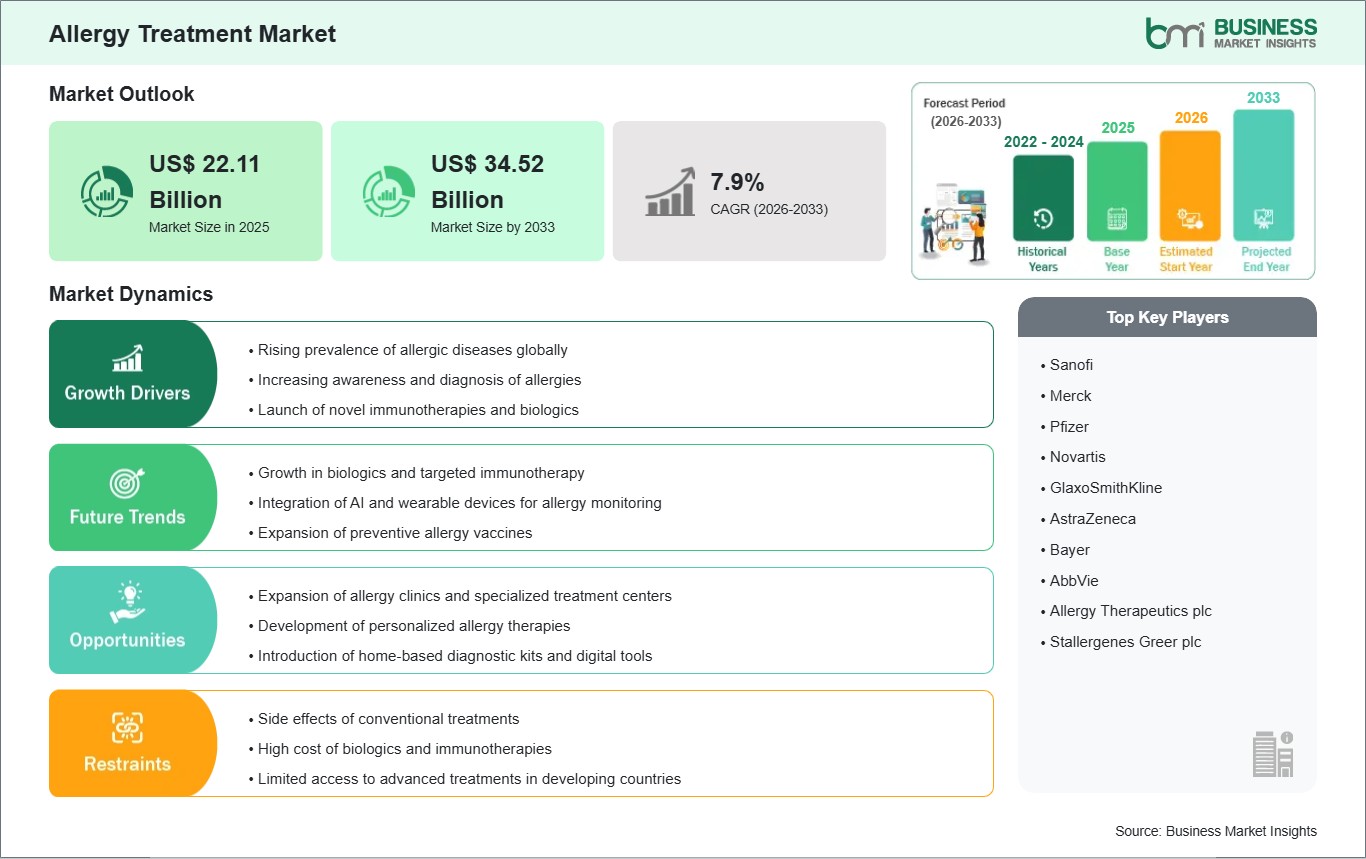
The Allergy Treatment Market size is expected to reach US$ 34.52 billion by 2033 from US$ 22.11 billion in 2025. The market is estimated to record a CAGR of 7.9% from 2026 to 2033.

Executive Summary and Global Market Analysis:

Allergy treatment is classified as a medical approach used to either prevent, manage, or relieve allergic reactions due to the immune system's hypersensitivity to substances such as pollen, dust mites, food, insect venom, or drugs. The most common treatments consist of antihistamines, corticosteroids, decongestants, leukotriene inhibitors, mast cell stabilizers, immunotherapy (allergy shots or sublingual tablets), and biologic therapies for conditions like asthma or chronic urticaria that are severe.

The global allergy treatment market is a steadily growing one that is, among other factors, driven by the ever-increasing number of allergic patients, ever-growing cities, pollution from the environment, changes in the climate, and the public's growing knowledge about allergy diagnosis and management. It is continuously innovative, especially in biologics, precision medicine, and long-acting therapies, which all improve efficacy and patient adherence. North America is the leader globally with its advanced healthcare infrastructure, high diagnosis rates, and wide acceptance of new therapies, while Europe is the second market with its supportive regulatory frameworks and research activity. The Asia-Pacific region is the area with the most significant opportunity for growth, due to its large population, improving healthcare access, and the increase in allergen exposure caused by the rapid development of industries. The market is characterized by the move towards personal treatments, the growing number of pediatric and elderly patients, and the increasing demand for over-the-counter allergy medications. All in all, the allergy treatment market is a competitive one, driven by innovation, and the focus has shifted to long-term disease control rather than just providing symptomatic relief.

Allergy Treatment Market - Strategic Insights:

global-market-strategic-framework
Get more information on this report

Allergy Treatment Market Segmentation Analysis:

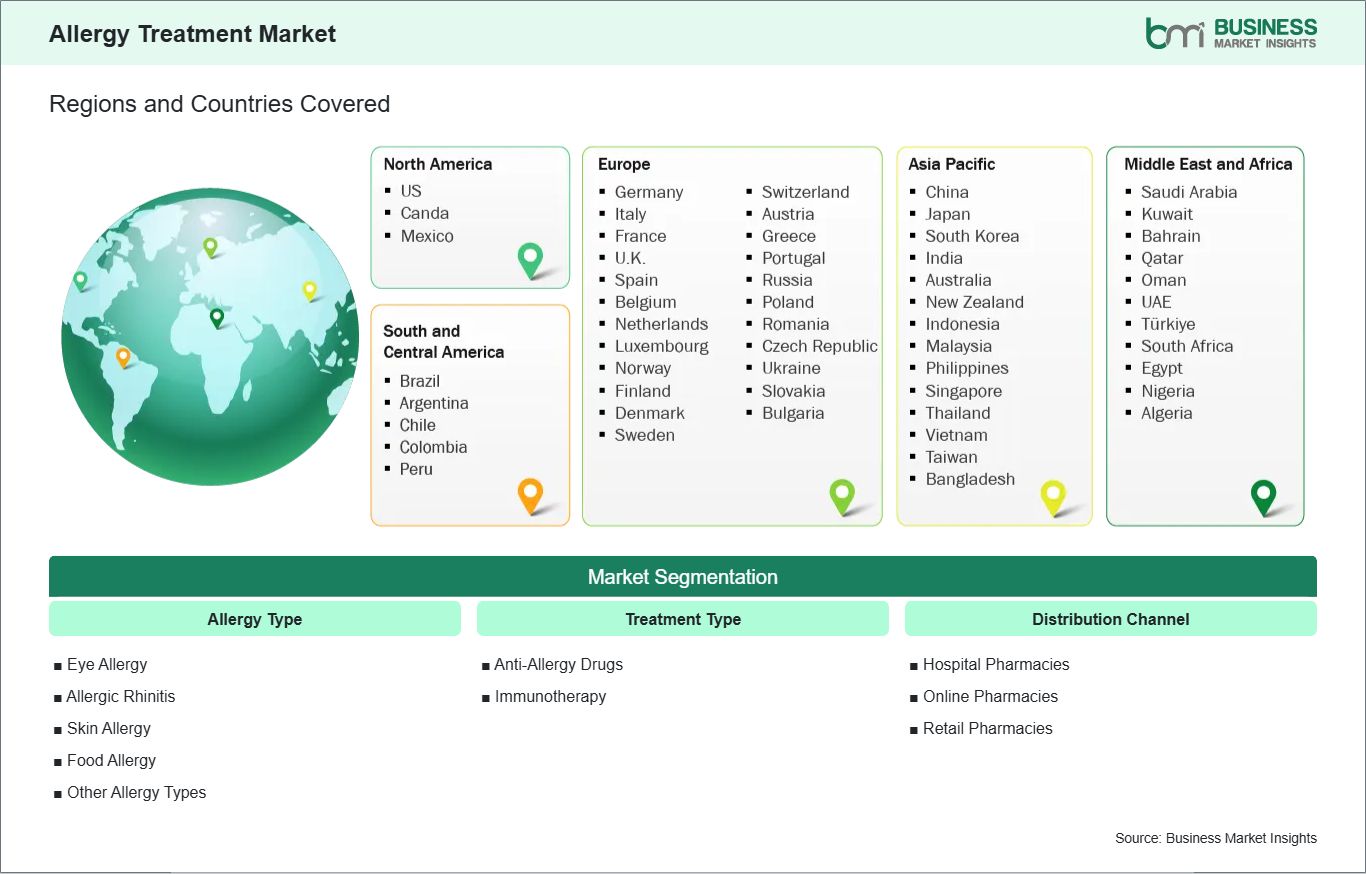
Key segments that contributed to the derivation of the allergy treatment market analysis are allergy type, treatment type, and distribution channel.

  • By allergy type, the market is categorized into eye allergy, allergic rhinitis, skin allergy, food allergy, other allergy types. The allergic rhinitis segment held the largest share of the market in 2025.
  • By treatment type, the market is bifurcated into anti-allergy drugs, immunotherapy. The anti-allergy drugs segment held a larger share of the market in 2025.
  • By distribution channel, the allergy treatment market is segmented into hospital pharmacies, online pharmacies, retail pharmacies. The retail pharmacies segment dominated the market in 2025.

Allergy Treatment Market Drivers and Opportunities:

Increasing Prevalence of Allergic Conditions

The rise in allergic conditions worldwide is caused by environmental, lifestyle, and diagnostic trends. Urban pollution exposure, the effects of climate change, such as longer pollen seasons, and indoor living conditions have all contributed to people becoming more sensitive, and therefore, there are more cases of allergic rhinitis, asthma, skin allergies, and food allergies. Studies show that from 10% to 30% of the world's population could be affected by allergies each year, with respiratory and food allergies being the most common ones in both developed and underdeveloped areas.

Increased public awareness and better screening procedures have also played a part in raising the number of diagnoses, which in turn has created a demand for new and effective treatments. Pharmaceutical research and development—like more efficient biologics and sublingual immunotherapy options—are not only making it easier for doctors to treat patients but also encouraging them to start treating patients earlier rather than just managing symptoms. For instance, the trend of using sublingual immunotherapy is still on the rise as patients prefer this method over traditional antihistamines and want to get long-term relief, which in turn supports the growth of the market that is associated with the increasing incidence of allergies and changing treatment expectations.

Innovation and New Treatment Developments

Pharma companies are not only targeting the traditional symptom suppression but also actively developing next-generation therapies that will meet the unmet needs of the market, including novel biologics, precision immunotherapies, and better delivery methods. For example, the strategic alliances have recently unveiled the next-generation sublingual immunotherapy (SLIT) tablets for the treatment of dust mite and pollen allergies in the key markets, which shows a change towards more patient-friendly, at-home treatments that will lead to better compliance and consequently, longer-term results. At the same time, the clinical trials for the biologic agents that target allergies through dual pathways (e.g., IL-13/TSLP) are being conducted, and they are expected to have a wider range of effect in patients with co-existing conditions such as rhinitis and asthma. Digital diagnostics and collaborations—such as the ones involving digital biomarker profiling—are making it possible to provide more personalized treatment plans and thus creating more opportunities for individualized care. All these innovations now allow the market to take full advantage of the increasing demand for precision medicine while being able to differentiate their offerings in the highly competitive global marketplaces.

Allergy Treatment Market Size and Share Analysis:

By allergy type, the allergy treatment market is categorized into eye allergy, allergic rhinitis, skin allergy, food allergy, other allergy types. The allergic rhinitis segment held the largest share of the market in 2025. Allergic rhinitis is the leading segment due to its high global prevalence and chronic, recurrent nature. Common triggers such as pollen, dust mites, and air pollution expose large populations year-round, especially in urban areas. The condition affects both adults and children, driving continuous demand for diagnosis and long-term management. Easy recognition of symptoms and wide availability of effective treatments further reinforce its dominance within the allergy treatment market.

By treatment type, the market is bifurcated into anti-allergy drugs, immunotherapy. The anti-allergy drugs segment held a larger share of the market in 2025. Anti-allergy drugs lead the market because they offer fast symptom relief, ease of use, and broad accessibility. Medications such as antihistamines, corticosteroids, and decongestants are widely prescribed and available over the counter, making them the first-line treatment for most allergic conditions. Their cost-effectiveness, strong patient compliance, and suitability for mild to moderate allergies ensure consistent demand compared to immunotherapy, which is longer-term and more specialized.

By distribution channel, the allergy treatment market is segmented into hospital pharmacies, online pharmacies, retail pharmacies. The retail pharmacies segment dominated the market in 2025. Retail pharmacies dominate due to their widespread presence, convenience, and consumer trust. Many allergy treatments are available without prescriptions, encouraging patients to directly purchase medications from local pharmacies. Retail outlets also provide pharmacist guidance, quick access, and immediate availability, which is crucial for acute allergy symptoms. Compared to hospital or online pharmacies, retail pharmacies better serve routine and repeat purchases, supporting their leading position.

Allergy Treatment Market Report Highlights:

Report Attribute Details
Market size in 2025 US$ 22.11 Billion
Market Size by 2033 US$ 34.52 Billion
Global CAGR (2026 - 2033)7.9%
Historical Data 2022 - 2024
Forecast period 2026-2033
Segments Covered By Allergy Type
  • Eye Allergy
  • Allergic Rhinitis
  • Skin Allergy
  • Food Allergy
  • Other Allergy Types
By Treatment Type
  • Anti-Allergy Drugs
  • Immunotherapy
By Distribution Channel
  • Hospital Pharmacies
  • Online Pharmacies
  • Retail Pharmacies
Regions and Countries Covered
North America US, Canada, Mexico
Europe Belgium, Austria, Finland, Denmark, Greece, Poland, Romania, Russia, Ukraine, Czech Republic, Slovakia, Bulgaria, Italy, Luxembourg, Germany, Switzerland, France, Netherlands, Norway, Portugal, Spain, Sweden, United Kingdom
Asia-Pacific Australia, China, India, Japan, South Korea, Indonesia, Malaysia, Philippines, Singapore, Thailand, Vietnam, Bangladesh, New Zealand, Taiwan
South and Central America Brazil, Argentina, Peru, Chile, Colombia
Middle East and Africa Bahrain, Kuwait, Oman, Qatar, Saudi Arabia, United Arab Emirates, Turkiye, South Africa, Egypt, Algeria, Nigeria
Market leaders and key company profiles
  • Sanofi
  • Merck
  • Pfizer
  • Novartis
  • GlaxoSmithKline
  • AstraZeneca
  • Bayer
  • AbbVie
  • Allergy Therapeutics plc
Get more information on this report

Allergy Treatment Market Report Coverage and Deliverables:

The " Allergy Treatment Market Size and Forecast (2022–2033)" report provides a detailed analysis of the market covering below areas:

  • Allergy treatment market size and forecast at global, regional, and country levels for all the key market segments covered under the scope
  • Allergy treatment market trends, as well as market dynamics such as drivers, restraints, and key opportunities
  • Allergy treatment market analysis covering key market trends, global and regional framework, major players, regulations, and recent market developments
  • Industry landscape and competition analysis covering market concentration, heat map analysis, prominent players, and recent developments for the allergy treatment market
  • Detailed company profiles, including SWOT analysis

Allergy Treatment Market Geographic Insights:

The geographical scope of the allergy treatment market report is divided into five regions: North America, Asia Pacific, Europe, Middle East & Africa, and South & Central America. The allergy treatment market in Asia Pacific is expected to grow significantly during the forecast period.

The Asia-Pacific allergy treatment market is segmented into China, Japan, South Korea, India, Australia, New Zealand, Indonesia, Malaysia, the Philippines, Singapore, Thailand, Vietnam, Taiwan, Bangladesh, and the Rest of Asia. The Asia-Pacific allergy treatment market is experiencing robust growth, due to growing urban development and industrialization at a rapid pace across countries such as China, India, and Southeast Asia have played a major role in increasing the exposure of people to air pollution and allergens, along with changing their lifestyles, thus, resulting in more cases of respiratory, skin, and food allergies. Global warming has also made the situation worse by lengthening pollen seasons in certain areas of Australia, Japan, and China; thus, the cases of allergic rhinitis and asthma have increased. The patient pool is further enlarged by a large and rising population, especially the kids and the elderly, who are more prone to getting allergies.

Moreover, the healthcare infrastructure is getting better, and thus the healthcare expenditure is going up, which is making access to better diagnosis and treatment easier and is mainly benefiting the urban population. Governments are putting money into public health awareness programs and insurance coverage expansion, which would make it easier for patients to seek medical care instead of just managing the symptoms themselves. The region is also seeing a rise in the number of over-the-counter anti-allergy medications available and the gradual acceptance of advanced therapies like immunotherapy and biologics in developed markets such as Japan and South Korea. Besides, low-cost manufacturing and wide pharmaceutical distribution networks are the reasons the Asia-Pacific is a region where both domestic and international players would want to be, since it would lead to an overall market acceleration.        

global-market-geography
Get more information on this report

Allergy Treatment Market Research Report Guidance:

  • The report includes qualitative and quantitative data in the Allergy Treatment Market across allergy type, treatment type, distribution channel, and geography.
  • The report starts with the key takeaways (chapter 2), highlighting the key trends and outlook of the allergy treatment market.
  • Chapter 3 includes the research methodology of the study.
  • Chapter 4 further includes ecosystem analysis.
  • Chapter 5 highlights the major industry dynamics in the allergy treatment market, including factors that are driving the market, prevailing deterrents, potential opportunities, as well as future trends. Impact analysis of these drivers and restraints is also covered in this section.
  • Chapter 6 discusses the allergy treatment market scenario, in terms of historical market revenues, and forecast till the year 2031.
  • Chapters 7 to 10 cover Allergy Treatment Market segments by allergy type, treatment type, distribution channel, and geography across North America, Europe, Asia Pacific, Middle East and Africa, and South and Central America. They cover the market revenue forecast and factors driving the market.
  • Chapter 11 describes the competitive analysis along with the heat map analysis for the key players operating in the market.
  • Chapter 12 describes the industry landscape analysis. It provides detailed descriptions of business activities such as market initiatives, new developments, mergers, and joint ventures globally, along with a competitive landscape.
  • Chapter 13 provides detailed profiles of the major companies operating in the allergy treatment market. Companies have been profiled on the basis of their key facts, business descriptions, products and services, financial overview, SWOT analysis, and key developments.
  • Chapter 14, i.e., the appendix is inclusive of a brief overview of the company, list of abbreviations, and disclaimer.

Allergy Treatment Market News and Key Development:

The allergy treatment market is evaluated by gathering qualitative and quantitative data post primary and secondary research, which includes important corporate publications, association data, and databases. A few of the key developments in the allergy treatment market are:

  • In February 2024, Novartis made a statement that the US Food and Drug Administration (FDA) had given approval to Xolair (omalizumab) for the treatment of allergic reactions, including anaphylaxis that may occur as a result of unintentional exposure to one or more foods in adult and pediatric patients aged one year and older with IgE-mediated food allergy. Xolair has become the first and only FDA-approved medication that can diminish allergic reactions in those having more than one food allergy.
  • In April 2025, Dupixent (dupilumab) was officially approved by the US Food and Drug Administration (FDA) for the treatment of chronic spontaneous urticaria (CSU) in adults and adolescents 12 years and older who are still symptomatic despite receiving histamine-1 (H1) antihistamine treatment. Dupixent has already been authorized for CSU in countries like Japan, the United Arab Emirates, and Brazil.

Key Sources Referred:

  • World Health Organization (WHO)
  • Centers for Disease Control and Prevention (CDC)
  • European Centre for Disease Prevention and Control
  • Global Health Data Exchange
  • Institute for Health Metrics and Evaluation
  • Company websites
  • Company annual reports
  • Company investor presentations
The List of Companies - Allergy Treatment Market
  • Sanofi,
  • Merck,
  • Pfizer,
  • Novartis,
  • GlaxoSmithKline,
  • AstraZeneca,
  • Bayer,
  • AbbVie,
  • Allergy Therapeutics plc,
  • Stallergenes Greer plc
Frequently Asked Questions
How big is the Allergy Treatment Market?

The Allergy Treatment Market is valued at US$ 22.11 Billion in 2025, it is projected to reach US$ 34.52 Billion by 2033.

What is the CAGR for Allergy Treatment Market by (2026 - 2033)?

As per our report Allergy Treatment Market, the market size is valued at US$ 22.11 Billion in 2025, projecting it to reach US$ 34.52 Billion by 2033. This translates to a CAGR of approximately 7.9% during the forecast period.

What segments are covered in this report?

The Allergy Treatment Market report typically cover these key segments-

  • Allergy Type (Eye Allergy, Allergic Rhinitis, Skin Allergy, Food Allergy, Other Allergy Types)
  • Treatment Type (Anti-Allergy Drugs, Immunotherapy)
  • Distribution Channel (Hospital Pharmacies, Online Pharmacies, Retail Pharmacies)

What is the historic period, base year, and forecast period taken for Allergy Treatment Market?

The historic period, base year, and forecast period can vary slightly depending on the specific market research report. However, for the Allergy Treatment Market report:

  • Historic Period : 2022 - 2024
  • Base Year : 2025
  • Forecast Period : 2026-2033
  • Who are the major players in Allergy Treatment Market?

    The Allergy Treatment Market is populated by several key players, each contributing to its growth and innovation. Some of the major players include:

  • Sanofi,
  • Merck,
  • Pfizer,
  • Novartis,
  • GlaxoSmithKline,
  • AstraZeneca,
  • Bayer,
  • AbbVie,
  • Allergy Therapeutics plc,
  • Stallergenes Greer plc
  • Who should buy this report?

    The Allergy Treatment Market report is valuable for diverse stakeholders, including:

    • Investors: Provides insights for investment decisions pertaining to market growth, companies, or industry insights. Helps assess market attractiveness and potential returns.
    • Industry Players: Offers competitive intelligence, market sizing, and trend analysis to inform strategic planning, product development, and sales strategies.
    • Suppliers and Manufacturers: Helps understand market demand for components, materials, and services related to concerned industry.
    • Researchers and Consultants: Provides data and analysis for academic research, consulting projects, and market studies.
    • Financial Institutions: Helps assess risks and opportunities associated with financing or investing in the concerned market.

    Essentially, anyone involved in or considering involvement in the Allergy Treatment Market value chain can benefit from the information contained in a comprehensive market report.

    Available Report Formats

    pdf-format excel-format pptx-format
    Buy Now
    Customization Form

    Please tell us your area of interest
    (Market Segments/ Regions and Countries/ Companies)