
Asthma Treatment Market Outlook: Size, Share, Trends, Growth Analysis, Competitive Landscape & Forecast, 2026-2033

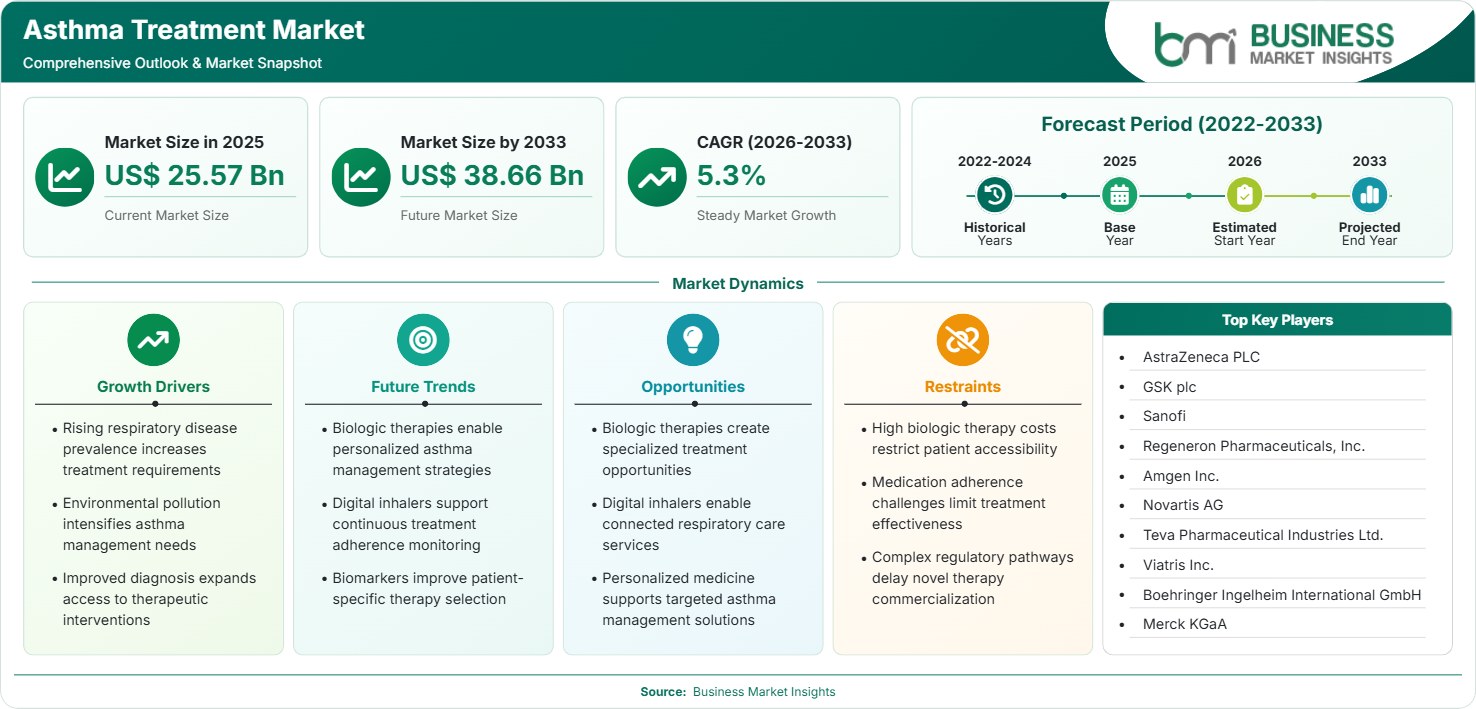
The Asthma Treatment Market size was valued at US$ 25.57 Billion in 2025 and is projected to reach US$ 38.66 Billion by 2033, growing at a CAGR of 5.3% during 2026–2033, driven by rising asthma burden, biologic adoption, inhaler innovation, improved diagnosis, and wider access to maintenance therapies.

Report Coverage
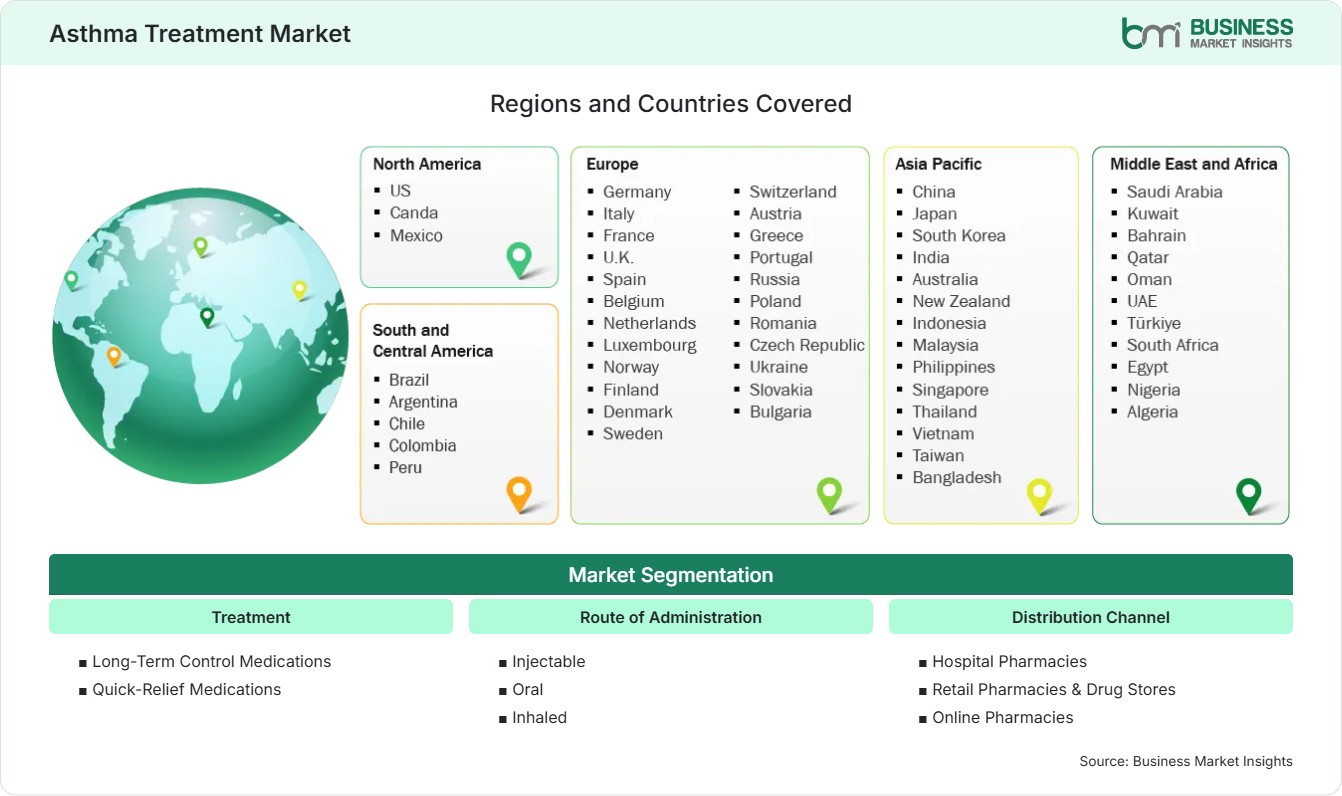
  • Treatment: Long-Term Control Medications, Quick-Relief Medications
  • Route of Administration: Injectable, Oral, Inhaled
  • Distribution Channel: Hospital Pharmacies, Retail Pharmacies & Drug Stores, Online Pharmacies
US$ 25.57 Bn Market size in 2025
US$ 38.66 Bn Market Size by 2033
5.3% CAGR, 2026 - 2033
2026-2033 Forecast Period

AI Overview

Asthma Treatment Market Summary

  • North America Region: 34%–38% share in 2025 and 5.0%–5.5% CAGR during 2026–2033 · Established biologic adoption, specialist care, reimbursement depth, inhaler innovation, and expanding pediatric indications support demand across severe and uncontrolled asthma populations. The US market benefits from established specialty care and biologic penetration, with 5.0%–5.5% CAGR during 2026–2033.
  • Fastest Growing Region: Asia Pacific · 19%–23% share in 2025 and 6.5%–7.2% CAGR during 2026–2033 · Expanding diagnosis, urbanization, pollution exposure, healthcare investment, generic inhaler availability, and improving specialist capacity are widening treatment access across major regional markets.
  • Leading Segment: Inhaled Route of Administration · 68%–73% share in 2025 and 5.0%–5.5% CAGR during 2026–2033 · Direct pulmonary delivery, established clinical pathways, combination inhalers, and continuing maintenance therapy requirements support dominant demand across patient populations and care settings.
  • High Growth Segment: Injectable Route of Administration · 8%–12% share in 2025 and 7.0%–8.0% CAGR during 2026–2033 · Biologic therapies, personalized treatment, severe asthma management, longer dosing intervals, and expanding self-administration options are increasing injectable utilization among appropriately selected patients.
  • Key Market Opportunity: Greater use of biomarker-guided treatment, long-acting therapies, biologics, combination inhalers, pediatric formulations, and digitally supported adherence programs can expand treatment coverage while addressing persistent undertreatment in emerging healthcare systems.
  • Major Market Players: AstraZeneca PLC, GSK plc, Sanofi, Regeneron Pharmaceuticals, Inc., Amgen Inc., Novartis AG, Teva Pharmaceutical Industries Ltd., Viatris Inc., Boehringer Ingelheim International GmbH, and Merck KGaA.
Strategic Insights

Asthma Treatment Market: Strategic Insights

Asthma Treatment Market Strategic Framework
FREE PDF
Request your free sample
Request free sample
Stakeholder View

Key Takeaways

  • The value chain extends from active pharmaceutical ingredient suppliers and formulation specialists to inhaler-device manufacturers, biologic developers, contract manufacturers, distributors, hospitals, pharmacies, and online channels. Device compatibility and manufacturing scale remain important competitive considerations.
  • Severe and uncontrolled asthma represents a commercially important area because treatment increasingly incorporates phenotype and biomarker assessment. Biologic therapies can command higher value per treated patient while addressing populations insufficiently controlled by conventional inhaled medicines.
  • Product development is moving toward longer dosing intervals, combination formulations, improved pulmonary deposition, self-administration, and targeted mechanisms involving IgE, IL-5, IL-4/13, and TSLP pathways.
  • Asia Pacific combines a large patient base with expanding healthcare infrastructure. Improving diagnostic capacity and broader availability of inhaled medicines can support volume growth even where premium biologic access remains limited.
  • Pharmaceutical companies continue allocating research resources toward respiratory immunology, biologics, and next-generation inhaled therapies. Pipeline expansion increasingly targets several inflammatory respiratory indications from common biological pathways.
  • Access, reimbursement, adherence, device usability, and physician familiarity can influence uptake as strongly as pharmacological differentiation, particularly for maintenance therapies requiring sustained patient engagement.
Geographic Outlook

Asthma Treatment Market Regional Highlights

North America Asthma Treatment Market

North America holds an estimated 34%–38% Asthma Treatment Market share in 2025 and is projected to expand at a 5.0%–5.5% CAGR through 2033. The region benefits from mature specialty care, extensive biologic availability, established reimbursement structures, advanced inhaler development, and strong clinical research activity. Severe asthma management is increasingly differentiated through phenotype and biomarker assessment. The US represents the largest national market within the region, supported by broad pharmaceutical availability and specialist networks. Regulatory expansion of biologic indications also supports demand.

  • Biologic adoption continues to broaden as targeted treatment becomes more integrated into severe asthma pathways and physicians use eosinophil, IgE, and FeNO information to support treatment selection.
  • Combination inhalers remain commercially important because maintenance treatment requires long-term disease control rather than reliance on rapid symptom relief alone.
  • Pediatric treatment is receiving greater attention as manufacturers expand evidence and regulatory indications for younger patients with severe or refractory disease.
  • Self-administration and longer dosing intervals can reduce treatment burden for selected patients while creating differentiation beyond mechanism of action.

US Asthma Treatment Market

The US accounts for approximately 27%–31% of the global Asthma Treatment Market in 2025 and is projected to register a 5.0%–5.5% CAGR during 2026–2033. The country combines high treatment availability with a sophisticated specialist network and substantial pharmaceutical research activity. Commercial demand spans controller inhalers, rescue medicines, combination products, and biologics. Competition increasingly depends on clinical differentiation, reimbursement, dosing convenience, pediatric evidence, and the ability to identify patients suitable for advanced therapies.

  • Biologics are increasingly positioned around distinct inflammatory pathways, allowing manufacturers to address severe asthma populations that remain uncontrolled despite conventional treatment.
  • Inhaled therapies continue to provide the broadest patient reach because they deliver medication directly to the respiratory tract and remain central to routine disease management.
  • The US regulatory environment also supports lifecycle expansion when manufacturers generate evidence across age groups and related inflammatory respiratory conditions.

Europe Asthma Treatment Market

Europe represents approximately 27%–31% of the Asthma Treatment Market in 2025 and is estimated to grow at a 4.5%–5.2% CAGR through 2033. Germany, the UK, France, Italy, and Spain form major demand centers, while Germany and the UK maintain substantial clinical and specialist infrastructure. The region emphasizes guideline-driven treatment, health-economic evaluation, and appropriate use of advanced therapies. Country-level reimbursement differences remain important, particularly for expensive biologics and newer delivery technologies.

  • Germany remains a major pharmaceutical market, with specialist respiratory services and broad availability of established inhaled treatments supporting demand.
  • The UK benefits from structured guideline development, while updated BTS/NICE/SIGN recommendations reinforce ICS-containing treatment and treatment escalation based on control.
  • France and Italy provide established markets for inhalers and specialty medicines, although reimbursement and procurement structures influence product uptake.
  • Spain and selected Central European markets offer additional growth as diagnosis and access to advanced treatment continue improving.

Asia Pacific Asthma Treatment Market

The Asia Pacific region accounts for roughly 19% to 23% of the Asthma Treatment Market in 2025 and is expected to grow at a CAGR of 6.5% to 7.2% through 2033. Countries like China, Japan, India, South Korea, and Australia constitute key markets, whereas India, China, and Southeast Asian economies provide volume potential. Factors such as urbanization, air pollution, improved diagnostics, growth in healthcare infrastructure, and the availability of generic inhalers drive the adoption of treatments.

  • China combines a large patient population with expanding specialty care, increasing pharmaceutical manufacturing capacity, and broader access to respiratory medicines.
  • Japan provides a mature market with established specialist care and growing use of advanced biologic therapies in appropriately selected severe asthma populations.
  • India represents an important volume market where improved diagnosis, inhaler awareness, affordability, and primary-care access can influence future treatment penetration.
  • Australia and South Korea offer established healthcare systems and relatively strong adoption of guideline-based respiratory treatment.

Rest of World Asthma Treatment Market

Rest of World represents approximately 11%–15% of the Asthma Treatment Market in 2025 and is projected to grow at a 5.5%–6.3% CAGR during 2026–2033. South and Central America are supported by expanding urban healthcare networks, while Brazil and Mexico remain major pharmaceutical markets. Middle Eastern markets, including Saudi Arabia and the United Arab Emirates, are increasing specialist respiratory capacity and introducing more structured approaches to severe asthma management.

  • Brazil represents a major South American opportunity, with demand shaped by population scale, public healthcare access, private insurance, and availability of established inhaled medicines.
  • Mexico provides an expanding market as diagnosis and respiratory specialist capacity improve, creating opportunities for both branded and generic treatment products.
  • Saudi Arabia is strengthening personalized severe-asthma management, including biomarker assessment and biologic selection within specialist care pathways.
  • The United Arab Emirates and neighboring Gulf markets provide premium opportunities for biologics and specialty respiratory medicines where reimbursement and specialist access support adoption.
Global Market Geography
FREE PDF
Request your free sample
Request free sample
Segment Analysis

Asthma Treatment Market Segmentation

Treatment

Treatment represents the major structure of the Asthma Treatment Market, with around 70%-75% comprising Long-Term Control Medications and 25%-30% of Quick-Relief Medications in 2025. There is a growing preference towards therapies that focus on inflammation, combination therapies, and personalized escalation in cases of uncontrolled asthma. Therefore, the scope of the Asthma Treatment Market includes both maintenance and acute symptom therapies.

  • Long-Term Control Medications: Controller therapies support sustained disease management through inhaled corticosteroids, combination inhalers, leukotriene modifiers, long-acting bronchodilators, and biologics for appropriately selected severe patients.
  • Quick-Relief Medications: Rapid symptom-relief products remain important for breakthrough symptoms, although guideline developments increasingly emphasize anti-inflammatory reliever strategies rather than bronchodilator-only approaches.

Route of Administration

The inhaled route accounts for around 68%-73% of the Asthma Treatment Market in 2025, due to direct drug delivery to the lungs, conventional medical practice, and product availability. Increasing importance is being attributed to injectables because biologics and oral drugs still have a role in certain therapy modalities.

  • Injectable: Injectable biologics address severe asthma phenotypes through targeted mechanisms and are increasingly differentiated by dosing interval, self-administration options, biomarker suitability, and evidence across patient groups.
  • Oral: Oral medicines provide convenient systemic administration and remain relevant in selected patients, although long-term treatment decisions consider efficacy, safety, and the availability of inhaled alternatives.
  • Inhaled: Inhaled medicines remain the principal delivery route because they provide direct airway exposure, support maintenance treatment, and include established corticosteroid, bronchodilator, and combination formulations.

Distribution Channel

The pharmacy channels remain vital to the Asthma Treatment Market due to patients' need for the repeated availability of both maintenance and reliever drugs. Hospital pharmacies play a significant role in specialist treatment, while retail pharmacies aid in regular prescriptions.

  • Hospital Pharmacies: Hospital pharmacies support specialist prescribing, initiation of biologics, severe asthma management, and treatment pathways requiring monitoring or multidisciplinary clinical oversight.
  • Retail Pharmacies & Drug Stores: Retail outlets provide broad access to established inhalers and oral medicines, making them important for recurring prescriptions and geographically distributed patient populations.
  • Online Pharmacies: Online channels improve convenience for repeat purchases and can support medication continuity where regulation, prescription systems, and logistics permit home delivery.
Market Forces

Asthma Treatment Market Dynamics

Key Market Drivers

Increasing Global Asthma Burden and Diagnosis

Asthma Treatment Market growth is supported by the large and persistent global patient population. WHO estimates that 363 million people were affected in 2023, while 442,000 deaths were attributed to asthma. The issues of underdiagnosis and undertreatment are highly significant for low- and lower-middle-income countries and offer many opportunities for treatment access. The risk factors may include air pollution, tobacco smoking, allergens, urbanization, work-related exposures, and respiratory infections. Increasing recognition of these risk factors is strengthening demand for diagnosis, maintenance therapy, and patient education. The treatment environment is also becoming more structured as guidelines emphasize inhaled corticosteroid-containing therapy and personalized escalation. Better identification of uncontrolled disease can therefore expand the treated population and increase demand for both established inhalers and advanced specialty therapies.

Shift Toward Targeted and Biomarker-Guided Therapies

The increasing use of phenotype and biomarker information is reshaping treatment decisions for severe asthma. Type 2 inflammation can involve pathways associated with IgE, IL-5, IL-4, IL-13, and TSLP, creating opportunities for mechanism-specific biologics. The clinical literature suggests that about 5% to 10% of patients with asthma suffer from severe asthma despite the use of optimized inhaled medications. The patient segment is commercially important as repeated episodes of exacerbations and exposure to corticosteroids can lead to escalation of treatment among specialists. Using biomarkers such as eosinophils, FeNO, IgE, and patient history allows doctors to select the right patients for treatment. With growing evidence across different patient segments and comorbidities, manufacturers can expand the addressable market and personalize treatment. These developments support Asthma Treatment Market trends toward precision treatment and longer-duration specialty products.

Evolution of Inhaled Combination Therapy

Inhalation therapy still matters a lot, as it delivers active substances directly into the lungs and improves management. Modern treatment guidelines have focused more on inhaled corticosteroid-based therapy rather than therapies that rely solely on bronchodilators. According to the 2024 GINA update, ICS-based therapies should be used by adults and adolescents, and low-dose ICS/formoterol is considered the best reliever strategy in the Track 1 pathway. Similar strategies can be found in BTS/NICE/SIGN guidelines. The guidelines call upon producers to develop better combination therapies, dose unification, inhaler ease of use, and improved compliance. The development of devices has been one of the major areas of competitiveness, alongside pharmaceutical developments. The product portfolios include innovations such as fixed-dose combination therapies and extended-release formulations.

Key Market Opportunities

Expansion of Biologics Into Underserved Severe Asthma Populations

Biologic treatment provides an avenue for uncontrolled patients despite optimized inhaled therapy. The business opportunity is not only in the existing market but also beyond it, as the company's diagnostic capabilities improve and more specialist centers gain experience with biomarker-directed treatments. The longer dosing schedule makes treatment less frequent, thereby increasing patient compliance; on the other hand, self-administration enables some treatment to be delivered in the home setting. Pipeline developments in the recent past include companies exploring new pathways and indications within the respiratory space. GSK, for instance, is developing depemokimab for the treatment of severe asthma. Such innovation can increase treatment choice while creating differentiated specialty portfolios.

Growth of Affordable and Accessible Inhaled Medicines

The Asthma Treatment Market Forecasts will be increasingly driven by access rather than innovation alone. According to WHO data, lifesaving bronchodilators could be obtained from public primary health care facilities in fewer than two-thirds of low- and low-middle-income countries in 2023, whereas steroid inhalers could be found in fewer than half of such countries. This access problem represents a significant opportunity for companies and health care organizations to increase inhaler availability, expand manufacturing and distribution channels, and improve patient education. The presence of generics will help lower prices, while standardization of delivery systems and product combinations will make prescribing easier.

Longer-Acting Products and Patient-Centered Delivery Models

Dosing flexibility, user administration, simplified inhaler use, and patient services could provide product differentiation in a market where compliance remains an issue. Biologic drug companies are developing extended-duration delivery methods, whereas inhaler companies are advancing dose delivery and convenience. There is also a chance to provide adherence support through connectivity technologies, although digital inhalers are not recommended in all cases. Companies have to demonstrate their added clinical or functional value to consumers rather than incorporating technology without any treatment advantage. A patient-centric approach could involve education, refills, specialist oversight, and treatment reminder services to enhance adherence.

Market Restraints and Challenges

High Cost and Unequal Access to Advanced Therapies

Factor: Specialty drugs, such as biologics, might incur much greater costs compared to already existing inhaled agents, while reimbursement practices and specialist availability differ greatly from one country to another. Impact: Uneven access may prevent further drug introduction, even if patients meet all clinical criteria, especially in low-budget healthcare settings. This issue hinders the expansion of innovative treatments beyond well-developed markets. Diagnostics can serve as yet another obstacle to market entry, since biomarker testing and specialist evaluation are required for proper selection of patients. Thus, there is a need for drug manufacturers to show their value in terms of reduction of exacerbations, prevention of hospitalization, steroid-sparing properties, and better management of the disease. Utilization controls, such as prior authorization, could be used by payers.

Adherence, Inhaler Technique, and Treatment Persistence

Factor: The management of asthma requires consistent effort from the patient, proper inhaler technique, accurate dosing, and ongoing reassessment, as the condition is variable and may be underdiagnosed in terms of controller use. Impact: Poor adherence can reduce medication efficacy and hinder the commercialization of clinical efficacy. The complexity of the devices involved poses an additional obstacle when patients use more than one inhaler or alternate among several delivery methods. Current trends in medicine place greater emphasis on patient education, writing action plans, reviewing treatment, and escalation. For medication manufacturers, patient usability and support become additional parameters alongside drug formulation.

Company Analysis

Competitive Landscape

The Asthma Treatment Market analysis indicates competition across inhaled therapies, biologics, combination products, and respiratory delivery technologies. Major participants are using lifecycle management, clinical differentiation, expanded indications, and pipeline investment to strengthen respiratory portfolios. AstraZeneca identifies Fasenra, Tezspire, Airsupra, Symbicort, and other respiratory medicines within its portfolio, while GSK continues to develop Nucala and depemokimab for inflammatory respiratory diseases.

Company Name

Overview

Products and Services relevant to this market

AstraZeneca PLC

Global biopharmaceutical company with an established respiratory franchise and extensive biologic pipeline.

Fasenra, Tezspire, Symbicort, Airsupra, Pulmicort, respiratory biologics, inhaled therapies, and clinical development.

GSK plc

Major pharmaceutical company with a long-standing respiratory portfolio and biologic capabilities.

Nucala, Ventolin, inhaled respiratory medicines, depemokimab development, and respiratory clinical research.

Sanofi

Global healthcare company with a major immunology franchise and targeted respiratory biologic portfolio.

Dupixent and respiratory immunology development targeting type 2 inflammation.

Regeneron Pharmaceuticals, Inc.

Biopharmaceutical company with significant antibody discovery and development capabilities.

Dupixent collaboration with Sanofi and antibody-based respiratory development.

Amgen Inc.

Biotechnology company with biologic development and manufacturing capabilities across specialty diseases.

Tezspire collaboration with AstraZeneca and respiratory immunology development.

Novartis AG

Global pharmaceutical company with respiratory and specialty medicine experience.

Respiratory medicines, biologic development capabilities, and specialty-care portfolio.

Teva Pharmaceutical Industries Ltd.

Global pharmaceutical company with branded and generic medicines and respiratory delivery expertise.

Inhaled respiratory products, generic medicines, and device-enabled respiratory therapies.

Viatris Inc.

Global healthcare company with broad generic, branded, and complex medicine capabilities.

Generic respiratory medicines, inhaled products, and pharmaceutical distribution capabilities.

Boehringer Ingelheim International GmbH

Privately held pharmaceutical company with extensive respiratory research and commercial expertise.

Respiratory inhalers, bronchodilator combinations, device technologies, and respiratory clinical development.

Merck KGaA

Science and technology company with pharmaceutical capabilities and a diversified healthcare portfolio.

Specialty pharmaceutical research, development capabilities, and healthcare technologies relevant to respiratory medicine.

Trust & Transparency

Research Methodology

The market analysis combines proprietary research with secondary data from government agencies, company disclosures, regulatory filings, industry databases and expert interviews. Market estimates are validated through data triangulation, cross-market benchmarking and analyst review.

View Full Research Methodology

Questions Answered

Frequently Asked Questions

What technologies are shaping future respiratory treatment?

The main technology directions include targeted biologics, longer-acting medicines, improved inhaler devices, combination formulations, biomarker-guided prescribing, and patient-support systems. Manufacturers are increasingly combining pharmacological innovation with delivery and adherence strategies.

How can emerging markets expand access to asthma medicines?

Expansion can be supported through affordable inhalers, generic manufacturing, stronger primary-care diagnosis, reliable pharmacy distribution, specialist training, reimbursement development, and patient education. WHO continues to identify underdiagnosis, undertreatment, and limited medicine availability as important challenges.

Why are biologics becoming more important in severe asthma?

Biologics can target specific inflammatory pathways associated with severe asthma. Biomarker assessment can help clinicians identify suitable patients, while newer products increasingly focus on dosing convenience, self-administration, broader age groups, and longer treatment intervals.

What role do inhaled therapies play in asthma management?

Inhaled therapies remain central because they deliver medicines directly to the airways. Inhaled corticosteroids, bronchodilators, and combination products form the foundation of treatment for many patients, while advanced therapies are generally reserved for appropriately selected populations.

What factors are influencing the Asthma Treatment Market report beyond patient population growth?

Growing adoption of biologics, biomarker-guided treatment, combination inhalers, longer dosing intervals, pediatric indications, and improved diagnosis are influencing value creation. Access and reimbursement remain important because advanced therapies require specialist evaluation and can involve substantially higher treatment costs.

Access the Full Asthma Treatment Market Report

Get segment-level forecasts, regional estimates, competitive benchmarking, company profiles and downloadable Excel datasets.

Access the full Asthma Treatment Market Report
350 pages PDF & Excel | 2026-09-23
Similar Research

Related Market Reports