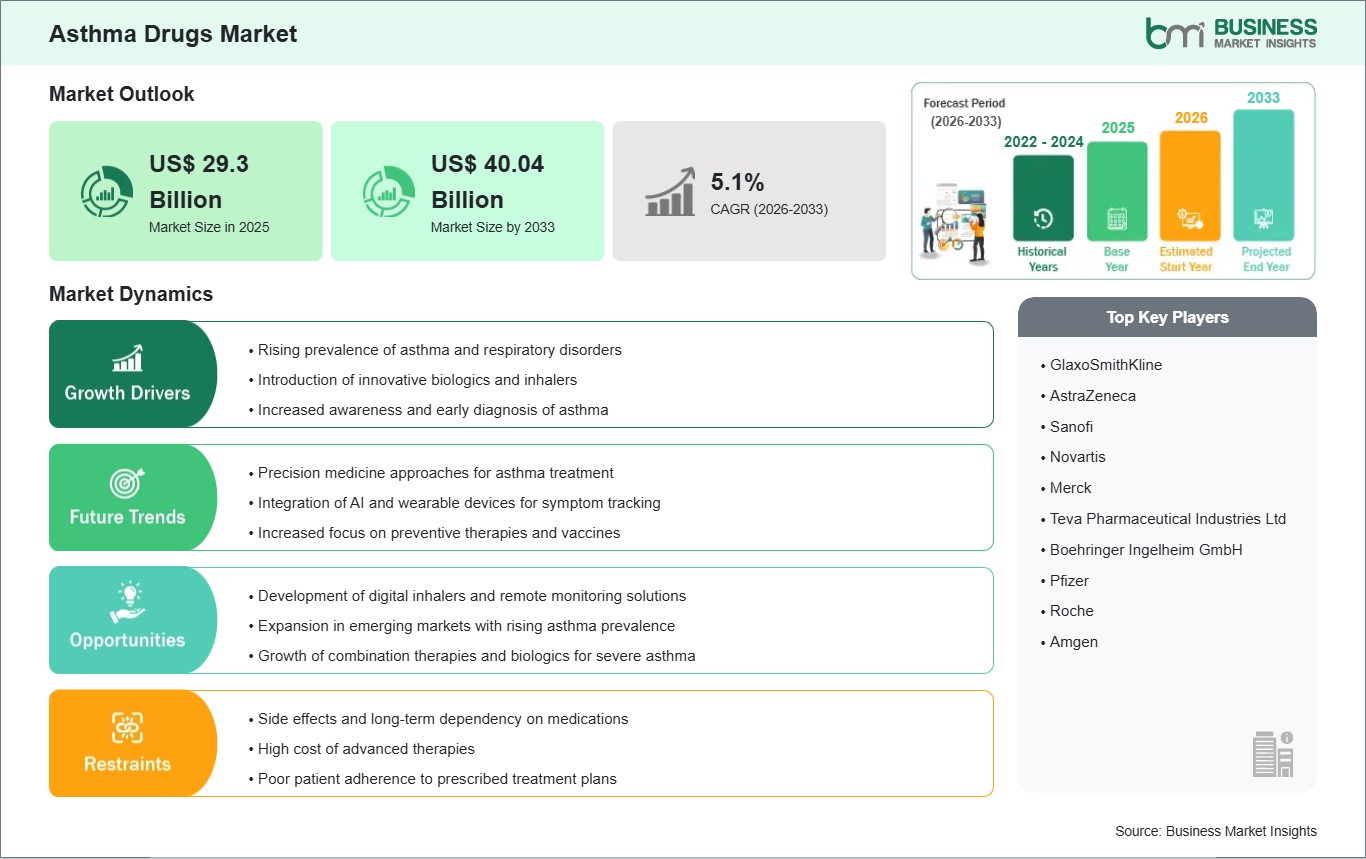
The Asthma Drugs Market size is expected to reach US$ 40.04 billion by 2033 from US$ 29.30 billion in 2025. The market is estimated to record a CAGR of 5.1% from 2026 to 2033.
Asthma medications are pharmaceutical agents that have the function of controlling and managing asthma, which is a long-lasting disease of the respiratory system manifested by the inflammation of the airways, the contraction of the bronchi, and difficulty in breathing. Among these medications are bronchodilators that bring instant relief by relaxing muscles around the airways and anti-asthma or anti-inflammatory agents like corticosteroids and leukotriene modifiers that slowly but surely eliminate inflammation in the airways over a long period of time.
The worldwide asthma drugs market is undergoing a slow but sure expansion caused by the increased incidence of asthma, the pollution of the environment, and more people being aware of their respiratory health. The involvement of new technologies in inhalers, the application of biologics, and personalized treatment are changing the whole scenario in terms of therapeutic area, thereby making it easier for the patients to adhere and also improve their results. North America and Europe are the two regions that together account for a major portion of the asthma drugs market because of their high-tech medical services and high rates of diagnosis. At the same time, the Asia-Pacific is seen as a very fast-growing area that is being spurred on by urbanization, increasing pollution, and healthcare accessibility. The market's movement is closely linked to government regulations, price wars, and the presence of cheaper generic drugs, thus making it necessary for pharmaceutical firms to allocate budgets for the research and development of new medicines. All in all, the asthma drugs market continues to be vibrant, thanks to ongoing innovation, the increase in the number of patients, and the worldwide aim to improve respiratory disease management and quality of life.

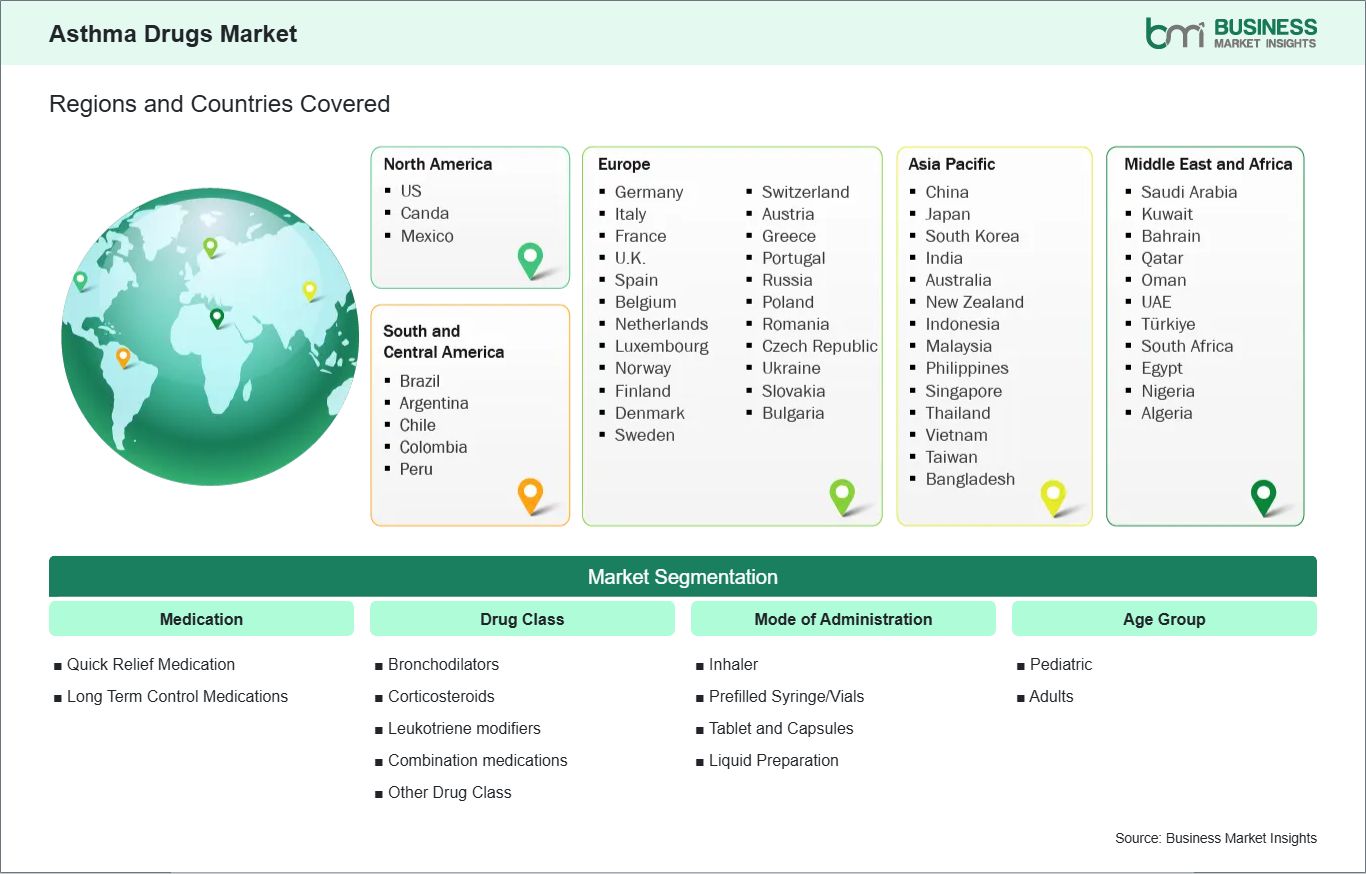
Key segments that contributed to the derivation of the asthma drugs market analysis are medication, drug class, mode of administration, age group, and distribution channel.
Around the globe, asthma is a condition that affects a couple of hundred million people, and this number keeps increasing every year because of urbanization, environmental pollution, and changing lifestyles. Besides, higher diagnosis rates and patients’ increased awareness of effective management of their condition are leading to a rise in demand for traditional and modern asthma medications, such as inhaled corticosteroids, combination therapies, and biologics. Among all the drug classes, biologics have been the most significant due to their approvals rising by 14% from 2023 to 2024, thereby satisfying the need for severe and eosinophilic asthma treatment and helping doctors in providing more personalized and correct treatments. Moreover, the use of technology in drug delivery — such as smart inhalers and digital monitoring tools — has improved patient compliance, dosage precision, and even treatment outcomes, thus creating a need for more asthma medications. The combined trends of increasing patient population, technological advancements, and optimized treatment are the factors that are responsible for the strong demand for global asthma therapeutics.
A significant opportunity in the asthma drugs market lies in the expansion and commercialization of innovative biologics and combination therapies that offer more targeted and effective treatment options. Recently, several leading regulatory bodies, which include the European Medicines Agency, have been supporting patient compliance and reducing hospitalizations as they might change standard care practices in severe asthma management. Moreover, the pipeline of combination and biosimilar biologics is getting wider; about 20–25% of new biologics are to be existing monoclonal antibodies, which can help cut down the costs of treatment and make it possible for more patients to be treated in the long run. Dual and triple combination inhalers with fixed doses are also being introduced into new markets, thereby increasing convenience and therapeutic efficacy. Smart inhaler attachments and digital health integration present further opportunities through better compliance and remote monitoring. These developments alone signify that there is a rising cash cow in the market that is pushed by the innovations, the expansion of indications, and the upsurge in the global adoption of cutting-edge respiratory therapies.
By medication, the asthma drugs market is bifurcated into quick relief medication, long term control medications. The long term control medications segment dominated the market in 2025. Long-term control medications lead the market as they are essential for managing chronic inflammation in asthma patients. Unlike quick-relief drugs, which address immediate symptoms, long-term therapies such as inhaled corticosteroids and leukotriene modifiers prevent frequent exacerbations and improve quality of life. The growing emphasis on proactive asthma management, adherence to treatment guidelines, and rising awareness among healthcare providers and patients about preventing severe attacks contribute to their dominant position in the market.
By drug class, the market is categorized into bronchodilators, corticosteroids, leukotriene modifiers, combination medications, other drug class. The corticosteroids segment held the largest share of the market in 2025. Corticosteroids are the leading drug class due to their potent anti-inflammatory properties, which effectively reduce airway inflammation, a root cause of asthma symptoms. Inhaled corticosteroids, in particular, are widely prescribed as first-line therapy for persistent asthma, ensuring better disease control with minimal systemic side effects. Their efficacy in preventing exacerbations, combined with widespread clinical adoption and guideline recommendations, has solidified corticosteroids as the most preferred treatment option among both physicians and patients globally.
By mode of administration, the market is segmented into inhaler, prefilled syringe/vials, tablet and capsules, liquid preparation. The inhaler segment held the largest share of the market in 2025. Inhalers dominate the mode of administration segment because they deliver medication directly to the lungs, ensuring rapid onset of action and improved therapeutic efficiency. They are portable, convenient, and minimize systemic side effects compared to oral or injectable forms. Patient preference for ease of use, combined with increasing adoption of metered-dose and dry powder inhalers, supports this trend. Additionally, healthcare guidelines recommend inhalation therapy as the primary route for both quick-relief and long-term asthma management, reinforcing their leading position.
By age group, the market is bifurcated into pediatric, adults. The adults segment held a larger share of the market in 2025. The adult segment leads due to a higher prevalence of diagnosed asthma cases in this population, coupled with greater awareness and access to healthcare services. Adults are more likely to seek treatment, adhere to prescribed therapies, and manage chronic conditions proactively. Lifestyle factors such as exposure to pollution, smoking, and occupational triggers also contribute to increased asthma incidence in adults, driving demand for both maintenance and rescue medications. Pediatric asthma management, while significant, remains comparatively smaller due to age-specific dosing limitations and parental monitoring.
By distribution channel, the asthma drugs market is segmented into hospital pharmacies, retail pharmacies, online pharmacies. The retail pharmacies segment dominated the market in 2025. Retail pharmacies are the leading distribution channel because they provide easy accessibility, wide geographic coverage, and convenience for patients. They cater to both prescription and over-the-counter asthma medications, allowing timely access for maintenance therapy and emergency relief drugs. Strong relationships between pharmaceutical companies and retail chains, coupled with increasing urbanization and consumer preference for local pharmacy purchases, further boost their dominance. Retail pharmacies also offer personalized guidance and counseling, enhancing patient adherence and trust in asthma treatment.

| Report Attribute | Details |
|---|---|
| Market size in 2025 | US$ 29.3 Billion |
| Market Size by 2033 | US$ 40.04 Billion |
| Global CAGR (2026 - 2033) | 5.1% |
| Historical Data | 2022 - 2024 |
| Forecast period | 2026-2033 |
| Segments Covered | By Medication
|
|
Regions and Countries Covered
| |
| North America | US, Canada, Mexico |
| Europe | Belgium, Austria, Finland, Denmark, Greece, Poland, Romania, Russia, Ukraine, Czech Republic, Slovakia, Bulgaria, Italy, Luxembourg, Germany, Switzerland, France, Netherlands, Norway, Portugal, Spain, Sweden, United Kingdom |
| Asia-Pacific | Australia, China, India, Japan, South Korea, Indonesia, Malaysia, Philippines, Singapore, Thailand, Vietnam, Bangladesh, New Zealand, Taiwan |
| South and Central America | Brazil, Argentina, Peru, Chile, Colombia |
| Middle East and Africa | Bahrain, Kuwait, Oman, Qatar, Saudi Arabia, United Arab Emirates, Turkiye, South Africa, Egypt, Algeria, Nigeria |
| Market leaders and key company profiles |
|
The " Asthma Drugs Market Size and Forecast (2022–2033)" report provides a detailed analysis of the market covering below areas:
The geographical scope of the asthma drugs market report is divided into five regions: North America, Asia Pacific, Europe, Middle East & Africa, and South & Central America. The asthma drugs market in Asia Pacific is expected to grow significantly during the forecast period.
The Asia-Pacific asthma drugs market is segmented into China, Japan, South Korea, India, Australia, New Zealand, Indonesia, Malaysia, the Philippines, Singapore, Thailand, Vietnam, Taiwan, Bangladesh, and the Rest of Asia. The Asia-Pacific asthma drugs market is experiencing robust growth due to a number of interrelated factors. One of the biggest reasons for this is the growing prevalence of asthma, which is mainly due to urbanization, industrialization, and the decline of air quality; to name a few, China is one of the countries where the asthma rates have been rising drastically over the recent decades, indicating a greater need for effective specialists. High pollution levels in the most populated cities in India, China, and Southeast Asia aggravate respiratory problems, and thus, more patients are left to seek medical treatments.
Secondly, the diagnosis and medication uptake have been encouraged by the improvements in healthcare systems and accessibility. The building of more hospitals, setting up specialty pulmonary clinics, and the better distribution of inhalers and biologics have made healthcare accessible even in previously neglected areas. Government projects and health awareness campaigns aimed at early diagnosis and asthma management have also created a larger pool of patients and doctors who are aware of the proper treatment and, consequently, increase treatment rates and awareness among patients and clinicians alike.
Last but not least, the rise of middle-class incomes and healthcare spending allows both standard and advanced therapies to be more affordable, while pharmaceutical investments — such as increased inhaler manufacturing and local production — create and support supply and availability. It is the combination of these trends that supports the strong growth momentum of the asthma drugs market in the Asia-Pacific region.

The asthma drugs market is evaluated by gathering qualitative and quantitative data post primary and secondary research, which includes important corporate publications, association data, and databases. A few of the key developments in the asthma drugs market are:
The Asthma Drugs Market is valued at US$ 29.3 Billion in 2025, it is projected to reach US$ 40.04 Billion by 2033.
As per our report Asthma Drugs Market, the market size is valued at US$ 29.3 Billion in 2025, projecting it to reach US$ 40.04 Billion by 2033. This translates to a CAGR of approximately 5.1% during the forecast period.
The Asthma Drugs Market report typically cover these key segments-
The historic period, base year, and forecast period can vary slightly depending on the specific market research report. However, for the Asthma Drugs Market report:
The Asthma Drugs Market is populated by several key players, each contributing to its growth and innovation. Some of the major players include:
The Asthma Drugs Market report is valuable for diverse stakeholders, including:
Essentially, anyone involved in or considering involvement in the Asthma Drugs Market value chain can benefit from the information contained in a comprehensive market report.
Please tell us your area of interest
(Market Segments/ Regions and Countries/ Companies)