Market Summary
Executive Summary and Global Market Analysis
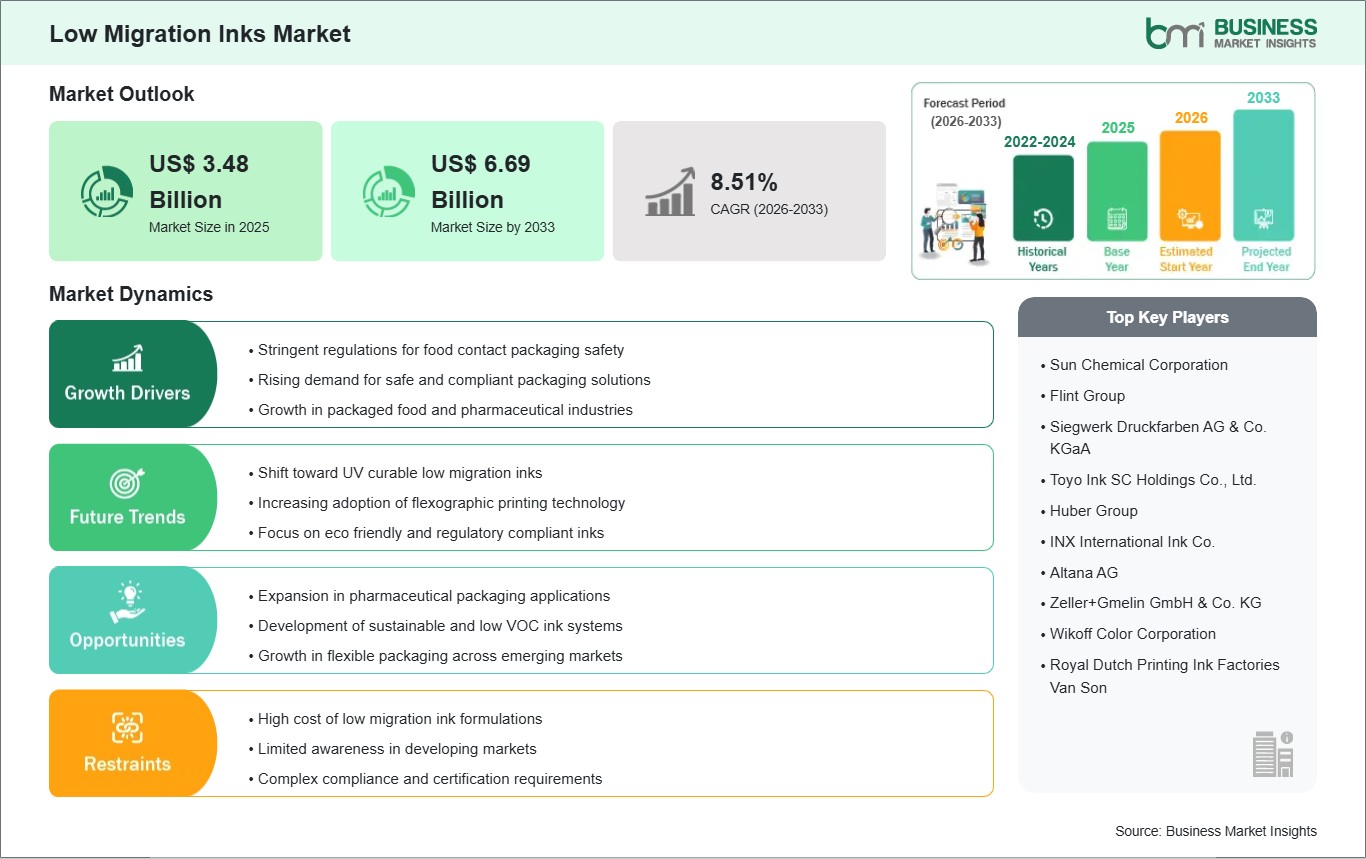
The low migration inks market is experiencing steady growth driven by increasing demand for safe and compliant packaging solutions across food and pharmaceutical industries. These inks are specifically formulated to reduce the risk of chemical migration from packaging materials into products, ensuring consumer safety and regulatory compliance. The rising consumption of packaged goods and the growing focus on product quality are key factors supporting market expansion.
The market is segmented by printing process and end user, with strong demand from flexographic printing and food and beverage applications. Technological advancements in ink formulation, including UV curable and environmentally friendly solutions, are enhancing performance and sustainability. Despite challenges related to higher costs and complex compliance requirements, the market continues to grow due to increasing regulatory pressure and consumer awareness. Expanding applications in pharmaceutical packaging and the shift toward flexible packaging solutions are expected to create additional growth opportunities, positioning low migration inks as a critical component in modern packaging systems.
Segment Analysis
Low Migration Inks Market Segmentation
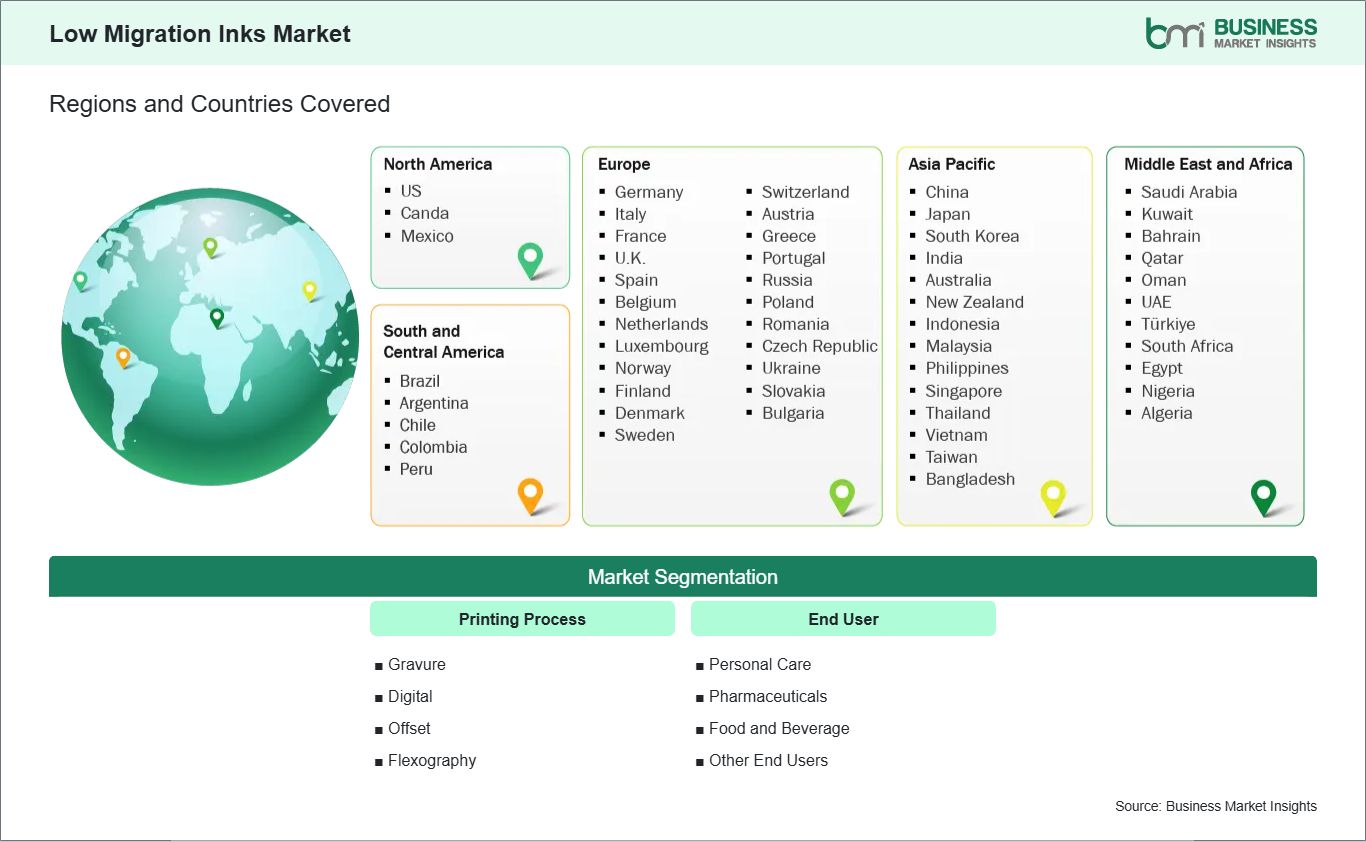
Key segments that contributed to the derivation of the Low Migration Inks market analysis are printing process and end user.
- By printing process, the low migration inks market is segmented into Gravure, Digital, Offset, and Flexography. The Flexography segment dominated the market in 2025.
- By end user, the low migration inks market is segmented into Personal Care, Pharmaceuticals, Food and Beverage, and Other End Users. The Food and Beverage segment dominated the market in 2025.
Market Forces
Low Migration Inks Market Drivers and Opportunities
Stringent regulations for food contact packaging safety
One of the major drivers of the low migration inks market is that there are stringent regulations in place for food contact packaging safety. This is because food products in different regions have regulatory bodies that have set standards for the amount of harmful materials that should be transferred from the packaging materials to consumable food products. Therefore, low migration inks have been developed in order to ensure that there is low migration of chemical components in the food products. This is especially true in today’s global market where food products have to be transported over long distances.
There are also stringent regulations and guidelines set by authorities that ensure the manufacturers of packaging materials adhere to safety standards related to ink composition, curing agents, and packaging integrity. This is leading to an increasing trend of moving towards low migration ink systems to ensure compliance with regulations and avoid product recall issues. The rise in demand for packaged and processed food products is also creating more opportunities in the market for safe printing materials. Moreover, the rise in awareness of food safety and transparency is also leading to an increase in the demand for quality ink systems in the food packaging sector.
Expansion in pharmaceutical packaging applications
One of the major growth prospects for the market is the increased demand for low migration inks in pharmaceutical packaging due to the need for product safety and regulatory compliance in the pharmaceutical industry. Pharmaceutical packaging requires strict material interaction controls to prevent contamination, which may impair drug efficacy and safety. Low migration inks play an important role in pharmaceutical packaging in order to ensure that information printed on packaging does not contaminate the product, especially in applications like blister packaging, labels, and flexible packaging.
With an ever-expanding pharmaceutical industry, especially with the rising demand for pharmaceutical products, vaccines, and healthcare products, the need for packaging solutions is also rising. Inks with low migration properties are ensuring better label clarity, durability, and resistance to environmental conditions, which are safe for use. Advances in technology are also enhancing the properties of inks, such as adhesion, curing rates, and chemical resistance, which are suitable for pharmaceutical products. This is creating an excellent opportunity for companies to manufacture specialized inks for healthcare products, which is an essential component of ensuring safety and compliance.
Size and Share Analysis
Low Migration Inks Market Size and Share Analysis
The global Low Migration Inks market is experiencing steady growth, with market size and share analysis reflecting evolving treatment preferences and competitive dynamics among key players. The report evaluates important subsegments categorized within printing process and end user highlighting their respective contributions to overall market performance.
By printing process, the Flexography subsegment dominated the market in 2025 due to its widespread use in packaging applications, compatibility with various substrates, cost efficiency, and ability to deliver high-speed printing with consistent ink transfer for flexible packaging.
By end user, the Food and Beverage subsegment dominated the market in 2025 due to stringent packaging safety regulations, high consumption of packaged foods, and increasing demand for contamination-free printing solutions that prevent ink migration into consumable products.
Report Coverage
Low Migration Inks Market Report Coverage and Deliverables
The "Low Migration Inks Market Size and Forecast (2022 - 2033)" report provides a detailed analysis of the market covering below areas:
- Low Migration Inks market size and forecast at the regional and country levels for segments covered under the scope
- Low Migration Inks market trends, as well as drivers, restraints, and opportunities
- Low Migration Inks market analysis covering key trends, regional framework, major players, regulations, and recent developments
- Industry landscape and competition analysis covering market concentration, heat map analysis, prominent players, and recent developments for the Low Migration Inks market
- Detailed company profiles, including SWOT analysis
Geographic Insights
Low Migration Inks Market Geographic Insights
The geographical scope of the Low Migration Inks market report is divided into: North America, Asia Pacific, Europe, Middle East & Africa, and South & Central America. North America held the largest share in 2025.
North America dominates the low migration inks market due to its strict regulatory framework and high awareness regarding food and pharmaceutical safety. The region has well-established guidelines governing packaging materials, which has led to widespread adoption of low migration inks across various applications. Strong presence of packaging manufacturers and advanced printing technologies further supports market growth in the region.
In addition, increasing demand for packaged food, beverages, and healthcare products is driving the need for safe and compliant packaging solutions. Companies in North America are actively investing in research and development to improve ink formulations and meet evolving regulatory requirements. The growing trend toward sustainable and environmentally friendly packaging is also influencing the adoption of low migration inks. With continuous innovation and strong regulatory support, the region is expected to maintain its leading position in the global market.
Industry Activity
Recent Developments
The Low Migration Inks market is evaluated by gathering qualitative and quantitative data post primary and secondary research, which includes important corporate publications, association data, and databases. A few of the key developments in the Low Migration Inks market are:
- In July 2025, Sun Chemical, announced the launch of its SunCure EcoPlast UV offset ink series for plastic cup decoration, featuring low migration properties along with high adhesion and fast curing for food-safe packaging applications.
- In September 2025, Siegwerk, announced the introduction of its latest low-migration ink series for labels, shrink sleeves, and flexible packaging at Labelexpo Europe 2025, aimed at improving recyclability and compliance with food packaging regulations.
- In January 2026, Sun Chemical, announced its expanded portfolio of GIO-compliant inks and coatings, including low migration solutions, to support packaging manufacturers in meeting the German Ink Ordinance requirements for food safety.
Trust & Transparency
Research Methodology
The market analysis combines proprietary research with secondary data from government agencies, company disclosures, regulatory filings, industry databases and expert interviews. Market estimates are validated through data triangulation, cross-market benchmarking and analyst
review.
View Full Research Methodology
Key Sources Referred:
American Chemistry Council (ACC)International Council of Chemical Associations (ICCA)European Chemical Industry Council (Cefic)China National Building Materials Group (CNBM)Indian Minerals & Granite Exporters Association (IMGEA)Japan Mining Industry Association (JMIA)Brazilian Mining Association (IBRAM)Gulf Petrochemicals and Chemicals Association (GPCA)Company WebsitesCompany Annual ReportsCompany Investor Presentations