Market Summary
Executive Summary and Global Market Analysis
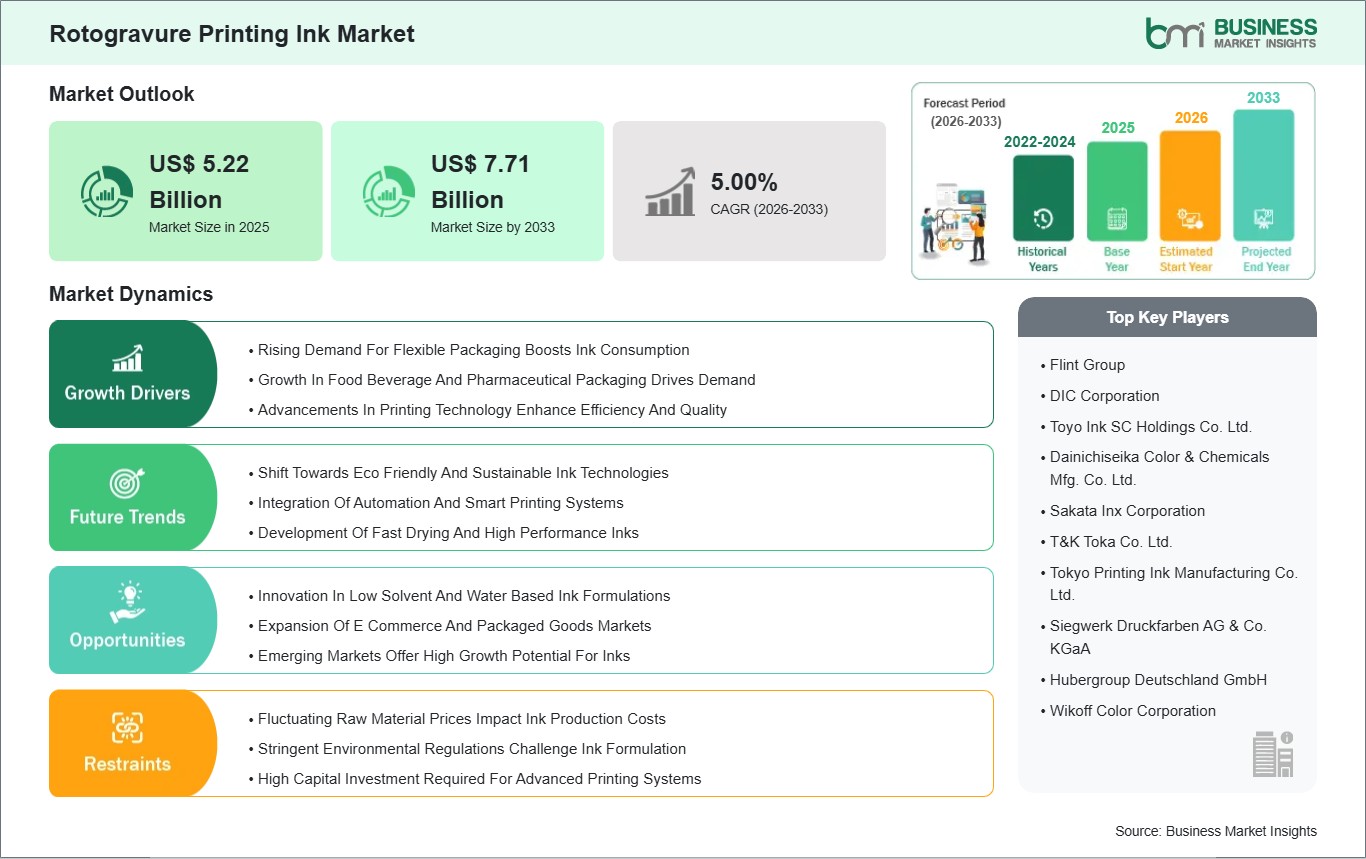
The global rotogravure printing ink market has been a vital part of the high-volume printing industry, especially in sectors where image quality and efficient production at large scales are of critical importance. Rotogravure inks are widely used in flexible packaging, publication printing, and decorative laminate applications owing to their ability to provide sharp images, efficient ink transfer, and excellent color reproduction at high speeds. The rising need for packaged consumer items, especially in food, beverage, and personal care categories, has significantly improved the use of rotogravure printing inks globally.
The major factor contributing to the growth of the rotogravure printing ink market is the growth of packaging industries around the world, driven by changing consumption habits and growth of organized retail and e-commerce platforms. Flexible packaging has been and continues to remain the major application of rotogravure inks, driven by the need for visual differentiation and durability in competitive retail environments. Packaging needs to keep its visual attractiveness and structural strength during complex supply chain operations because products need these two elements to remain intact. High-performance inks have become essential for packaging because products in supply chains need to maintain their visual appeal and their packaging needs to stay intact during shipping.
The development of better inks which stick better and dry faster and work with various plastics and laminates has been made possible by new printing technologies and substrate materials. Manufacturers have started to make sustainability their main priority which has led them to investigate water-based and low-solvent and bio-based product formulations that meet environmental standards and their sustainability objectives. The market observes growth drivers but it experiences particular challenges that prevent its expansion. Any changes in raw material prices which include pigments and resins and solvents will directly affect the company's pricing structure and its ability to make profits. Manufacturing companies need to develop new product formulations because environmental regulations specify limits on solvent emissions which require them to invest money into research projects and compliance activities.
The global packaging industry keeps expanding while companies create environmentally friendly ink products which will maintain persistent demand for rotogravure printing inks in the future.
Segment Analysis
Rotogravure Printing Ink Market Segmentation
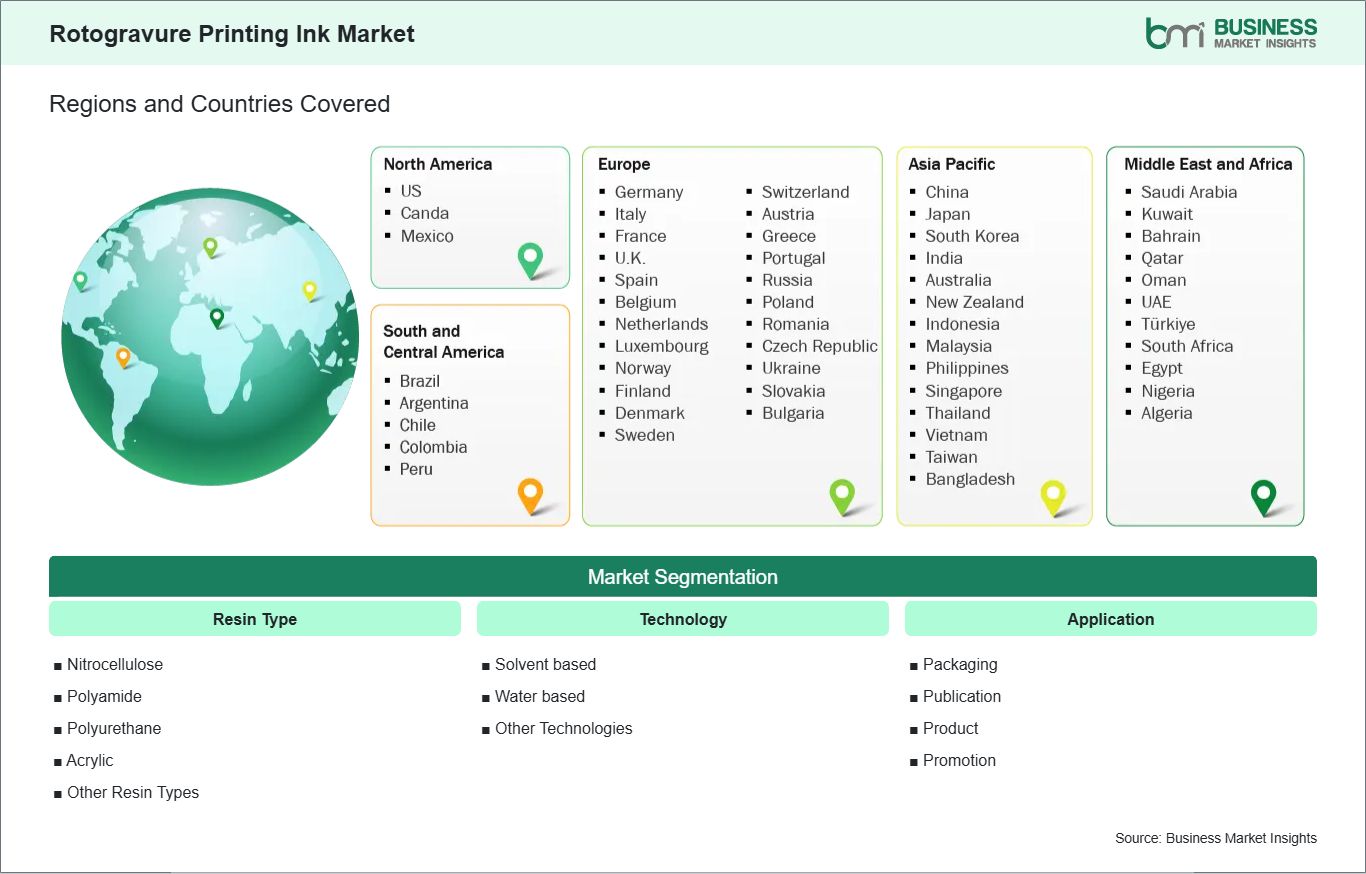
Key segments that contributed to the derivation of the rotogravure printing ink market analysis are resin type, technology, and application.
- By resin type, the rotogravure printing ink market is segmented into nitrocellulose, polyamide, polyurethane, acrylic, others. The nitrocellulose segment dominated the market in 2025.
- Based on technology, the rotogravure printing ink market is categorized into solvent based, water based, others. The solvent based segment dominated the market in 2025.
- In terms of application, the rotogravure printing ink market is categorized into packaging, publication, product, promotion. The packaging segment dominated the market in 2025.
Market Forces
Rotogravure Printing Ink Market Drivers and Opportunities
Rising Demand For Flexible Packaging Boosts Ink Consumption
The global rotogravure printing ink market is strongly supported by the increasing demand for flexible packaging across food, beverage, personal care, and pharmaceutical industries. Flexible packaging formats such as pouches, laminates, and wraps require high‑quality gravure inks that can deliver sharp graphics, vivid colors, and strong adhesion to films and polymers, which enhances brand appeal at the retail level. In regions like Asia Pacific and Latin America, rapid growth in packaged foods has led manufacturers to prefer rotogravure printing for its consistency in high‑speed, high‑volume production.
In North America and Europe, where consumer preferences emphasize convenience and sustainability, flexible packaging has become a preferred alternative to rigid containers. This shift has prompted brand owners to invest in advanced ink systems that maintain durability while supporting moisture barriers and recyclable materials. Even in emerging markets, small and mid‑tier manufacturers are adopting rotogravure technology because it balances production efficiency with print quality. As packaging converters expand capacity to meet global retail and export demand, the requirement for reliable, high‑performance rotogravure inks continues to rise worldwide.
Innovation In Low Solvent And Water Based Ink Formulations
The development of low solvent and water-based rotogravure ink formulations has reached new heights because of environmental regulations which now exist as global standards. The use of traditional solvent-rich inks creates the risk of volatile organic compound (VOC) emissions which North American and European countries and some Asian territories now control through new rules. Major ink manufacturers now develop water-based and low-solvent solutions which enable them to decrease emissions while matching their existing product attributes of quick drying and strong adhesion and bright colors. Eco-friendly ink formulations have become essential for many packaging contracts in Europe because of strict environmental requirements. Brands which prioritize sustainable packaging choose water-based rotogravure inks because these inks maintain recyclability and low carbon emissions while delivering clear print results.
The United States and Canada show similar movements which support corporate sustainability objectives through low-VOC products. Emerging markets are incorporating these advancements into their sustainable development efforts. Indian and Chinese and Southeast Asian manufacturers implement low-solvent technologies to meet both customer preferences and legal requirements for environmentally friendly packaging solutions. The global rotogravure printing ink market now develops its product range and competitive tactics according to the widespread trend of environmentally sustainable ink technology adoption.
Size and Share Analysis
Rotogravure Printing Ink Market Size and Share Analysis
The rotogravure printing ink market demonstrates steady growth, with size and share analysis highlighting evolving trends and competitive dynamics among key players. The report examines subsegments categorized within resin type, technology, and application, offering insights into their contribution to overall market performance.
By resin type, the nitrocellulose subsegment dominated the market in 2025, driven by its fast drying properties and strong adhesion required for high-speed printing.
Based on technology, the solvent based subsegment dominated the market in 2025, driven by its superior print quality and compatibility with rotogravure printing processes.
On the basis of application, the packaging subsegment dominated the market in 2025, driven by the high demand for flexible packaging across food and consumer goods industries.
Report Coverage
Rotogravure Printing Ink Market Report Coverage and Deliverables
The "Rotogravure Printing Ink Market Size and Forecast (2022 - 2033)" report provides a detailed analysis of the market covering below areas:
- Rotogravure Printing Ink Market size and forecast at global, regional, and country levels for all the key market segments covered under the scope
- Rotogravure Printing Ink Market trends, as well as drivers, restraints, and opportunities
- Rotogravure Printing Ink Market analysis covering key trends, global and regional framework, major players, regulations, and recent developments
- Industry landscape and competition analysis covering market concentration, heat map analysis, prominent players, and recent developments for the Rotogravure Printing Ink Market
- Detailed company profiles, including SWOT analysis
Geographic Insights
Rotogravure Printing Ink Market Geographic Insights
The geographical scope of the Rotogravure Printing Ink Market report is divided into North America, Asia Pacific, Europe, Middle East & Africa, and South & Central America. North America held the largest share in 2025.
The global rotogravure printing ink market shows North America as its leading market because of its modern packaging and printing facilities and its substantial consumer goods manufacturing base and its needs for high-quality flexible packaging production. The region`s converters extensively utilize rotogravure technology for large-scale production of packaging materials used in food beverages pharmaceuticals and personal care products because these industries require both reliable print quality and fast production rates. The market now uses environmentally friendly solvent-free and water-based inks because manufacturers need to develop new products which meet stringent environmental regulations.
The Asia Pacific market experiences rapid growth because industrialization and urbanization and the rising demand for packaged goods are increasing in China India Japan and Southeast Asian nations. The growth of flexible packaging creates major business opportunities because food and e-commerce industries demand these products while manufacturers develop affordable and effective ink solutions.
The European market has reached maturity which results in higher adoption of sustainable practices and eco-friendly inks and specialized product formulations that comply with regulations. The Middle East and Africa region experiences growing retail markets and increasing packaged food needs and rising industrial operations which drive urban areas to adopt rotogravure printing inks.
The South and Central American market develops because cities gain more residents and retail businesses grow and customers increasingly purchase packaged goods. However, in all regions, the need for high-quality printing, coupled with considerations of sustainability and changing requirements in packaging, continues to influence the global market for rotogravure printing ink, where North America retains its lead due to technological advancement as well as demand in the region.
Industry Activity
Recent Developments
The Rotogravure Printing Ink Market is evaluated by gathering qualitative and quantitative data post primary and secondary research, which includes important corporate publications, association data, and databases. A few of the key developments in the rotogravure printing ink market are:
- In January 2025, Sun Chemical announced that it had expanded and enhanced its nitrocellulose‑alternative ink portfolio with a broad range of NC‑free inks, coatings, primers, and adhesives optimized for flexible packaging applications, supporting recyclability and sustainability goals across global gravure and flexo printing operations.
- In November 2025, Siegwerk Druckfarben AG & Co. KGaA announced that it had introduced the first NC‑free surface ink systems for improved recyclability of polyolefin‑based packaging, offering new gravure and flexo solutions that comply with design‑for‑recycling guidelines and support circular packaging design worldwide.
Trust & Transparency
Research Methodology
The market analysis combines proprietary research with secondary data from government agencies, company disclosures, regulatory filings, industry databases and expert interviews. Market estimates are validated through data triangulation, cross-market benchmarking and analyst
review.
View Full Research Methodology
Key Sources Referred:
World Health Organization (WHO) Organisation for Economic Cooperation and Development (OECD) The World Bank Group Worldometer The Lancet International Bar Association International Trade Administration