
Low Friction Coating Market Outlook (2022-2033)

Historic Data: 2022-2024   |   Base Year: 2025   |   Forecast Period: 2026-2033
Report Content: Market Scope, Market Segmentation, Market Dynamics, and Competitive Analysis

Report Coverage:
  • Type (Molybdenum Disulfide, Tungsten Disulfide, Polytetrafluoroethylene (PTFE), Other Types)
  • Application (Bearings, Automotive Parts, Power Transmission Items, Valve Components & Actuators, Other Applications)
  • End-User Industry (Automotive & Transportation, Aerospace & Defense, Healthcare, Construction, Oil & Gas, Other End User Industries)

No. of Pages: 430
Report Code: BMIPUB00034021
Category: Chemicals and Materials
Low Friction Coating Market

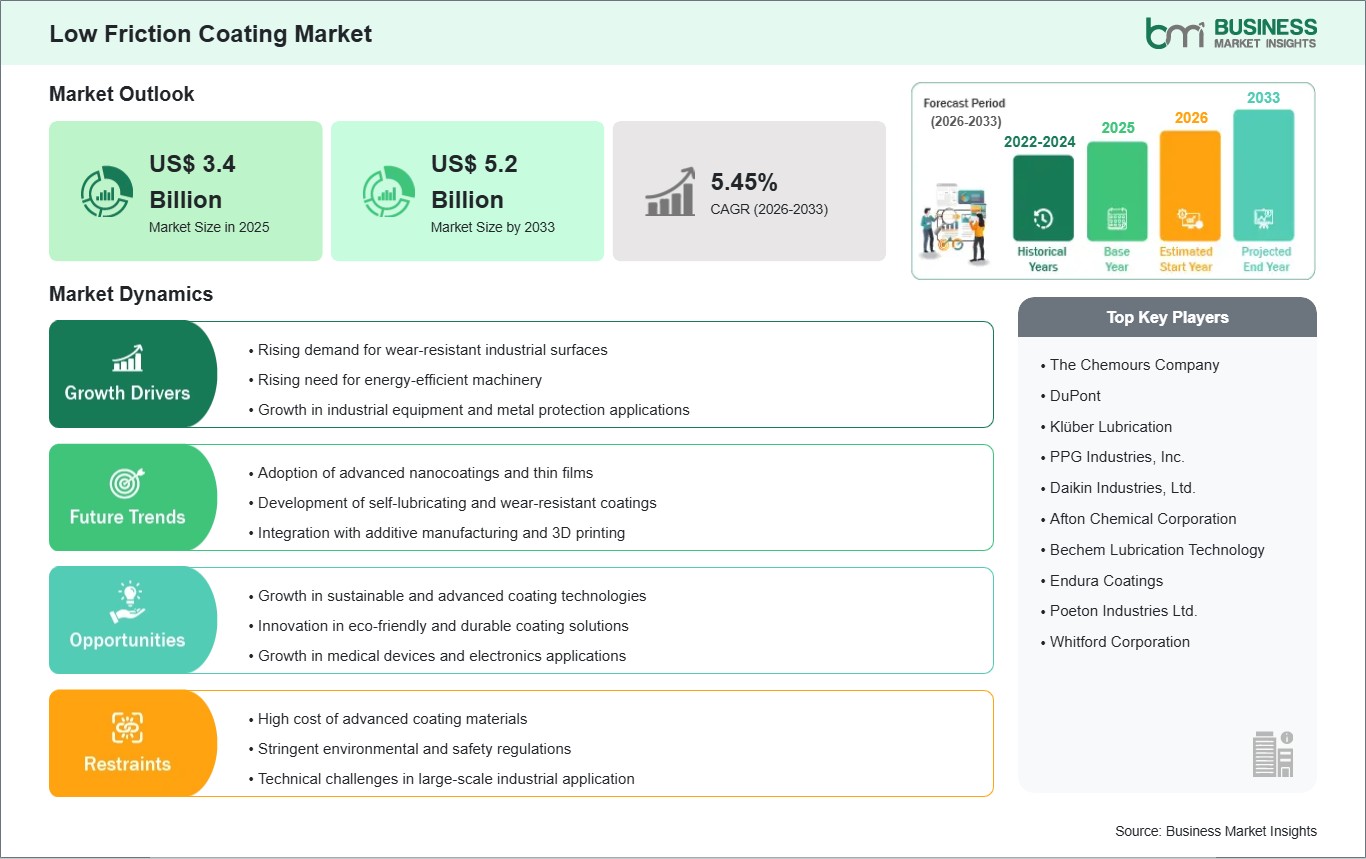
The Low Friction Coating Market size is expected to reach US$ 5.2 Billion by 2033 from US$ 3.4 Billion in 2025. The market is estimated to record a CAGR of 5.45% from 2026 to 2033.

Executive Summary and Global Market Analysis:

The low-friction coating market globally is showing steady growth, primarily driven by the demand from the automotive, aerospace, industrial, and electronics sectors for cost-effective solutions that help reduce wear, energy consumption, and operating costs. Low-friction coatings are designed to reduce resistance between surfaces, improve the life of components, and increase the efficiency of moving parts. The result is reduced maintenance costs and extended service life of the coated product. The key technologies used to achieve these benefits are polymer-based coatings, fluoropolymer, ceramic, and nano-composite solutions, and each of these technologies has a unique engineering design to provide optimal performance for applications subjected to different loads, temperatures, and environmental conditions.

The growth of this market segment is driven by the increased use of lightweight materials and energy-efficient systems in both automotive and aerospace applications. As such, reducing friction will result in improved fuel economy and increased performance in both sectors. There are also many other industries, such as industrial machinery and manufacturing, that rely on low-friction coatings, both as a means to improve productivity and minimize downtime, and to ensure precision in their high-speed operations. Sustainability continues to be an emerging differentiator, with many companies racing to develop eco-friendly and solvent-free coating processes to reduce VOC emissions. Competitive strategies in the marketplace focus heavily on innovation, custom formulations, and partnerships with OEMs in order to deliver performance-tailored solutions. Companies that combine new advances in materials science with application-specific knowledge will be well-positioned to capture market growth in this segment going forward.

Low Friction Coating Market - Strategic Insights:

global-market-strategic-framework
Get more information on this report

Low Friction Coating Market Segmentation Analysis:

Key segments that contributed to the derivation of the low friction coating market analysis are type, application, and end‑user industry.

  • Type, the low friction coating market is segmented into molybdenum disulfide, tungsten disulfide, polytetrafluoroethylene (PTFE), and others. The molybdenum disulfide segment dominated the market in 2025.
  • Application, the low friction coating market is classified into bearings, automotive parts, power transmission items, valve components & actuators, and others. The automotive parts segment dominated the market in 2025.
  • End‑User Industry, the low friction coating market is categorized into automotive & transportation, aerospace & defense, healthcare, construction, oil & gas, and others. The automotive & transportation segment dominated the market in 2025.
Low Friction Coating Market Drivers and Opportunities:

Rising demand for wear-resistant industrial surfaces

The increasing demand for wear-resistant surfaces, which improve the effectiveness and decrease the cost of maintaining equipment, is leading to the global growth of the low friction coating market. In the industries of automotive, aerospace, machinery, and manufacturing, there is an increasing use of coatings designed to help reduce friction and wear for the purpose of extending the life of the component and improving operational efficiency. Therefore, there is an increasing need for specialized low friction coatings that allow for an acceptable level of performance even in high-performance and harsh conditions. In terms of mechanical stress and repetitive motion, many companies are utilizing the use of low friction coatings in order to reduce energy usage, prevent material deterioration, and enhance the overall reliability of systems.

Another supporting factor for the increasing market demand for low friction coatings is the increased pressure (operational and economic) to maximize equipment uptime (i.e., time that the equipment is available to run) and reduce the amount of downtime that may occur as a result of wear-related failures. With the rising complexity of industrial processes, low friction coatings are increasingly being utilized in essential components to provide for high-performance operations. Additionally, coating selection is also affected by both regulatory and safety issues in the industrial environment. Manufacturers of industrial equipment are looking for solutions that will enhance the wear resistance of their products and also meet health, safety, and environmental regulations. By continuing to enhance the operational efficiency of equipment while conforming to industry standards and regulations, low friction coatings will continue to be a driving force to promote sustainable growth in the industrial marketplace.

Growth in sustainable and advanced coating technologies

Innovation in sustainable and advanced low friction coating technologies is driving market expansion. Manufacturers are developing coatings that combine low friction properties with environmentally friendly formulations, reducing the reliance on harmful chemicals and enabling compliance with evolving environmental regulations. This trend is particularly important as industries increasingly prioritize eco-friendly solutions without compromising performance. Research and development efforts are also focusing on enhancing coating durability, heat resistance, and adaptability to different substrates. Advanced technologies, such as nanocoating`s, ceramic-based formulations, and self-lubricating layers, are improving performance under extreme conditions while extending component life. This allows industries to reduce maintenance costs and improve energy efficiency. Collaborations between coating developers and end-users are accelerating the adoption of customized solutions tailored to specific industrial applications. The integration of advanced low friction coatings into new equipment designs and retrofitting existing systems is creating significant market opportunities. These technological innovations, combined with sustainability trends, are positioning the low friction coating market for long-term growth across diverse industrial sectors.

Low Friction Coating Market Size and Share Analysis:

The low friction coating market demonstrates stable growth, with size and share analysis highlighting evolving trends and competitive dynamics among key players. The report examines subsegments categorized within type, application, and end‑user industry, offering insights into their contribution to overall market performance.

By Type, the molybdenum disulfide subsegment dominated the market in 2025, driven by its excellent low friction performance under boundary lubrication conditions and widespread use in automotive, aerospace, and industrial machinery applications.

Based on Application, the automotive parts subsegment dominated the market in 2025, supported by increasing demand for coated gears, e‑axle shafts, bearings, and components that reduce energy loss and enhance drivetrain efficiency.

On the basis of End‑User Industry, the automotive & transportation subsegment dominated the market in 2025, owing to the growing adoption of low friction coatings to improve fuel economy, reduce emissions, and extend component life in passenger cars and commercial vehicles.

Low Friction Coating Market Report Highlights:

Report Attribute Details
Market size in 2025 US$ 3.4 Billion
Market Size by 2033 US$ 5.2 Billion
Global CAGR (2026 - 2033)5.45%
Historical Data 2022-2024
Forecast period 2026-2033
Segments Covered By Type
  • Molybdenum Disulfide
  • Tungsten Disulfide
  • Polytetrafluoroethylene
  • Other Types
By Application
  • Bearings
  • Automotive Parts
  • Power Transmission Items
  • Valve Components & Actuators
  • Other Applications
By End-User Industry
  • Automotive & Transportation
  • Aerospace & Defense
  • Healthcare
  • Construction
  • Oil & Gas
  • Other End User Industries
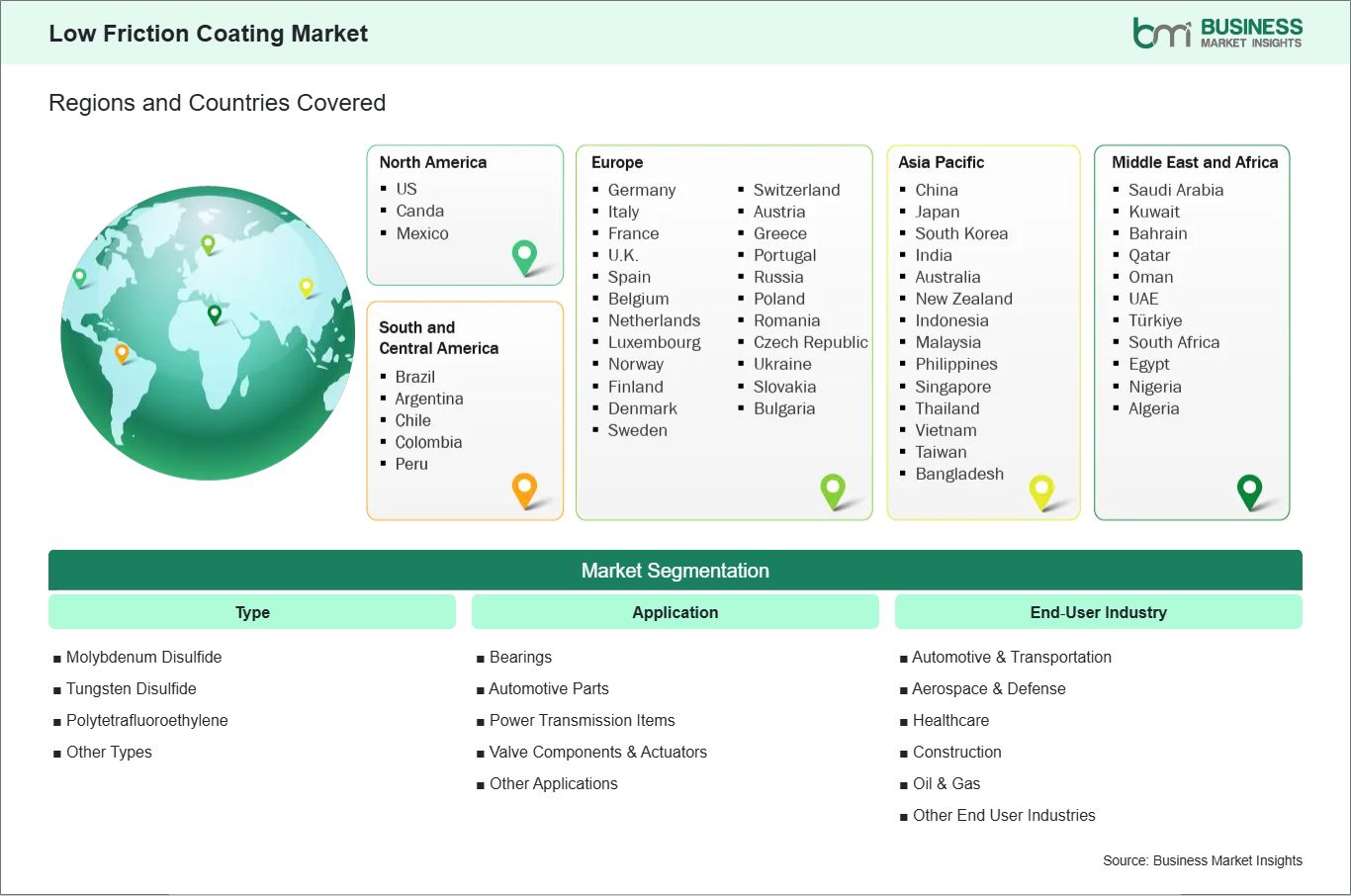
Regions and Countries Covered
North America US, Canada, Mexico
Europe Belgium, Austria, Finland, Denmark, Greece, Poland, Romania, Russia, Ukraine, Czech Republic, Slovakia, Bulgaria, Italy, Luxembourg, Germany, Switzerland, France, Netherlands, Norway, Portugal, Spain, Sweden, United Kingdom
Asia-Pacific Australia, China, India, Japan, South Korea, Indonesia, Malaysia, Philippines, Singapore, Thailand, Vietnam, Bangladesh, New Zealand, Taiwan
South and Central America Brazil, Argentina, Peru, Chile, Colombia
Middle East and Africa Bahrain, Kuwait, Oman, Qatar, Saudi Arabia, United Arab Emirates, Turkiye, South Africa, Egypt, Algeria, Nigeria
Market leaders and key company profiles
  • The Chemours Company
  • DuPont
  • Klüber Lubrication
  • PPG Industries, Inc.
  • Daikin Industries, Ltd.
  • Afton Chemical Corporation
  • Bechem Lubrication Technology
  • Endura Coatings
  • Poeton Industries Ltd.
  • Whitford Corporation
Get more information on this report

Low Friction Coating Market Report Coverage and Deliverables:

The "Low Friction Coating Market Size and Forecast (2022 - 2033)" report provides a detailed analysis of the market covering below areas:

  • Low Friction Coating Market size and forecast at global, regional, and country levels for all the key market segments covered under the scope
  • Low Friction Coating Market trends, as well as drivers, restraints, and opportunities
  • Low Friction Coating Market analysis covering key trends, global and regional framework, major players, regulations, and recent developments
  • Industry landscape and competition analysis covering market concentration, heat map analysis, prominent players, and recent developments for the Low Friction Coating Market
  • Detailed company profiles, including SWOT analysis

Low Friction Coating Market Geographic Insights:

The geographical scope of the Low Friction Coating Market report is divided into North America, Asia Pacific, Europe, Middle East & Africa, and South & Central America. North America held the largest share in 2025.

Regional adoption of low friction coatings varies based on industrial development, regulatory frameworks, and technological investment. North America dominates the market, driven by automotive, aerospace, and industrial machinery sectors that prioritize efficiency, durability, and precision. The U.S. and Canada are investing in high-performance polymer and ceramic coatings, particularly for energy-saving applications. Europe is another major market, led by Germany, France, and the UK, where stringent environmental standards, industrial automation, and sustainable manufacturing practices are accelerating adoption of low-VOC, eco-friendly coating technologies.

In Asia Pacific, rapid industrialization, automotive production, and electronics manufacturing in China, Japan, South Korea, and India are creating strong demand for friction-reducing coatings to enhance operational efficiency and component longevity. Middle East & Africa is emerging, with applications primarily in industrial machinery and heavy transport sectors, supported by infrastructure modernization and maintenance optimization efforts.

South & Central America, particularly Brazil and Mexico, is gradually increasing adoption, focusing on automotive and industrial equipment efficiency. Across all regions, innovation, regulatory compliance, and material performance remain the primary drivers of market growth and differentiation in the low friction coating sector.

global-market-geography
Get more information on this report

Low Friction Coating Market Research Report Guidance:

  • The report includes qualitative and quantitative data in the Low Friction Coating Market across type, application, end‑user industry and geography.
  • The report starts with the key takeaways (chapter 2), highlighting key trends and outlook of the Low Friction Coating Market.
  • Chapter 3 focuses on the research methodology of the study.
  • Chapter 4 includes ecosystem analysis.
  • Chapter 5 highlights the major industry dynamics in the Low Friction Coating Market, including factors that are driving the market, prevailing deterrents, potential opportunities, as well as future trends. Impact analysis of these drivers and restraints is also covered in this section.
  • Chapter 6 discusses the Low Friction Coating Market scenario, in terms of historical market revenues, and forecast till the year 2033.
  • Chapters 7 to 10 cover Low Friction Coating Market segments across type, application, end‑user industry and geography across North America, Asia Pacific, Europe, the Middle East & Africa, and South & Central America. They cover the market revenue forecast and factors driving the market.
  • Chapter 11 describes the competitive analysis along with the heat map analysis for the key players operating in the market.
  • Chapter 12 describes the industry landscape analysis. It provides detailed descriptions of business activities such as market initiatives, new developments, mergers, and joint ventures globally, along with a competitive landscape.
  • Chapter 13 provides detailed profiles of the major companies operating in the Low Friction Coating Market. Companies have been profiled on the basis of their key facts, business descriptions, products, financial overview, SWOT analysis, and key developments.
  • Chapter 14, i.e., the appendix, is inclusive of a brief overview of the company, a list of abbreviations, and a disclaimer.

Low Friction Coating Market News and Key Development:

The Low Friction Coating Market is evaluated by gathering qualitative and quantitative data post primary and secondary research, which includes important corporate publications, association data, and databases. A few of the key developments in the low friction coating market are:

  • In February 2024, Quaker Houghton (formerly Quaker Chemical) completed the acquisition of IKV Tribologie Ltd (IKVT), strengthening its portfolio in advanced tribology and low‑friction coatings/fluids used across automotive, industrial and energy applications globally.
  • In September 2024, PPG Industries, Inc. expanded its Malaysian plant operations in Petaling Jaya to include production and testing of non‑stick and low‑friction coatings, increasing capacity to support regional demand and advanced surface solutions for industrial and cookware segments.

Key Sources Referred:

  • International Organization for Standardization (ISO)
  • American Society for Testing and Materials (ASTM International)
  • Bureau of Indian Standards (BIS)
  • Environmental Protection Agency (EPA), USA
  • European Chemicals Agency (ECHA)
  • Central Pollution Control Board (CPCB), India
  • Ministry of Chemicals and Fertilizers, India
  • American Chemistry Council (ACC)
  • Indian Chemical Council (ICC)
  • European Chemical Industry Council (Cefic)
  • Specialty Chemical Association of India (SCAI)
  • Company Websites
  • Company Annual Reports
  • Company Investor Presentations
The List of Companies - Low Friction Coating Market
  • The Chemours Company
  • DuPont
  • Klüber Lubrication
  • PPG Industries, Inc.
  • Daikin Industries, Ltd.
  • Afton Chemical Corporation
  • Bechem Lubrication Technology
  • Endura Coatings
  • Poeton Industries Ltd.
  • Whitford Corporation
Frequently Asked Questions
How big is the Low Friction Coating Market?

The Low Friction Coating Market is valued at US$ 3.4 Billion in 2025, it is projected to reach US$ 5.2 Billion by 2033.

What is the CAGR for Low Friction Coating Market by (2026 - 2033)?

As per our report Low Friction Coating Market, the market size is valued at US$ 3.4 Billion in 2025, projecting it to reach US$ 5.2 Billion by 2033. This translates to a CAGR of approximately 5.45% during the forecast period.

What segments are covered in this report?

The Low Friction Coating Market report typically cover these key segments-

  • Type (Molybdenum Disulfide, Tungsten Disulfide, Polytetrafluoroethylene (PTFE), Other Types)
  • Application (Bearings, Automotive Parts, Power Transmission Items, Valve Components & Actuators, Other Applications)
  • End-User Industry (Automotive & Transportation, Aerospace & Defense, Healthcare, Construction, Oil & Gas, Other End User Industries)

What is the historic period, base year, and forecast period taken for Low Friction Coating Market?

The historic period, base year, and forecast period can vary slightly depending on the specific market research report. However, for the Low Friction Coating Market report:

  • Historic Period : 2022-2024
  • Base Year : 2025
  • Forecast Period : 2026-2033
  • Who are the major players in Low Friction Coating Market?

    The Low Friction Coating Market is populated by several key players, each contributing to its growth and innovation. Some of the major players include:

  • The Chemours Company
  • DuPont
  • Klüber Lubrication
  • PPG Industries, Inc.
  • Daikin Industries, Ltd.
  • Afton Chemical Corporation
  • Bechem Lubrication Technology
  • Endura Coatings
  • Poeton Industries Ltd.
  • Whitford Corporation
  • Who should buy this report?

    The Low Friction Coating Market report is valuable for diverse stakeholders, including:

    • Investors: Provides insights for investment decisions pertaining to market growth, companies, or industry insights. Helps assess market attractiveness and potential returns.
    • Industry Players: Offers competitive intelligence, market sizing, and trend analysis to inform strategic planning, product development, and sales strategies.
    • Suppliers and Manufacturers: Helps understand market demand for components, materials, and services related to concerned industry.
    • Researchers and Consultants: Provides data and analysis for academic research, consulting projects, and market studies.
    • Financial Institutions: Helps assess risks and opportunities associated with financing or investing in the concerned market.

    Essentially, anyone involved in or considering involvement in the Low Friction Coating Market value chain can benefit from the information contained in a comprehensive market report.

    Available Report Formats

    pdf-format excel-format pptx-format
    Buy Now
    Sales Assistance
    +1 646 791 7070 (US & UK)
    Customization Form

    Please tell us your area of interest
    (Market Segments/ Regions and Countries/ Companies)