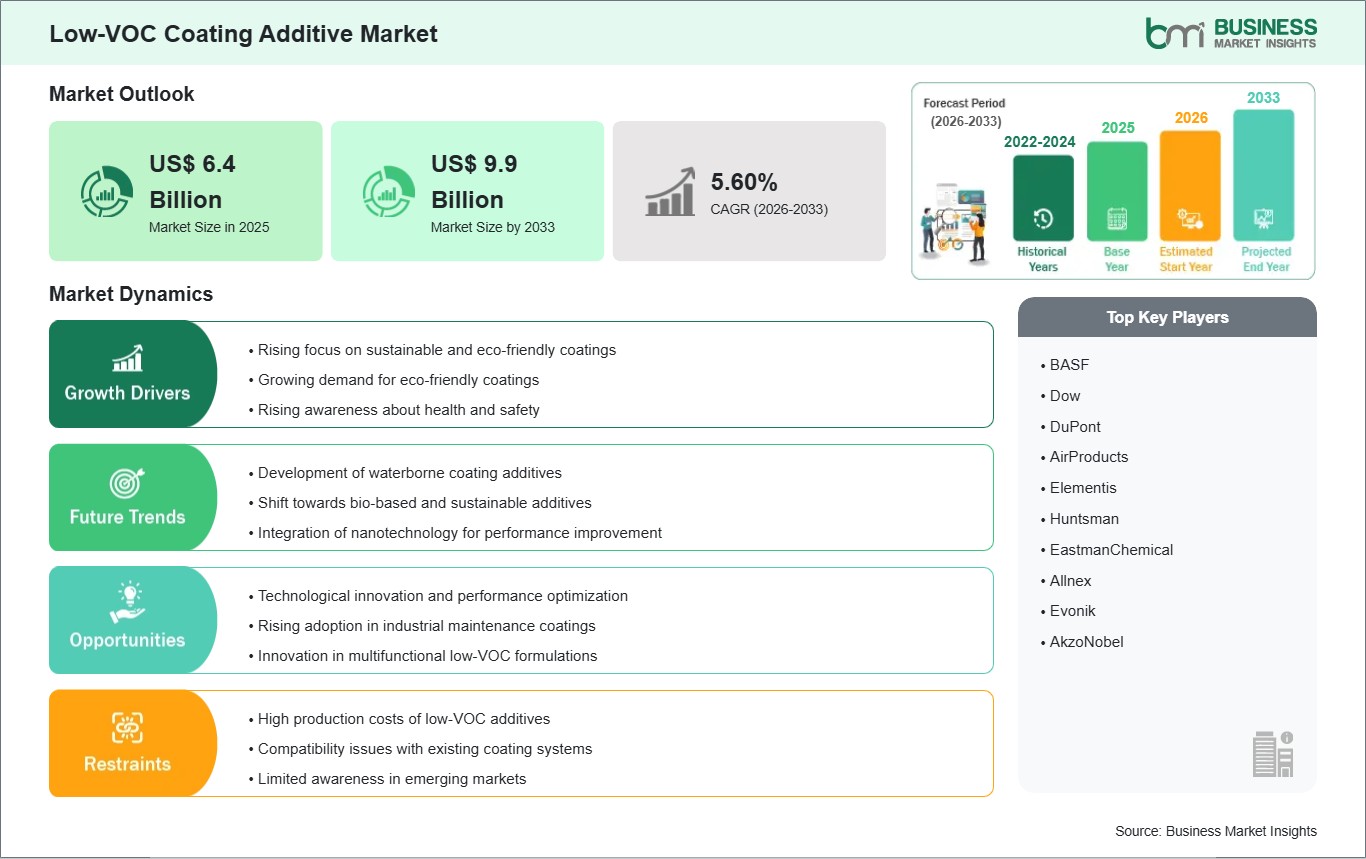
The Low-VOC Coating Additive Market size is expected to reach US$ 9.9 Billion by 2033 from US$ 6.4 Billion in 2025. The market is estimated to record a CAGR of 5.60% from 2026 to 2033.
The low-VOC coating additive market is growing as all industries look to lessen their impact on the environment while not sacrificing the quality of their coatings. These additives are added into paints, varnishes and protective coatings to help reduce VOCs emitted from these products, while also providing enhancements to adhesion, flow, leveling and durability of the coatings as well. The increase in low-VOC coating additive usage is driven by a number of factors, including regulations by industries such as limiting VOCs in North America, Europe and the Asia Pacific. Additionally, the increase in demand for green building and infrastructure projects is also a driver of this product's growth in the marketplace.
Innovations and technological advancements in the market tend to be focused on water-based, bio-based and solvent-free additives where performance characteristics remain consistent, specifically in terms of weather resistance, corrosion resistance and the appearance of the coatings. End-use segments such as automotive, construction, industrial maintenance and consumer products are all increasingly adopting low-VOC coating additives to meet regulatory requirements, improve indoor air quality and achieve corporate sustainability initiatives. Companies are developing their R&D capabilities, providing custom formulating services and developing strategic alliances with paint and coating manufacturers to differentiate themselves from their competition. This increased focus on environmentally responsible production will continue to drive the growth of this product category and ultimately allow manufacturers to not only comply with regulations but also provide high-performance coating solutions.

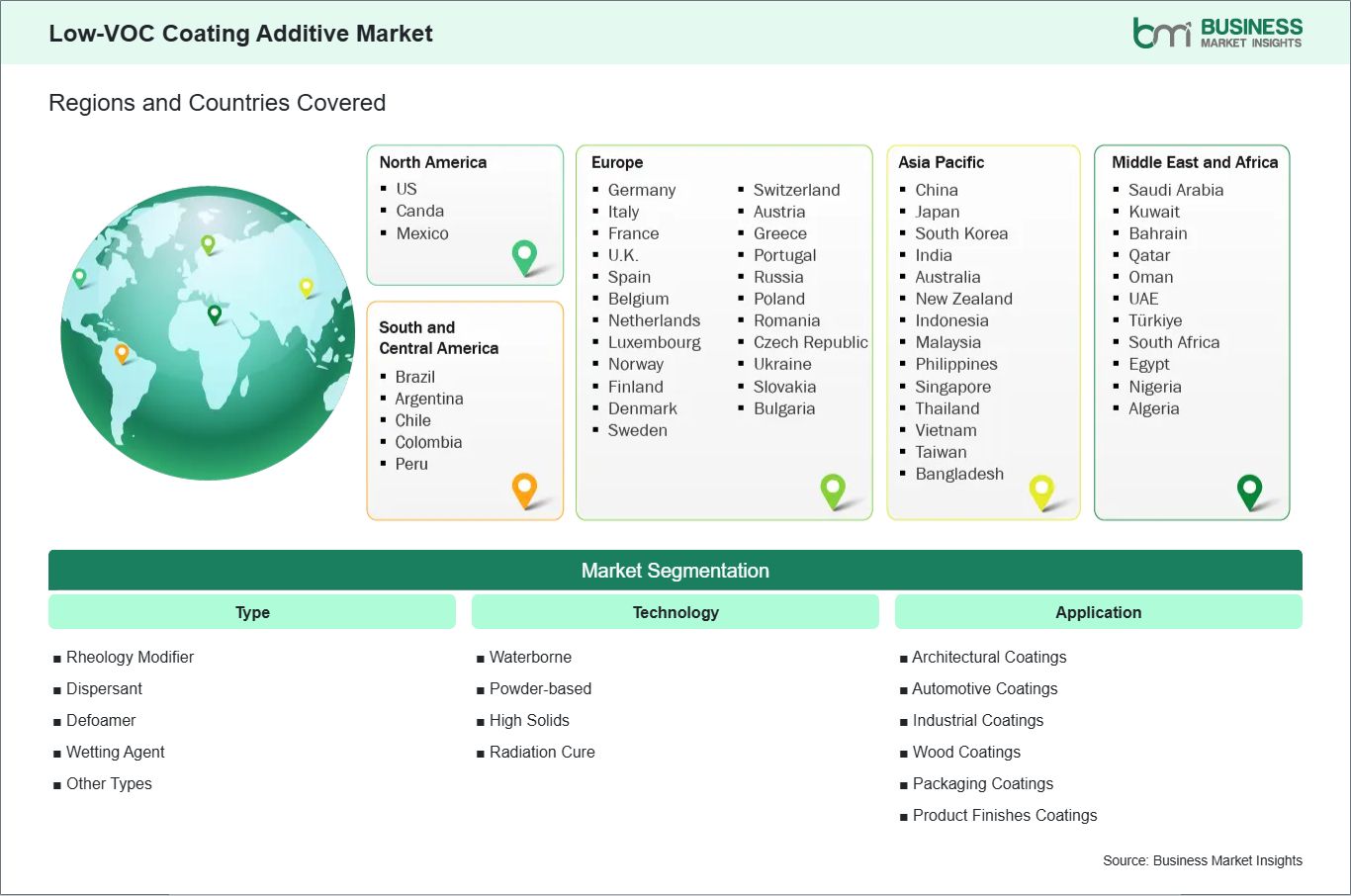
Key segments that contributed to the derivation of the low‑VOC coating additive market analysis are type, technology, and application.
The low-VOC coating additive market globally is experiencing growth driven by the higher focus on sustainability and environmental regulations. Manufacturers in construction, auto, industrial and decorative coatings are looking for additives that lower the emissions of volatile organic compounds (VOCs) while keeping their products functioning properly. Increased regulations to reduce air pollution and improve safety in workplaces are forcing manufacturers to develop low-VOC additives in their new formulations. In addition, low-VOC coating additives will help to increase the efficiency of applying coatings and provide better leveling and surface smoothness in industrial and commercial applications while improving environmental compliance. As a result of the use of these types of additives, formulators will be able to supply their customers with significant properties such as adhesion, durability, and resistance to chemicals, while still reducing emissions of harmful materials.
Therefore, end-users are placing greater emphasis on these properties in their purchasing decisions and aligning their goals of operating efficiently with objectives towards being sustainable. Building and infrastructure-related companies are also using low-VOC coatings in order to qualify for the green building certification and comply with local laws for indoor air quality. As manufacturers continue to develop new formulations with low-VOC coating additives, there will continue to be growing demands for these products from manufacturers within many different markets, which will lead to significant growth opportunities within this industry for several years.
Innovation in low-VOC coating additives is expanding market opportunities by enhancing coating performance across multiple dimensions. Researchers and manufacturers are developing additives that improve leveling, flow, gloss retention, and chemical resistance while maintaining minimal VOC emissions. These advanced solutions allow coating formulators to optimize product performance without compromising environmental standards. R&D is also focused on compatibility with various resin systems, enabling applications in waterborne, solvent-free, and hybrid coating formulations. This versatility allows coatings to meet the evolving needs of industries such as automotive refinishing, wood finishing, protective coatings, and industrial maintenance. By addressing both functional and environmental requirements, these additives improve efficiency, reduce defects, and extend coating lifespan.
Collaborations between additive producers and coating formulators are driving the creation of customized solutions for specific substrate types and application processes. The emphasis on performance optimization, regulatory compliance, and sustainability is encouraging broader adoption, positioning the low-VOC coating additive market for robust global growth in the coming years.
The low‑VOC coating additive market demonstrates steady growth, with size and share analysis highlighting evolving trends and competitive dynamics among key players. The report examines subsegments categorized within type, technology, and application, offering insights into their contribution to overall market performance.
By Type, the rheology modifier subsegment dominated the market in 2025, driven by its critical role in enhancing flow control, stability, and performance of low‑VOC coating formulations.
Based on Technology, the waterborne subsegment dominated the market in 2025, supported by regulatory push toward low‑VOC systems and strong adoption in architectural and industrial coating applications.
On the basis of Application, the architectural coatings subsegment dominated the market in 2025, owing to large demand from residential and commercial building industries seeking environmentally compliant coating solutions.
| Report Attribute | Details |
|---|---|
| Market size in 2025 | US$ 6.4 Billion |
| Market Size by 2033 | US$ 9.9 Billion |
| Global CAGR (2026 - 2033) | 5.60% |
| Historical Data | 2022-2024 |
| Forecast period | 2026-2033 |
| Segments Covered | By Type
|
|
Regions and Countries Covered
| |
| North America | US, Canada, Mexico |
| Europe | Belgium, Austria, Finland, Denmark, Greece, Poland, Romania, Russia, Ukraine, Czech Republic, Slovakia, Bulgaria, Italy, Luxembourg, Germany, Switzerland, France, Netherlands, Norway, Portugal, Spain, Sweden, United Kingdom |
| Asia-Pacific | Australia, China, India, Japan, South Korea, Indonesia, Malaysia, Philippines, Singapore, Thailand, Vietnam, Bangladesh, New Zealand, Taiwan |
| South and Central America | Brazil, Argentina, Peru, Chile, Colombia |
| Middle East and Africa | Bahrain, Kuwait, Oman, Qatar, Saudi Arabia, United Arab Emirates, Turkiye, South Africa, Egypt, Algeria, Nigeria |
| Market leaders and key company profiles |
|
The "Low‑VOC Coating Additive Market Size and Forecast (2022 - 2033)" report provides a detailed analysis of the market covering below areas:
The geographical scope of the Low‑VOC Coating Additive Market report is divided into North America, Asia Pacific, Europe, Middle East & Africa, and South & Central America. North America held the largest share in 2025.
Regional adoption of low-VOC coating additives varies based on industrial development, environmental regulations, and application demand. North America leads due to strict VOC emission standards, green building certifications, and high adoption in construction, automotive, and industrial maintenance sectors. The U.S. and Canada are actively investing in waterborne and bio-based additive technologies to meet sustainability and indoor air quality requirements. Europe is another mature market, with Germany, France, and the UK driving demand through stringent environmental regulations and widespread green construction practices.
In Asia Pacific, rapid industrialization, construction growth, and automotive expansion in China, Japan, South Korea, and India are propelling demand, especially in applications requiring regulatory compliance and environmental safety. Middle East & Africa is emerging, with adoption focused on high-end commercial projects, infrastructure, and industrial coatings, aided by awareness of occupational health standards.
South & Central America, led by Brazil and Mexico, is gradually integrating low-VOC coating additives in construction, automotive, and industrial applications. Across all regions, innovation, environmental compliance, and application-specific customization remain central to competitive positioning and market growth in the low-VOC coating additive segment.

The Low‑VOC Coating Additive Market is evaluated by gathering qualitative and quantitative data post primary and secondary research, which includes important corporate publications, association data, and databases. A few of the key developments in the low‑VOC coating additive market are:
The Low‑VOC Coating Additive Market is valued at US$ 6.4 Billion in 2025, it is projected to reach US$ 9.9 Billion by 2033.
As per our report Low‑VOC Coating Additive Market, the market size is valued at US$ 6.4 Billion in 2025, projecting it to reach US$ 9.9 Billion by 2033. This translates to a CAGR of approximately 5.60% during the forecast period.
The Low‑VOC Coating Additive Market report typically cover these key segments-
The historic period, base year, and forecast period can vary slightly depending on the specific market research report. However, for the Low‑VOC Coating Additive Market report:
The Low‑VOC Coating Additive Market is populated by several key players, each contributing to its growth and innovation. Some of the major players include:
The Low‑VOC Coating Additive Market report is valuable for diverse stakeholders, including:
Essentially, anyone involved in or considering involvement in the Low‑VOC Coating Additive Market value chain can benefit from the information contained in a comprehensive market report.
Please tell us your area of interest
(Market Segments/ Regions and Countries/ Companies)