Market Summary
Executive Summary and Global Market Analysis
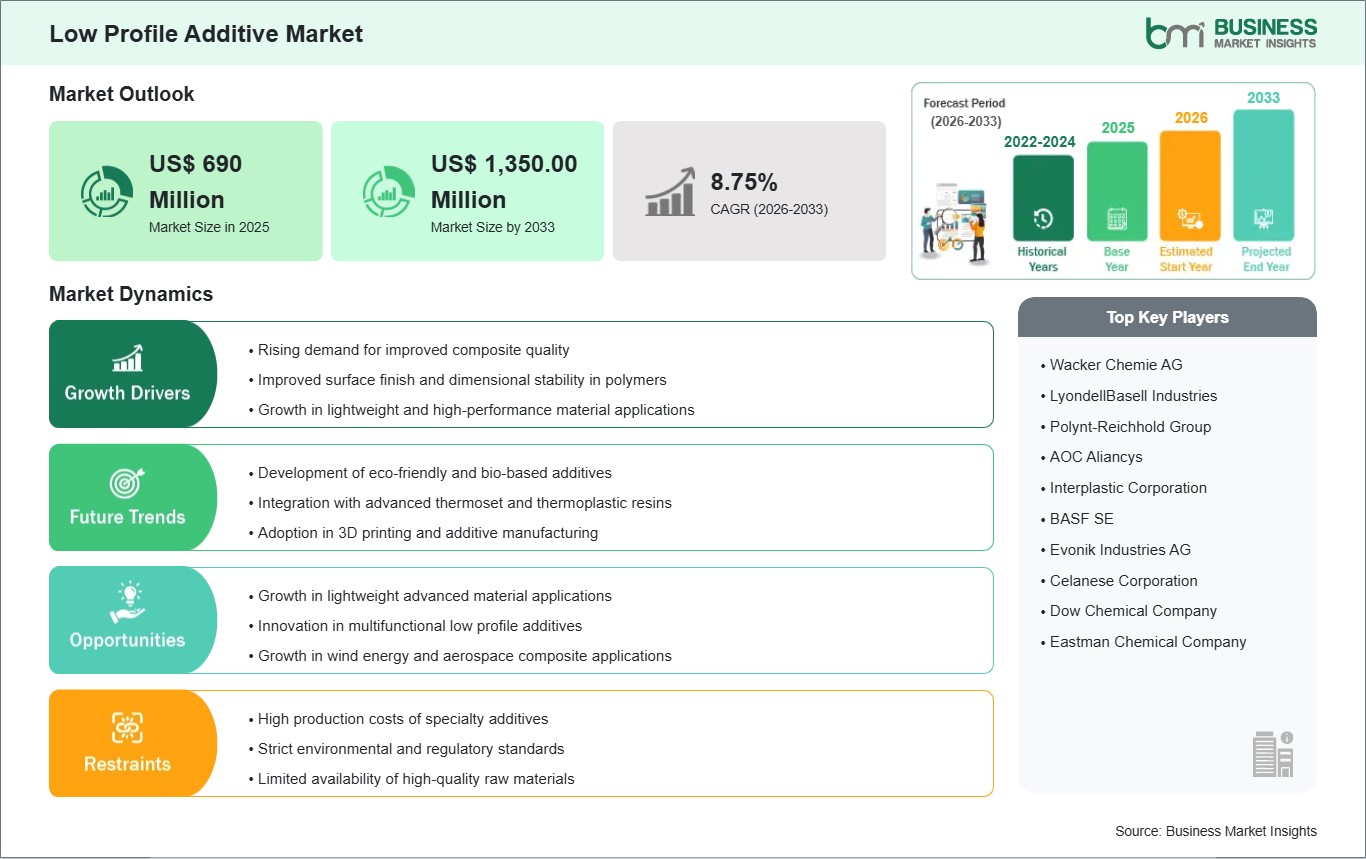
The global market for low profile additives is growing steadily, with composite material manufacturers looking for improvements in the dimensional stability, surface finish, and mechanical properties of thermoset resins. The LPAs are used mainly in unsaturated polyester, vinyl ester, and epoxy resin systems, which require shrinkage reduction during curing, improved mold reproduction, and reduction of internal stresses. The industry is witnessing a shift to lightweight, high-performance composites in the automotive and transportation sectors, leading to the adoption of LPAs, which will provide improvements in fuel efficiency without compromising structural integrity.
The market is also witnessing an increase in the use of LPAs in consumer products and industrial items, where appearance and smoothness of the product's surface are critical. The latest developments in the industry include the introduction of reactive, non-reactive, and hybrid LPAs, which provide the advantage of resin system viscosity, cure rate, and processing flexibility, especially for complex molding operations such as SMC and BMC. Sustainability is another factor driving the industry, with companies developing bio-based and recyclable LPAs to meet sustainability requirements. Strategic activities, including R&D, working with resin manufacturers, and customization, have helped companies to differentiate their products and capitalize on opportunities in this specialized additive market.
Segment Analysis
Low Profile Additive Market Segmentation
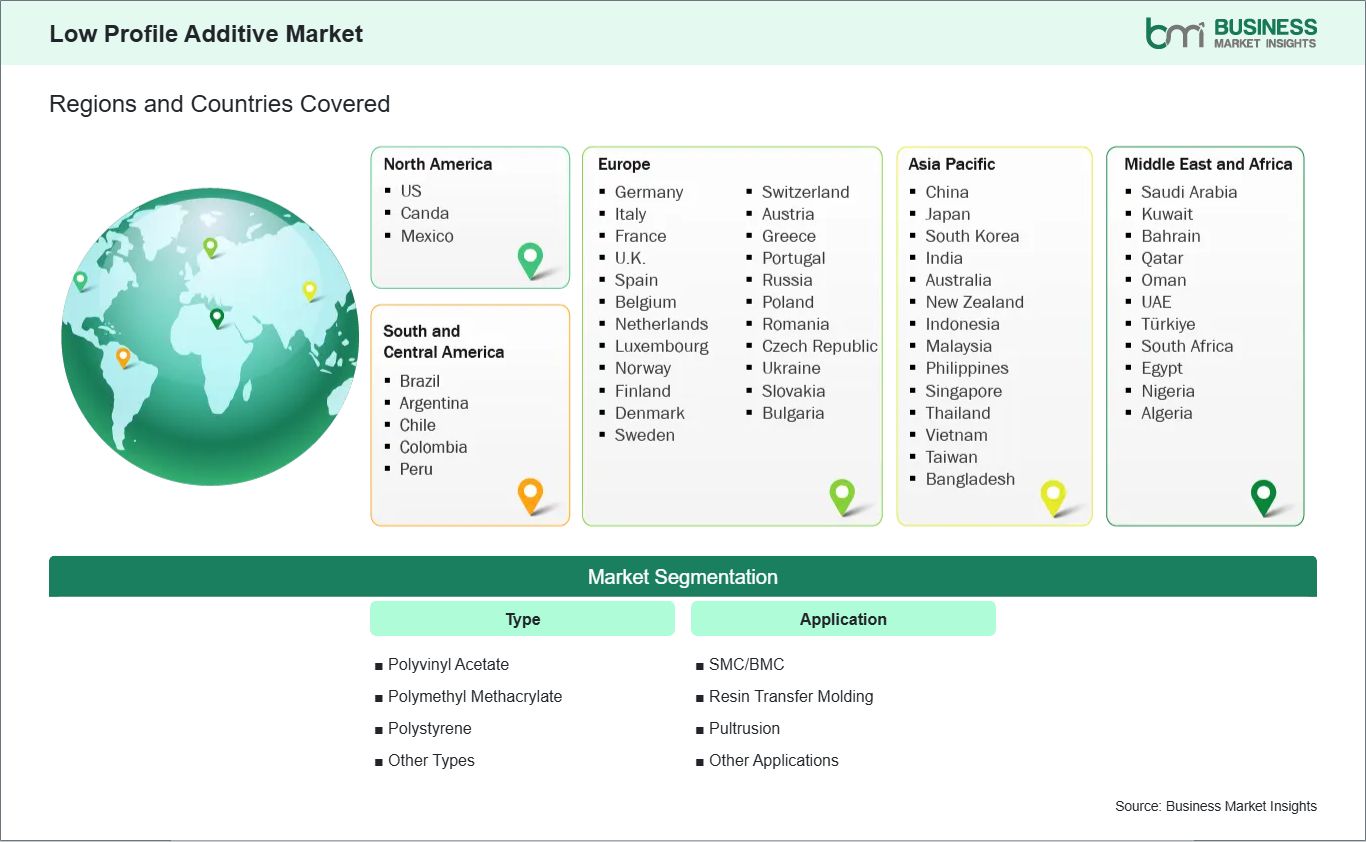
Key segments that contributed to the derivation of the low profile additive market analysis are type and application.
- Type, the low profile additive market is segmented into polyvinyl acetate (PVA), polymethyl methacrylate (PMMA), polystyrene, and others. The polyvinyl acetate (PVA) segment dominated the market in 2025.
- Application, the low profile additive market is classified into SMC/BMC, resin transfer molding (RTM), pultrusion, and others. The SMC/BMC segment dominated the market in 2025.
Market Forces
Low Profile Additive Market Drivers and Opportunities
Rising demand for improved composite quality
The expanding need for high-performance composites in industrial applications is propelling growth in the global low-profile additives market. Automotive, construction, marine, electrical and other industries are seeking to improve the performance of reinforced polyester composites through the introduction of low-profile additives, which improve the dimensional stability, reduce shrinkage and enhance surface finish of polyester composites. The increasing demand for low-profile additives is supporting the numerous industries adopting them to ensure consistent quality and structural integrity of final products. Industries that rely on precision and durability for manufacturing require the use of low-profile additives for implementing uniform molding, minimizing warpage and maintaining aesthetic quality in their product offerings.
The ability of low-profile additives to optimize mechanical and thermal properties of the composite materials allows manufacturers to produce high-quality composites, while at the same time decreasing waste and product defects, and meeting stringent quality requirements. This is an essential element for manufacturers operating in high-volume production environments where production efficiency and product performance are directly related. In addition to these challenges, emerging industry standards and consumer priorities are also causing manufacturers to adopt higher performing low-profile additives to produce consistent results in a variety of processing conditions. Focused on producing high-quality composites with improved dimensional accuracy and surface smoothness, the low-profile additives market is set to experience significant growth across multiple industrial industries.
Growth in lightweight advanced material applications
The emergence of low-profile additives in additive manufacturing is providing manufacturers with new opportunities to develop lightweight, high performance materials. Manufacturers are creating new formulas that increase composite strength while reducing the overall density of these materials, thus enabling industries to create lighter and more efficient components without compromising durability. The trend has gained momentum particularly in the automotive and aerospace industries because of the direct impact on energy efficiency and performance through weight reduction.
Research and development efforts are also aimed at improving the compatibility of various resin systems and reinforcement fibers so that they can be used for greater versatility in developing customized solutions. By optimizing the balance between mechanical performance and processing efficiency, these additives are maximizing the ability of high-performance composites to be adopted for structural, decorative, and functional applications. Collaborative relationships between additive manufacturers and end-users are also accelerating the development of specialized solutions that fit the specific requirements of materials and applications. The continued focus on lightweighting, energy efficiency, and advanced performance and characteristics of materials support sustained growth within the market; making low profile additives a key component of modern composite manufacturing strategies throughout the world.
Size and Share Analysis
Low Profile Additive Market Size and Share Analysis
The low profile additive market demonstrates steady growth, with size and share analysis highlighting evolving trends and competitive dynamics among key players. The report examines subsegments categorized within type and application, offering insights into their contribution to overall market performance.
By Type, the polyvinyl acetate (PVA) subsegment dominated the market in 2025, driven by its extraordinary solubility characteristics during curing, excellent shrinkage prevention in end products, and broad availability.
Based on Application, the SMC/BMC subsegment dominated the market in 2025, supported by rising demand for lightweight composite materials, particularly in automotive and industrial sectors where reduced shrinkage and improved surface quality are valued.
Report Coverage
Low Profile Additive Market Report Coverage and Deliverables
The "Low Profile Additive Market Size and Forecast (2022 - 2033)" report provides a detailed analysis of the market covering below areas:
- Low Profile Additive Market size and forecast at global, regional, and country levels for all the key market segments covered under the scope
- Low Profile Additive Market trends, as well as drivers, restraints, and opportunities
- Low Profile Additive Market analysis covering key trends, global and regional framework, major players, regulations, and recent developments
- Industry landscape and competition analysis covering market concentration, heat map analysis, prominent players, and recent developments for the Low Profile Additive Market
- Detailed company profiles, including SWOT analysis
Geographic Insights
Low Profile Additive Market Geographic Insights
The geographical scope of the Low Profile Additive Market report is divided into North America, Asia Pacific, Europe, Middle East & Africa, and South & Central America. North America held the largest share in 2025.
Regional trends in the low profile additive market are shaped by the concentration of composite manufacturing, industrial development, and material regulations. North America leads, supported by automotive, construction, and aerospace sectors that prioritize high-performance, lightweight composites with superior surface quality. The U.S. and Canada are investing in advanced SMC/BMC applications for electric vehicles, commercial vehicles, and infrastructure projects. Europe is another mature market, particularly in Germany, France, and Italy, where stringent quality standards and a strong automotive and aerospace industry drive demand for LPAs with tailored shrinkage control and surface finish properties.
In Asia Pacific, rapid industrialization and expanding automotive and construction sectors in China, India, Japan, and South Korea are boosting adoption, with a focus on high-volume, cost-effective composite production.
Middle East & Africa is emerging, with demand linked to industrial and infrastructure projects where composite materials are gaining traction. South & Central America, led by Brazil and Mexico, is gradually integrating LPAs into automotive, marine, and construction composites. Across all regions, innovation, application-specific customization, and quality assurance remain the primary drivers for market adoption and competitive positioning in the low profile additive industry.
Industry Activity
Recent Developments
The Low Profile Additive Market is evaluated by gathering qualitative and quantitative data post primary and secondary research, which includes important corporate publications, association data, and databases. A few of the key developments in the low profile additive market are:
- In March 2024, Polynt Group entered into a non‑binding memorandum of understanding to acquire Polyprocess, a European producer of specialty additives and resin technologies. This contemplated acquisition aimed to enhance Polynt`s formulation capabilities for additives used in composite materials — including low profile additives for SMC/BMC applications and to expand its production footprint in Europe.
- In October 2025, BASF SE expanded its sustainable materials portfolio in North America with the launch of Ultramid LowPCF and Ultramid BMB grades, offering reduced carbon footprint nylon solutions for industrial and engineering applications. While not strictly termed “low profile additive,” this product launch reflects BASF`s broader innovation push in advanced polymer additives that improve performance and sustainability in composite and engineered resin systems used in structural applications.
Trust & Transparency
Research Methodology
The market analysis combines proprietary research with secondary data from government agencies, company disclosures, regulatory filings, industry databases and expert interviews. Market estimates are validated through data triangulation, cross-market benchmarking and analyst
review.
View Full Research Methodology
Key Sources Referred:
International Organization for Standardization (ISO) American Society for Testing and Materials (ASTM International) Bureau of Indian Standards (BIS) Environmental Protection Agency (EPA), USA European Chemicals Agency (ECHA) Central Pollution Control Board (CPCB), India Ministry of Chemicals and Fertilizers, India American Chemistry Council (ACC) Indian Chemical Council (ICC) European Chemical Industry Council (Cefic) Specialty Chemical Association of India (SCAI) Company Websites Company Annual Reports Company Investor Presentations