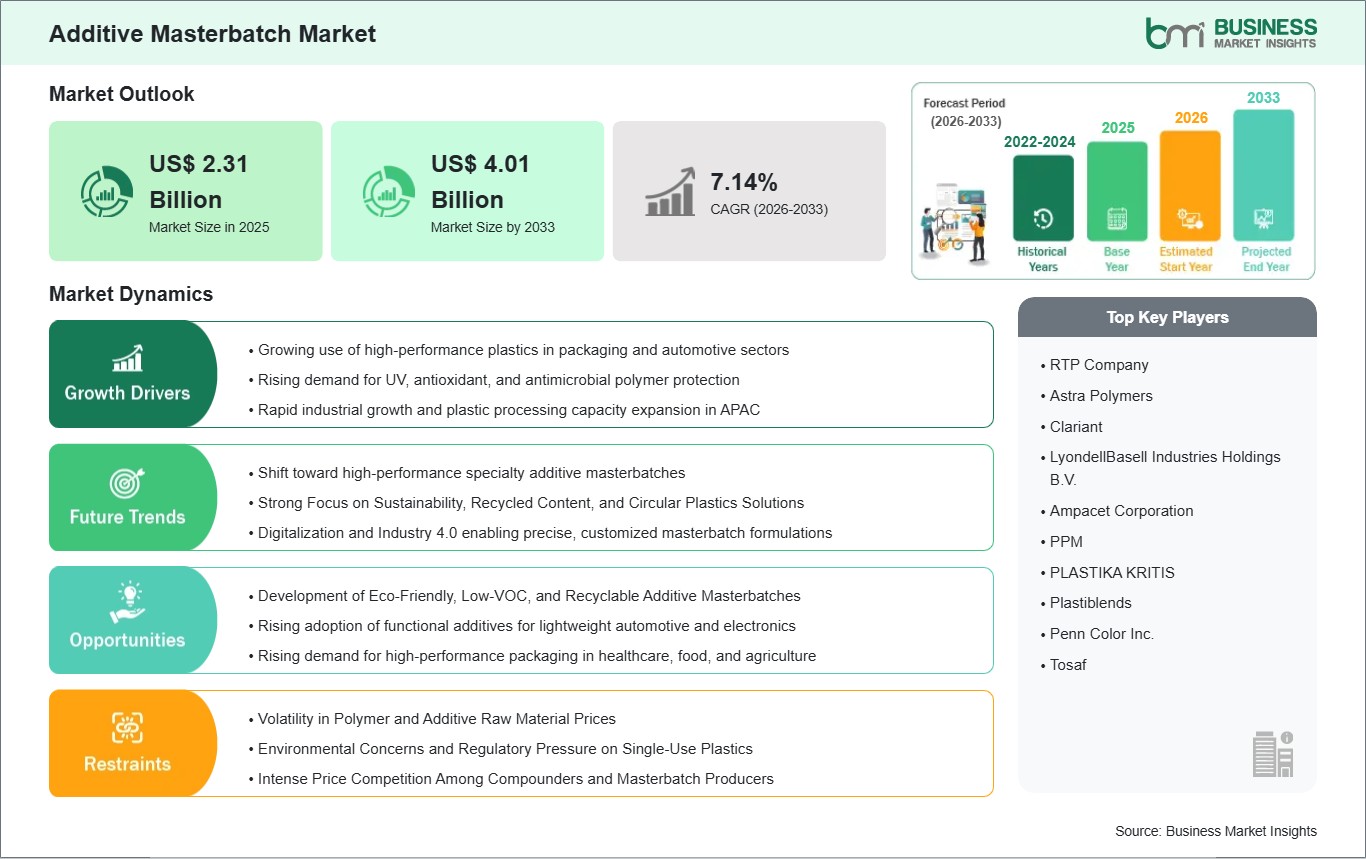
The Additive Masterbatch Market size is expected to reach US$ 4.01 Billion by 2033 from US$ 2.31 Billion in 2025. The market is estimated to record a CAGR of 7.14% from 2026 to 2033.
Additive masterbatch plays a significant role in contemporary plastic processing and production, as it helps improve the performance of the material and processing capability. It also minimizes the cost of production and increases the durability and service life of plastic materials. Additive masterbatches are important in enhancing the properties of polymers utilized in packaging, automotive, construction, consumer goods, agriculture, and electrical and electronics sectors to provide quality, safety, and consistent performance of products. In the packaging industry, additive masterbatches are widely applied for UV stabilization and antioxidant protection. The automotive sector relies on flame‑retardant and impact‑modifying masterbatches to enhance material performance and safety. Consumer and medical product manufacturers commonly incorporate antimicrobial and anti‑fog masterbatches to improve hygiene and product usability. Additionally, industrial plastics frequently utilize processing aids and color-enhancing additives to optimize manufacturing efficiency and achieve consistent aesthetic quality.
The benefits of additive masterbatches usage are convenience, consistent dispersion, better control of the processing, enhanced mechanical and thermal characteristics, and the possibility to add numerous functions with the help of advanced compounding technologies. The market is growing as a result of the rising consumption of plastics, increasing demand for high-performance and lightweight materials, and the growing concern for efficiency and automation in polymer processing industries. Moreover, the market is motivated by innovations in the additive formulations, by the creation of bio-based and sustainable additives, and the increased use of advanced plastics in end-use applications.
Nevertheless, the high rate of market expansions can be slowed down by the changes in the prices of raw materials, the lack of compatibility of some additives with particular polymers, and comparatively high prices of specialty additives and masterbatches. Other issues are regulatory compliance, performance emergencies, and the necessity of accurate formulation to satisfy end-user needs. However, the market has enormous growth potential because of the current technological development, the rising demand for durable and useful plastic items, and the modernization of the manufacturing industries. More research and development efforts, facilitating government policies, and the development of environment-friendly and high-performance additive solutions will positively influence the growth of the additive masterbatch market globally.

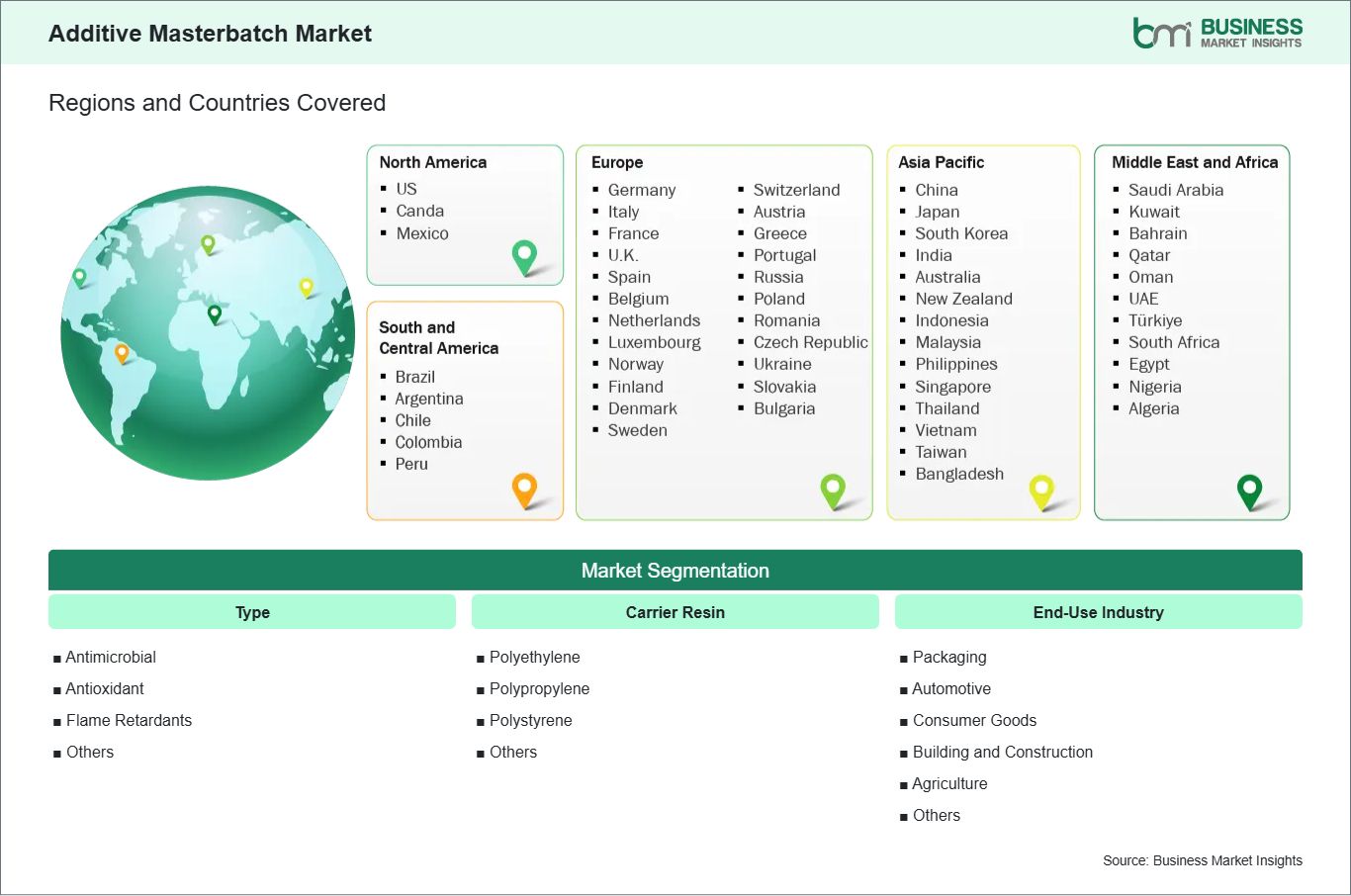
Key segments that contributed to the derivation of the Additive Masterbatch market analysis are type, carrier resin, and end-use industry.
The masterbatch market in additives is being greatly driven by the increased usage of plastics in the packaging, automotive, building, consumer goods, agricultural, and electronic products sectors. Manufacturers are increasingly using additive masterbatches to enhance the mechanical strength, thermal stability, UV resistance, flame retardancy, and aesthetic appeal of plastic products. Additive masterbatches present a fast and economical means of imparting several functional characteristics to plastic components without modifying the fundamental polymer designs as end-use industries seek greater durability, safety, and performance in their components. Their capability to provide reliable quality, better process efficiency, and the life of the products favors their extensive use both in commodity and engineering plastics.
The move toward lightweight, high-performance, and application-specific plastic products is forcing processors and compounders to incorporate sophisticated additive technologies. The industries are investing significantly in research and product optimization to fulfill the changing performance standards and consumer expectations. The rapid industrialization, the development of infrastructures, and increasing consumption of plastic in the emerging economies also reinforce the market growth. Also, the growing interest in customizing material properties stimulates manufacturers to come up with new additive masterbatches products, thus guaranteeing the future development of the market.
The recyclable properties of additive solutions are progressively embraced by manufacturers to enhance the life span of a product, as well as to decrease waste in the process of making the product. Additive masterbatches are also used to facilitate effective utilization of materials, reduce energy usage, and enhance stability in the process, which is in line with the increasing demand for sustainable production of plastics. The bio-based additives, anti-degradants, and stabilizers are in demand because industries are trying to strike a balance between performance and environmental impact.
Government policies, stringent environmental laws, and global efforts toward eliminating plastic waste are favorable to the inventions of additive technologies that are environmentally sustainable. The industries are concentrating on the additives that make the products durable, recyclable more than once, and satisfy safety and environmental requirements. Enhanced economic efficiency across the product lifecycle, enhanced regulatory compliance, and minimization of environmental footprints rank high among what is driving the rapid uptake of sustainable and high-performance additive masterbatches in the world's plastic processing sectors.

The Additive Masterbatch market demonstrates steady growth, with size and share analysis revealing evolving trends and competitive positioning among key players. The report further examines subsegments categorized within type, carrier resin, and end-use industry, offering insights into their contribution to overall market performance.
Based on type, the antioxidant segment had the largest share of the additive masterbatch market. It offers plastic products better thermal stability, resistance to oxidation, and extended service life. These are popular additives in packaging, in automotive components, and in industrial plastics. This is what renders them the ideal choice of manufacturers that want uniform performance and long material life in the face of different end-use applications.
| Report Attribute | Details |
|---|---|
| Market size in 2025 | US$ 2.31 Billion |
| Market Size by 2033 | US$ 4.01 Billion |
| Global CAGR (2026 - 2033) | 7.14% |
| Historical Data | 2022-2024 |
| Forecast period | 2026-2033 |
| Segments Covered | By Type
|
|
Regions and Countries Covered
| |
| North America | US, Canada, Mexico |
| Europe | Belgium, Austria, Finland, Denmark, Greece, Poland, Romania, Russia, Ukraine, Czech Republic, Slovakia, Bulgaria, Italy, Luxembourg, Germany, Switzerland, France, Netherlands, Norway, Portugal, Spain, Sweden, United Kingdom |
| Asia-Pacific | Australia, China, India, Japan, South Korea, Indonesia, Malaysia, Philippines, Singapore, Thailand, Vietnam, Bangladesh, New Zealand, Taiwan |
| South and Central America | Brazil, Argentina, Peru, Chile, Colombia |
| Middle East and Africa | Bahrain, Kuwait, Oman, Qatar, Saudi Arabia, United Arab Emirates, Turkiye, South Africa, Egypt, Algeria, Nigeria |
| Market leaders and key company profiles |
|
The " Additive Masterbatch Market Size and Forecast (2022–2033)" report provides a detailed analysis of the market covering below areas:
The geographical scope of the Additive Masterbatch market report is divided into five regions: North America, Asia Pacific, Europe, the Middle East & Africa, and South & Central America.
The Asia-Pacific Additive Masterbatch Market is segmented into China, Japan, South Korea, India, Australia, New Zealand, Indonesia, Malaysia, the Philippines, Singapore, Thailand, Vietnam, Taiwan, Bangladesh, and the Rest of Asia Pacific. Asia Pacific remains the dominant region in the additive masterbatch market, supported by its extensive plastics manufacturing base and rapid industrialization across key sectors such as packaging, automotive, construction, and consumer goods. The region’s expanding demand for high‑performance and function‑specific plastics, particularly those requiring UV stabilization, antioxidant protection, and flame‑retardant properties, continues to accelerate market growth. Rising urbanization, increasing per‑capita plastic consumption, and heightened awareness around material quality and sustainability further strengthen the Asia Pacific’s position as the global hub for both the production and consumption of additive masterbatches. Together, these factors reinforce the region’s leadership role in driving innovation and scale within the global plastics value chain.

The Additive Masterbatch market is evaluated by gathering qualitative and quantitative data post-primary and secondary research, which includes important corporate publications, association data, and databases. A few of the key developments in the additive masterbatch market are:
The Additive Masterbatch Market is valued at US$ 2.31 Billion in 2025, it is projected to reach US$ 4.01 Billion by 2033.
As per our report Additive Masterbatch Market, the market size is valued at US$ 2.31 Billion in 2025, projecting it to reach US$ 4.01 Billion by 2033. This translates to a CAGR of approximately 7.14% during the forecast period.
The Additive Masterbatch Market report typically cover these key segments-
The historic period, base year, and forecast period can vary slightly depending on the specific market research report. However, for the Additive Masterbatch Market report:
The Additive Masterbatch Market is populated by several key players, each contributing to its growth and innovation. Some of the major players include:
The Additive Masterbatch Market report is valuable for diverse stakeholders, including:
Essentially, anyone involved in or considering involvement in the Additive Masterbatch Market value chain can benefit from the information contained in a comprehensive market report.
Please tell us your area of interest
(Market Segments/ Regions and Countries/ Companies)