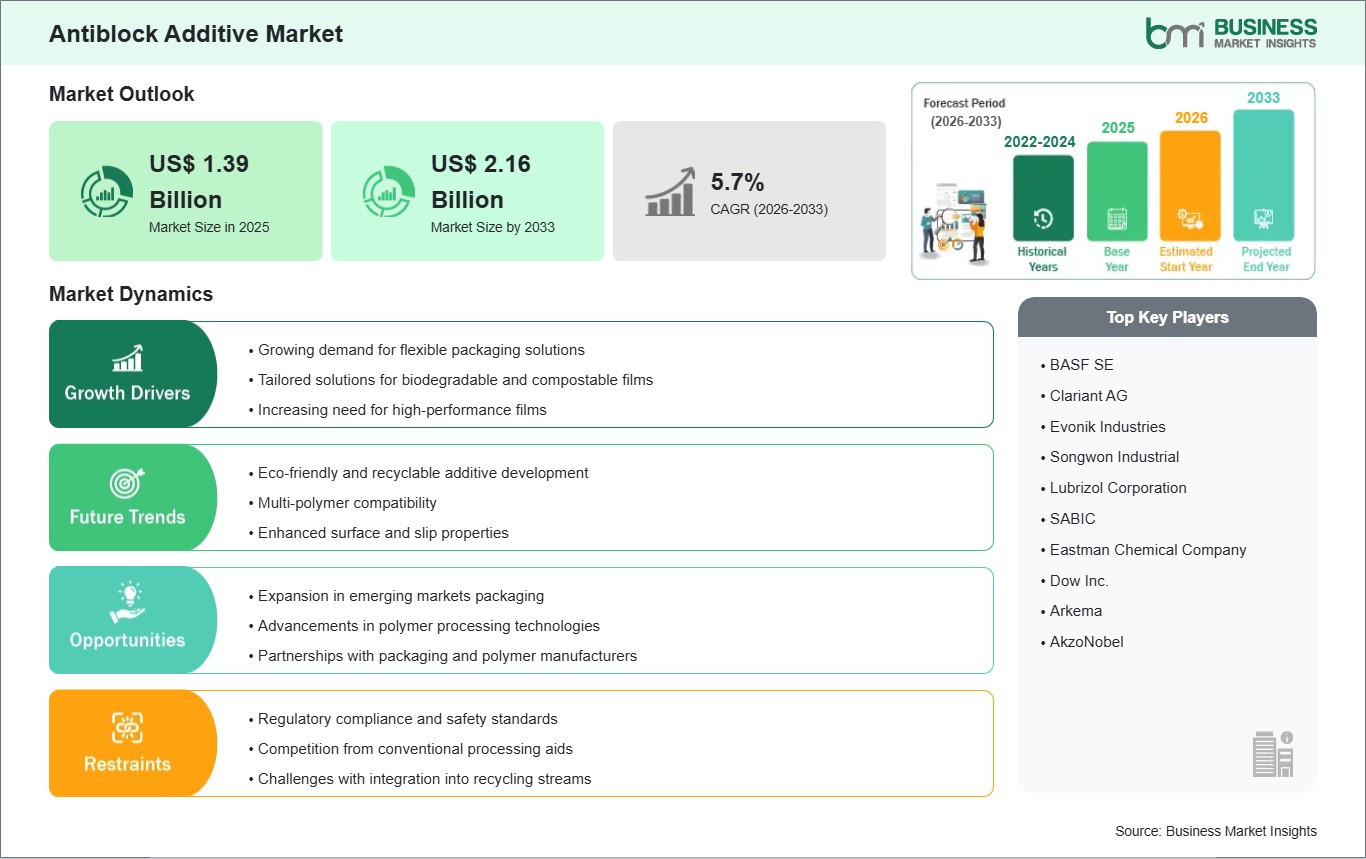
The Antiblock Additive Market size is expected to reach US$ 2.16 Billion by 2033 from US$ 1.39 Billion in 2025 .The market is estimated to record a CAGR of 5.7% from 2026 to 2033.
The global antiblock additive market is experiencing steady growth, driven by increasing demand for high-performance plastic films in packaging and industrial applications. Antiblock additives are incorporated into polymer films to prevent adhesion between layers, improving handling, processing efficiency, and end-use performance.
These additives are widely used in polyethylene and polypropylene films, particularly in flexible packaging applications such as food packaging, agricultural films, and industrial wraps. By reducing surface friction and blocking, antiblock additives enhance film clarity, machinability, and durability.
The market is also benefiting from the rapid growth of the packaging industry, especially in emerging economies where demand for packaged food and consumer goods is rising. Manufacturers are focusing on developing advanced additives that offer improved dispersion, compatibility with various polymers, and compliance with food safety regulations.

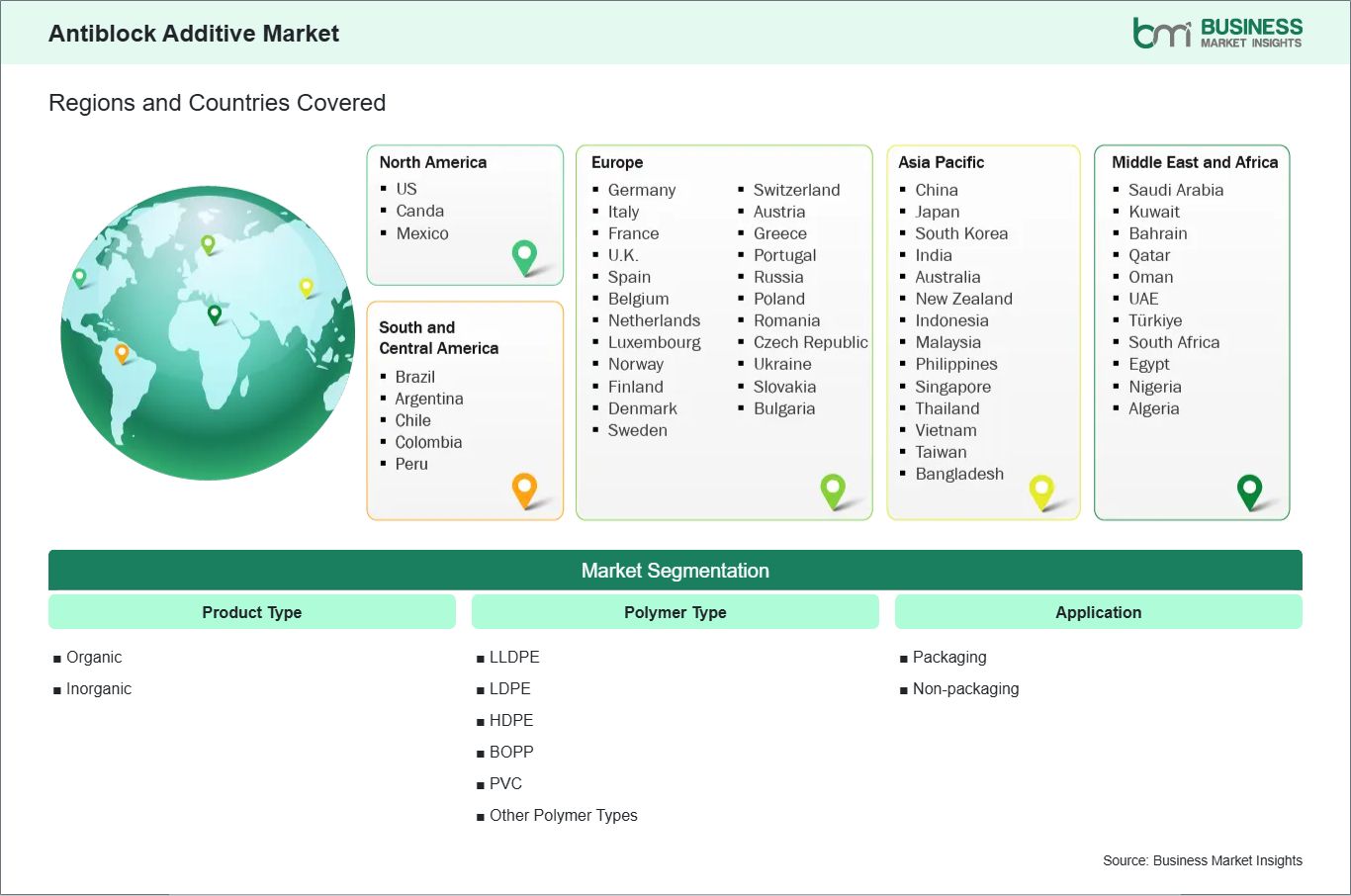
Key segments that contributed to the derivation of the antiblock additive market analysis are product type, polymer type, and application.
As the packaged food and beverage industries and the consumer goods sectors continue to grow rapidly, we are seeing a strong forward push in the antiblock additive industry. Flexible packaging, such as polyethylene and polypropylene films are widely used for their light weight and low cost and will help maintain the freshness of products. One of the common problems flexible films face during processing and handling is they can stick together, thereby decreasing productivity and product quality. Antiblock additives, which provide micro-rough surfaces to create a barrier between film layers, are critical to resolving sticking issues in order to enhance the overall processing of films.
This attribute contributes to a more efficient processing of film, and there is a higher throughput of films manufactured to produce ‘consistent’ finished products when antiblock additives are incorporated. As e-commerce and modern retail continue to grow, so does the need for more efficient packaging. As a result, manufacturers are continually searching for packaging materials that are easy to handle, provide long-term durability, and are also visually attractive. Flexible packaging also supports sustainability initiatives by using fewer materials than rigid packaging; antiblock additives improve the utility of flexible packaging in many different applications, thereby further reducing the environmental impact of packaging.
Consumer lifestyles are increasingly moving toward greater convenience and consumption of products on-the-go; therefore, the demand for dependable packaging continues to increase. In addition to enhancing operational efficiency, antiblock additives enable manufacturers to comply with increasingly strict safety and quality standards. Packaging is also becoming more and more important from a marketing perspective.
Technological progress in polymer processing and film extrusion is opening new opportunities for the antiblock additives market. Modern extrusion techniques demand additives that can deliver precise particle size distribution, ensuring uniform performance without compromising film clarity. Innovations in additive chemistry are enabling better compatibility with a wide range of polymers, including polyethylene, polypropylene, and emerging bio‑based plastics. This compatibility is vital for maintaining film transparency and mechanical strength while preventing blocking during production and storage.
The push toward sustainable packaging is also reshaping the market. With increasing regulatory and consumer pressure to reduce environmental impact, manufacturers are developing antiblock additives that work effectively with recyclable and biodegradable materials. These eco‑friendly solutions allow companies to meet sustainability targets without sacrificing performance. For example, additives designed for compostable films ensure smooth processing while maintaining compliance with green packaging standards.
Beyond sustainability, technological advancements are enhancing performance characteristics such as faster curing times, improved slip resistance, and superior surface finishes. These innovations reduce downtime, increase production efficiency, and expand the application scope of antiblock additives into areas like high‑clarity food packaging, medical films, and specialty industrial applications.
As polymer science continues to evolve, antiblock additives are becoming more sophisticated, offering tailored solutions for diverse industry needs. This convergence of technology, sustainability, and performance is expected to drive significant growth in the market, positioning advanced antiblock additives as essential components in the future of packaging and polymer processing.

The Antiblock Additive Market demonstrates steady growth, with size and share analysis highlighting evolving trends and competitive dynamics among key players. The report examines subsegments categorized within product type, polymer type, and application, offering insights into their contribution to overall market performance.
By product type, the inorganic subsegment dominated the market in 2025, driven by its effectiveness in reducing film blocking and improving processing efficiency.
Based on polymer type, the LLDPE subsegment dominated the market in 2025, driven by its widespread use in flexible packaging applications.
In terms of application, the packaging subsegment dominated the market in 2025, driven by increasing demand for high-quality packaging materials.
| Report Attribute | Details |
|---|---|
| Market size in 2025 | US$ 1.39 Billion |
| Market Size by 2033 | US$ 2.16 Billion |
| Global CAGR (2026 - 2033) | 5.7% |
| Historical Data | 2022-2024 |
| Forecast period | 2026-2033 |
| Segments Covered | By Product Type
|
|
Regions and Countries Covered
| |
| North America | US, Canada, Mexico |
| Europe | Belgium, Austria, Finland, Denmark, Greece, Poland, Romania, Russia, Ukraine, Czech Republic, Slovakia, Bulgaria, Italy, Luxembourg, Germany, Switzerland, France, Netherlands, Norway, Portugal, Spain, Sweden, United Kingdom |
| Asia-Pacific | Australia, China, India, Japan, South Korea, Indonesia, Malaysia, Philippines, Singapore, Thailand, Vietnam, Bangladesh, New Zealand, Taiwan |
| South and Central America | Brazil, Argentina, Peru, Chile, Colombia |
| Middle East and Africa | Bahrain, Kuwait, Oman, Qatar, Saudi Arabia, United Arab Emirates, Turkiye, South Africa, Egypt, Algeria, Nigeria |
| Market leaders and key company profiles |
|
The "Antiblock Additive Market Size and Forecast (2022 - 2033)" report provides a detailed analysis of the market covering below areas:
The geographical scope of the Antiblock Additive Market report is divided into North America, Asia Pacific, Europe, Middle East & Africa, and South & Central America. North America held the largest share in 2025.
North America and Europe are characterized by advanced packaging technologies and stringent regulations related to food safety and sustainability. These regions are witnessing increased adoption of high-performance and eco-friendly additives.
Asia Pacific market is growing due to rapid growth in packaging, food processing, and consumer goods industries. Countries such as China and India are major contributors, supported by increasing population, urbanization, and demand for packaged products.
The Middle East & Africa and South & Central America are experiencing gradual growth, driven by expanding industrial activities and rising demand for flexible packaging solutions. Across all regions, technological advancements and sustainability trends are shaping market dynamics.

The Antiblock Additive Market is evaluated by gathering qualitative and quantitative data post primary and secondary research, which includes important corporate publications, association data, and databases. A few of the key developments in the antiblock additive market are:
The Antiblock Additive Market is valued at US$ 1.39 Billion in 2025, it is projected to reach US$ 2.16 Billion by 2033.
As per our report Antiblock Additive Market, the market size is valued at US$ 1.39 Billion in 2025, projecting it to reach US$ 2.16 Billion by 2033. This translates to a CAGR of approximately 5.7% during the forecast period.
The Antiblock Additive Market report typically cover these key segments-
The historic period, base year, and forecast period can vary slightly depending on the specific market research report. However, for the Antiblock Additive Market report:
The Antiblock Additive Market is populated by several key players, each contributing to its growth and innovation. Some of the major players include:
The Antiblock Additive Market report is valuable for diverse stakeholders, including:
Essentially, anyone involved in or considering involvement in the Antiblock Additive Market value chain can benefit from the information contained in a comprehensive market report.
Please tell us your area of interest
(Market Segments/ Regions and Countries/ Companies)