Market Summary
Executive Summary and Global Market Analysis
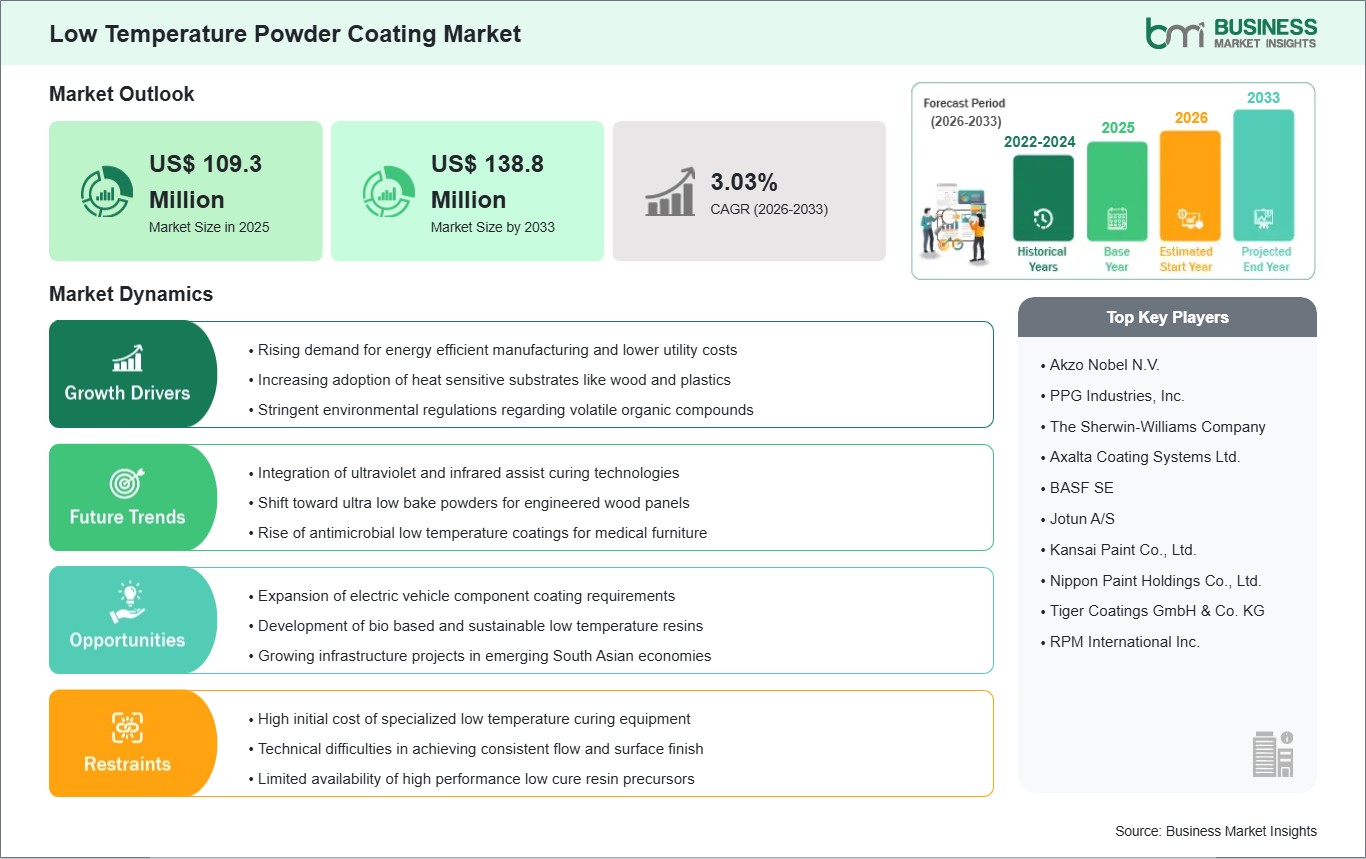
The low temperature powder coating industry across the globe is dominated by the strategic shift towards sustainability and efficiency. The advanced coating materials are developed to cure at low temperatures that are significantly lower than the conventional powders. The low-temperature powders can be used to coat materials that are heat sensitive in nature, such as medium-density fiberboard, plastics, and special alloys. The low-temperature powders have opened up new markets beyond the conventional industrial sector and have penetrated the consumer electronics industry. The industry is currently dominated by the twin needs of saving energy and adhering to the stringent regulations that govern the air quality and emissions globally.
Technological innovation is still the key driver in this competitive picture. Resin chemists are continuing to fine-tune polyester and epoxy hybrid materials to ensure that reduced curing temperatures do not have any impact on surface appearance or longevity. The regional markets with high concentrations of automotive and appliance manufacturing have high growth rates, where the benefits of reduced cycle time and energy cost savings are maximized. As we transition toward a more circular economy, the recyclability of powder coatings, in conjunction with the energy-saving benefits of low-temperature products, makes this market an essential part of any future vision of green manufacturing.
Segment Analysis
Low Temperature Powder Coating Market Segmentation
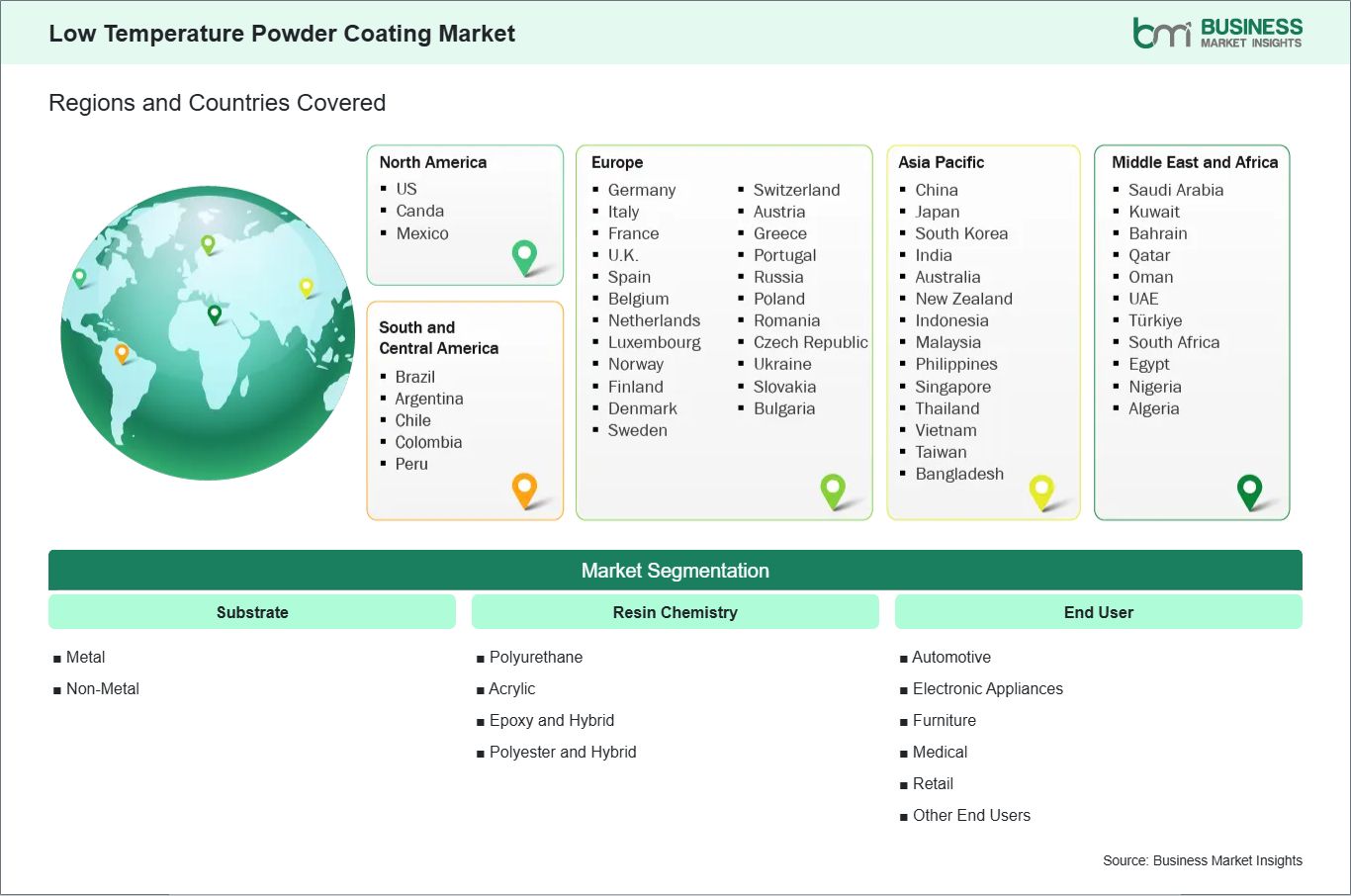
Key segments that contributed to the derivation of the Low Temperature Powder Coating market analysis are substrate, resin chemistry, and end user.
- By substrate, the low temperature powder coating market is segmented into Metal and Non-Metal. The Metal segment dominated the market in 2025.
- By resin chemistry, the low temperature powder coating market is segmented into Polyurethane, Acrylic, Epoxy and Hybrid, and Polyester and Hybrid. The Polyester and Hybrid segment dominated the market in 2025.
- By end user, the low temperature powder coating market is segmented into Automotive, Electronic Appliances, Furniture, Medical, Retail, and Other End Users. The Automotive segment dominated the market in 2025.
Market Forces
Low Temperature Powder Coating Market Drivers and Opportunities
Rising demand for energy efficient manufacturing and lower utility costs
The global industrial sector is facing immense pressure to reduce its operational expenses while maintaining its sustainability goals. Traditionally, the process of powder coating has involved high oven temperatures, which are above 200°C, to ensure proper cross-linking and film forming. However, the use of low-temperature coatings has the potential to reduce the amount of heat required in the curing process. This has the potential to reduce the operational expenses, considering the impact on the utility bills. Additionally, the process would enable the reduction of the burn rate of industrial ovens, which is likely to be beneficial in regions where there is high volatility in the cost of electricity and gas.
Moreover, energy efficiency is no longer just a cost-saving measure but a core component of corporate social responsibility. Major OEMs are setting ambitious net-zero targets, and the painting shop is historically one of the most energy-intensive parts of the factory. Implementing low-cure powders enables these companies to report lower carbon emissions per unit produced. This shift is supported by advancements in catalyst technology that allow resins to react at temperatures as low as 150°C without sacrificing the mechanical integrity of the finish. As energy prices continue to be a primary concern for the global supply chain, the drive toward thermal optimization remains a powerful market force.
Expansion of electric vehicle component coating requirements
The growth of electric vehicles has created a new opportunity for the low temperature powder coating market, which is of significant value. Unlike conventional combustion engine vehicles, electric vehicles consist of various electronic components, battery cases, and lightweight composite materials that are unable to withstand the high-temperature cycles of conventional coating systems. Low-temperature powder coatings can be used to apply protective coatings to these components without compromising their internal electronic circuitry or structural adhesive bonds. These factors are of significant importance in battery thermal management systems.
Moreover, the dielectric properties of certain types of epoxy or hybrid low cure powders also provide a secondary advantage in that they provide electrical insulation for battery cells or busbars. With the integration of vehicle architecture, there is an ever-increasing demand for coatings that not only provide protective qualities against corrosion but also offer dielectric properties at lower curing temperatures. This is creating an opportunity for chemical manufacturers to create unique products that cater specifically to the automotive electronics sector. The meeting point of green mobility and surface materials is arguably one of the most exciting opportunities for future growth, with each new electric vehicle requiring unique thermal management solutions.
Size and Share Analysis
Low Temperature Powder Coating Market Size and Share Analysis
The global Low Temperature Powder Coating market is experiencing steady growth, with market size and share analysis reflecting evolving treatment preferences and competitive dynamics among key players. The report evaluates important subsegments categorized within substrate, resin chemistry, and end user, highlighting their respective contributions to overall market performance.
By substrate, the Metal subsegment dominated the market in 2025 because of the long-standing use of aluminum and steel in industrial manufacturing, where these coatings offer significant energy savings and prevent metal warping during the curing process.
By resin chemistry, the Polyester and Hybrid subsegment dominated the market in 2025 due to its superior outdoor weathering resistance, UV stability, and versatility in providing a wide range of gloss levels for both decorative and functional applications.
By end user, the Automotive subsegment dominated the market in 2025 because manufacturers increasingly adopted low-cure technologies to reduce the carbon footprint of production lines and to protect temperature-sensitive components found in modern vehicle assemblies.
Report Coverage
Low Temperature Powder Coating Market Report Coverage and Deliverables
The "Low Temperature Powder Coating Market Size and Forecast (2022 - 2033)" report provides a detailed analysis of the market covering below areas:
- Low Temperature Powder Coating market size and forecast at the regional and country levels for segments covered under the scope
- Low Temperature Powder Coating market trends, as well as drivers, restraints, and opportunities
- Low Temperature Powder Coating market analysis covering key trends, regional framework, major players, regulations, and recent developments
- Industry landscape and competition analysis covering market concentration, heat map analysis, prominent players, and recent developments for the Low Temperature Powder Coating market
- Detailed company profiles, including SWOT analysis
Geographic Insights
Low Temperature Powder Coating Market Geographic Insights
The geographical scope of the Low Temperature Powder Coating market report is divided into: North America, Asia Pacific, Europe, Middle East & Africa, and South & Central America. North America held the largest share in 2025.
North America stands as the dominant region in the low temperature powder coating market, a position rooted in its highly developed industrial base and early adoption of stringent environmental standards. The United States and Canada have implemented rigorous air quality mandates that limit the use of solvent-borne coatings, pushing manufacturers toward eco-friendly powder alternatives. This regulatory environment is complemented by a robust automotive and aerospace sector that prioritizes process innovation and cost reduction. The presence of leading global coating manufacturers in the region ensures a steady pipeline of advanced resin technologies and specialized curing equipment, allowing North American facilities to maintain high throughput with lower energy footprints.
Furthermore, the dominance of North America is bolstered by a strong consumer goods and furniture industry that is increasingly utilizing non-metal substrates. The region's expertise in wood finishing and plastic coating has led to the widespread integration of low-bake powders in residential and office furniture manufacturing. Additionally, the rapid expansion of the domestic electric vehicle supply chain has created a specialized demand for low-temperature solutions that protect sensitive battery components. High labor costs in the region also incentivize the adoption of automated, fast-curing powder lines that minimize manual intervention. This combination of technological leadership, regulatory pressure, and a diverse end-user base solidifies North America’s leading role in the global market hierarchy.
Industry Activity
Recent Developments
The Low Temperature Powder Coating market is evaluated by gathering qualitative and quantitative data post primary and secondary research, which includes important corporate publications, association data, and databases. A few of the key developments in the Low Temperature Powder Coating market are:
- In March 2024, AkzoNobel, announced the expansion of its powder coatings production facility in Como, Italy, including investments in low-temperature curing powder coating technologies to enhance supply for energy-efficient coating solutions.
- In June 2025, Sherwin-Williams, announced increased R&D investment focused on low-temperature curing powder coatings, aimed at enabling coating of heat-sensitive substrates such as engineered wood and thin metals while reducing energy consumption.
- In May 2025, PPG Industries, announced the development of advanced sustainable powder coatings incorporating recycled materials and PFAS-free formulations, supporting low-temperature and environmentally compliant coating applications.
Trust & Transparency
Research Methodology
The market analysis combines proprietary research with secondary data from government agencies, company disclosures, regulatory filings, industry databases and expert interviews. Market estimates are validated through data triangulation, cross-market benchmarking and analyst
review.
View Full Research Methodology
Key Sources Referred:
American Chemistry Council (ACC)International Council of Chemical Associations (ICCA)European Chemical Industry Council (Cefic)China National Building Materials Group (CNBM)Indian Minerals & Granite Exporters Association (IMGEA)Japan Mining Industry Association (JMIA)Brazilian Mining Association (IBRAM)Gulf Petrochemicals and Chemicals Association (GPCA)Company WebsitesCompany Annual ReportsCompany Investor Presentations