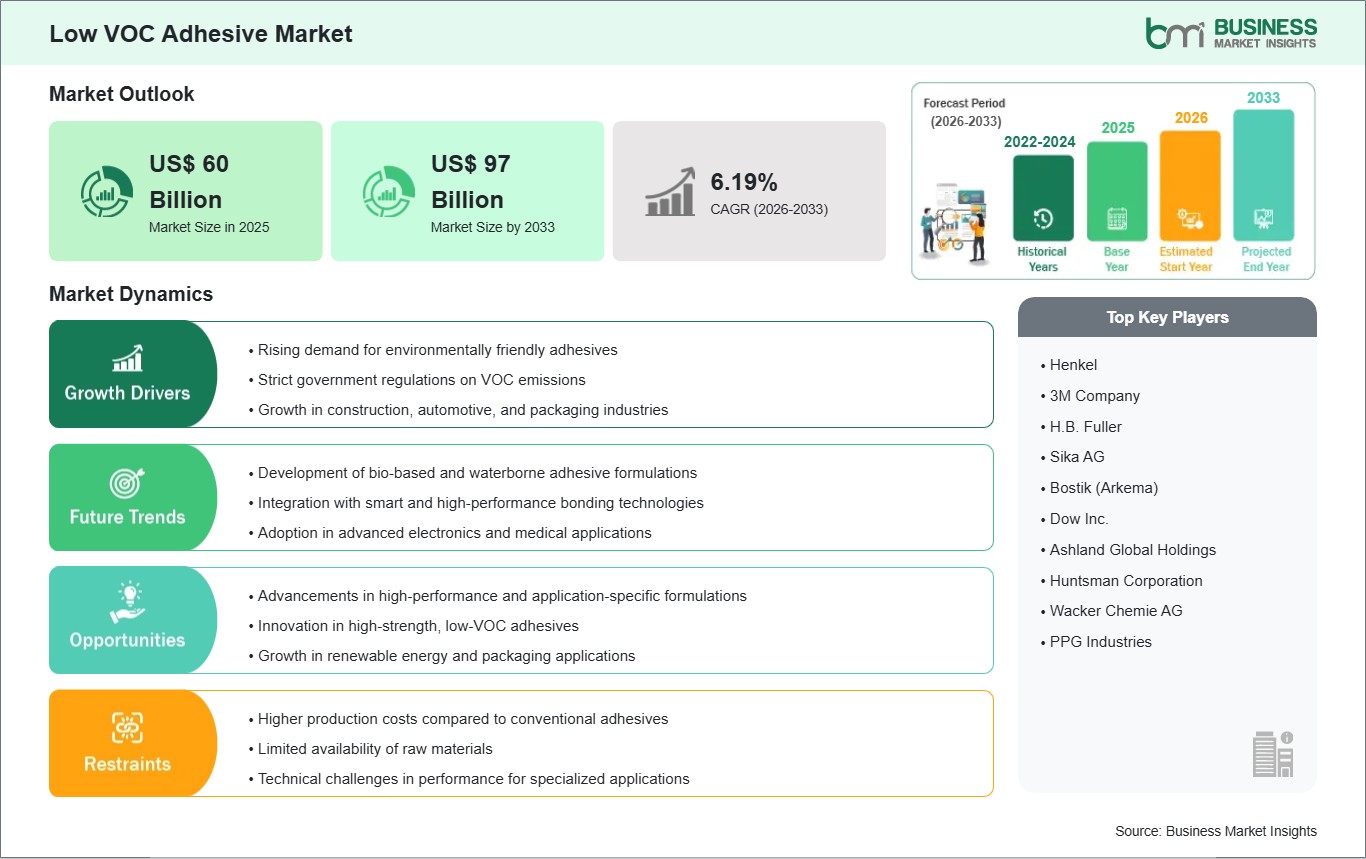
The Low VOC Adhesive Market size is expected to reach US$ 97 Billion by 2033 from US$ 60 Billion in 2025. The market is estimated to record a CAGR of 6.19% from 2026 to 2033.
In many industries, there is an increasing focus on environmentally friendly and health-conscious bonding systems, which has led to substantial expansion of the global low VOC (volatile organic compound) adhesive market. Low VOC adhesives are designed to emit little or no pollutants when used to bond materials, providing a high level of bonding performance across a variety of materials, from wood and metal, to plastic and glass, to composite materials. Low VOC adhesives are being used in many industries, including construction, furniture, automotive, packaging, electronics and home improvement projects, where compliance with product specifications, air quality considerations, and sustainability are major factors in choosing products. Many companies are developing water-based, solvent-free and bio-based adhesives to meet the increased awareness of worker safety and strict environmental regulations.
The use of technology, such as high-speed curing processes, temperature resistance, and compatibility with materials, is allowing manufacturers to create stronger adhesives with faster curing times, while still complying with VOC limits. Manufacturers are also providing more customized solutions to meet the needs of industrial and consumer customers, including high-performance structural adhesives, sealants, and laminating compounds. Innovation and sustainability are the primary drivers of market competitiveness, and companies are increasingly dependent on product innovation, sustainability credentials, technical assistance, and compliance with international standards (e.g. LEED, BREEAM, EPA). Manufacturers are also benefitting from developing strategic alliances with original equipment manufacturers (OEMs) and construction integrators to increase the adoption of their products in high-growth sectors. As the demand for low-emission building materials, environmentally responsible packaging, and energy-efficient manufacturing increase, low VOC adhesives are becoming an integral part of environmentally responsible industrial processes

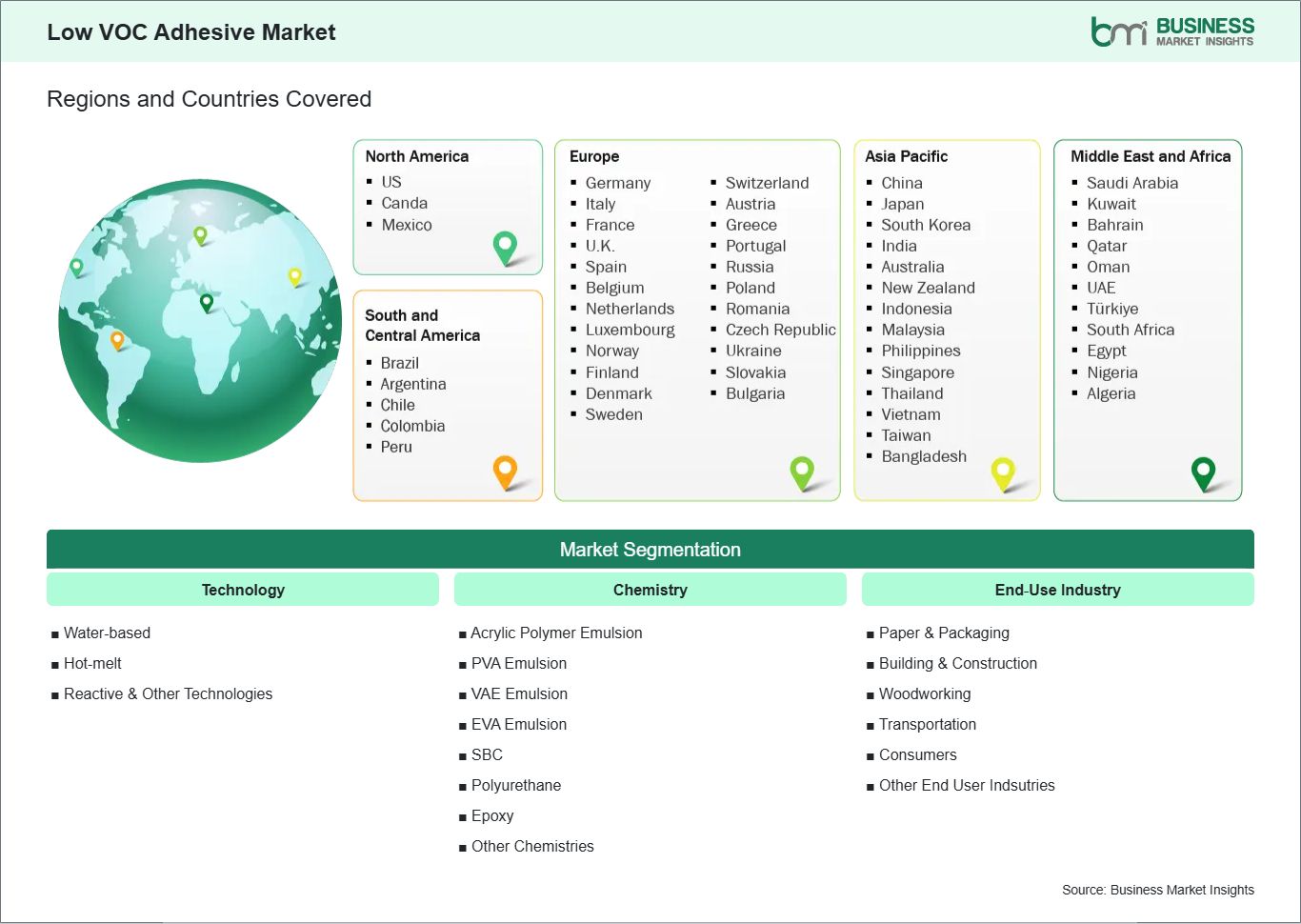
Key segments that contributed to the derivation of the low VOC adhesive market analysis are technology, chemistry, and end‑use industry.
The global marketplace is benefiting from an increase in environmental awareness and tighter regulations on volatile organic compounds (VOCs). Industries such as construction, automotive, packaging, and electronics are using low VOC adhesives due to lower amounts of air pollution, increased workplace safety, and meeting the sustainability standards of buyers. Low VOC adhesives meet consumer expectations by maintaining bonding performance between different types of materials with minimal release of harmful emissions. In both construction and interior applications, there is a preference for low VOC adhesives because they provide excellent adhesion and also contribute to better indoor air quality.
Manufacturers have developed low VOC adhesives that are compatible with many different substrates (wood, concrete, metals, plastics) while still providing performance characteristics under many different environmental conditions, making these adhesives very versatile. The trend towards using safer, greener adhesives has caused companies to reformulate existing adhesives to reduce the amount of VOCs in them without sacrificing their quality or durability. Increasingly many end-use customers consider the environmental credentials of low VOC adhesives as part of their corporate sustainability initiatives. Companies are using eco-friendly adhesive products to ensure compliance with green building certifications and other environmental policies. As a result, the market for low VOC adhesives will continue to grow as a result of both regulatory requirements and consumer demand.
Innovation in low VOC adhesive technologies is creating significant opportunities for market growth. Manufacturers are developing high-performance adhesives that maintain excellent bonding strength, flexibility, and durability while meeting stringent VOC emission standards. These advancements allow adhesives to be applied in demanding industrial processes without compromising safety or efficiency. R&D efforts are focused on creating application-specific formulations tailored to unique requirements, such as temperature resistance, moisture tolerance, and compatibility with specialized substrates. This customization enables wider adoption in industries including electronics, automotive assembly, packaging, and furniture manufacturing.
By addressing both functional and environmental requirements, these products offer added value to end-users. Furthermore, collaborations between adhesive producers and industrial clients are accelerating the development of innovative solutions that align with green manufacturing practices. Combining performance, sustainability, and ease of use, these innovations are driving the market toward broader acceptance, reinforcing low VOC adhesives as a critical component in environmentally conscious manufacturing and construction strategies worldwide.
The low VOC adhesive market demonstrates steady growth, with size and share analysis highlighting evolving trends and competitive dynamics among key players. The report examines subsegments categorized within technology, chemistry, and end‑use industry, offering insights into their contribution to overall market performance.
By Technology, the water‑based adhesive subsegment dominated the market in 2025, driven by its environmental compliance, ease of application, and widespread adoption across industries seeking greener adhesive solutions.
Based on Chemistry, the acrylic polymer emulsion subsegment dominated the market in 2025, owing to its strong adhesive performance, flexibility, and compatibility across paper, packaging, woodworking, and construction applications.
On the basis of End‑Use Industry, the paper & packaging subsegment dominated the market in 2025, supported by stringent environmental regulations and growing demand for sustainable packaging solutions.
| Report Attribute | Details |
|---|---|
| Market size in 2025 | US$ 60 Billion |
| Market Size by 2033 | US$ 97 Billion |
| Global CAGR (2026 - 2033) | 6.19% |
| Historical Data | 2022-2024 |
| Forecast period | 2026-2033 |
| Segments Covered | By Technology
|
|
Regions and Countries Covered
| |
| North America | US, Canada, Mexico |
| Europe | Belgium, Austria, Finland, Denmark, Greece, Poland, Romania, Russia, Ukraine, Czech Republic, Slovakia, Bulgaria, Italy, Luxembourg, Germany, Switzerland, France, Netherlands, Norway, Portugal, Spain, Sweden, United Kingdom |
| Asia-Pacific | Australia, China, India, Japan, South Korea, Indonesia, Malaysia, Philippines, Singapore, Thailand, Vietnam, Bangladesh, New Zealand, Taiwan |
| South and Central America | Brazil, Argentina, Peru, Chile, Colombia |
| Middle East and Africa | Bahrain, Kuwait, Oman, Qatar, Saudi Arabia, United Arab Emirates, Turkiye, South Africa, Egypt, Algeria, Nigeria |
| Market leaders and key company profiles |
|
The "Low VOC Adhesive Market Size and Forecast (2022 - 2033)" report provides a detailed analysis of the market covering below areas:
The geographical scope of the Low VOC Adhesive Market report is divided into North America, Asia Pacific, Europe, Middle East & Africa, and South & Central America. North America held the largest share in 2025.
Regional adoption of low VOC adhesives is shaped by industrial development, environmental regulations, and end-use sector growth. North America dominates due to stringent emission standards, sustainable building practices, and high awareness of indoor air quality in construction, automotive, and furniture sectors. The U.S. and Canada are leading in water-based, bio-based, and low-emission adhesive innovations. Europe maintains strong adoption, especially in Germany, France, and the UK, where environmental regulations, green building certifications, and sustainable industrial practices drive demand for low VOC solutions.
Asia Pacific is growing rapidly, driven by urbanization, construction expansion, and automotive and electronics manufacturing in China, Japan, India, and South Korea. Middle East & Africa is emerging, with adoption focused on commercial construction, industrial facilities, and furniture manufacturing, supported by increasing awareness of environmental and occupational health standards.
South & Central America, led by Brazil and Mexico, is gradually adopting low VOC adhesives in construction, automotive, and consumer goods manufacturing, driven by sustainability initiatives and growing regulatory oversight. Across all regions, product performance, environmental compliance, and application-specific customization remain critical factors influencing market growth and competitive positioning.

The Low VOC Adhesive Market is evaluated by gathering qualitative and quantitative data post primary and secondary research, which includes important corporate publications, association data, and databases. A few of the key developments in the low VOC adhesive market are:
The Low VOC Adhesive Market is valued at US$ 60 Billion in 2025, it is projected to reach US$ 97 Billion by 2033.
As per our report Low VOC Adhesive Market, the market size is valued at US$ 60 Billion in 2025, projecting it to reach US$ 97 Billion by 2033. This translates to a CAGR of approximately 6.19% during the forecast period.
The Low VOC Adhesive Market report typically cover these key segments-
The historic period, base year, and forecast period can vary slightly depending on the specific market research report. However, for the Low VOC Adhesive Market report:
The Low VOC Adhesive Market is populated by several key players, each contributing to its growth and innovation. Some of the major players include:
The Low VOC Adhesive Market report is valuable for diverse stakeholders, including:
Essentially, anyone involved in or considering involvement in the Low VOC Adhesive Market value chain can benefit from the information contained in a comprehensive market report.
Please tell us your area of interest
(Market Segments/ Regions and Countries/ Companies)