Market Summary
Executive Summary and Global Market Analysis
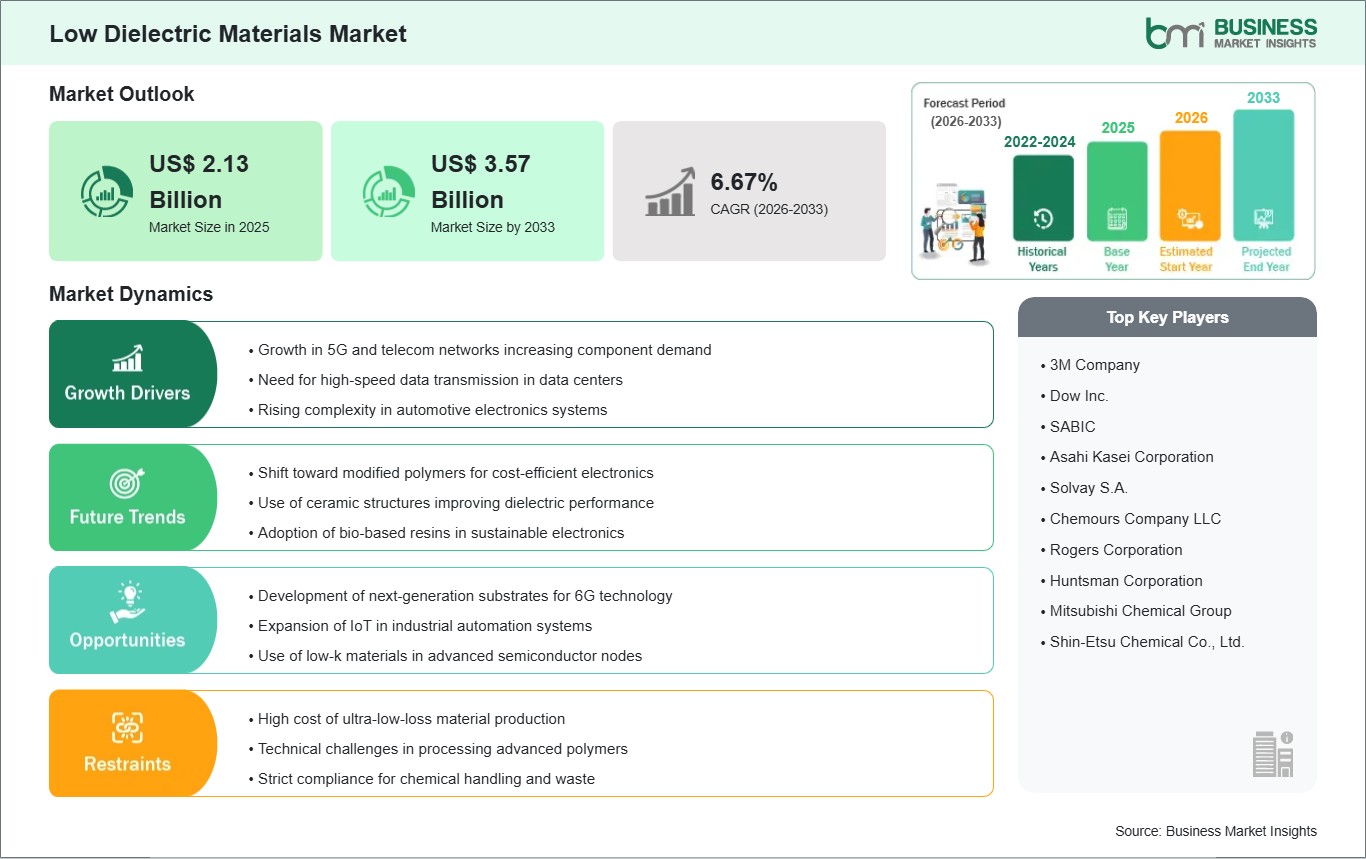
The world market for low dielectric materials is in an era of intense technological development, mainly driven by the growing demands of high-frequency electronic devices. With the telecommunications and data processing industries moving towards higher speeds and bandwidths in information transmission, it is imperative that insulating materials also develop to ensure that there is no degradation in signals and loss in transmitted energy. These materials, with their low dielectric constant and dissipation factor, have been the unsung heroes in our journey towards modern-day technology and computing. The world market for low dielectric materials is presently dominated by high-performance polymers and ceramics.
This market growth is also fueled by the general trend in the world towards the miniaturization of electronic devices, which demands materials with consistent electrical properties, even in extremely thin layers or complex three-dimensional structures. Although the telecommunication industry is the main driver of market volume, the automobile and aerospace industries are gaining importance as key high-value segments. Despite the challenges of high material costs and complex manufacturing processes, the industry's focus on innovation, coupled with the trend towards sustainable, recyclable materials, promises a bright future. The market is highly competitive, with a strong focus on research and development to meet the requirements of future 6G and AI technologies.
Segment Analysis
Low Dielectric Materials Market Segmentation
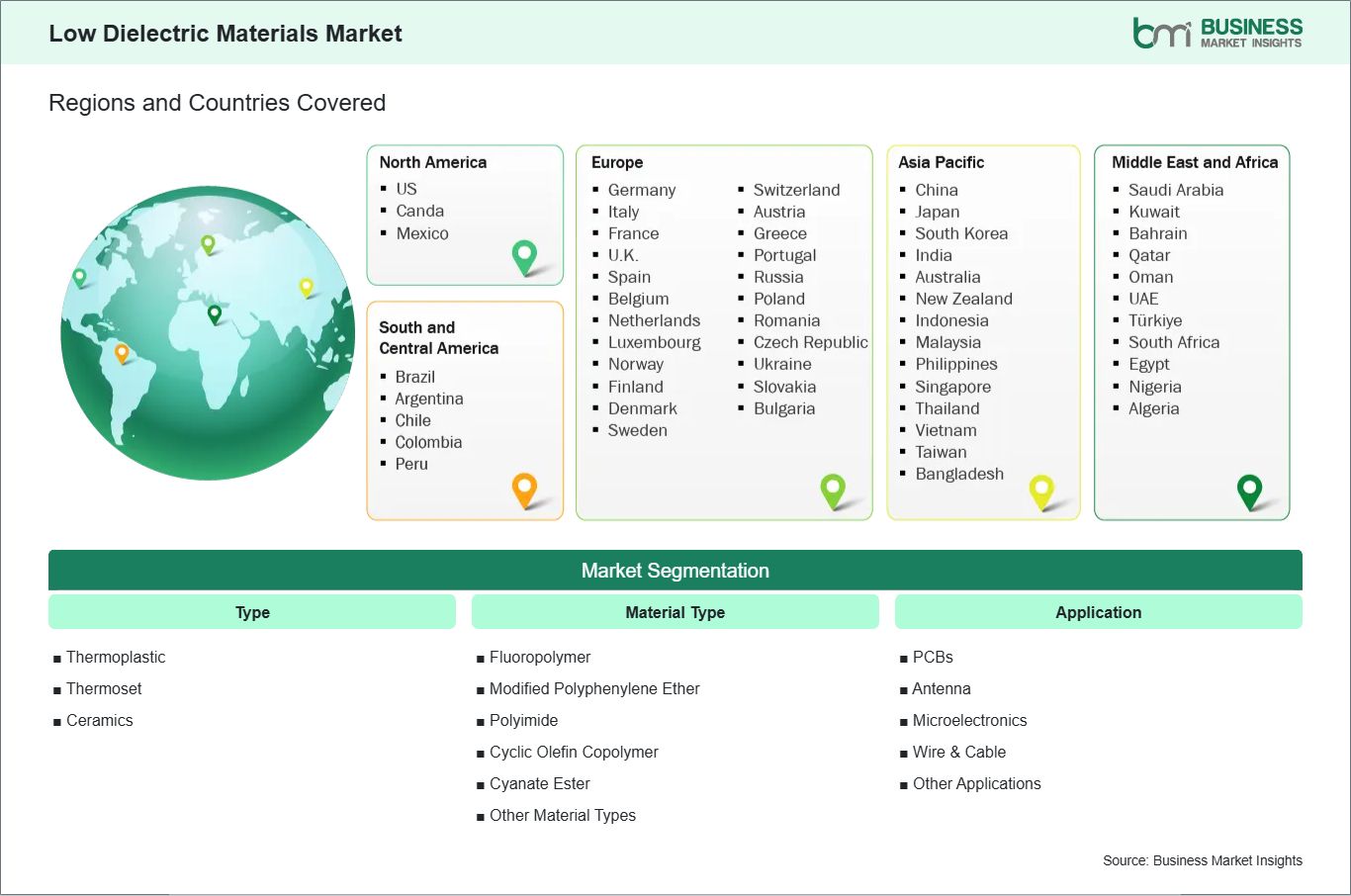
Key segments that contributed to the derivation of the Low Dielectric Materials market analysis are type, material type, and application.
- By type, the low dielectric materials market is segmented into Thermoplastic, Thermoset, and Ceramics. The Thermoset segment dominated the market in 2025.
- By material type, the low dielectric materials market is segmented into Fluoropolymer, Modified Polyphenylene Ether, Polyimide, Cyclic Olefin Copolymer, Cyanate Ester, and Other Material Types. The Fluoropolymer segment dominated the market in 2025.
- By application, the low dielectric materials market is segmented into PCBs, Antenna, Microelectronics, Wire & Cable, and Other Applications. The PCBs segment dominated the market in 2025.
Market Forces
Low Dielectric Materials Market Drivers and Opportunities
Surging global deployment of 5G and mmWave telecommunications networks
The move to fifth-generation wireless technology is a big change for the electronics materials industry. 5G networks work at much higher frequencies than older networks, so they need hardware that can handle millimeter-wave signals without losing much energy. At these frequencies, traditional insulating materials often have a lot of signal loss, which can cause overheating and a shorter network range. Because of this, there is a specific need for advanced polymers and ceramics that have a very low dielectric constant and loss tangent. These materials keep the signal clear and prevent the base stations from using too much power.
The rise of 5G-enabled consumer devices, such as smartphones and wearables, has made it necessary to redesign the internal parts of the infrastructure itself. To keep high data rates in hardware environments that are getting more crowded, antennas and internal circuit substrates need to be more efficient. To meet these strict standards, manufacturers are aggressively looking for high-purity polyimides and liquid crystal polymers. This demand isn't just about performance; it's also about making sure the network can do what it's supposed to do. As global coverage grows, the need for high-frequency hardware keeps growing. This creates a steady and recession-proof engine for the materials market.
Development of next-generation 6G compatible dielectric substrates
While 5G is being rolled out, the research and development community is already focusing on 6G, which is expected to use the terahertz frequency spectrum. Operating at these extreme levels brings a new set of challenges that current materials cannot completely solve. This gap has created a big opportunity for companies to innovate ultra-low-k dielectric substrates that provide near-zero signal interference. These materials are being designed with controlled porosity and precise molecular structures to ensure the necessary electrical insulation while meeting the massive bandwidth needs of the future. The first movers in this area are likely to secure high-margin contracts for pilot infrastructure and advanced research equipment.
This opportunity involves satellite communications and deep-space exploration, where high-frequency data links are essential. As the world shifts toward a more connected global satellite network, the hardware on these orbital platforms needs to be durable and energy-efficient. There is a high demand for low dielectric materials that can endure the vacuum of space and solar radiation while keeping their electrical properties. Creating these specialized materials requires teamwork between chemical manufacturers and aerospace designers. By establishing a presence in 6G development now, material providers are placing themselves at the leading edge of a technological cycle that will reshape global connectivity for decades to come.
Size and Share Analysis
Low Dielectric Materials Market Size and Share Analysis
The global Low Dielectric Materials market is experiencing steady growth, with market size and share analysis reflecting evolving treatment preferences and competitive dynamics among key players. The report evaluates important subsegments categorized within type, material type, and application, highlighting their respective contributions to overall market performance.
By type, the Thermoset subsegment dominated the market in 2025 due to its superior dimensional stability and high resistance to deformation under extreme thermal stress, making it the industry standard for high-density interconnects and structural electronics that require long-term reliability.
By material type, the Fluoropolymer subsegment dominated the market in 2025 because it offers an unrivaled combination of ultra-low dielectric constant and chemical inertness, which is essential for maintaining signal integrity in high-frequency 5G infrastructure and specialized aerospace communication systems.
By application, the PCBs subsegment dominated the market in 2025 as the rapid expansion of high-speed computing and advanced telecommunications increased the demand for multi-layered circuit boards that rely on low-loss substrates to minimize signal attenuation and crosstalk.
Report Coverage
Low Dielectric Materials Market Report Coverage and Deliverables
The "Low Dielectric Materials Market Size and Forecast (2022 - 2033)" report provides a detailed analysis of the market covering below areas:
- Low Dielectric Materials market size and forecast at the regional and country levels for segments covered under the scope
- Low Dielectric Materials market trends, as well as drivers, restraints, and opportunities
- Low Dielectric Materials market analysis covering key trends, regional framework, major players, regulations, and recent developments
- Industry landscape and competition analysis covering market concentration, heat map analysis, prominent players, and recent developments for the Low Dielectric Materials market
- Detailed company profiles, including SWOT analysis
Geographic Insights
Low Dielectric Materials Market Geographic Insights
The geographical scope of the Low Dielectric Materials market report is divided into: North America, Asia Pacific, Europe, Middle East & Africa, and South & Central America. North America held the largest share in 2025.
North America dominates the low dielectric materials market because it is the world center for semiconductors and the design of advanced telecommunications. The region also hosts some of the world’s greatest technology companies and defense firms responsible for setting the guidelines for next-generation communication standards. Such leadership enables low dielectric material suppliers to be located near end-users for quick prototyping and quick uptake of advanced dielectric solutions. Focus on the U.S. has been evident in domestic chip production, 5G building efforts, and stabilizing demand for top-tier PCBs and antenna components.
The region’s dominance is also reinforced by a strong regulatory framework and institutional support for technological innovation in the defense and aerospace sectors. Low dielectric materials are critical for stealth technology, radar systems, and secure satellite communications, all of which are priority areas for North American national security. Additionally, the presence of a mature venture capital ecosystem allows for the continuous funding of startups focused on material science and nanotechnology, keeping the region at the cutting edge of the industry. As North America continues to push the boundaries of high-speed computing and artificial intelligence, the demand for superior insulating materials that can support these energy-intensive and high-frequency environments is expected to remain the highest in the world.
Industry Activity
Recent Developments
The Low Dielectric Materials market is evaluated by gathering qualitative and quantitative data post primary and secondary research, which includes important corporate publications, association data, and databases. A few of the key developments in the Low Dielectric Materials market are:
- In February 2024, SABIC, announced new damp heat performance data for its Elcres™ HTV150A dielectric films at APEC 2024, demonstrating enhanced reliability for high-temperature electronic applications such as capacitors.
- In October 2024, DIC Corporation, in collaboration with Unitika, announced the development of a low-dielectric PPS film designed for millimeter-wave PCB and radar applications, supporting high-frequency communication systems.
- In 2023, DuPont, announced continued advancements in low dielectric constant materials for semiconductor and advanced packaging applications, focusing on reducing signal loss and improving performance in high-speed computing environments.
Trust & Transparency
Research Methodology
The market analysis combines proprietary research with secondary data from government agencies, company disclosures, regulatory filings, industry databases and expert interviews. Market estimates are validated through data triangulation, cross-market benchmarking and analyst
review.
View Full Research Methodology
Key Sources Referred:
American Chemistry Council (ACC)International Council of Chemical Associations (ICCA)European Chemical Industry Council (Cefic)China National Building Materials Group (CNBM)Indian Minerals & Granite Exporters Association (IMGEA)Japan Mining Industry Association (JMIA)Brazilian Mining Association (IBRAM)Gulf Petrochemicals and Chemicals Association (GPCA)Company WebsitesCompany Annual ReportsCompany Investor Presentations