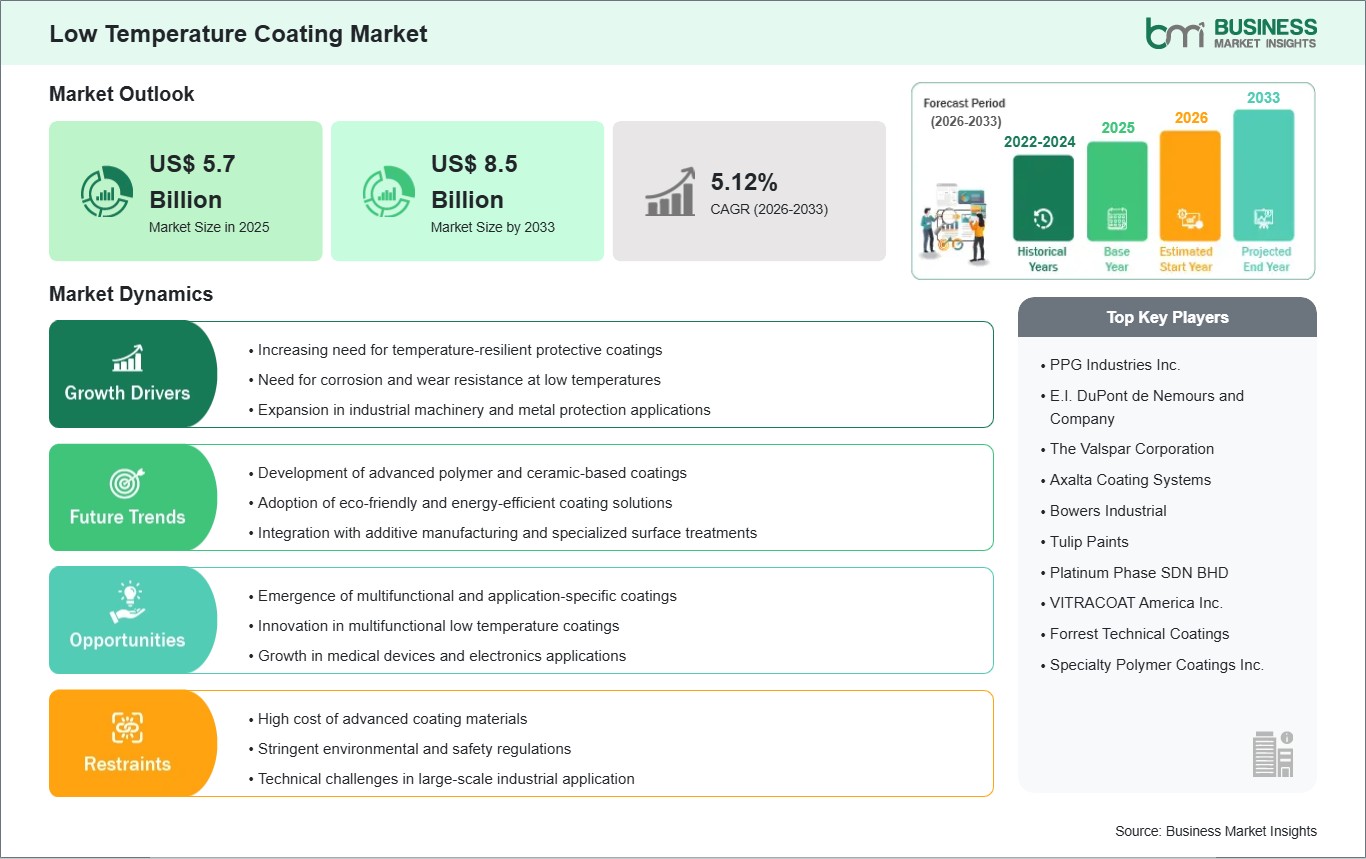
The Low Temperature Coating Market size is expected to reach US$ 8.5 Billion by 2033 from US$ 5.7 Billion in 2025. The market is estimated to record a CAGR of 5.12% from 2026 to 2033.
The global market for low-temperature coatings has been experiencing rapid growth as various industrial sectors seek coatings that will quickly cure while also delivering a high level of performance when working below room or moderate temperature conditions. These types of coatings are typically used in applications where traditional curing methods may not be suitable, such as in outdoor construction, cold-storage facilities, transportation equipment, pipelines, and various types of specialized machinery used in industrial settings. Low-temperature coatings can be manufactured from a variety of different product types including epoxy, polyurethane, acrylic, and waterborne formulations specifically designed for fast curing and good adhesion, corrosion protection, and long-lasting performance at low temperatures.
The drivers for market growth include the increasing demand for energy-efficient manufacturing methods, shorter cycle times, and lower levels of operational downtime during manufacturing and maintenance. Emerging trends associated with these coatings include the use of solvent-free and ultraviolet (UV) light curable formulations that provide substantially improved levels of environmental compliance and significantly reduced volatile organic compound (VOC) emissions during application. Other common trends include advancements in nano-additives and hybrid formulations, which can enhance the mechanical and chemical performance characteristics of these coatings, as well as improving surface appearance, even in extremely low-temperature environments.
Automotive, aerospace, oil and gas, and heavy engineering end-use industries are among the types of businesses increasingly using these types of coatings to extend their useful life, lower the cost of maintenance, and provide a better-performing product when used in severe working conditions. Companies that manufacture low-temperature coatings are focusing on product development, customized formulation, and providing technical assistance in order to meet specific industrial requirements and help develop a competitive advantage in this specialized category of coating products.

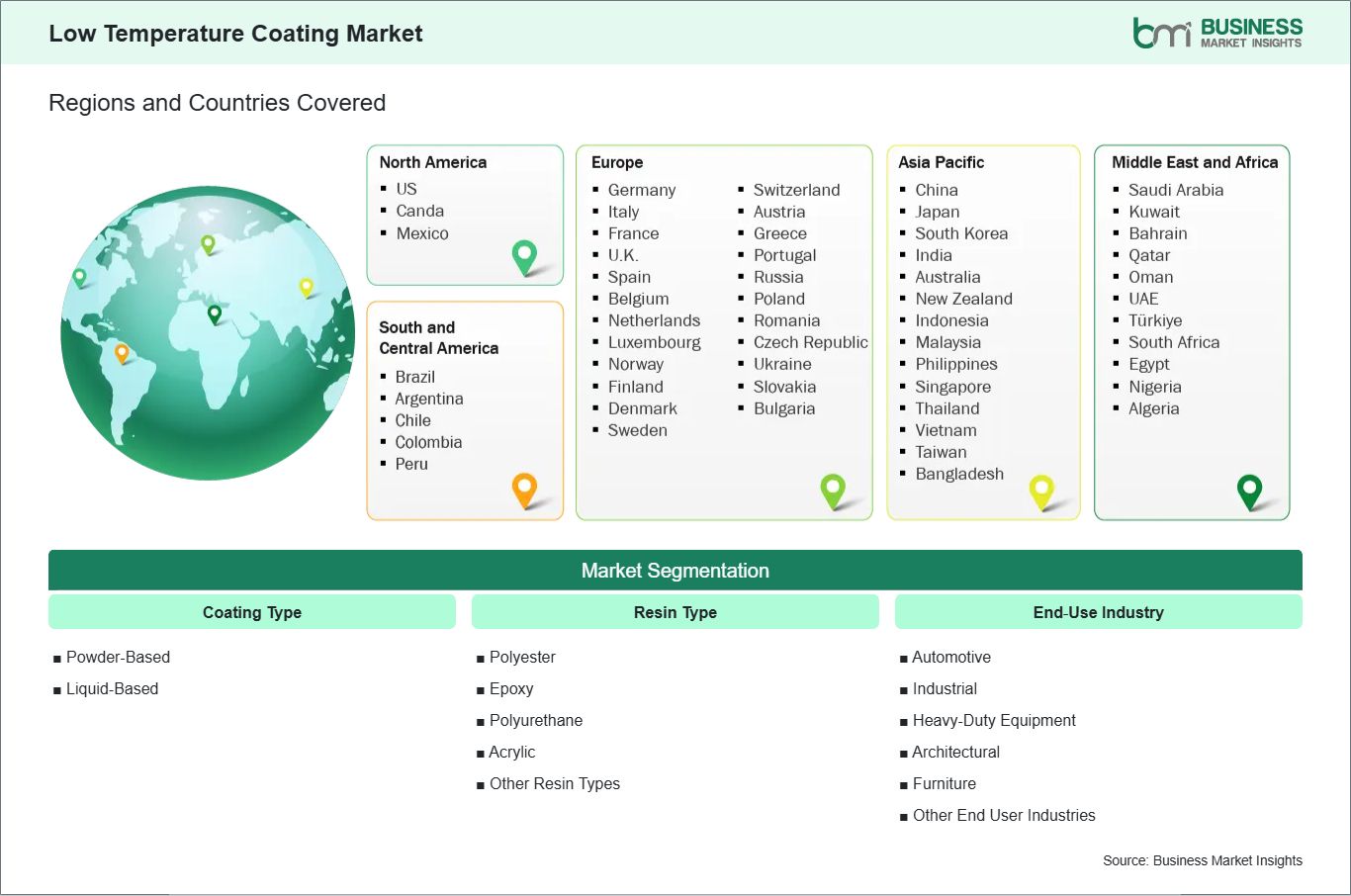
Key segments that contributed to the derivation of the low temperature coating market analysis are coating type, resin type, and end‑use industry.
The global low temperature coating market is expanding due to the rising need for coatings that can withstand extreme cold without compromising performance. Industrial equipment, transportation components, and infrastructure exposed to low temperatures require coatings that maintain structural integrity, prevent brittleness, and resist cracking. This growing emphasis on temperature resilience is driving the adoption of specialized coating solutions across multiple sectors. In applications such as refrigeration, cold storage facilities, and low-temperature processing plants, coatings are critical to preventing corrosion and material degradation. Companies are seeking formulations that not only protect surfaces but also improve operational reliability and reduce downtime caused by environmental stress. Low temperature coatings are increasingly integrated into preventive maintenance strategies to enhance asset longevity. Furthermore, industries facing extreme weather conditions are prioritizing protective solutions that maintain aesthetics and functionality even under freezing conditions. The rising awareness of lifecycle costs and maintenance challenges is encouraging organizations to invest in advanced low temperature coatings that provide consistent protection, positioning the market for steady growth across industrial and commercial applications.
Innovation in low temperature coatings is driving the development of multifunctional and application-specific solutions. Manufacturers are creating coatings that combine resistance to cold with additional performance characteristics such as chemical stability, abrasion resistance, and moisture protection. These advances allow coatings to serve multiple operational needs simultaneously, enhancing efficiency and reducing the need for multiple protective layers. Research is also focusing on tailoring formulations for diverse substrates, including metals, plastics, and composites, ensuring strong adhesion and durability in challenging environments. Customized solutions allow end-users to optimize performance for specific low-temperature conditions, increasing adoption across industrial, automotive, and energy sectors. Additionally, sustainable coating formulations are gaining attention, with manufacturers exploring eco-friendly additives and low-VOC alternatives that meet environmental regulations without compromising low-temperature performance. By combining enhanced functionality with compliance and operational efficiency, these innovations are creating opportunities for long-term market growth and wider adoption of low temperature coating technologies worldwide.
The low temperature coating market demonstrates steady growth, with size and share analysis highlighting evolving trends and competitive dynamics among key players. The report examines subsegments categorized within coating type, resin type, and end‑use industry, offering insights into their contribution to overall market performance.
By Coating Type, the powder‑based subsegment dominated the market in 2025, driven by its superior corrosion resistance, durability, and market acceptance in industrial applications.
Based on Resin Type, the polyester subsegment dominated the market in 2025, supported by its balanced chemical resistance, weatherability, and cost advantages.
On the basis of End‑Use Industry, the automotive subsegment dominated the market in 2025, owing to high demand for low cure coatings in automotive exterior and interior parts to protect against corrosion and improve finish quality.
| Report Attribute | Details |
|---|---|
| Market size in 2025 | US$ 5.7 Billion |
| Market Size by 2033 | US$ 8.5 Billion |
| Global CAGR (2026 - 2033) | 5.12% |
| Historical Data | 2022-2024 |
| Forecast period | 2026-2033 |
| Segments Covered | By Coating Type
|
|
Regions and Countries Covered
| |
| North America | US, Canada, Mexico |
| Europe | Belgium, Austria, Finland, Denmark, Greece, Poland, Romania, Russia, Ukraine, Czech Republic, Slovakia, Bulgaria, Italy, Luxembourg, Germany, Switzerland, France, Netherlands, Norway, Portugal, Spain, Sweden, United Kingdom |
| Asia-Pacific | Australia, China, India, Japan, South Korea, Indonesia, Malaysia, Philippines, Singapore, Thailand, Vietnam, Bangladesh, New Zealand, Taiwan |
| South and Central America | Brazil, Argentina, Peru, Chile, Colombia |
| Middle East and Africa | Bahrain, Kuwait, Oman, Qatar, Saudi Arabia, United Arab Emirates, Turkiye, South Africa, Egypt, Algeria, Nigeria |
| Market leaders and key company profiles |
|
The "Low Temperature Coating Market Size and Forecast (2022 - 2033)" report provides a detailed analysis of the market covering below areas:
The geographical scope of the Low Temperature Coating Market report is divided into North America, Asia Pacific, Europe, Middle East & Africa, and South & Central America. North America held the largest share in 2025.
Regional dynamics in the low temperature coating market reflect industrial activity, climate considerations, and infrastructure development. North America leads the market due to advanced industrial and aerospace manufacturing, extensive cold storage logistics, and stringent maintenance standards, with the U.S. and Canada investing in innovative coating solutions for pipelines, automotive parts, and industrial equipment. Europe maintains strong adoption, particularly in Germany, France, and the Nordic countries, where energy-efficient construction, renewable energy projects, and regulatory frameworks for VOC reduction drive demand for advanced low-temperature coatings.
Asia Pacific is experiencing rapid growth, driven by industrial expansion, construction activities, and growing automotive and aerospace production in China, Japan, South Korea, and India. Middle East & Africa is emerging, with demand focused on oil & gas infrastructure, industrial machinery, and logistics equipment that operate in extreme temperature conditions.
South & Central America, led by Brazil and Mexico, is gradually adopting low-temperature coatings in manufacturing, transportation, and construction projects, driven by durability and maintenance optimization needs. Across all regions, product innovation, environmental compliance, and application-specific performance remain critical drivers shaping market growth and competitive differentiation in the low temperature coatings sector.

The Low Temperature Coating Market is evaluated by gathering qualitative and quantitative data post primary and secondary research, which includes important corporate publications, association data, and databases. A few of the key developments in the low temperature coating market are:
The Low Temperature Coating Market is valued at US$ 5.7 Billion in 2025, it is projected to reach US$ 8.5 Billion by 2033.
As per our report Low Temperature Coating Market, the market size is valued at US$ 5.7 Billion in 2025, projecting it to reach US$ 8.5 Billion by 2033. This translates to a CAGR of approximately 5.12% during the forecast period.
The Low Temperature Coating Market report typically cover these key segments-
The historic period, base year, and forecast period can vary slightly depending on the specific market research report. However, for the Low Temperature Coating Market report:
The Low Temperature Coating Market is populated by several key players, each contributing to its growth and innovation. Some of the major players include:
The Low Temperature Coating Market report is valuable for diverse stakeholders, including:
Essentially, anyone involved in or considering involvement in the Low Temperature Coating Market value chain can benefit from the information contained in a comprehensive market report.
Please tell us your area of interest
(Market Segments/ Regions and Countries/ Companies)