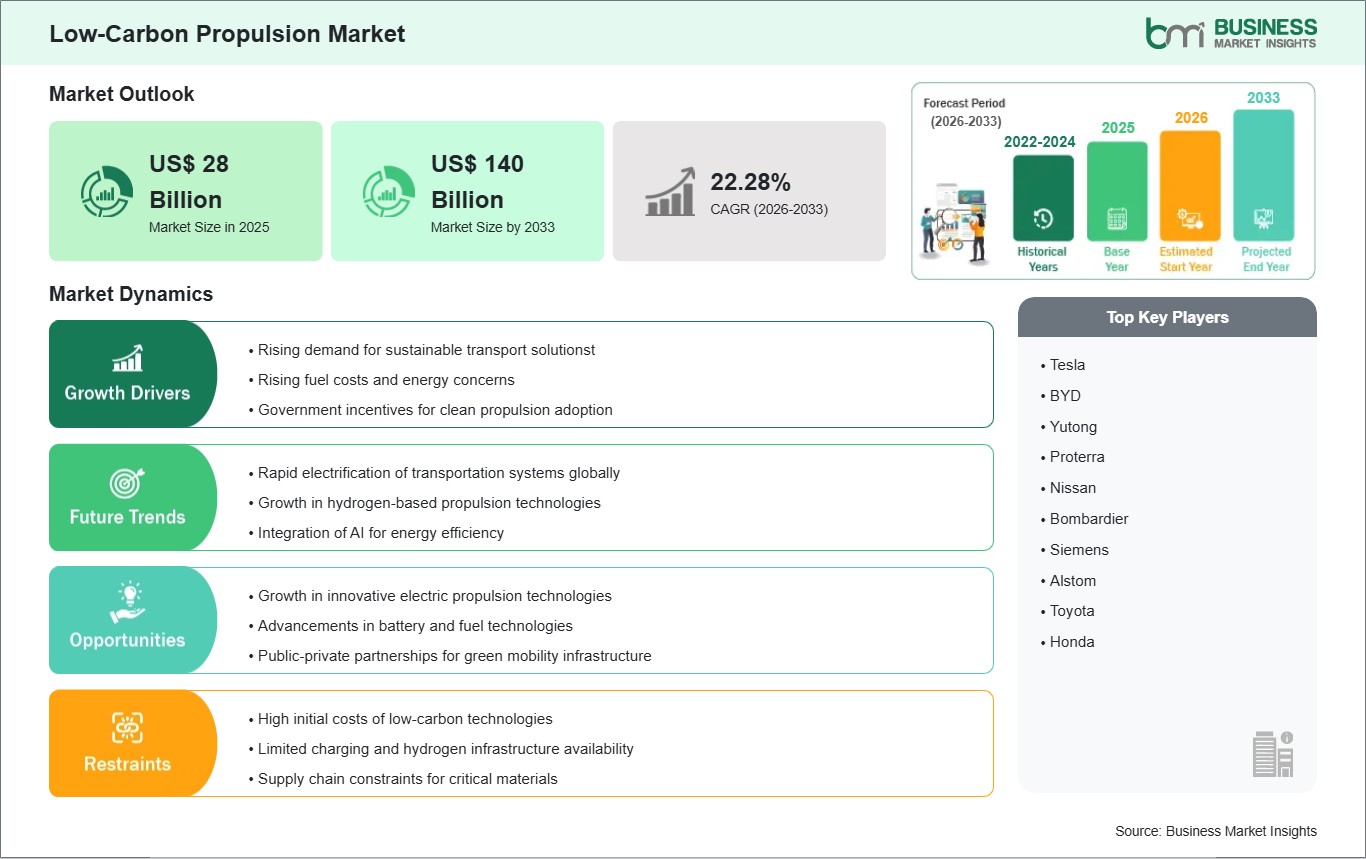
The Low-Carbon Propulsion Market size is expected to reach US$ 140 Billion by 2033 from US$ 28 Billion in 2025. The market is estimated to record a CAGR of 22.28% from 2026 to 2033.
The low‑carbon propulsion market is expanding rapidly as industries worldwide adopt sustainable mobility solutions and energy-efficient transportation methods. The automotive industry, the aerospace industry, the marine industry and the heavy-duty vehicle industry prioritize electric and hydrogen fuel-cell and biofuel and hybrid propulsion technologies. Regulatory mandates, which include strict emissions limits and zero-emission vehicle (ZEV) targets and sustainability frameworks, force OEMs and suppliers to fast-track their research and development efforts while expanding their propulsion system options. The passenger vehicle market and the commercial vehicle market show increasing demand for battery electric vehicles (BEVs) and modular hybrid systems, while hydrogen fuel cells and synthetic fuels gain popularity in heavy-duty transport and maritime applications.
Technological advancements in energy storage systems, power electronic devices and high-efficiency electric motors enable better performance and lower emissions throughout their lifecycle while making electric propulsion systems more affordable than traditional systems. Automotive companies, energy providers and component manufacturers are forming strategic partnerships to solve infrastructure problems, enhance supply chain efficiency and reduce total ownership costs. Market participants use financial tools like green bonds and carbon credits, and government incentives to speed up their market entry process. The global low-carbon propulsion market will benefit from technological innovation, which companies use with operational resilience and sustainability initiatives despite the challenges created by supply chain instability, their reliance on scarce materials and their insufficient charging and fueling infrastructure.

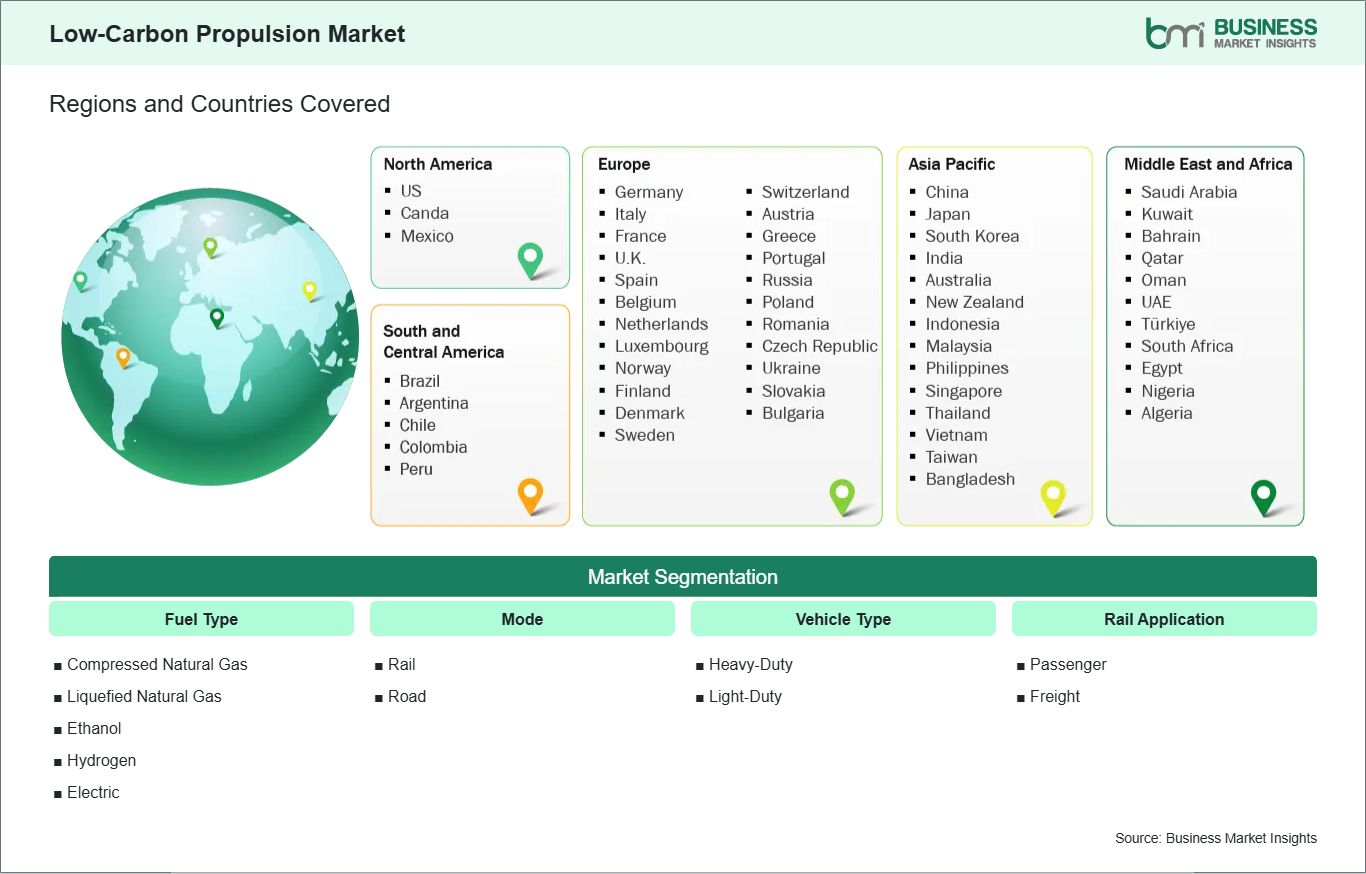
Key segments that contributed to the derivation of the low‑carbon propulsion market analysis are fuel type, mode, vehicle type, rail application, and electric vehicle type.
The global low-carbon propulsion market is experiencing a transformation because multiple regions are now adopting environmentally friendly transportation methods. The need for cleaner propulsion alternatives stems from established markets that already have emissions reduction regulations because they must decrease their emissions. The current transport planning process combines electrical system development with alternative fuel solutions to achieve decarbonization goals and better air quality results. The ongoing demand for low-carbon propulsion solutions has become a key focus area for both industrial and city transportation planners. The combined effect of strong manufacturing development and transportation policy incentives has resulted in rapid changes to fleet operations.
The shift from internal combustion engines to hybrid and electric drivetrains by urban bus networks and commercial vehicle segments creates a fundamental transformation in mobility service delivery. The market area is growing because investments in charging and refueling infrastructure, plus low emission vehicle procurement preferences, are expanding operations. Emerging economies are participating in market growth, but they adopt new technologies at different speeds. Public and private stakeholders are balancing infrastructure development with cost considerations, leading to phased deployment of low-carbon propulsion solutions. The example of electric bus rollouts and alternative fuel commercial fleet deployments shows how organizations now include eco-friendly transport solutions into their overall mobility plans, which increases regional demand and helps market development.
The global low-carbon propulsion market experiences its biggest growth through innovations that create new electric propulsion technologies. The development of new battery systems, powertrain designs and propulsion control systems leads to better performance, energy efficiency and dependable operation of multiple vehicle types. The advanced R&D ecosystems in various markets have made it easier for electric and hybrid propulsion systems to gain acceptance in both light and heavy transport vehicles. The main manufacturers, together with the technology developers, are optimizing their electric propulsion systems through their efforts to enhance system integration, energy storage capabilities and operational effectiveness throughout the system's entire lifespan. Solid-state batteries, modular drive systems and hybrid engine systems create new competitive advantages that make these technologies suitable for both fleet operators and individual customers.
The partnership between original equipment manufacturers and technology companies drives the development of new solutions, which leads to the creation of additional market alternatives. Electric propulsion technologies expand their applications from passenger vehicles to public transportation and freight operations and business use in areas where electrification infrastructure experiences fast growth. The establishment of charging networks and their associated support systems enables a system to operate at its full capacity while maintaining dependable performance. The system's economic performance and resilience improvements result from developments in power electronics, smart energy management and grid resource integration, which establish electric propulsion as a fundamental element for worldwide low-carbon transportation solutions.
The Low‑Carbon Propulsion Market demonstrates steady growth, with size and share analysis highlighting evolving trends and competitive dynamics among key players. The report examines subsegments categorized within fuel type, mode, vehicle type, rail application, and electric vehicle type, offering insights into their contribution to overall market performance.
By Fuel Type, the electric subsegment dominated the market in 2025, driven by increasing demand for battery‑electric powertrains and stringent emission regulations incentivizing zero‑emission vehicles.
Based on Mode, the road subsegment dominated in 2025, owing to widespread adoption of low‑carbon propulsion solutions across passenger and commercial road vehicles.
On the Basis of Vehicle Type, the light‑duty vehicle subsegment led the market in 2025, supported by growth in last‑mile delivery vehicles and personal transport electrification.
From the Rail Application perspective, the passenger segment dominated in 2025 thanks to increasing deployment of eco‑friendly rail transport options.
Within Electric Vehicle Types, electric passenger cars held the largest share in 2025, reflecting strong consumer demand and policy support for electrified passenger mobility.
| Report Attribute | Details |
|---|---|
| Market size in 2025 | US$ 28 Billion |
| Market Size by 2033 | US$ 140 Billion |
| Global CAGR (2026 - 2033) | 22.28% |
| Historical Data | 2022-2024 |
| Forecast period | 2026-2033 |
| Segments Covered | By Fuel Type
|
|
Regions and Countries Covered
| |
| North America | US, Canada, Mexico |
| Europe | Belgium, Austria, Finland, Denmark, Greece, Poland, Romania, Russia, Ukraine, Czech Republic, Slovakia, Bulgaria, Italy, Luxembourg, Germany, Switzerland, France, Netherlands, Norway, Portugal, Spain, Sweden, United Kingdom |
| Asia-Pacific | Australia, China, India, Japan, South Korea, Indonesia, Malaysia, Philippines, Singapore, Thailand, Vietnam, Bangladesh, New Zealand, Taiwan |
| South and Central America | Brazil, Argentina, Peru, Chile, Colombia |
| Middle East and Africa | Bahrain, Kuwait, Oman, Qatar, Saudi Arabia, United Arab Emirates, Turkiye, South Africa, Egypt, Algeria, Nigeria |
| Market leaders and key company profiles |
|
The "Low‑Carbon Propulsion Market Size and Forecast (2022 - 2033)" report provides a detailed analysis of the market covering below areas:
The geographical scope of the Low‑Carbon Propulsion Market report is divided into North America, Asia Pacific, Europe, Middle East & Africa, and South & Central America. North America held the largest share in 2025.
Regional trends in the low‑carbon propulsion market highlight differences in policy, infrastructure, and technology adoption across North America, Europe, Asia Pacific, the Middle East & Africa, and South & Central America. North America leads due to federal incentives, strict emissions regulations, and advanced R&D ecosystems supporting electrification, hydrogen corridors, and public transit electrification. The United States and Canada are prioritizing domestic manufacturing and supply chain localization to meet growing EV and fuel-cell demand. Europe is driven by aggressive climate goals, carbon pricing, and ZEV mandates, with Germany, France, and the Nordic countries pioneering hydrogen adoption for heavy transport, electrified rail, and industrial mobility.
In the Asia Pacific, China dominates electrified vehicle production and battery manufacturing, while Japan and South Korea focus on hydrogen propulsion and industrial electrification.
Middle East & Africa are emerging markets, investing in hydrogen hubs, renewable-powered transportation pilots, and low-carbon energy strategies despite infrastructure constraints.
South & Central America, particularly Brazil and Chile, is gradually adopting electric and hybrid mobility in urban transport and light commercial fleets, supported by renewable energy and sustainability initiatives. Across all regions, collaboration between policymakers, manufacturers, and technology providers remains critical to achieving scalable, low-carbon mobility solutions and meeting global decarbonization targets.

The Low‑Carbon Propulsion Market is evaluated by gathering qualitative and quantitative data post primary and secondary research, which includes important corporate publications, association data, and databases. A few of the key developments in the low‑carbon propulsion market are:
The Low‑Carbon Propulsion Market is valued at US$ 28 Billion in 2025, it is projected to reach US$ 140 Billion by 2033.
As per our report Low‑Carbon Propulsion Market, the market size is valued at US$ 28 Billion in 2025, projecting it to reach US$ 140 Billion by 2033. This translates to a CAGR of approximately 22.28% during the forecast period.
The Low‑Carbon Propulsion Market report typically cover these key segments-
The historic period, base year, and forecast period can vary slightly depending on the specific market research report. However, for the Low‑Carbon Propulsion Market report:
The Low‑Carbon Propulsion Market is populated by several key players, each contributing to its growth and innovation. Some of the major players include:
The Low‑Carbon Propulsion Market report is valuable for diverse stakeholders, including:
Essentially, anyone involved in or considering involvement in the Low‑Carbon Propulsion Market value chain can benefit from the information contained in a comprehensive market report.
Please tell us your area of interest
(Market Segments/ Regions and Countries/ Companies)