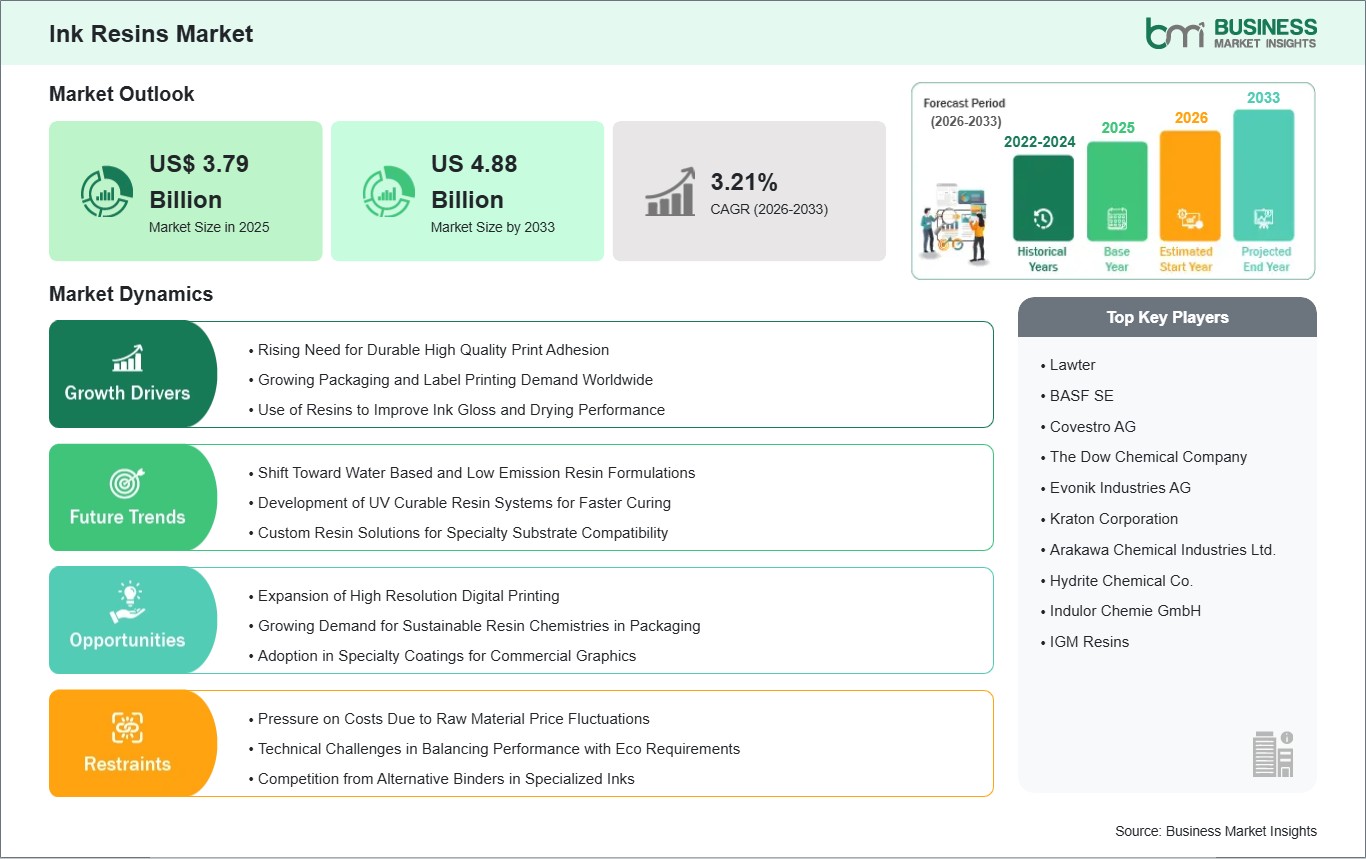
The Ink Resins Market size is expected to reach US$ 4.88 Billion by 2033 from US$ 3.79 Billion in 2025. The market is estimated to record a CAGR of 3.21% from 2026 to 2033.
The ink resins market is a vital segment of the printing and coatings industry. It is comprised of special polymers that are utilized as the binding component of the ink. Ink resins offer adhesion, gloss, flexibility, and durability to the ink. This ensures the ink performs well in various printing operations. Ink resins are highly versatile and can be formulated for various substrates such as papers, plastics, metals, and textiles. This makes the market thrive on innovations and developments in the field of polymer chemistry. This is because the market is constantly looking for improved ink resins with better performance, the ability to use environmentally friendly solvents, and improved resistance to heat, abrasion, and chemicals. The major drivers for the global ink resins market include increasing demand for high-quality printing in various industries such as packaging, advertising, and industrial applications, in addition to increasing demand for inks with better performance in terms of sustainability.
The sustainability factor, especially in terms of low VOC content, water-based inks, and UV curable inks, is changing the way resins are being developed. At the same time, there are limitations such as high prices for specialty resins and difficulties in formulating inks with better performance in terms of sustainability. In addition, differences in substrate materials and printing processes require research efforts to develop resins with specific properties such as adhesion, flexibility, and drying. Despite these limitations, constant innovation in bio-based resins, additives, and hybrid resins makes ink resins an essential part in meeting the changing needs for global printing and industrial coating applications.

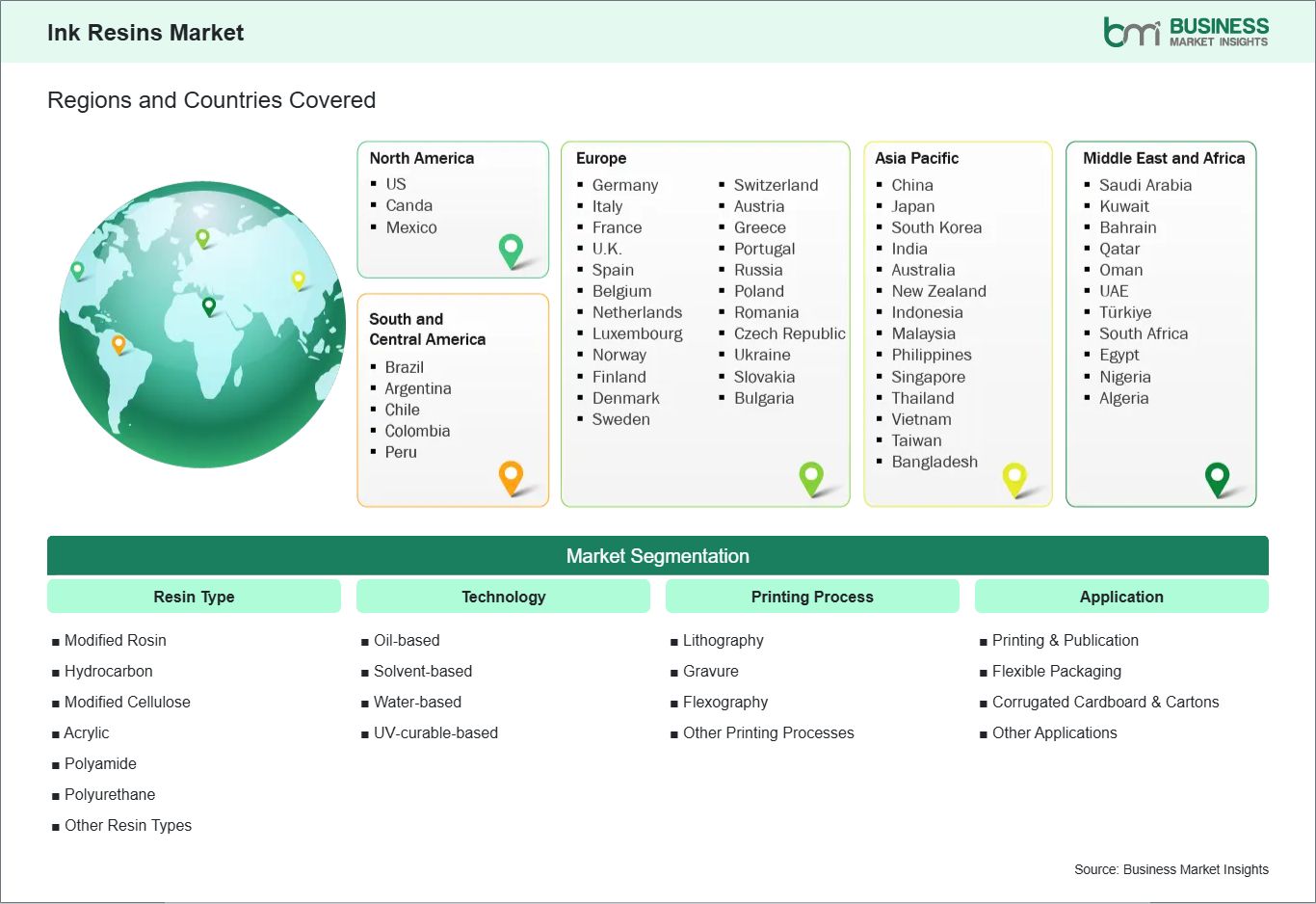
Key segments that contributed to the derivation of the ink resins market analysis are resin type, technology, printing process, and application.
The global ink resins market is experiencing substantial growth due to the increasing need for durable, high-quality print adhesion across diverse applications. Ink resins act as essential binding agents in inks, ensuring that pigments and dyes adhere effectively to substrates such as paper, plastics, metals, and textiles. This adhesion is critical for maintaining color vibrancy, sharpness, and long-term durability, especially in demanding environments where printed materials are exposed to moisture, friction, or sunlight. Industries including packaging, publishing, automotive, and labeling are increasingly specifying high-performance resins to meet stringent quality standards and improve product presentation and longevity.
Beyond basic adhesion, ink resins contribute to enhanced resistance against mechanical and chemical stress, which is particularly important for industrial and commercial printing applications. Coatings and laminates often require inks that do not smudge, fade, or peel during handling, transportation, or storage. Resins such as acrylics, polyurethanes, and epoxy-modified formulations are widely used to provide these properties, allowing manufacturers to deliver visually appealing and resilient printed materials. As global printing demands shift toward premium packaging, long-life labels, and durable outdoor signage, the role of advanced ink resins in ensuring adhesion, consistency, and performance becomes increasingly critical.
Moreover, the focus on sustainable and environmentally friendly printing solutions has influenced resin development and selection. Modern ink resins are being engineered to reduce volatile organic compound (VOC) emissions, improve compatibility with water-based and UV-curable inks, and enhance recyclability of printed substrates. This allows manufacturers to meet both environmental regulations and consumer expectations while maintaining performance standards. As industries worldwide continue to prioritize durability, visual appeal, and eco-consciousness in printed materials, high-quality ink resins remain an indispensable component of modern printing processes.
The rise of high-resolution digital printing has further fueled demand for advanced ink resins globally. Digital printing technologies require inks that can produce sharp images, vibrant colors, and precise detailing on a variety of substrates. Ink resins serve as the backbone of these formulations, controlling viscosity, pigment dispersion, drying behavior, and adhesion properties to achieve optimal print quality. From commercial publications to personalized packaging and labels, the expansion of digital printing capabilities is driving the need for resins that support high-definition, fast-drying, and durable prints.
Moreover, the growth in the use of industrial-scale digital printing for packaging materials and promotional items has put further pressure on the performance of the resin. Inks have to perform well under post-print operations such as lamination, folding, and cutting. Specialty resins, such as UV-curable resins and polymer-modified resins, have the required hardness and flexibility to perform under such demanding applications. The flexibility in the resins used in inks enables manufacturers to formulate resins to meet the needs of various applications in digital printing across the world.
Furthermore, the trend toward personalized and short-run printing has accelerated the demand for adaptable resin systems. High-resolution digital printing enables customization of product labels, packaging, and marketing materials at scale, but it requires inks with reliable flow, uniformity, and adhesion characteristics. By supporting precise pigment suspension, rapid curing, and substrate compatibility, ink resins have become essential enablers of digital print innovation. As businesses globally embrace digital printing for its speed, flexibility, and high-definition output, the market for advanced ink resins is poised to expand steadily, driven by the need for performance, consistency, and visual excellence in printed materials.

The ink resins market is experiencing steady growth, with market size and share analysis reflecting evolving treatment preferences and competitive dynamics among key players. The report evaluates important subsegments categorized within resin type, technology, printing process, and application, highlighting their respective contributions to overall market performance.
By resin type, the Modified Rosin subsegment dominated the Ink Resins market in 2025. Modified rosin resins provide excellent adhesion, gloss, and printability, making them highly suitable for diverse printing applications, driving their widespread adoption.
Based on technology, the Solvent‑Based subsegment dominated the Ink Resins market in 2025. Solvent-based inks offer superior drying, color strength, and substrate compatibility, supporting strong demand across industrial and commercial printing sectors.
On the basis of printing process, the Gravure subsegment dominated the Ink Resins market in 2025. Gravure printing requires high-quality, consistent resins for fine-detail and high-volume production, reinforcing the dominance of this segment.
In terms of application, the Printing & Publication subsegment dominated the Ink Resins market in 2025. Printing and publication applications demand reliable, high-performance resins for color fidelity, durability, and efficiency, driving widespread use in the market.
| Report Attribute | Details |
|---|---|
| Market size in 2025 | US$ 3.79 Billion |
| Market Size by 2033 | US 4.88 Billion |
| Global CAGR (2026 - 2033) | 3.21% |
| Historical Data | 2022-2024 |
| Forecast period | 2026-2033 |
| Segments Covered | By Resin Type
|
|
Regions and Countries Covered
| |
| North America | US, Canada, Mexico |
| Europe | Belgium, Austria, Finland, Denmark, Greece, Poland, Romania, Russia, Ukraine, Czech Republic, Slovakia, Bulgaria, Italy, Luxembourg, Germany, Switzerland, France, Netherlands, Norway, Portugal, Spain, Sweden, United Kingdom |
| Asia-Pacific | Australia, China, India, Japan, South Korea, Indonesia, Malaysia, Philippines, Singapore, Thailand, Vietnam, Bangladesh, New Zealand, Taiwan |
| South and Central America | Brazil, Argentina, Peru, Chile, Colombia |
| Middle East and Africa | Bahrain, Kuwait, Oman, Qatar, Saudi Arabia, United Arab Emirates, Turkiye, South Africa, Egypt, Algeria, Nigeria |
| Market leaders and key company profiles |
|
The "Ink Resins Market Size and Forecast (2022 - 2033)" report provides a detailed analysis of the market covering below areas:
The geographical scope of the Ink Resins market report is divided into five regions: North America, Asia Pacific, Europe, Middle East & Africa, and South & Central America. The Ink Resins market in North America is expected to grow during the forecast period.
North America dominates the ink resins market, driven by its strong industrial base, mature printing and packaging sectors, and early adoption of innovative and sustainable materials. The region’s printing industry relies heavily on high-performance resins for commercial and packaging applications, where quality, consistency, and durability are critical. Ink resins are widely used across industries such as food and beverage, pharmaceuticals, automotive, and consumer goods, ensuring that printed materials maintain adhesion, color fidelity, and resistance to environmental factors during handling, storage, and transportation.
The presence of technologically advanced printing facilities and research-focused resin manufacturers further strengthens the region’s leadership in the market. A major factor contributing to North America’s leadership in the ink resins market is its focus on sustainability and regulatory compliance, which has led to the creation and adoption of water-based, UV-curable, and low-emission resin products. The companies in this region are working hard to improve resin products’ performance while ensuring sustainability. Sustainability includes reducing volatile organic compounds, improving recyclability, and creating bio-based products. Another factor is the integration of ink resins with digital and specialty printing technologies, which has opened doors for new opportunities in various printing materials.
The strong supply chain, infrastructure, and research capabilities in this region ensure the swift commercialization of new resin innovations. The companies in this region collaborate with each other to improve performance, ensuring North America remains ahead in the ink resins market globally.

The ink resins market is evaluated by gathering qualitative and quantitative data post primary and secondary research, which includes important corporate publications, association data, and databases. A few of the key developments in the ink resins market are:
The Ink Resins Market is valued at US$ 3.79 Billion in 2025, it is projected to reach US 4.88 Billion by 2033.
As per our report Ink Resins Market, the market size is valued at US$ 3.79 Billion in 2025, projecting it to reach US 4.88 Billion by 2033. This translates to a CAGR of approximately 3.21% during the forecast period.
The Ink Resins Market report typically cover these key segments-
The historic period, base year, and forecast period can vary slightly depending on the specific market research report. However, for the Ink Resins Market report:
The Ink Resins Market is populated by several key players, each contributing to its growth and innovation. Some of the major players include:
The Ink Resins Market report is valuable for diverse stakeholders, including:
Essentially, anyone involved in or considering involvement in the Ink Resins Market value chain can benefit from the information contained in a comprehensive market report.
Please tell us your area of interest
(Market Segments/ Regions and Countries/ Companies)